Theo Solves a 35-Year-Old Math Problem

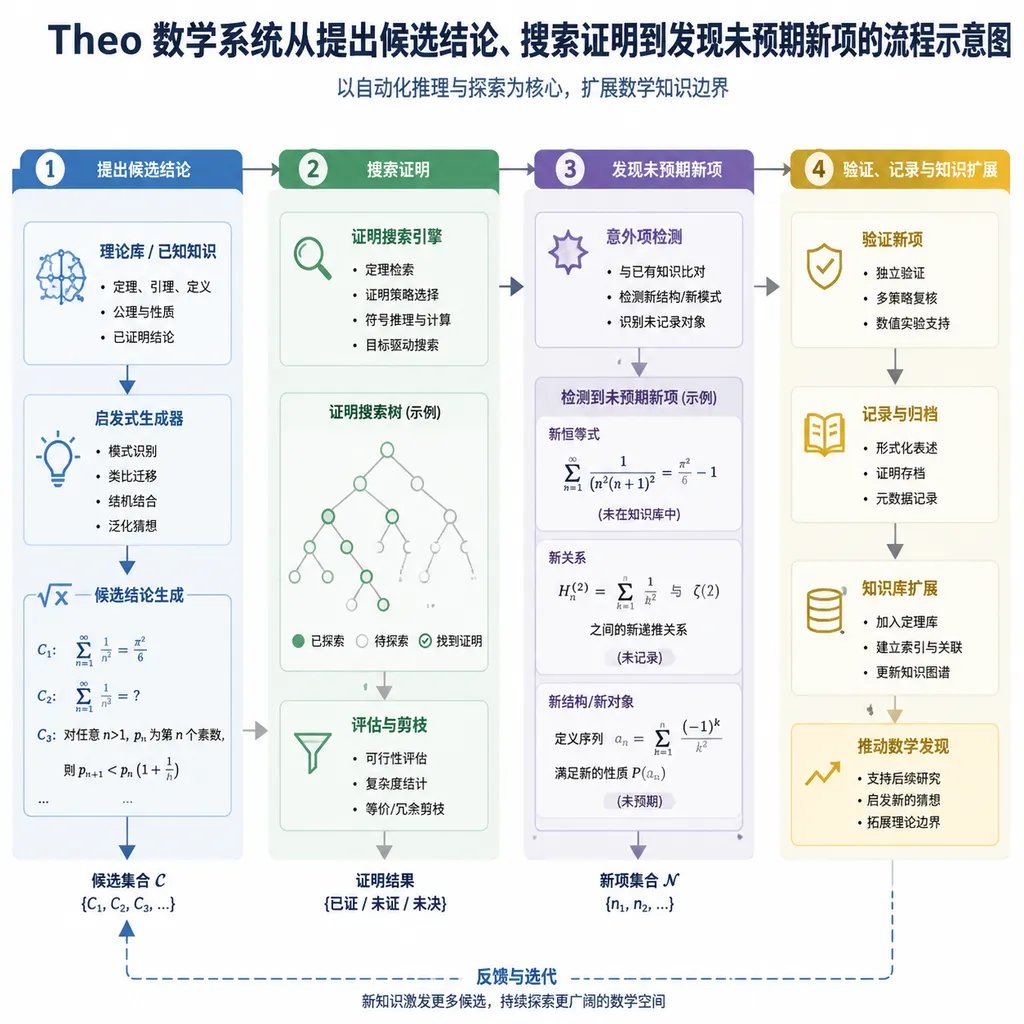
Conjecture’s AI system Theo has reportedly solved a 35-year-old open mathematical problem and uncovered a previously unexpected new term in the derivation. The real breakthrough is not merely automated proof, but that AI is beginning to produce new results that reshape the structure of the problem itself.
AI Not Only Completes the Proof, but Rewrites the Answer
As of July 29, Conjecture, the team developing the Theo AI mathematics system, has disclosed that Theo has solved a mathematical problem that had remained open for roughly 35 years. More notably, its result did not merely confirm the original conjecture: during the derivation, it discovered a new term that researchers had not anticipated.
If the result withstands subsequent peer review and independent verification, it will carry substantially more weight than “a model solving an Olympiad problem.” It would mean that AI is no longer merely searching for proofs along routes laid out by humans, but is beginning to point out that the problems humans originally formulated may not even fully describe what their answers should look like.
This is also the most important distinction between Theo and the previous wave of “high-scoring mathematical benchmark models.” Most of the latter searched for known answers to closed-ended problems. Theo, by contrast, faced an open research problem: there was no standard answer, correctness could not be determined by matching against a training set, and no one had told it in advance what additional structure to look for.
However, it is still too early to declare that “AI has independently conquered the mathematical frontier.” The current information comes primarily from public disclosures by the project team. The complete proof, verification records, and the boundary conditions under which the new term holds still need to be examined individually by the mathematical community.
Why “One Additional Term” Matters More Than Proving the Original Conjecture
When general readers see “new term,” they may interpret it as simply adding another line to a calculation. In mathematical research, the opposite is usually true: an unanticipated term may mean that the original conjecture captured only the dominant behavior while missing a finer structure.
Consider a common asymptotic formula. Researchers may originally have expected that, as the parameter n grows, some quantity would satisfy:
F(n) ≈ A(n) + error
Theo’s result, however, might take the following form:
F(n) ≈ A(n) + B(n) + smaller error
Here, B(n) is the so-called new term. It may not be larger than the leading term A(n), but it could determine whether the formula is accurate at finite scales. It might also reveal that two mathematical structures previously thought to be unrelated are in fact coupled.
This is somewhat like hidden state in software engineering. A service’s average latency may appear to fit an established model, yet show a systematic deviation under high concurrency. It is eventually discovered that the deviation is not sampling noise: the model omitted cache invalidation or lock contention. Adding the missing term does more than correct the numbers; it changes engineers’ understanding of the system bottleneck.
A new term has similar value in mathematics. It may have at least three levels of impact:
- Correcting the original conjecture. The original conclusion may hold only at a lower level of precision, while a stronger version requires an additional term.
- Exposing a new mechanism. New terms rarely appear from nowhere; they often arise from previously overlooked symmetries, boundary contributions, or special families of solutions.
- Generating follow-up questions. Researchers must continue asking when the term appears, whether it is universal, and whether it can be generalized to a broader family of problems.
Therefore, if Theo merely proved a proposition that humans had already formulated accurately, it would still primarily be a high-performance proof-search engine. But if it truly identified and proved an unanticipated term, it has taken a step toward “creating mathematical content.”
Theo Is Not Simply Guessing Answers Like an Ordinary Language Model
Large language models can generate seemingly fluent proofs, but in mathematics the greatest danger is not poor prose. It is the subtle substitution of one quantifier for another, the omission of boundary conditions, or the tacit assumption of an unproven conclusion at a critical step.
In a long proof, a single invalid step renders everything after it meaningless, no matter how elegant it appears. The tendency of natural-language models to be “locally plausible but globally wrong” is especially dangerous in mathematical research.
An AI mathematics system designed for frontier problems typically needs to divide the task into multiple mutually constraining stages:
- Construct a representation of the problem from papers and definitions;
- Generate potentially valid lemmas and intermediate propositions;
- Search for counterexamples and proactively eliminate overly strong or incorrect conjectures;
- Use symbolic computation, numerical experiments, or proof assistants to check local steps;
- Assemble chains of reasoning and track the assumptions on which each step depends;
- Remodel anomalous results rather than forcing them to fit the original conjecture.
“Discovering a new term” depends especially heavily on the final point. When numerical results diverge from expectations, many systems tend to classify the discrepancy as error. A research-oriented system, however, must determine whether the deviation results from insufficient precision or whether the original model has omitted genuine structure.
In other words, Theo needs to play three roles at once: first observing patterns like a computational researcher, then proposing explanations like a theoretical mathematician, and finally trying to overturn its own conclusions like a reviewer.
The information currently available is not sufficient to determine exactly which models, search strategies, and verification tools Theo used in this pipeline. In particular, it is necessary to distinguish between two things: generating a human-readable proof and generating a proof object that can be checked step by step by a formal proof assistant. Both may be valuable, but they do not offer the same level of confidence.
Compared With Aristotle, Theo’s Key Attraction Is “Discovery”
AI mathematics systems have produced several notable breakthroughs over the past year. Harmonic’s Aristotle was reported to have independently addressed an Erdős problem and completed formal verification in Lean 4. Lean plays a role similar to that of a compiler in the mathematical world: if a proof contains a type error, lacks a required premise, or leaves a goal unresolved, it cannot pass verification.
The Aristotle approach emphasizes that “the correctness of a proof can be machine-verified.” This addresses what mathematicians find most troubling about generative AI: it can write something that looks correct, but it cannot bluff its way through verification with confident phrasing.
Theo’s latest disclosure has a somewhat different focus. The most noteworthy aspect is not that it translated an existing human proof into a formal language, but that it obtained a result beyond prior expectations. These capabilities can be roughly divided as follows:
| Capability | Core Question | Primary Value | |---|---|---| | Formalized proof | Has a proposed proposition been rigorously proved? | Eliminates logical gaps and provides a machine-checkable certificate | | Automated proof search | Can a proof strategy be found within an enormous search space? | Reduces the cost of long proofs and technical work | | Conjecture discovery | Has the problem itself been formulated correctly, or is some structure missing? | Produces new mathematical knowledge and research directions |
The three are not mutually exclusive. An ideal system would first discover new structure, then automatically generate a proof, and finally submit it to a formal kernel for verification. The difficulty is that the closer a system gets to “discovery,” the less its evaluation can rely on fixed benchmarks.
The IMO, AIME, and university exercises can measure whether a model knows how to solve problems, but they cannot tell us whether it can identify a question that no one in a research field has asked before. What Theo truly needs to demonstrate this time is whether it has crossed that line.
A “Project Announcement” Cannot Yet Be Treated as a Mathematical Verdict
A mathematical conclusion is not like a product benchmark score; a screenshot of the result is not enough. In particular, a claim such as “solving a 35-year-old problem” must answer at least the following questions:
- Was the complete version of the original problem solved, or only a special case under stronger assumptions?
- Does the new term exist across the entire parameter range, or only under specific boundary conditions?
- Has the proof been published, and can domain experts inspect it line by line?
- Does it rely on unproven auxiliary lemmas or numerical assumptions?
- Can the computational component be independently reproduced using different software and different levels of precision?
- Has it been formalized, or at least reviewed by multiple experts without conflicts of interest?
These questions are not nitpicking. The history of mathematics contains many cases in which “the main direction of a proof was correct, but it failed in an extreme case.” AI can amplify this risk: a system may generate hundreds of pages of highly consistent errors, while human reviewers may lower their guard because the preceding material appears reliable.
Another issue that marketing language can easily blur is “independence.” Whether AI conducted the research independently depends on exactly what humans provided. Supplying only the publicly stated problem is clearly not equivalent to supplying key lemmas, a proof framework, and records of failed approaches. Tool use, paper retrieval, and verification programs should not be treated as cheating, but these processes must be fully disclosed before the system’s actual contribution can be assessed.
A more accurate description of the event is therefore: The project team has reported that Theo solved a 35-year-old problem and discovered an unanticipated new term. This is a strong candidate research result, but until the full proof is published and independently verified, it is not yet equivalent to a theorem accepted by the community.
AI Mathematics Is Moving From “Problem Solving” to a “Research Pipeline”
Even if the final proof requires revision, the direction demonstrated by Theo remains relevant to developers. The cost of frontier mathematical research often comes not only from a single flash of insight, but from the extensive search surrounding it: checking special cases, constructing counterexamples, adjusting parameters, verifying intermediate lemmas, and comparing results with the existing literature.
These tasks are naturally suited to agent-based systems. The mathematical AI of the future is unlikely to be just a chat box into which a problem is entered and from which an answer emerges. It will be more like continuously operating research infrastructure:
- A literature agent maintains definitions, theorems, and citation relationships;
- A conjecture agent looks for patterns in computational results;
- A counterexample agent specifically attacks candidate propositions;
- A proof agent searches for derivation chains that can be closed;
- A formal kernel accepts only final results that can be mechanically verified;
- Human researchers decide which anomalies deserve to be elevated into new theories.
This process closely resembles “generation—testing—static analysis—human review” in software development. The difference is that software testing can usually prove only that certain inputs do not produce errors, while formal mathematics attempts to prove that a result holds for all inputs satisfying the stated conditions.
For model companies, this also means that the competitive metrics for mathematical capability will change. Accuracy on individual problems will remain important, but the real differentiators will be long-horizon search, reliable tool use, state management, recovery from failure, and the ability to provide an auditable chain of evidence for conclusions. A system that can conduct continuous research for hours and proactively discard erroneous approaches is more practically valuable than a model that generates a ten-page proof in a single pass.
Assessment: Important, but It Is Too Soon to Say “Mathematicians Have Been Replaced”
If Theo’s result is confirmed, it will be a solid milestone. The appearance of the new term is especially significant, suggesting that the system may not merely be compressing the existing literature, but may have formed an effective closed loop between computation, conjecture, and proof.
Yet it remains far from “replacing mathematicians.” Open-ended mathematical research requires more than proving a proposition. It also involves selecting problems, judging whether results matter, establishing connections with other fields, and reorganizing entire theories around appropriate concepts. AI can generate correct but inconsequential theorems, and it may expend vast computational resources proving results that domain experts would never prioritize.
A more realistic change is that the division of labor in mathematical research will be redrawn. Humans will no longer need to perform every technical search themselves and will devote more effort to problem selection, conceptual design, and interpretation of results. AI, meanwhile, will explore proof spaces that humans do not have time to exhaustively search and promptly surface anomalous signals.
From Aristotle to Theo, AI mathematics systems are undergoing a clear transition: first proving that they can write the answer correctly, and then proving that they can discover that “the original answer was still missing something.” The latter is more difficult—and much closer to genuine scientific research.
For now, the key questions are not about promotional videos or benchmark scores, but when the complete proof will be published, whether it can be independently reproduced, and whether the unanticipated new term will ultimately reshape subsequent research in the field surrounding the original problem. If it passes all three tests, Theo’s significance will extend beyond solving a problem that had remained open for 35 years. It will provide a more direct signal that AI has begun participating in the production of new mathematical objects.
References
- First Principles: “Theo Conjecture solves 35-year-old math problem, finds a term no one predicted” — the original disclosure of this event; no external link is included due to domain restrictions at the end of the article.
- Zhihu: Has AI Overturned an 87-Year-Old Mathematical Problem? Discussion Related to the Jacobian Conjecture — included to explain why public computational verification and peer review are indispensable after AI generates a mathematical result; it is not direct evidence regarding the Theo event.