Alipay Uses Token Subsidies to Boost AI Payments
Alipay has upgraded its AI Payment Developer Incentive Program. Developers who integrate pay-as-you-go billing or in-app payments can receive up to RMB 5,660 in Alibaba Cloud token subsidies. The subsidy is not particularly generous; what is truly noteworthy is that automatic per-call payments for agents are beginning to become productized.
Alipay Uses Token Subsidies to Drive AI Payments
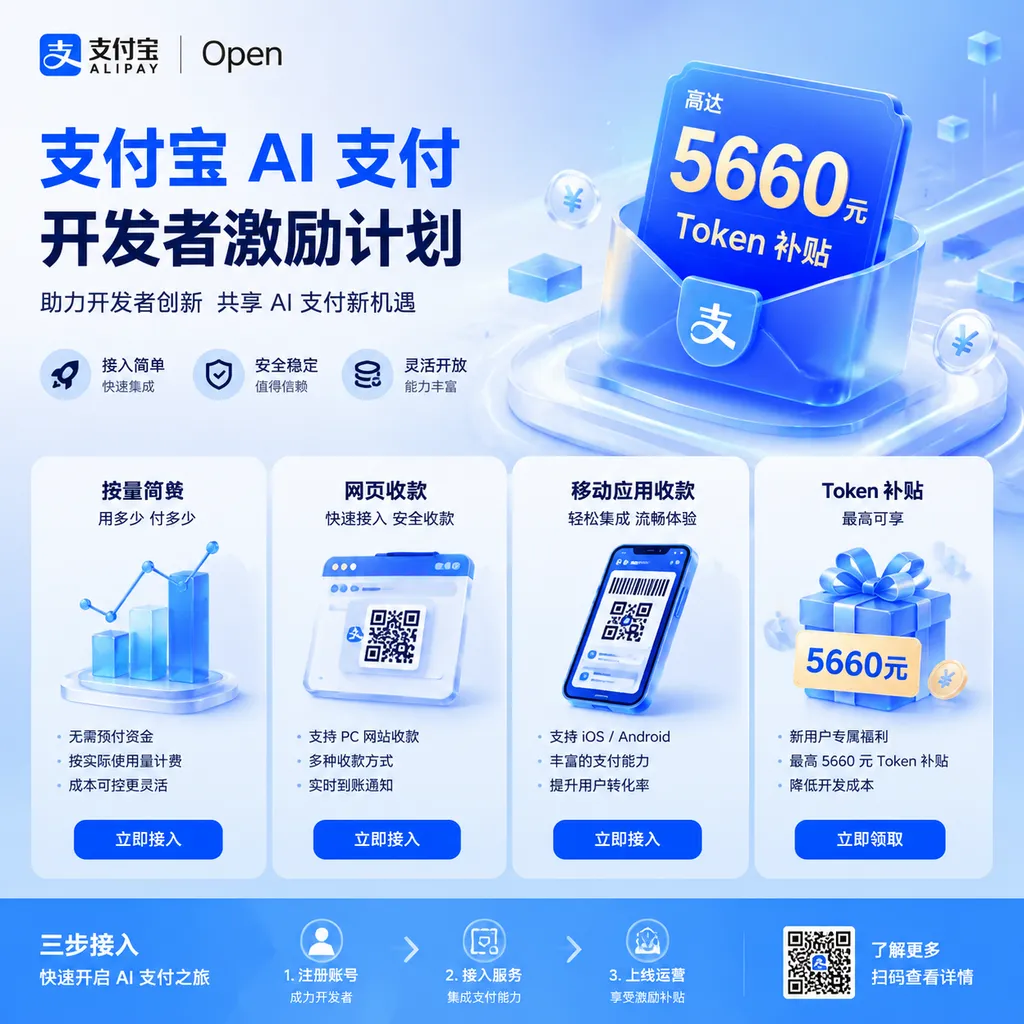
Alipay upgraded its “AI Payment Developer Incentive Program” today (July 29). From now through August 21, developers who register and integrate any of the following capabilities—“AI Pay-as-You-Go,” “AI Web App Payments,” or “AI Mobile App Payments”—can receive Alibaba Cloud Token resource packages based on their cumulative number of valid transacting users, with a maximum total value of RMB 5,660.
At the same time, individual developers using Alipay’s “AI Pay-as-You-Go” service can enjoy a 0% transaction fee through December 31, 2026.
Here is the bottom line: The RMB 5,660 figure is more of a promotional hook than a substantial subsidy capable of changing development decisions. The genuinely valuable update is that Alipay has expanded the scope of its incentives from the narrower Agent payment scenario to web, mobile app, and individual payment acceptance, while attempting to use A402 to embed payment for APIs, MCP Tools, digital content, and computing resources directly into Agent invocation chains.
In other words, Alipay is not subsidizing “yet another AI wrapper app.” It wants developers to install a checkout counter for AI services as quickly as possible.
Subsidies Come in Five Tiers, but Most of the Money Is Tied to 50,000 Users
The rewards are divided into five tiers based on the cumulative number of valid transacting users, and rewards from each tier can be combined:
| Cumulative Valid Transacting Users | Additional Token Package for This Tier | Cumulative Total | |---:|---:|---:| | 10 | RMB 10 | RMB 10 | | 100 | RMB 50 | RMB 60 | | 1,000 | RMB 100 | RMB 160 | | 5,000 | RMB 500 | RMB 660 | | 50,000 | RMB 5,000 | RMB 5,660 |
Once the corresponding tier is reached, the reward is unlocked on the seventh day. These “Token subsidies” are not cash rebates but Alibaba Cloud Token resource packages of equivalent value. Developers still need to pay attention to which models and products the packages apply to, as well as their validity periods and specific redemption rules.
The reward structure is also straightforward: completing all of the first four tiers yields only RMB 660 in total, while the RMB 5,000 reward tied to 50,000 valid transacting users accounts for roughly 88% of the total.
This means the program offers limited help to projects in the cold-start phase. Even if a newly launched indie product reaches 1,000 valid transacting users, it will receive only RMB 160 in cumulative resource packages. For an AI app that already has steady traffic and is preparing to add payments, RMB 5,660 is a useful bonus. But if a product has yet to identify real demand for paid services, integrating payments solely to obtain the subsidy offers a poor return on investment.
What may be more relevant to individual developers is the extension of the 0% transaction fee for “AI Pay-as-You-Go” through the end of this year. For API and tool services with low average transaction values and high invocation frequency, payment fees directly erode gross margins, making a temporary 0% fee more useful for day-to-day operations than a one-time Token voucher. However, this offer applies specifically to individual developers using AI Pay-as-You-Go. It should not be interpreted as a fee waiver for every web or app payment scenario. Developers should still verify the campaign rules and merchant eligibility requirements before integrating it.
One Upgrade Covers Three Monetization Paths
The capabilities included in Alipay’s incentive program fall into three categories, corresponding to AI products at three different stages of maturity.
1. AI Web App Payments
This capability is designed for desktop websites and mobile web pages. Alipay says developers can quickly integrate it with a single Skill command, and it supports payment acceptance by individuals.
It is suitable for the most common type of AI product today: products without native clients that provide document processing, image generation, data analysis, prompt tools, or vertical Agent services through a web interface. In the past, individual developers seeking to accept payments often had to navigate merchant qualifications, payment APIs, order pages, and callback handling. Support for individual payment acceptance at least lowers the barrier to validating users’ willingness to pay.
However, “a single command” should be understood as shortening the initialization and configuration process for payment capabilities—not as solving the entire transaction system with one command. In a production launch, order status, payment callbacks, signature verification, refunds, reconciliation, duplicate notifications, and exception handling still require careful implementation.
2. AI Mobile App Payments
Mobile app payments cover iOS, Android, and HarmonyOS and can be used for in-app purchases involving e-commerce, membership top-ups, online ticketing, local services, digital content, and more.
In essence, this is closer to a mature mobile payment capability than an Agent-specific protocol. Its inclusion in the “AI Payment” program shows that Alipay is not betting exclusively on fully autonomous Agent transactions. It is also targeting AI apps that already have users and native clients but still lack a complete monetization loop.
Developers should also note that integrating Alipay does not mean bypassing app store rules. When digital content, membership benefits, or virtual services are involved, the in-app purchase policies of different operating systems and distribution channels must still be evaluated separately. The payment system may be capable of completing a transaction, but that does not mean the distribution channel will necessarily permit the same payment route.
3. AI Pay-as-You-Go
This is the most technically significant—and the most noteworthy—of the three capabilities.
Traditional SaaS products tend to use monthly subscriptions, but Agent usage is characterized by highly variable frequency and costs. One user may perform only two data queries in a month, while another Agent may execute hundreds of tool tasks in succession. A uniform monthly fee either feels too expensive to light users or allows heavy users to overwhelm the service provider’s inference and computing cost structure.
Pay-as-you-go billing attempts to bring pricing down to the level of each individual API, MCP Tool, content, or computing invocation. The service provider sets a price for the capability, and the Agent initiates a request when needed, receives the result immediately after payment, and completes the transaction. It resembles metered cloud computing billing, except settlement is compressed into a single invocation chain.
A402 Aims to Solve the Problem That Agents Cannot Sign Up for Memberships on Their Own
Alipay’s AI Pay-as-You-Go capability uses the A402 solution, designed around the HTTP 402 Payment Required status code. The complete process can be summarized as follows:
- A user or Agent sends a request to the service provider;
- The service provider returns the price and payment requirements;
- The user or Agent completes payment through Alipay AI Pay;
- The service provider verifies the payment result;
- After successful verification, the service provider returns the data, content, or tool execution result.
This process may appear to be nothing more than “payment first, delivery afterward,” but it addresses a very practical problem in the Agent economy: Machines can invoke tools, but unlike humans, they struggle to register accounts, select plans, top up balances, and remember when memberships expire on every platform.
If every external tool requires a separate account and prepaid balance, cross-service Agent orchestration quickly devolves into a pile of manual configuration. A402 aims to place price discovery, payment, and result delivery within the same request chain, allowing services to be sold per use.
Typical scenarios include:
- An Agent temporarily invoking a paid database query;
- A coding agent purchasing a one-off sandbox compilation or GPU execution task;
- A content Agent accessing a restricted industry report;
- A merchant Agent invoking mapping, ticketing, or logistics tools;
- An MCP client using a third-party professional tool on a per-use basis;
- An AI app selling image, video, or audio services per generation.
For resource providers, per-use billing also makes costs easier to control than simply issuing long-term API keys. Each invocation corresponds to one transaction and one authorization, which can theoretically reduce shared accounts, key reselling, and the abuse of plans by a small number of heavy users.
But a Payment Protocol Does Not Run Automatically Once Connected
The A402 concept may be sound, but that does not mean commercialization will happen automatically after integration.
The first issue is protocol coverage. HTTP 402 has long remained “reserved” without becoming a unified internet payment standard. Alipay can define an A402 workflow suited to its own ecosystem, but for different Agent frameworks, model clients, MCP hosts, and servers to recognize it by default, enough buyers and sellers must adopt it simultaneously. If only the server supports it while the Agent cannot process quotes, authorization, and payment, the protocol still will not work.
The second issue is authorization boundaries. When an Agent can make payments automatically, developers must provide per-transaction limits, daily budgets, service allowlists, secondary confirmation, and automatic circuit breakers. Otherwise, a single planning error, prompt injection, or invocation loop could escalate from “consuming a few thousand extra Tokens” to “repeatedly generating real transactions.” The more automated the payment capability becomes, the less budget control can depend on the model’s own judgment.
Then there is the economics of micropayments. If a single tool invocation is worth only a few cents, payment confirmation latency, transaction processing costs, refund costs, and accounting complexity may exceed the value of the service itself. High-value, low-frequency invocations are more likely to become viable first. High-frequency tools with extremely low transaction values may still require balances, preauthorization, or aggregated settlement. Developers should not assume that every invocation is suitable for individual settlement simply because per-use payment is technically supported.
Finally, there are the familiar engineering challenges:
- How to generate globally unique order numbers and guarantee idempotency;
- How to issue refunds or compensation when payment succeeds but service execution fails;
- How to update status when a callback arrives before the client query;
- Whether repeated Agent requests should trigger repeated charges;
- Whether paid results can be cached, and for how long;
- How to preserve evidence in disputes after digital content has been delivered;
- How to perform end-of-day reconciliation and revenue recognition.
So, “a single Skill command” reduces integration friction; it does not eliminate the full complexity of a transaction system. Developers still need to treat payments as a core production workflow rather than an ordinary front-end component.
What Alipay Is Really Competing for Is the Settlement Gateway for AI Services
From a product strategy perspective, this expansion of the incentive program sends two signals.
First, Alipay is moving AI payments from proof of concept to real transactions. The reward metric is not the number of registered developers, apps created, or API calls, but the “number of valid transacting users.” This forces participants to deliver a product that people actually pay for, while making it easier for Alipay to identify AI services with genuine monetization potential.
Second, placing web payments, mobile app payments, and Agent-based pay-as-you-go billing in the same program shows that Alipay does not intend to wait for a pure Agent economy to mature. At this stage, developers can first charge human users through the web and apps, and later allow Agents to purchase services automatically. Regardless of how the interaction layer changes, payment accounts, merchant systems, risk controls, and settlement networks remain the hardest infrastructure to replace.
This is also Alipay’s advantage over ordinary AI tool platforms: model platforms can provide inference credits, and cloud providers can offer computing power, but payment platforms control real accounts, transaction confirmation, merchant settlement, and risk management. The question is whether this advantage can be converted into an open protocol that developers are willing to adopt, rather than remaining a closed loop within a single payment ecosystem.
Which Developers Should Integrate It Now?
This campaign is worth evaluating if your product has any of the following characteristics:
- It already has web or mobile users and only lacks formal payment acceptance;
- It offers clearly priced APIs, MCP tools, data, or computing resources;
- Each service invocation has relatively high value and is suitable for per-call billing;
- Its users are primarily located in China, where Alipay offers a sufficiently frictionless payment path;
- It is built by an individual developer who needs a low-barrier way to validate willingness to pay;
- It is already close to one of the valid transacting user tiers, making the subsidy easy to obtain.
Conversely, if a product lacks steady traffic, has not yet confirmed whether users are willing to pay, or provides invocations worth far less than the cost of processing each transaction, there is no need to rush into an architectural overhaul merely because of the headline figure of RMB 5,660. In particular, reaching 50,000 valid transacting users is not a short-term goal for the vast majority of indie AI products.
Before integrating, developers should confirm at least four things: the campaign’s precise definition of a “valid transacting user,” how multiple payments by the same user are counted, the applicable scope and validity period of the Token resource packages, and whether refunds or abnormal orders affect reward tiers. Public information provides the reward framework, but final eligibility remains subject to Alipay’s campaign page and review results.
Conclusion
This Alipay upgrade can hardly be described as lavish spending. The subsidies are clearly skewed toward projects operating at scale, early-stage developers receive limited resources, and even the maximum RMB 5,660 is not enough to cover the development and operational costs of a serious payment system.
However, it sends a more important product signal: competition among AI apps is shifting from “who can invoke more models” to “who can deliver a service and get paid.” As Agents begin invoking external data, tools, and computing resources, payments will no longer be merely a button at the bottom of a page; they will become part of the machine collaboration protocol.
It is still too early to conclude whether A402 can become a widely adopted standard. At the very least, Alipay has turned per-use transactions, Agent payments, and developer settlement into an integrable product instead of leaving them in demo videos. For developers with real services to sell, that is more worthy of investigation than the RMB 5,660 Token subsidy itself.
References
- ITHome: Alipay Upgrades Its “AI Payment Developer Incentive Program” — Reports the campaign period, three integration capabilities, five reward tiers based on valid transacting users, and the 0% fee policy for individual developers.