Microsoft Is No Longer Playing Second Fiddle to OpenAI
This week, Microsoft showcased its in-house models, Agent Harness, and the Perception AI security platform, signaling a shift from its role as a cloud service provider and investor toward directly competing in the markets for models, agent runtimes, and enterprise security.
Microsoft Is No Longer Playing Second Fiddle to OpenAI
The relationship between Microsoft and OpenAI is shifting from “growing the market together” to “dining at the same table while opening competing shops next door.”
As of July 30, Microsoft has showcased three AI product lines advancing in parallel to Wall Street this week: its in-house MAI model family, the Agent Harness for AI agents, and Project Perception, powered by a specialized cybersecurity model. The last of these takes direct aim at Anthropic’s Mythos. Microsoft claims it delivers comparable or even better performance on certain security tasks at a much lower cost.
This is not merely a routine effort to fill gaps in the product portfolio. In the past, Microsoft primarily supplied Azure compute, enterprise distribution channels, and Copilot applications, while OpenAI provided the most powerful models. Now, Microsoft is bringing the models, agent runtime layer, and vertical applications entirely under its own control.
In other words, Microsoft does not intend to remain merely OpenAI’s largest shareholder, cloud provider, and distributor forever. It wants to be an OpenAI customer—and an OpenAI competitor.
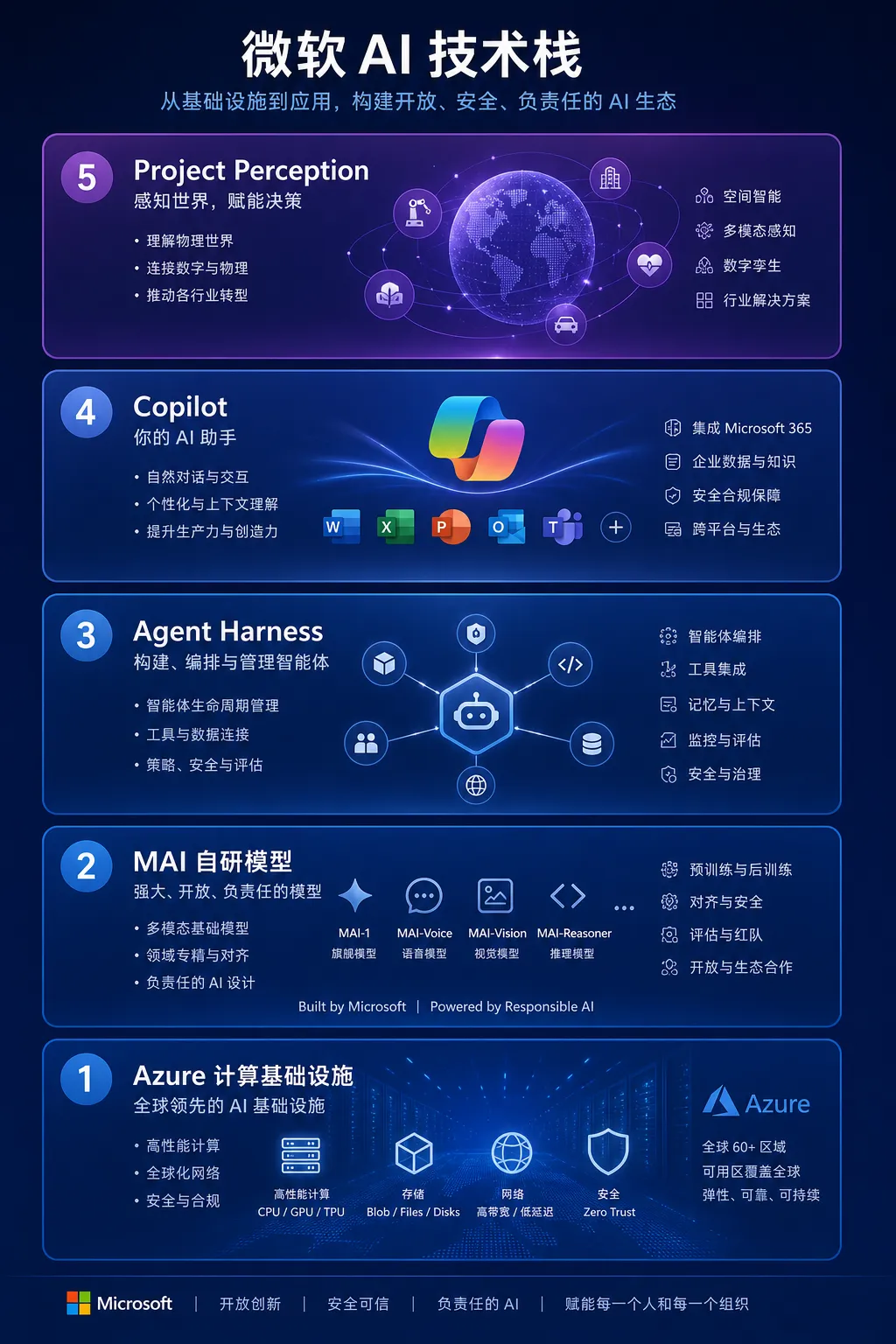
Advancing on Three Fronts at Once
Microsoft’s latest moves can be divided into three layers:
| Layer | Representative products | The problem Microsoft aims to solve | | --- | --- | --- | | Model layer | MAI-Code-1-Flash, MAI-Thinking-1, MAI-Cyber-1-Flash | Reduce cost and capability dependence on external models | | Runtime layer | Agent Harness | Control how agents invoke tools, manage context, and execute tasks | | Application layer | Project Perception, Copilot family | Turn model capabilities into products enterprises can purchase |
None of these initiatives is surprising on its own. What truly matters is that Microsoft is now connecting all three layers.
Front One: MAI Models Are Entering Real Products
Microsoft has already unveiled several in-house models this year.
MAI-Code-1-Flash targets code generation, emphasizing response speed and inference cost, and is beginning to enter development environments such as GitHub Copilot and Visual Studio Code. MAI-Thinking-1 is a medium-sized reasoning model whose goal is not to top individual benchmarks, but to deliver sufficiently reliable reasoning for enterprise workloads using fewer tokens.
The newly introduced MAI-Cyber-1-Flash is even more specialized. Rather than being a general-purpose chat model, it is a cybersecurity model designed to discover, validate, and remediate vulnerabilities in large codebases. It is also one of Project Perception’s key components.
Microsoft’s goals for these models are pragmatic: they do not need to outperform the strongest GPT or Claude models across every task. As long as they are “good enough and cheap enough” for high-frequency tasks such as Excel operations, Outlook workflows, code completion, and security-alert classification, they have replacement value.
This differs from the competitive logic of traditional model companies. OpenAI and Anthropic need to prove that their frontier models are powerful enough. Microsoft, by contrast, has hundreds of millions of productivity-software users and a vast base of Azure enterprise customers. For Microsoft, slightly reducing the cost of each inference and multiplying that saving across enormous call volumes may improve profits more than winning a public benchmark.
Microsoft has recently begun testing more of its own models in certain software workloads instead of sending every request to OpenAI or Anthropic by default. The key word here is “certain”: Microsoft will not abandon external models in the near term, but it will turn them from the default foundation into one set of options within a broader routing system.
Front Two: The Agent Harness Is Where Control Resides
The model determines whether an agent is “smart,” but the Harness determines whether it can actually get the job done.
An Agent Harness can be understood as the execution system wrapped around a model. It is typically responsible for:
- Selecting and switching between models;
- Managing context and memory during long-running tasks;
- Invoking browsers, terminals, databases, and enterprise APIs;
- Handling retries, timeouts, rollbacks, and human approvals;
- Restricting file, identity, and network permissions;
- Recording execution traces for evaluation, auditing, and billing.
If the model is a programmer, the Harness is the combination of the code repository, terminal, CI pipeline, permissions system, and project manager. Give a model only a chat window, and at most it can offer suggestions. Give it a Harness, and it may be able to work continuously for hours, modify files, run tests, and submit results.
This is also why Microsoft must build the Harness itself. Once enterprise agents genuinely enter production environments, the most valuable data is not merely the prompts, but the task traces: which model works best for each step, which tool calls are most likely to fail, and where in the approval process enterprises stop an agent. That data can then be fed back into improving both models and products.
If OpenAI or Anthropic controls this layer, Microsoft could be reduced to an infrastructure provider and traffic gateway even if it retains control over Azure and Office. Conversely, as long as Microsoft controls the Harness, it can mix GPT, Claude, Gemini, and MAI at the foundation layer, routing tasks dynamically without betting on a single model.
This matters far more than “Microsoft released another model.” Model capabilities can quickly converge, but agent runtimes, enterprise permissions, and workflow integrations are much harder to replace.
Perception: More Than Just a Mythos Alternative
Project Perception is the most directly competitive product in this round of announcements.
It targets security workflows such as vulnerability identification, risk analysis, and remediation. Rather than having a single expensive frontier model handle everything, it uses a multi-model architecture: more capable models handle complex reasoning, while specialized models such as MAI-Cyber-1-Flash take on high-throughput, low-latency tasks.
This resembles a hospital triage system. Routine examinations do not require a top specialist every time. Only high-risk cases, those with insufficient information, or those with conflicting results are escalated to more capable models. For security products that continuously scan codebases and enterprise IT environments, this architecture makes more sense than simply pursuing the highest possible model performance.
Microsoft also possesses an asset that model labs would find difficult to replicate: enterprise-wide visibility spanning identities, endpoints, email, productivity applications, data, cloud resources, and code repositories. A security agent must do more than discover problems. It also needs to know what a particular account can access, whether a vulnerability is exposed to the public internet, and whether a remediation action could disrupt business operations.
This is what distinguishes Perception from a general-purpose security chatbot. Perception aims to create a closed loop of “discovery–validation–remediation–reverification,” rather than merely generating a longer alert report.
Microsoft claims that MAI-Cyber-1-Flash can match Anthropic’s Mythos on certain security tasks while reducing costs by about half. However, this claim is still based primarily on vendor testing. Microsoft has yet to provide sufficiently comprehensive third-party evaluations, task distributions, or details about how the figures were calculated.
For developers, “half the cost” should not be interpreted directly as a 50% reduction in API pricing. Vulnerability scanning involves context length, the number of tool calls, false-positive reviews, and retries after failures. A cheaper model that produces more false positives may not have a lower total cost in the end. Whether Perception can truly deliver on its advantages will depend on its performance against real codebases after the public preview—not its average score at a launch event.
In addition, reports differ on the exact preview timeline, and Microsoft still needs to clarify regional availability, eligible customers, and the order in which features will be released. It is therefore too early to call Perception a mature replacement for Mythos. A more accurate assessment is that Microsoft has built a complete product architecture capable of challenging Mythos.
Why Microsoft Is Choosing Direct Competition Now
The first reason is cost.
Using third-party models at scale across Copilot, Office, and Azure means Microsoft must continuously pay model providers for inference. If its in-house models can take over high-frequency tasks such as classification, summarization, code completion, and security scanning, Microsoft can improve its product margins.
The second reason is bargaining power.
Microsoft has invested approximately $13 billion in OpenAI and several billion dollars in Anthropic, while also selling both companies’ models through Azure. But an investment relationship does not equal control. As OpenAI and Anthropic expand their enterprise businesses, they will interact directly with customers that once belonged to Microsoft, while also building their own agent platforms and application gateways.
Microsoft cannot accept a position in which it provides the expensive computing infrastructure while its partners capture the model branding, developer relationships, and application profits.
The final reason is that the center of competition in enterprise AI is moving up the stack.
In 2023, the key question was who had the most powerful chat model. In 2026, enterprises care more about who can connect to internal data, who can pass permissions audits, who can operate reliably for hours, and who is accountable when something goes wrong. Models remain important, but they are no longer the only moat in the overall system.
Microsoft owns Windows, Microsoft 365, GitHub, Azure, the Entra identity system, and Defender security products. Its real strategy is to transform these existing gateways into environments where agents can take action. OpenAI and Anthropic have an advantage in models; Microsoft’s advantage is the enterprise software world itself.
Does This Mean Microsoft and OpenAI Are Breaking Up?
Not in the near term.
Microsoft still needs OpenAI’s frontier models to maintain Copilot’s capability ceiling, while Azure needs popular models such as GPT and Claude to attract customers. Project Perception itself also uses a multi-model architecture and can invoke models from OpenAI and Anthropic as well as Microsoft’s own models.
The more likely outcome is “infrastructure cooperation, full-scale product competition”:
- Azure continues to host and sell third-party models;
- Microsoft applications route requests dynamically based on cost, latency, and task type;
- MAI models gradually take over high-frequency, standardized workloads;
- The most complex reasoning tasks continue to use external frontier models;
- Microsoft uses the Harness to control orchestration, permissions, and customer-data boundaries.
This resembles the database market in the cloud-computing era. Cloud providers sell third-party databases while also launching their own, competing for the same customers through bundling, pricing, and the operational experience. Cooperation does not disappear; partners simply no longer enjoy the default position.
What Developers Should Really Pay Attention To
For development teams, these changes will not require an immediate model migration, but they will alter the priorities of technology selection.
First, do not hardwire business logic to a single model. Model updates and pricing changes are becoming increasingly frequent, and a unified interface, routing layer, and evaluation layer will have more long-term value than a temporary lead on a leaderboard. For teams that still need to test GPT, Claude, Gemini, DeepSeek, and other models side by side, aggregator APIs compatible with the OpenAI format—including services such as OpenAI Hub—can reduce the cost of early validation and switching. However, once systems enter production, teams must still separately evaluate data compliance, failover, and vendor restrictions.
Second, security agents cannot be limited to “read-only access.” Truly valuable systems need to remediate vulnerabilities, revoke credentials, and adjust policies. But the more execution privileges they have, the greater the potential damage from an erroneous action. Least-privilege access, sandboxes, human confirmation, and rollback mechanisms should be designed alongside model evaluations.
Third, focus on end-to-end cost rather than per-token pricing. A single task may invoke multiple models, execute dozens of tool calls, and undergo several rounds of retries. Microsoft’s emphasis on specialized small models shows that the industry is shifting from “use the most powerful model for everything” to tiered orchestration.
Fourth, beware of new forms of platform lock-in. The deeper Microsoft’s Harness integrates with Microsoft 365, GitHub, Azure, and Defender, the easier deployment becomes—but the higher the migration cost. Enterprises need to retain standardized tool protocols, execution logs, and the ability to replace models, preventing agent workflows from becoming the next generation of proprietary APIs.
Microsoft’s Decisive Advantage Will Not Be the Model Leaderboards
The biggest change at Microsoft is not that it finally has several models whose names begin with MAI. It is that the company is now openly acknowledging that OpenAI and Anthropic are not merely partners, but competitors it must confront directly.
MAI models are responsible for reducing costs, the Agent Harness gives Microsoft control over execution, and Perception packages the two into a security product that enterprises are willing to buy. Only when these three fronts are combined do they form a complete AI technology stack.
The strategy is pragmatic—and distinctly Microsoft. It may not require every model to be the best in the world, but it does aim to ensure that every enterprise workflow ultimately runs through Microsoft’s platform.
The real risk lies in execution. It remains unclear whether Microsoft’s in-house models can keep pace with frontier capabilities over the long term, whether the Harness can strike the right balance between an open ecosystem and platform lock-in, and whether Perception’s performance and cost claims can withstand real-world validation.
But as of today, Microsoft is no longer disguising its position. It remains one of OpenAI’s largest partners while simultaneously building a future that does not depend on OpenAI.
References
Details of the core developments were compiled from Microsoft’s recent product communications and reports by multiple media outlets. Due to restrictions on external-link domains, only accessible related technical projects are listed below to provide additional background on the Agent Harness and Microsoft’s agent technology stack.
- Microsoft AutoGen: Microsoft’s open-source framework for multi-agent applications, useful for understanding model orchestration, tool invocation, and agent collaboration mechanisms.
- Microsoft Semantic Kernel: Microsoft’s agent and model integration SDK for enterprise applications, covering plugins, workflow orchestration, and multi-model access.
- Microsoft Prompt Flow: An open-source tool for building, evaluating, and deploying large-model workflows, providing background for understanding Harness evaluation and observability.