Meta Bets Its Next Phase of Growth on AI Agents
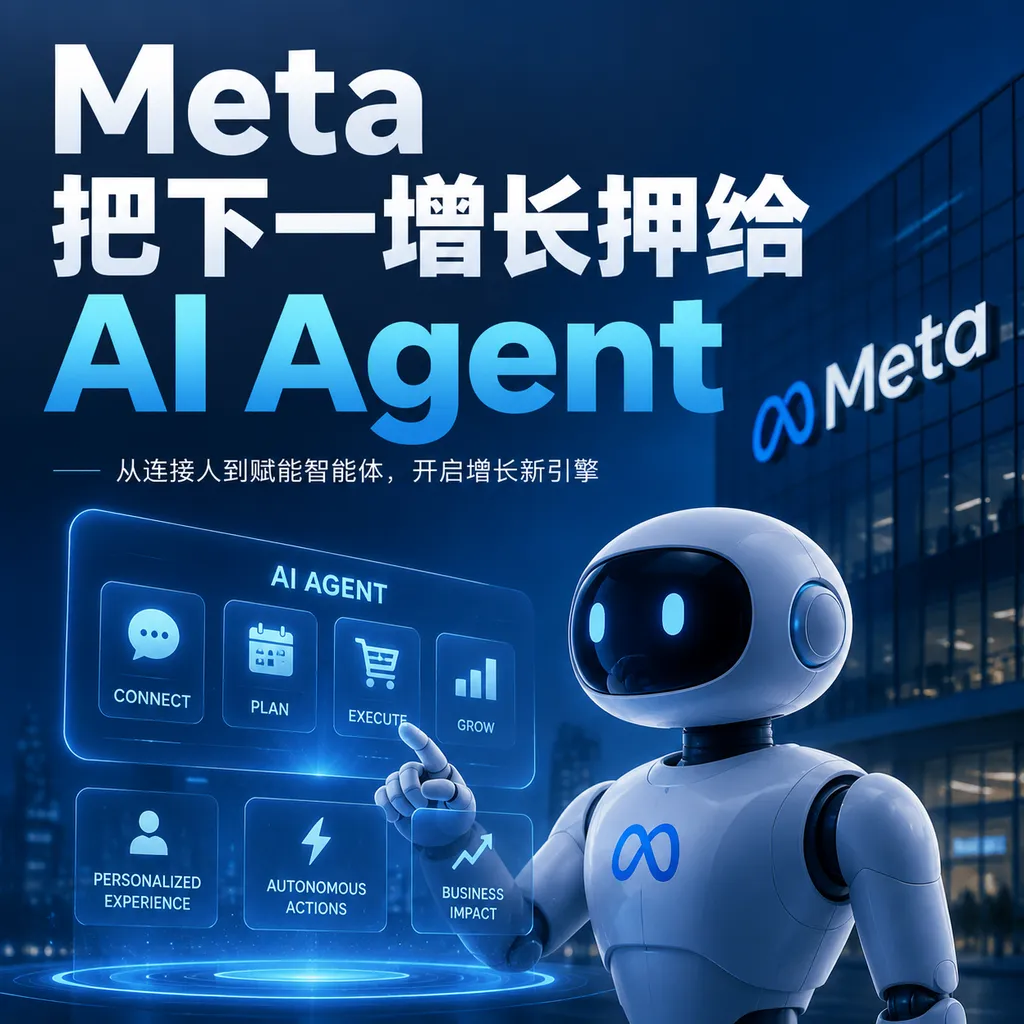
Meta is expanding its AI footprint from personal agents to enterprise APIs, compute, and internal software. What truly deserves attention is not the chat interface, but its attempt to connect social distribution, business messaging, and model infrastructure into a unified platform.
Meta Is Betting Its Next Phase of Growth on AI Agents
Meta is presenting a more complete business case for its AI investments.
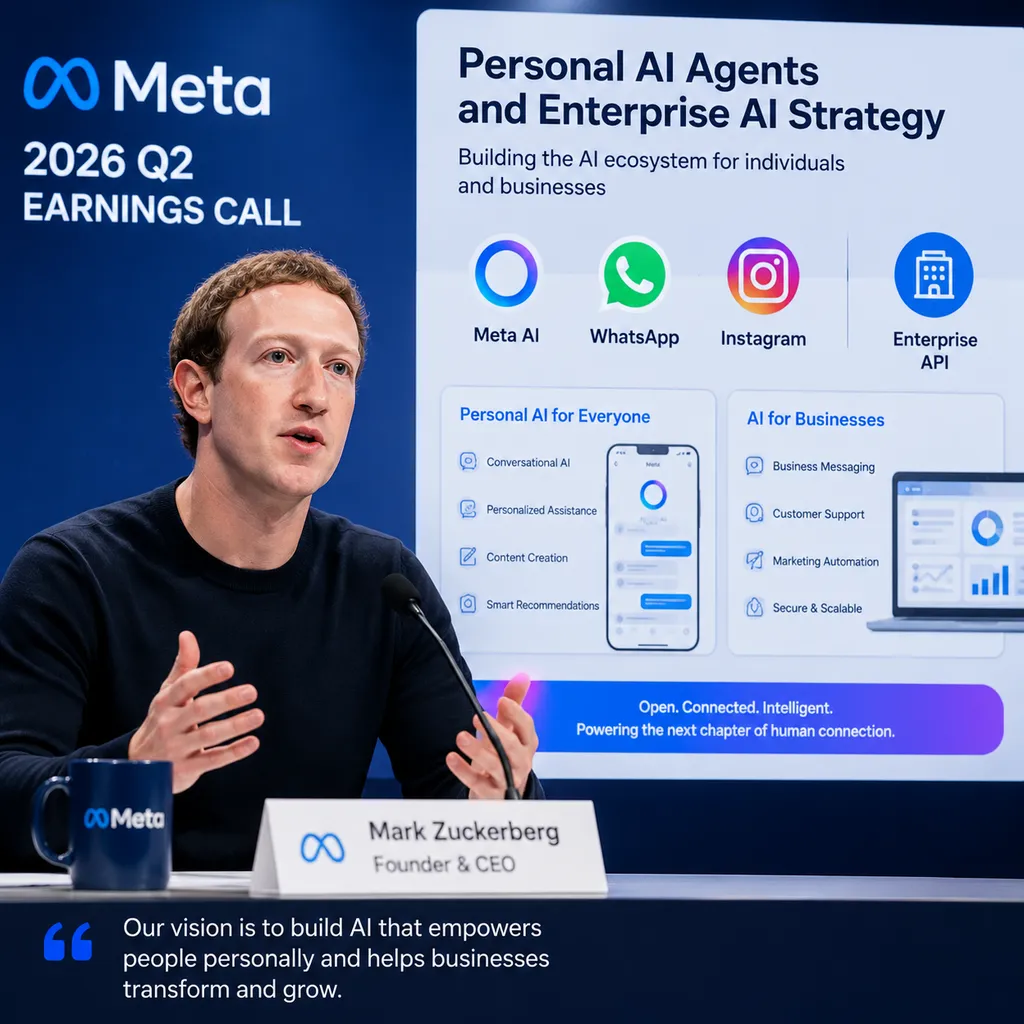
During its second-quarter 2026 earnings call on July 29 local time, CEO Mark Zuckerberg said that over the next five years, billions of people may have personal AI agents that can act on their behalf around the clock. At the same time, Meta sees an enterprise opportunity that extends beyond one or two agent products to an entire technology stack encompassing AI agents, model APIs, computing resources, and internal enterprise software.
This was not a specific product launch. Meta did not announce a release date, pricing, or a complete list of capabilities for its personal agent, much less prove that it has solved challenges such as long-term memory, cross-application authorization, and high-risk actions. Nevertheless, the statement matters: Meta is beginning to explain to investors that its years of massive AI capital expenditure are ultimately intended not only to improve ad recommendation efficiency or add a chat box to its apps, but also to generate new software and infrastructure revenue.
From Chatbots to “Someone Who Gets Things Done for You”
The personal agent described by Zuckerberg could work on a user’s behalf 24 hours a day, helping improve their life, health, relationships, and financial situation. This may sound ambitious, but the difference between such an agent and most of today’s chatbots is actually quite clear: Chatbots wait for questions, while agents continuously monitor goals and proactively invoke tools to complete tasks.
For example, an ordinary chatbot can tell users how to plan a trip. A personal agent, by contrast, would need to read their calendar, understand their budget, compare flights and hotels, ask fellow travelers about their availability, and finally complete the booking once authorized. The former primarily consumes inference tokens; the latter must also handle identity, permissions, payments, exception recovery, and accountability.
Zuckerberg specifically noted that programming is the first field in which agents are truly taking off. This assessment is unsurprising. Coding is one of the few task environments that simultaneously meets the following conditions:
- Inputs and outputs are relatively structured;
- Results can be verified through compilation, testing, and static analysis;
- Git provides built-in version control and rollback mechanisms;
- When an agent makes a mistake, the consequences are usually more manageable than those of an erroneous money transfer, message, or diagnosis;
- Developers are willing to tolerate complex configurations and can tell when a model is making things up.
Personal life is completely different. An agent capable of generating code is not necessarily capable of safely managing a user’s health, relationships, and finances. The latter requires long-term memory, but remembering too much creates privacy concerns. It must act proactively, but excessive initiative could lead it to overstep its authority. It needs to understand user preferences without misinterpreting a few incidental actions as permanent intent.
Therefore, “billions of people having personal agents within five years” is better understood as Meta’s directional forecast than as a product roadmap that can be evaluated quarter by quarter. It is not difficult to imagine billions of people using Meta products with AI capabilities, given the enormous user bases of WhatsApp, Instagram, Facebook, and Messenger. But convincing billions of people to hand over their calendars, contact lists, transaction data, and authority over critical decisions to an agent is another matter entirely.
Meta’s Biggest Asset Is Not Its Models, but Distribution and Context
As model capabilities rapidly converge, Meta’s truly scarce resource is not another chat interface, but the distribution network it controls.
To be useful, a personal agent must know whom the user contacts, what content they follow, what business they are running, and where their daily communications take place. Meta’s social and messaging products inherently possess this kind of context. Hardware such as smart glasses can further supplement this with visual, voice, and environmental information, enabling agents to progress from “understanding chat history” to “understanding what the user is experiencing.”
This is also the fundamental difference between Meta and model companies such as OpenAI and Anthropic. The latter are moving from models and developer platforms toward the application layer, while Meta can enter the agent market from the opposite direction through its existing social relationships, content distribution, and business messaging channels.
It may not even need to build the most capable general-purpose model first. For mainstream users, convenient access, the ability to reach real contacts and services, and the capacity to complete tasks without switching applications are often more important than outperforming competitors by a few percentage points on benchmarks.
But this distribution advantage is also a double-edged sword. The legacy of distrust Meta has accumulated over its data practices and ad targeting will directly affect whether users are willing to grant more sensitive permissions to its agents. A recommendation system that knows what content users like and an agent that can handle their finances, health, or private relationships on their behalf present entirely different levels of risk.
Meta must answer at least three questions:
- What data does the agent access, and will that data be used for advertising or model training?
- When the agent acts on a user’s behalf, can its permissions be precisely controlled by application, time, and transaction amount?
- If the agent mistakenly sends a message, purchases a product, or leaks information, who is responsible, and how can the action be reversed?
If the answers to these questions are buried in lengthy user agreements, personal agents will struggle to evolve from demo features into trusted digital representatives.
The Enterprise Market Is Not Just About Selling Agents, but Also “What Lies Beneath Them”
Compared with the long-term vision for personal agents, Meta’s remarks about the enterprise market deserve more immediate attention from developers.
Zuckerberg explicitly stated that Meta sees an enormous enterprise opportunity encompassing agents, APIs, computing power, and internal software. In other words, Meta does not intend to build only an AI customer-service product for businesses. It wants to participate across multiple layers of enterprise AI spending:
- Application layer: Business Agents for customer service, sales, marketing, market research, and operational workflows;
- Platform layer: Model APIs and tools that developers can use to build, evaluate, and deploy agents;
- Infrastructure layer: Computing resources required for training, fine-tuning, and inference;
- Software layer: Commercialized versions of the systems Meta uses internally for data processing, model training, evaluation, and collaboration.
This logic resembles that of cloud providers. A business may initially purchase only a customer-service agent, but as usage deepens, it will go on to buy model calls, data connectors, permission management, audit logs, evaluation tools, and inference capacity. The truly stable revenue is usually not in the visible chat window, but in the infrastructure behind it.
In June, Meta had already demonstrated how it plans to expand Business Agents, including market research, product insights, calendar-tool integration, and competitive intelligence gathering. This indicates that it wants to move agents beyond advertising support tools and turn them into an everyday gateway for running a business.
This is a valuable position. Many small and medium-sized businesses already use Instagram, Facebook, and WhatsApp for customer acquisition, inquiries, and transactions. If Business Agents can directly access product catalogs, answer customer questions, qualify sales leads, and sync the results with enterprise systems, Meta can extend its existing ad revenue into software and transaction services.
The problem is that businesses will not pay premium prices simply because an agent can chat. Purchasing decisions will ultimately depend on whether it can reduce customer-service costs, improve lead conversion rates, or shorten a measurable process. Enterprise customers will also demand reliable service levels, data isolation, permission controls, audit logs, and human takeover mechanisms. These capabilities are less visible than social-product features, but they determine whether agents can enter production environments.
APIs Will Become the “Utilities” of the Agent Era, but Meta May Not Set the Standards
By listing APIs separately as an enterprise opportunity, Meta has signaled that it is not satisfied with merely allowing developers to download model weights. Open-source or open-weight models can expand influence, but APIs are more conducive to recurring revenue and make it easier for platforms to control model versions, inference optimization, safety policies, and service quality.
When building agents, enterprises generally will not remain permanently tied to a single model. A customer-service system may use a low-cost model for intent classification, a more powerful model for complex complaints, and a vision model to interpret images. Development agents may also dynamically route tasks among GPT, Claude, Gemini, Llama, and other models.
As a result, beyond model capabilities, API formats, tool-calling protocols, structured output, caching, batch processing, observability, and price stability will all become competitive battlegrounds. The providers that allow enterprises to swap models with the lowest migration costs are the most likely to become part of developers’ default technology stacks.
For Meta, this presents both an opportunity and a constraint. Meta can attract developers through open models, but enterprise customers will seek to avoid vendor lock-in. OpenAI-compatible interfaces, multi-model gateways, and standardized tool protocols will therefore continue to grow. For teams in China, services such as OpenAI Hub—which support OpenAI-compatible formats while aggregating models from multiple providers—essentially solve the same problem: The agent continues running at the upper layer, while the underlying models can be replaced based on cost, latency, and capability.
If agents become the dominant application paradigm, the most valuable platform may not be the one with a single best-in-class model, but the one capable of unifying identity, context, tools, and model routing.
Meta Is Turning Its Internal AI Investments Into Marketable Software Assets
“Internal software” is an easily overlooked part of Meta’s remarks.
To train and deploy large models, Meta has already invested heavily in data centers, chip clusters, training frameworks, inference systems, and evaluation tools. These systems initially support ad recommendations, content ranking, and Meta’s own AI products. But once its internal capabilities are sufficiently mature, packaging some of them as enterprise software is a natural way to amortize R&D and infrastructure costs.
Microsoft has Azure and Copilot Studio, Google has Vertex AI, and Amazon has Bedrock. Their common advantage is that they already control enterprise cloud budgets and procurement channels. Meta lacks a public-cloud business of comparable scale, making it difficult to catch up quickly if it competes directly in general-purpose cloud computing.
A more sensible strategy for Meta, therefore, is not to replicate AWS in its entirety, but to pursue vertical integration around its own strengths:
- Use open models to attract trials from developers and enterprises;
- Use APIs to provide stable, managed inference;
- Use Business Agents to connect advertising, messaging, and business operations;
- Use internal tools to cover training, evaluation, deployment, and operations;
- Ultimately charge for computing power, usage volume, software subscriptions, or transaction commissions.
This strategy offers more potential than simply selling chatbots, but it is also harder to execute. It requires Meta to excel simultaneously at models, cloud infrastructure, developer experience, and enterprise sales—capabilities that have historically belonged to different types of companies.
Massive Capital Expenditure Needs an Answer Beyond Advertising
Meta has continued to ramp up its AI infrastructure investments in recent years. For investors, the question is no longer whether AI matters, but when and how these investments will translate into revenue.
In the short term, the most direct return AI delivers for Meta will still come from advertising: more accurate recommendations, more efficient creative generation, and better ad automation. Personal agents are also more likely to boost engagement with existing products in the near term than to become a standalone paid business.
Enterprise APIs, computing power, and software offer a second monetization path. They could transform Meta, at least in part, from a consumer internet company primarily dependent on advertising into a developer platform and enterprise technology provider. This is precisely the story Meta now needs to articulate clearly to the capital markets.
Strategic potential, however, is not the same as revenue. Enterprise sales cycles are longer, customers are more cautious about migration, and service obligations are more demanding. Meta has historically excelled at rolling out a feature to billions of users at once, but it may not be equally adept at providing customized deployments, compliance reviews, and long-term technical support to thousands of enterprises.
Assessment: The Direction Makes Sense, but the Five-Year Timeline Remains Aggressive
Meta’s view of agents consists of two parts.
The first is that personal agents will become a new interaction gateway. This direction is broadly sound. Applications will shift from “users opening each piece of software individually” to “users describing a goal and agents invoking multiple services.” With its social relationships, messaging channels, business accounts, and hardware devices, Meta is reasonably well positioned in this competition.
The second is that billions of people will truly have always-on personal agents within five years. This timeline is clearly more aggressive. Model reasoning is only one part of the equation. Identity, payments, permissions, long-term memory, safety, and accountability mechanisms may mature far more slowly than the models themselves.
The enterprise market is more realistic. Agents, APIs, computing power, and software can each be monetized separately while also reinforcing one another. But Meta must prove that it offers more than inexpensive models and massive traffic: it must deliver a production system that enterprises are willing to rely on over the long term.
The key signal from this earnings call, therefore, is not that Meta plans to build yet another AI assistant. It is that the company is attempting to establish a new growth chain: Personal agents will expand usage, Business Agents will serve commercial scenarios, APIs and computing resources will generate developer revenue, and internal software will extend deeper into the enterprise technology stack.
If this combination succeeds, Meta will no longer merely use AI to sell more ads; it will become a platform provider for the agent era. Before that can happen, however, it must overcome three major hurdles: user trust, enterprise service capabilities, and multi-model standardization.
At least as of July 30, 2026, Meta has provided a direction—but not yet an answer.
References
- Official Meta Llama GitHub Repository: Background on Meta’s open models, inference tools, and developer ecosystem.
- Model Context Protocol GitHub Organization: Information on the development of open protocols for connecting agents to external tools, data sources, and context.
- Overview of Future AI Agent Trends: Additional industry context on agent platforms, enterprise adoption, and ecosystem competition.