Grafana Unified LLM Backend
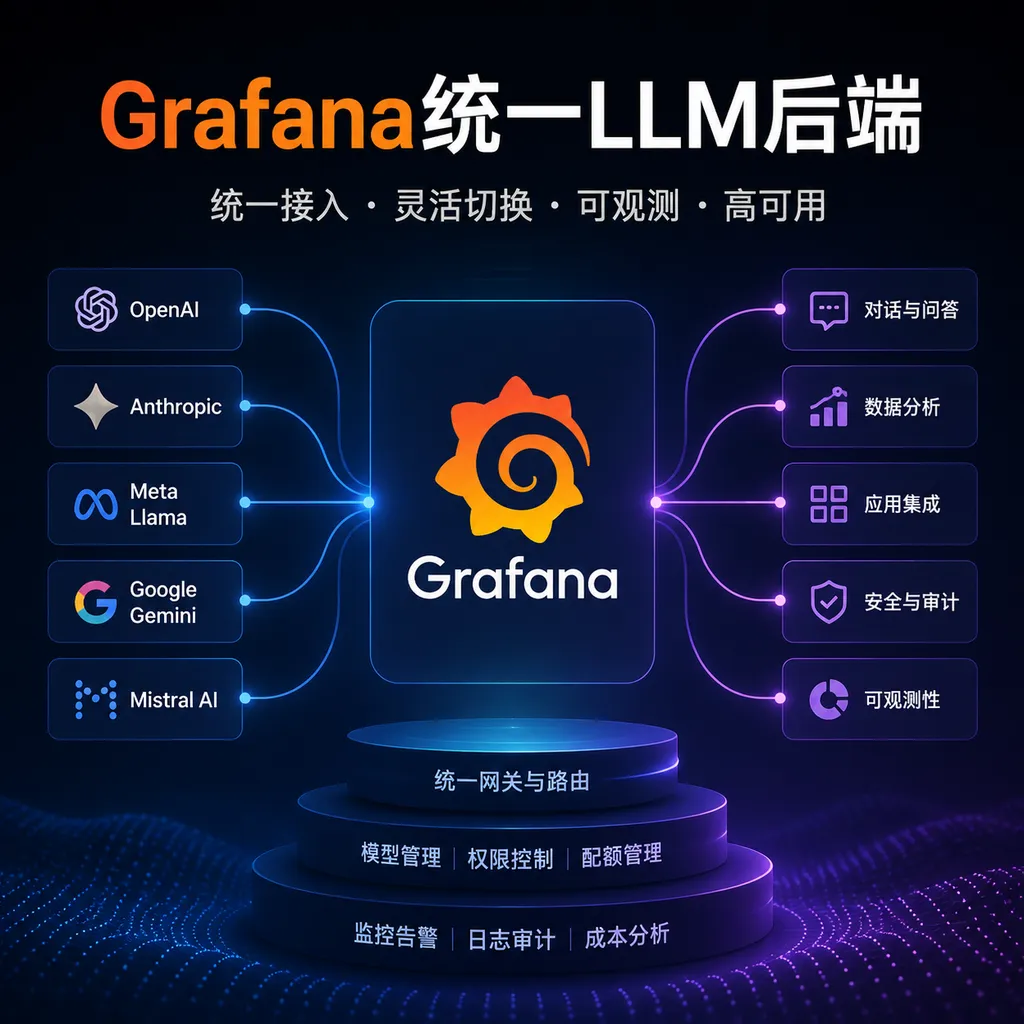
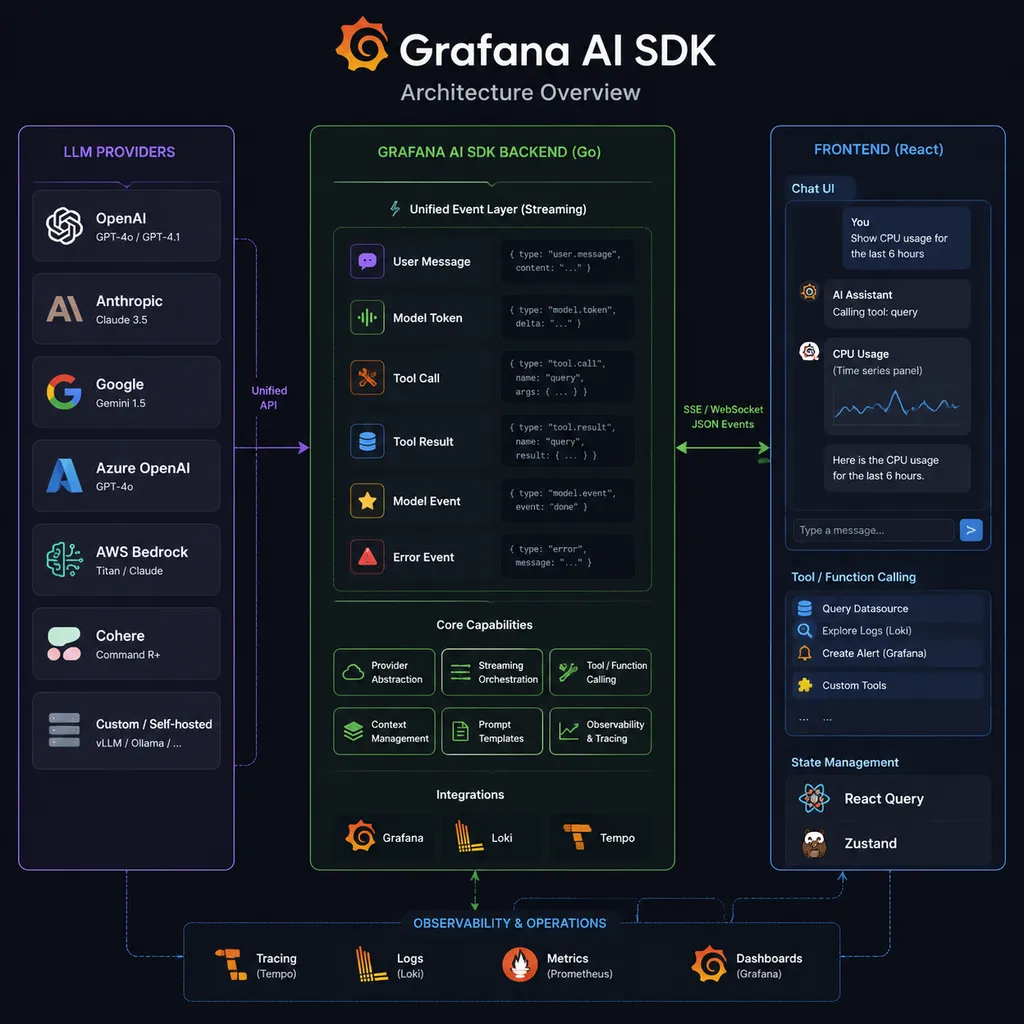
Grafana recently open-sourced an AI SDK that uses Go to provide a unified way to handle LLM streaming output and tool calls, along with a companion React frontend library. Rather than creating yet another agent framework, it targets the protocol layer—the part of multi-model applications most prone to spiraling out of control.
Grafana Has Separated Out the Most Troublesome Layer of LLM Applications
As of July 30, 2026, Grafana has recently open-sourced grafana/ai-sdk for AI applications. The project’s core purpose is not to provide yet another chatbot template, nor to take over business logic with complex workflows. Instead, it standardizes LLM streaming output and tool calling in Go backends, as well as how these events are transmitted to and consumed by React frontends.
In short, it aims to translate the disparate streaming protocols used by different model providers into a single language that applications can process reliably.
This may not be as eye-catching as the release of a new model, but it is highly relevant to production environments. When developers first integrate a model, they often only need to send a request and read the returned text. Once the product begins to support stopping generation, function calling, source citations, reasoning status, usage statistics, and switching between multiple models, what started as a few dozen lines of invocation code quickly turns into a fragile event system.
Grafana AI SDK is attempting to eliminate precisely this kind of repetitive work.
Streaming Output Has Never Been Just About Printing One Word at a Time
Many SDKs describe streaming output as continuously reading text chunks, but in real-world applications, a single model response may contain multiple types of events at the same time:
- Regular incremental text;
- Incrementally generated tool names and arguments;
- Tool execution results;
- The model’s finish reason;
- Token usage and latency information;
- Server-side errors, timeouts, or user-initiated cancellation;
- Model-specific citations, reasoning, or intermediate states.
These events do not always arrive in the ideal order. Tool arguments may be split across multiple incomplete JSON fragments, text and tool calls may be interleaved, and the connection may be interrupted before the completion event arrives. If the frontend receives only strings, it has to determine on its own whether a given segment is part of the answer, a control message, or a tool argument.
The value of a unified event layer is that it converts raw provider data into events with explicit semantics before passing them to the application. The following is a conceptual event sequence, not an exact type definition from the project’s source code:
message.start
text.delta          -> "Query"
text.delta          -> "the error rate over the past hour"
tool_call.start     -> query_metrics
tool_call.args      -> { service: "api"
tool_call.args      -> , range: "1h" }
tool_call.result    -> { error_rate: 0.018 }
text.delta          -> "The error rate is 1.8%"
message.finish      -> reason: stop, usage: ...
With this abstraction in place, the React interface does not need to understand each model’s raw SSE format, nor does it need separate branches for assembling tool arguments, handling completion states, and processing errors. The backend absorbs upstream differences, while the frontend handles only stable events.
This is also why Grafana chose to provide both a Go backend library and a React frontend library: if only model invocation is standardized, but the data structure sent to the browser is not, the complexity merely moves from the server to the client rather than truly disappearing.
Tool Calling Is the Hardest Part of Protocol Compatibility
Multi-model compatibility can easily create an illusion: as long as every provider supports something resembling function calling, the same code should be able to switch seamlessly between them. In reality, the differences in tool calling go far beyond API field names.
Different providers impose different constraints on tool selection, parallel calls, argument validation, call identifiers, and result submission. Some models return multiple tool calls at once, while others stream arguments incrementally. Some adhere strictly to JSON Schema, while others may still generate arguments with missing fields or incorrect types. Even if the request layer is standardized, the runtime semantics may not be.
The real value of Grafana AI SDK, therefore, is not that it renames a field from one convention to another, but that it establishes a relatively stable execution boundary for applications:
- The model declares which tool it intends to call;
- The backend incrementally collects and parses the arguments;
- The application performs validation, authorization, and actual execution;
- The execution result is fed back into the model context;
- The frontend receives displayable and traceable state changes.
This boundary is particularly well suited to Grafana’s own use cases. Asking a model to explain monitoring data is only the first step. More common requirements involve calling tools for metric queries, log retrieval, alert analysis, and similar tasks. In these cases, the tool is not a demo weather lookup function: it may access production systems, tenant data, and expensive queries. A unified protocol can reduce integration code, but it cannot implement access control on behalf of developers.
In other words, the SDK can standardize how tools are called, but it cannot determine whether a tool should be called. Argument validation, tenant isolation, timeouts, concurrency limits, audit logs, and confirmation for high-risk operations must still be implemented at the business-logic layer.
Why Go Instead of Yet Another TypeScript Framework?
The current AI application toolchain clearly favors Python and TypeScript. Python supports model experimentation and data processing, while TypeScript has a large number of full-stack SDKs aimed at web products. The Go ecosystem is not without LLM clients, but there are relatively few options covering the entire chain of unified streaming events, tool calling, and browser state management.
Grafana’s decision to start with Go is unsurprising. Grafana’s backend plugin ecosystem already relies heavily on Go, and its plugin SDK hides the underlying plugin protocol through RPC, allowing developers to focus on data queries and business logic. The AI SDK follows a similar philosophy: rather than requiring every plugin author to study each model provider’s streaming protocol from scratch, it provides a higher-level AI interaction abstraction on the Go server.
Its goals are similar in some respects to JavaScript solutions such as the Vercel AI SDK, with both focusing on streaming UIs and tool calling. The difference is that Grafana places the Go backend at the center. For teams already using Go to build API gateways, Grafana plugins, observability platforms, or internal infrastructure, this is more natural than introducing an additional Node.js service solely to integrate LLMs.
Its approach also differs from frameworks such as LangChain. Those frameworks typically cover prompt templates, retrieval, agents, memory, and workflow orchestration, offering broader capabilities but also heavier abstractions. Grafana AI SDK currently resembles a narrow, clearly defined protocol pipeline: it converts model output into unified events and then reliably delivers those events to the frontend.
In our view, this restraint is actually one of its strengths. What most production applications lack is not another agent concept, but a messaging protocol that will not immediately fall apart when models are switched, tools are added, or the UI is upgraded.
The Most Practical Value for Developers: Keeping Provider Differences in the Backend
If an application will always call a single model, return only complete text, and use neither tools nor a real-time UI, directly using the official client is usually simpler. There is no need to introduce abstraction for abstraction’s sake.
However, the following types of projects are more likely to benefit from Grafana AI SDK:
- Go backends that need to integrate with multiple model providers;
- Products that require incremental display during generation, along with cancellation and error recovery;
- Models that need to call internal search, database, monitoring, or ticketing tools;
- React frontends that need to display states such as tool execution in progress, succeeded, or failed;
- Teams that want to replace models in the future without rewriting the entire frontend-to-backend pipeline;
- Grafana backend plugins preparing to add natural-language querying or diagnostic capabilities.
This design also provides an often-overlooked benefit: clearer security boundaries. The browser does not need to hold model provider keys directly, nor does it need to know which upstream model is being used. Authentication, quotas, model routing, and sensitive-field filtering can all remain in the Go backend.
However, a unified interface does not mean that all model capabilities can be reduced to their common denominator without trade-offs. To support provider-specific features, SDKs usually have to choose between two approaches: expose only the minimum common capabilities, or allow extension fields to pass through. The former is simple but may waste model capabilities; the latter is flexible but gradually erodes the abstraction boundary. This will be one of the most important aspects to watch as the project evolves.
Grafana’s Real Advantage Is Observability, Not Just Model Invocation
The most promising aspect of Grafana building an AI SDK is not whether it can wrap another chat API, but whether it can integrate the generation process naturally into an observability system.
A single LLM request involves at least time to first token, total duration, input and output tokens, model name, provider, retry count, tool execution duration, and finish reason. In an agent scenario, a single user request may expand into multiple rounds of model calls and multiple tool calls. Traditional HTTP status codes can tell developers only whether a request succeeded or failed. They cannot explain why costs suddenly increased, why a response stalled, or whether latency occurred on the model side or the tool side.
Grafana is already advancing observability capabilities for Go agents, enabling the recording of model generations and their context. If the AI SDK becomes more closely integrated with these capabilities, it could form a natural pipeline: unified events handle execution, while traces and metrics explain that execution.
However, this also creates data governance risks. Prompts, model responses, and tool arguments often contain user input, business data, or even credentials. Developers should not log complete content to logs or telemetry backends by default merely because tracing makes it convenient. A safer approach is to record metadata by default, sample, redact, or hash message bodies, and establish separate retention policies for different tenants.
Worth Adopting Now, but Not a Reason to Replace Existing Architectures Blindly
As a newly emerging open-source project, Grafana AI SDK’s greatest appeal is that it is moving in the right direction: the Go ecosystem does need a more unified LLM streaming protocol, and frontend-backend communication needs a more reliable event model than string concatenation.
However, teams should still examine several questions before adopting it in production:
- Whether the required providers, model capabilities, and tool-calling patterns are supported;
- Whether upstream generation and downstream tools can both stop when a request is canceled;
- Whether stream interruptions can be distinguished from failures, user cancellations, and normal completion;
- Whether tool calls are designed to be idempotent and whether retries could repeat write operations;
- Whether events can be resumed or deduplicated after the frontend reconnects;
- Whether SDK upgrades could change the event structure and frontend state machine;
- How sensitive prompts, tool arguments, and model outputs are redacted and audited.
Duplicate execution in tool calls deserves particular caution. Network retries for text generation usually only consume a few more tokens, but repeated calls to tools that create tickets, modify alert rules, or trigger deployments can cause real incidents. Applications should assign call IDs and idempotency keys to high-risk tools and require human confirmation, rather than treating model output as a trusted instruction.
Overall, Grafana AI SDK is not an AI application framework that attempts to handle everything. It is a more foundational and engineering-oriented piece of the puzzle. It addresses the protocol issues that inevitably arise when model capabilities enter production systems: how events are defined, how tools are chained together, how state is delivered to the frontend, and how provider differences are isolated.
If Grafana continues to expand provider integrations, stabilize the event protocol, and make tracing, token-cost tracking, and tool-call observability default capabilities, this project could become a highly practical foundation for Go teams building streaming AI features. It may not replace existing agent frameworks, but it could become a more reliable connector between those frameworks and web products.
References
- Grafana AI SDK: The project’s main repository, introducing LLM streaming output and tool-calling capabilities for Go backends, along with the accompanying React library.
- Grafana Plugin SDK for Go: Grafana’s official Go plugin SDK repository, useful for understanding the backend plugin and RPC ecosystem in which the AI SDK operates.