Noisegate Open-Sourced: Add Noise to Agents
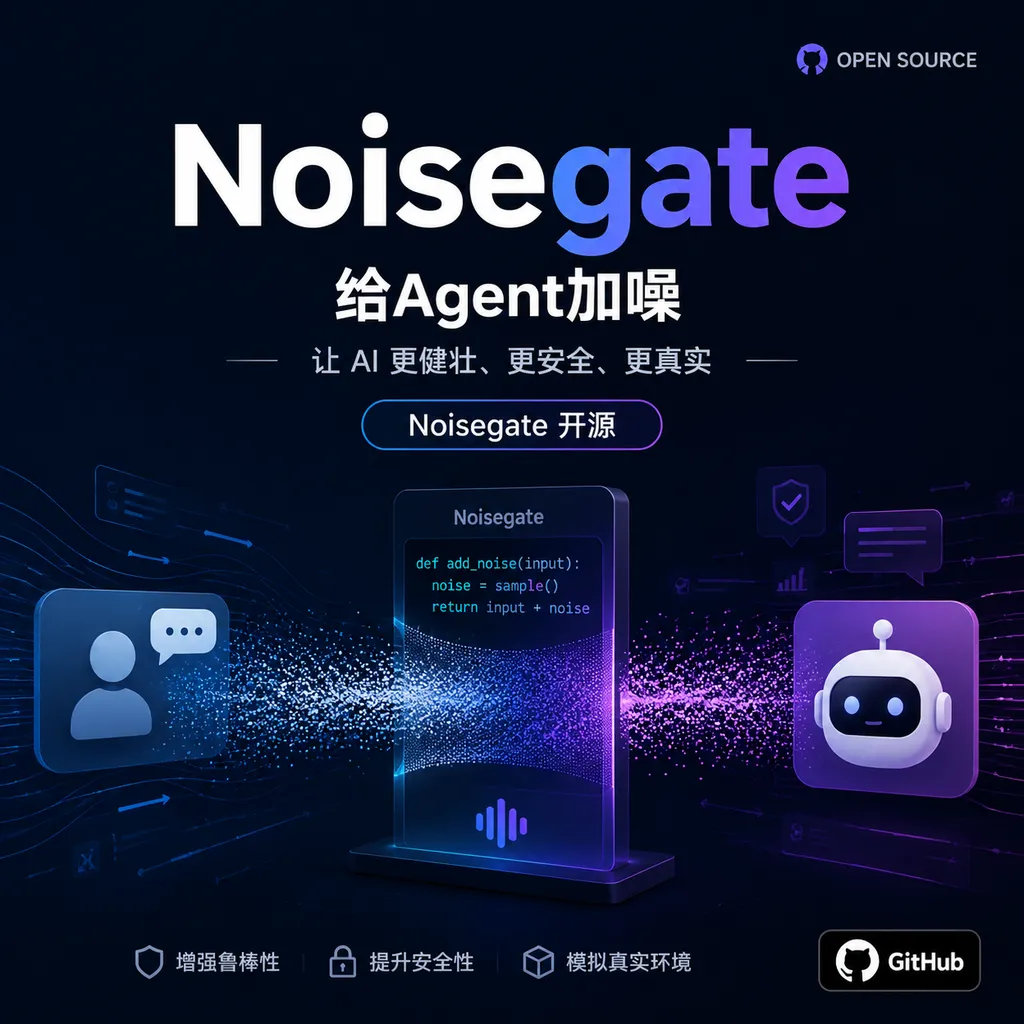
Noisegate was recently open-sourced. It attempts to use differential privacy budgets to limit untrusted AI agents from repeatedly probing sensitive data. The approach is worth watching, but it is not a universal data-loss prevention silver bullet. Whether it is production-ready depends on query boundaries, budget persistence, and auditing capabilities.
Noisegate Goes Open Source, Adding Noise to Agents
Noisegate recently debuted as an open-source project designed to add a differential privacy gateway between untrusted AI Agents and sensitive data. Agents can continue to query and analyze data, but instead of gaining unrestricted access to raw records, they receive results constrained by a privacy budget and, when necessary, infused with statistical noise.
This is not just another prompt filter, nor is it data-masking middleware that replaces ID numbers with asterisks. Noisegate attempts to address a harder-to-prevent class of risk: Every question an Agent asks may appear legitimate on its own, but through a large number of continuous, correlated queries, it may ultimately “tease out” a particular user or record.
As of July 30, 2026, the project is still better viewed as a security prototype worth validating than as a production-ready enterprise data loss prevention product. The problem it targets is real, and its technical approach is more robust than relying solely on system prompts. However, the effectiveness of differential privacy depends heavily on the query model, budget management, and deployment boundaries. If any of these are handled carelessly, the gateway may offer little more than the psychological comfort of “randomly jittering the numbers.”
Agent Data Risks Do Not Come Only From Unauthorized Access
Over the past year, enterprise discussions about Agent security have focused primarily on prompt injection, tool abuse, and sandbox escapes. For example, attackers may hide malicious instructions in webpages, emails, or documents, inducing an Agent to invoke internal tools and then send database contents to an external service.
These issues are certainly important, but they usually involve a relatively clear anomalous action: reading a table that should not be accessed, invoking an unauthorized tool, or sending results to an unapproved domain. Traditional authentication, least privilege, tool allowlists, and network isolation at least have a clear idea of what they should block.
Statistical inference attacks are more troublesome because every individual step may be legitimate.
Suppose an Agent is authorized to query departmental salary statistics. It first asks for the average salary of a 20-person team, then asks for the average salary of the remaining 19 people after excluding a particular employee. By subtracting the two results, it may be able to infer the approximate salary of the excluded employee. Similarly, an Agent could repeatedly vary filters such as region, age, and disease type. Even if the API never returns patient names, the Agent may gradually narrow the results down to a unique individual.
This type of risk cannot simply be attributed to SQL injection or misconfigured permissions. The Agent genuinely has permission to query the data, and the database returns only aggregate results. The problem is that multiple results can be combined. An Agent capable of autonomous planning, bulk tool invocation, and follow-up queries based on previous results is inherently better than an ordinary user at conducting this kind of low-cost probing.
The significance of Noisegate lies in advancing the line of defense from “Is this query legitimate?” to “How much information has this sequence of queries cumulatively disclosed?”
What Exactly Does a Differential Privacy Gateway Do?
The core goal of differential privacy is not to guarantee that results remain absolutely confidential, but to limit the effect that the presence or absence of a single individual in a dataset has on the output.
Put more plainly, if the distribution of query results remains very similar when one person’s record is added or removed, it becomes difficult for an observer to determine from the returned results alone whether that person is in the database, and harder still to infer that person’s specific attributes. Systems typically achieve this by limiting query sensitivity, injecting calibrated random noise, and tracking cumulative privacy consumption.
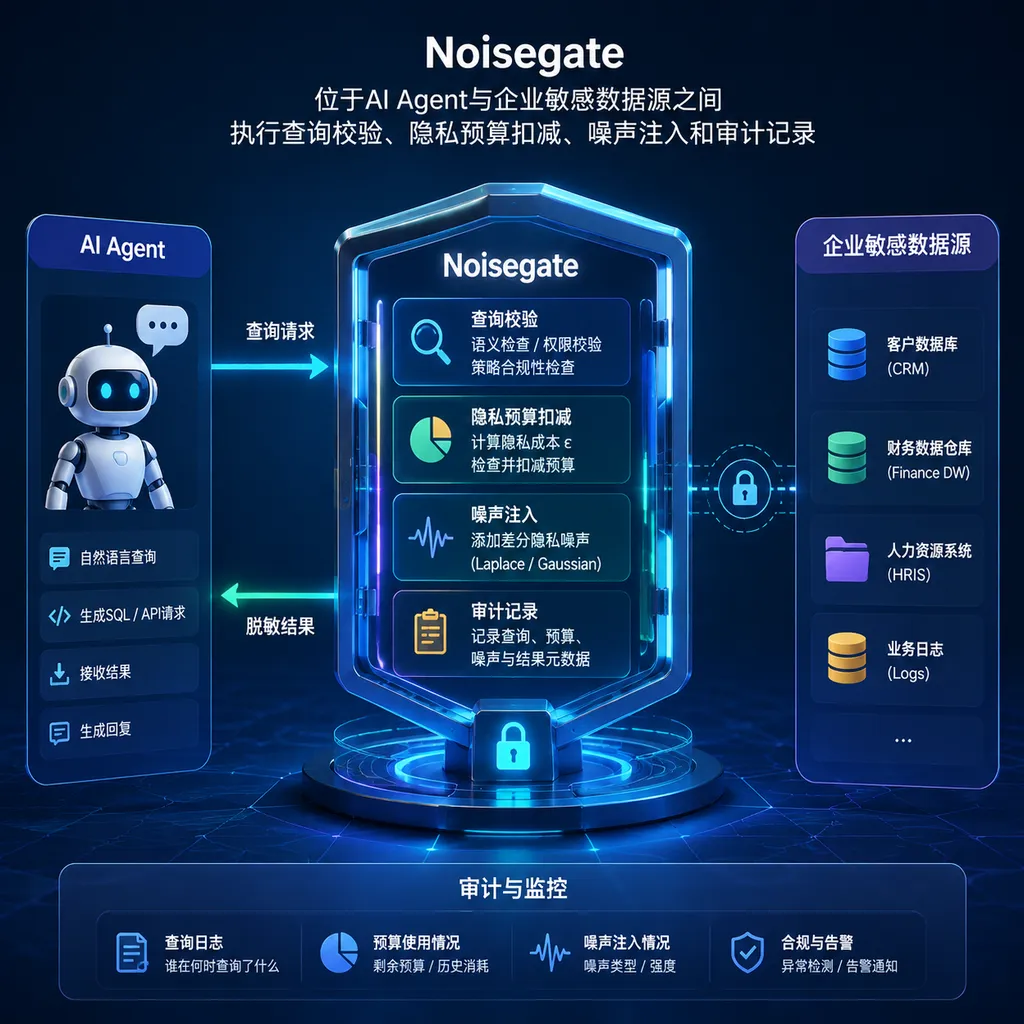
In an Agent-based architecture, the gateway generally sits in the following position:
Untrusted Agent
       |
       | Structured query or tool call
       v
+---------------------------+
| Differential Privacy Gate |
| - Identity and session    |
|   recognition             |
| - Query scope validation  |
| - Sensitivity estimation  |
| - Privacy budget          |
|   deduction               |
| - Noise injection         |
| - Rejection and auditing  |
+---------------------------+
       |
       v
Private Data / Analytics Service
The most important concept here is the privacy budget, typically represented by epsilon (ε). It can be understood as an “information disclosure allowance” that is continuously depleted: the smaller the budget, the stronger the privacy protection generally is, but the more noticeable the noise in the results may become; the larger the budget, the closer the results are to the true values, but the more information an attacker can obtain.
A query that appears safe once may not remain safe when repeated ten thousand times. Differential privacy has a composition effect, meaning that repeated queries cumulatively consume the budget. A capable gateway therefore cannot simply add noise to each result statelessly. It must know who is making the query, which task the query belongs to, which dataset is being accessed, and how much budget has already been consumed.
This is what makes Noisegate more noteworthy than ordinary output masking: rather than identifying phone numbers and email addresses in text, it focuses on controlling how much information query results can disclose in statistical terms.
Why Must It Sit Outside the Agent?
Relying on the Agent itself to follow privacy rules is not dependable.
Developers can certainly write instructions such as “Do not disclose personal data” or “Do not execute queries that could identify users” in the system prompt. The problem is that the Agent itself is part of the threat model: it may be compromised through prompt injection, or it may deviate from the rules because of planning errors, model upgrades, or context contamination. More realistically, an attacker may not need to persuade the model to leak anything at all; they only need to drive it to continuously issue seemingly reasonable statistical queries.
The security boundary must be located somewhere the Agent cannot modify. The gateway can reject requests, deduct from the budget, or reduce result precision, while the Agent can only accept the processed output. This is similar to configuring a sandbox for a code-execution Agent: a model’s promise that it “will not delete files” is not a reason to grant it administrator access to a production server.
However, the gateway cannot replace existing security measures. It addresses statistical leakage rather than every possible Agent-related risk. A more reasonable deployment combines several types of controls:
- Identity and access-control systems determine which datasets and tools the Agent may access;
- Sandboxes and network policies restrict code execution, file access, and external communications;
- Parameterized queries and database permissions prevent SQL injection and unauthorized reading;
- Differential privacy layers such as Noisegate limit cumulative information leakage from aggregate results;
- Audit systems record query chains and introduce human confirmation for high-risk actions.
In other words, a differential privacy gateway is more like a “flow-control valve” at the data outlet than a universal shield covering the entire factory.
The Real Challenge Is the Budget, Not the Random Numbers
Adding a random number to a count is not difficult. The challenge is proving that the random number is sufficient to provide the expected privacy guarantee without making the result useless to the business.
The first issue is query sensitivity. Counting people, calculating totals, computing averages, and training model parameters differ in how sensitive they are to an individual record. Consider average salary: if the system does not first bound salary values, a single extreme record could significantly change the average, making it impossible to calibrate the noise correctly. Production systems usually need to clip input ranges, restrict query types, or expose only reviewed statistical operators.
The second issue is budget ownership. Should the budget be calculated by user, Agent, tenant, dataset, or business task? If it is tracked only by API key, an attacker can switch keys. If it is tracked only by Agent session, the Agent can continually create new sessions. If the budget is shared globally, one team may exhaust everyone else’s query allowance. This is fundamentally a security identity and data governance problem, not something that differential privacy formulas alone can solve.
The third issue is budget persistence. Restarting the gateway must not reset the consumed budget, and deployments with multiple replicas must not maintain separate, unrelated counters. Otherwise, an attacker need only cycle through different instances to turn a finite budget into unlimited queries. The budget ledger requires atomic deductions, consistency, fault recovery, and tamper resistance, making it nearly as complex as a billing system.
There is also an easily overlooked problem: the same fact may be exposed through multiple tools. An Agent might first query an analytics API, then inspect a cache, logs, a vector database, or an exported CSV file. If Noisegate protects only one of these exits, an attacker can bypass the gateway and retrieve data through a side channel. Before deploying it, enterprises must first map their data flows rather than simply placing a proxy in front of an HTTP endpoint.
It Is Not Suitable for Protecting Every Agent Output
Noisegate’s direction can easily be misunderstood as suggesting that “any LLM output can be made private by adding noise,” but that is not the case.
Differential privacy is best suited to statistical tasks with clear boundaries and calculable sensitivity, such as counts, histograms, interval distributions, bounded means, and specially designed machine-learning training processes. For arbitrary natural-language question answering, it is difficult for a system to determine how much a summary reveals about a particular individual, let alone select noise that is both safe and useful.
If an Agent can directly read complete medical records and the gateway is then asked to rewrite its response, the differential privacy layer has already intervened too late. Once sensitive source text enters the Agent’s context, the model may leak it through logs, memory, tool parameters, or subsequent calls. A safer approach is to allow the Agent to invoke only constrained statistical tools, with the gateway protecting the data before it enters the model’s context.
Likewise, differential privacy cannot guarantee that an output contains no trade secrets, nor can it prevent an Agent from transferring funds, deleting files, or modifying production configurations. It protects the influence of individual records on statistical outputs, not confidentiality, integrity, and availability in every sense.
Noisegate Is Worth Trying, but Do Not Rush to Label It Production-Ready
Noisegate targets a rapidly expanding gap. Enterprises have already begun connecting Agents to data warehouses, CRMs, medical records, and internal analytics platforms, yet most security solutions remain focused on tool authorization and sensitive-word filtering. For Agents capable of autonomously breaking down tasks and invoking APIs at high frequency, inspecting individual requests is clearly insufficient.
From an engineering perspective, packaging differential privacy as an independent gateway is also more sensible than requiring every Agent framework to reimplement it. The gateway can serve as a model-agnostic and Agent-framework-agnostic data control layer: upstream models and orchestration frameworks can change, and downstream databases can be replaced, while the privacy policy remains within the same trusted boundary.
However, for an early-stage open-source project, developers should focus on whether it can answer the following questions rather than merely whether a demonstration successfully adds noise to a result:
- Which query types are supported, and which privacy guarantees have clearly defined boundaries?
- Who configures ε, sensitivity, and clipping ranges, and are secure defaults provided?
- How are budgets composed and deducted across repeated, adaptive queries?
- Can budgets remain consistent across tenants, instances, and service restarts?
- Can the system resist bypass techniques such as identity switching, request replay, and query splitting?
- When a query is rejected, could error messages indirectly leak characteristics of the data?
- Are attack simulations, utility evaluations, and reproducible privacy tests available?
- Do the logs themselves contain raw queries, sensitive parameters, or true results?
If these questions do not have clear answers, the project may still be useful for research, prototyping, and internal red-team exercises, but it should not be considered compliant simply because it carries the label “differential privacy.”
How Developers Should Evaluate It
The most practical way to test it is not to connect it to a production database immediately, but to construct a simulated dataset containing known sensitive records and then have the Agent actively play the role of an attacker.
Tests can cover differencing attacks, repeated queries, fine-grained filtering, cross-session retries, concurrent requests, and identity rotation. Teams need to test both privacy and utility: if the noise is too small, attacks remain effective; if the noise is too large, business users will demand that the gateway be bypassed because the statistics are unusable.
A reasonably complete evaluation should record at least four groups of metrics:
- Privacy consumption: How much budget has each identity, task, and dataset cumulatively used?
- Attack success rate: Can the Agent infer membership, individual attributes, or information about rare groups?
- Statistical error: What are the deviation and confidence interval between protected and true results?
- System cost: What latency, state-storage requirements, concurrency bottlenecks, and failure behavior does the gateway introduce?
Failure modes also require special testing. If the budget store is unavailable, the system should deny queries by default rather than bypassing protection in the name of availability. If sensitivity cannot be calculated, it should also fail conservatively. The most dangerous security gateway designs are often those that automatically fall back to an “unprotected pass-through” mode when errors occur.
A Signal Worth Watching
Noisegate’s most important value at present may not be that it already provides a complete answer, but that it advances the discussion of Agent security beyond prompts and access control into the realm of statistical inference.
As Agents gain longer operating times, lower invocation costs, and stronger tool-use capabilities, the fact that “a single request did not leak anything” will become increasingly insufficient evidence that a system is secure. What truly needs to be managed is what an Agent has cumulatively learned over hours, days, or even multiple tasks, and whether those pieces of information can be assembled into sensitive facts.
Differential privacy provides a mathematical language for describing cumulative leakage. Implementing it as a gateway gives existing Agent systems a relatively practical integration point.
Our assessment is: Noisegate’s recognition of the problem deserves more praise than its current product maturity. It could become a highly useful layer for structured statistical tools, internal analytics bots, and controlled data sandboxes. For arbitrary natural language, raw-document access, and highly privileged action-oriented Agents, it is nowhere near sufficient. Developers can begin monitoring and testing it now, but they should not treat it as a shortcut that replaces zero trust, sandboxing, access governance, and human review.
References
- Noisegate: llm-differential-privacy-gateway—The project’s open-source repository, introducing its approach to a differential privacy gateway for untrusted AI Agents and the related implementation.