MiniMax H3 Unifies Audio-Visual Generation
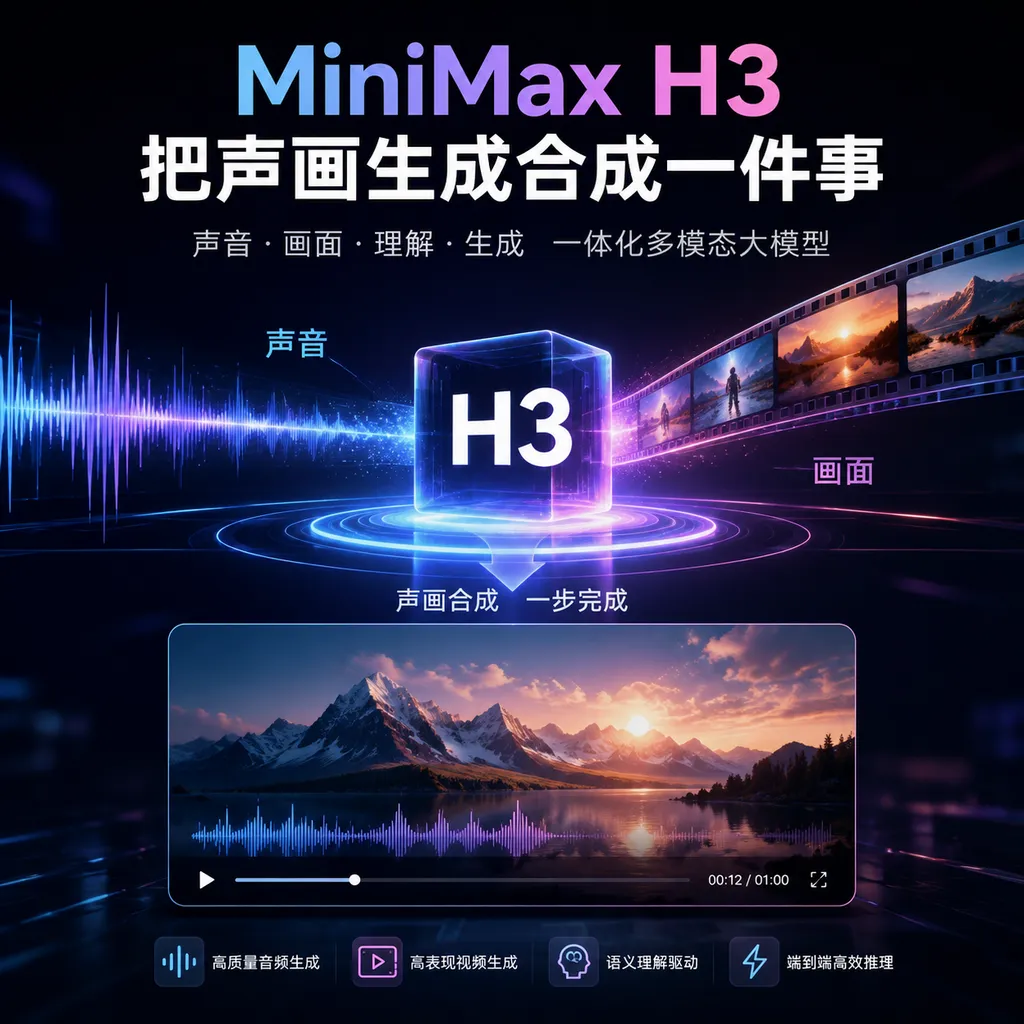
MiniMax today released H3, a fully multimodal generative model that can understand text, images, video, and audio in a unified manner and generate native stereo audiovisual content up to 15 seconds long at resolutions up to 2K. The model weights are expected to be released in the coming days.
MiniMax Officially Launches H3
On July 31, MiniMax officially launched H3, a general-purpose, omni-modal generative model. Rather than accepting only text prompts, it can understand text, images, video, and audio within a single context, then directly output video with native stereo audio. It can generate up to 15 seconds of video at resolutions of up to 2K.
MiniMax also said it plans to release the H3 model weights in the coming days, subject to compliance with applicable laws and regulations. The company has not yet disclosed the specific release date, parameter count, license, deployment requirements, inference costs, or full technical report.
This marks the official rollout of H3 following its preview at WAIC 2026 earlier this month. Compared with previous product approaches that split text-to-video, image-to-video, audio generation, and video editing into separate tools, what makes H3 noteworthy is not simply another increase in resolution or duration. Instead, it attempts to bring these tasks into a single model and a unified creative process.

“Omni-Modal” Means More Than Accepting More File Types
Although video models have broadly begun supporting multimodal inputs over the past two years, many products still rely on a stitched-together pipeline behind the scenes: a language model first rewrites the prompt, a vision model generates the visuals, a speech model synthesizes dialogue, a music or sound-effects model adds audio, and lip-syncing and editing modules finally align everything on the timeline.
This approach can work, but problems often arise at the boundaries between modules. Characters may move their mouths at the wrong time, footsteps may sound only after a foot has landed, or ambient audio from one scene may continue after the camera has already cut away. These are typical cases in which each component generates something correctly on its own, but the combined result is wrong. To fix such problems, developers often have to maintain multiple models, multiple prompts, and a complex post-processing workflow.
H3’s concept of unified understanding aims to have the model treat all source material as part of the same creative context, rather than as several isolated input slots. For example, a user could use a photo to specify a character’s appearance, a video to define the rhythm of the camera movement, an audio clip to establish the speaker’s voice and emotion, and text to describe the story. The model must understand how these conditions relate to one another and ultimately generate a complete shot with synchronized audio and visuals.
In other words, the traditional workflow is more like putting the screenwriter, cinematographer, voice actor, and editor in separate rooms and then having software stitch together their work. H3 aims to bring all of them to the same table, working around the same timeline from the outset.
If this capability proves sufficiently stable in real-world use, it could deliver more value than a simple improvement in image quality. The generative video field already has plenty of models capable of producing impressive demos. What remains genuinely scarce is controllable, reproducible production capability that supports continuous revision.
What 15 Seconds, 2K, and Native Stereo Audio Mean
According to the information released by MiniMax, H3 can generate videos up to 15 seconds long at resolutions of up to 2K, complete with native stereo audio. There are three key signals here.
- 15 seconds is beginning to approach a practical shot length. It is still not enough to generate an entire short film in one pass, but it can cover a single advertising shot, one exchange of dialogue in a short-form drama, a product showcase segment, or a piece of social media content. Longer continuous shots also mean developers can reduce the number of edits, lowering the risk of abrupt changes in character appearance, lighting, and audio between shots.
- 2K is better suited to post-production. Compared with low-resolution output suitable only for mobile previews, 2K footage leaves room for cropping, reframing, digital stabilization, and recompression. However, “2K” is not a fully standardized specification in the industry. It may refer to a digital cinema resolution approximately 2,000 pixels wide, but it is also often used loosely to describe 1440p-class output. Third-party pages currently list 1440p at 24 FPS, which differs from the official description of “up to 2K.” MiniMax still needs to clarify the exact pixel dimensions, frame rates, and aspect-ratio limitations.
- Native stereo audio matters more than “adding a voice-over after generation.” Stereo itself is nothing new. The key question is whether the audio and visuals are created within the same generative process. If dialogue, ambience, action sound effects, and music share the same timeline, it should theoretically be easier to synchronize lip movements, actions, and sound, while also using the left and right channels to convey object positions and camera movement.
For example, imagine a character running from the left side of the frame to the right, opening a door into a noisy room, and delivering a line after sitting down. A stitched-together system must separately handle motion generation, footsteps, the door-opening sound, indoor ambience, changes in spatial positioning, and lip synchronization. A unified model, by contrast, has the opportunity to learn the temporal relationships across the entire event. For users, the difference between these two approaches is not merely a few fewer button clicks; it determines whether the finished video requires extensive rework.
Of course, “native generation” does not automatically mean accurate generation. Whether the model can maintain stable lip-sync during long sentences, correctly assign voices in multi-character conversations, encode meaningful spatial information in its left and right channels, and produce natural Chinese intonation, pauses, and environmental reverberation all require real-world samples and independent testing. MiniMax has not yet released systematic evaluations, so the launch specifications alone are not enough to conclude that H3 has solved audio-visual consistency.
H3 Aims to Merge Generation and Editing
Third-party model pages provide more specific capability descriptions than the official announcement: H3 may support combined image, video, and audio references, while allowing users to replace characters, backgrounds, or dialogue within the same task. According to these pages, a single request can include up to nine images, three videos, and three audio clips, with no more than 12 reference files in total. Output clips range from five to 15 seconds and support both landscape and portrait aspect ratios.
MiniMax’s official announcement has not yet fully confirmed these details, and the actual specifications should be based on the forthcoming model card, API documentation, and open-weight release notes. Nevertheless, the overall design direction makes sense: generation and editing are becoming the same thing.
Early video models primarily answered the question, “Can a video be generated from scratch?” The new generation of products must answer a different question: “Can an existing asset be modified exactly as requested, with only part of it changed?” For professional teams, the latter is more important. Brands will not accept a product whose appearance changes with every generation, nor can film and television teams regenerate every shot simply because a single line of dialogue needs revision. A model that can truly enter production must understand which elements should remain unchanged and which may vary.
If H3 can place reference materials into a unified context, it may support a more natural iterative workflow: retain the character and camera movement while replacing only the background; preserve the visual rhythm while rewriting the dialogue; reuse a reference voice while changing its emotion; or extend an existing clip forward or backward. This resembles the workflow of nonlinear editing software more closely than moving assets among multiple specialized models.
Against Veo, Seedance, and Other Models, Specifications Will Not Decide the Winner
On paper, H3 is entering an already crowded field. Google’s Veo series continues to improve high-resolution video and native audio, while models such as ByteDance’s Seedance are also advancing multi-reference input, long takes, and audio generation. Numerous products in China and abroad are competing on character consistency, video editing, and controllable camera movement.
H3’s 15-second output has practical significance, and native stereo audio is a clear selling point, but these specifications alone do not give it a decisive lead. Some competing models support higher advertised resolutions, while others have already established more mature creative tools and distribution channels. Ultimately, video models will not be judged by how many input modalities can be listed on a launch page, but by several capabilities that are much harder to quantify:
- Whether characters, scenes, and cinematic language remain stable after multiple rounds of revision;
- Whether voices, lip movements, and identities remain correctly aligned during multi-character dialogue;
- Whether movement and camera motion from reference videos can be transferred rather than mechanically copied;
- Whether complex prompts are followed reliably enough, and whether failed portions can be regenerated locally;
- Whether inference speed, pricing, and concurrency limits can support large-scale production;
- Whether commercial licensing, content moderation, and AI-generated content labeling are clearly defined.
H3’s real opportunity for differentiation lies in MiniMax’s previous work on video, speech, and music models. A native audio-video model needs more than visual generation capabilities; it must also handle natural speech, voice consistency, layered background sound, and musical structure. Compared with temporarily attaching an audio module to a video model, companies that have spent years developing all these modalities are more likely to unify their data, timelines, and generative architectures.
However, this also makes the model significantly harder to train and deploy. Video already consumes substantial computing resources. Adding high-quality stereo audio and multiple forms of reference input further increases inference memory requirements, latency, and context-encoding costs. If H3’s open weights can run only in expensive multi-GPU environments, its open-release value may be largely limited to research and cloud deployment rather than direct use by local creators.
The Open-Weight Release Is the News Most Worth Waiting For
MiniMax says it will release H3’s weights in the coming days, potentially the most appealing part of this announcement for developers. However, “open weights” and “truly open source” are not the same thing.
Developers will need to confirm whether the license permits commercial use and redistribution; whether the full model or only quantized and distilled versions will be provided; whether the audio and video components can be invoked independently; whether inference code will be released at the same time; the minimum GPU memory requirement; support for mainstream GPUs and Chinese computing platforms; and how training data, content safety, and digital watermarking will be handled.
If MiniMax also provides a functional inference framework, a clear license, and reasonable hardware requirements, H3 could supply a missing piece in the open-source video ecosystem: a general-purpose model capable of jointly processing text, images, video, and audio while natively producing finished videos with stereo sound. Developers could build vertical fine-tuning, private asset retrieval, character asset management, and automated editing on top of it without handing the core creative pipeline entirely to a closed-source service.
Conversely, if MiniMax releases only extremely large weights that are difficult to deploy, without data-processing tools or engineering documentation, the release will carry more symbolic than practical value. Open video models are far harder to deploy than language models. Downloading the weights is only the beginning; preprocessing, memory optimization, parallel inference, video encoding, and audio synchronization can all become implementation barriers.
Developers Cannot Rely on Demo Reels Alone
As of July 31, MiniMax has not disclosed H3’s official API pricing, rate limits, model version identifiers, or stability commitments in this announcement, and the model weights are still described as coming “in the next few days.” It is therefore too early to lock in interfaces or production specifications based on third-party pages, particularly details such as 1440p, 24 FPS, and reference-file limits, which should not yet be treated as final official parameters.
A more sensible evaluation approach would be to create a fixed test set once the API or model weights are officially available, focusing on conflicts between multimodal conditions and iterative editing rather than merely generating a single visually impressive sample. For example, use an image to specify the character, a video to define the movement, and an audio clip to establish the voice, then deliberately add partially conflicting requirements in the text and observe how the model prioritizes them. Next, repeatedly modify the dialogue, background, and shot length to check whether unchanged elements drift.
Teams that use unified APIs to manage models from multiple providers could also evaluate integrating H3 through OpenAI-compatible aggregation platforms such as OpenAI Hub once its interface and access permissions are clarified, reducing duplicated development work for authentication, billing, and model switching. However, audio-video generation usually involves asynchronous jobs, file uploads, callbacks, and object storage, so it may not be possible to fully reuse chat-completion interfaces. Actual compatibility will ultimately determine feasibility.
Our Assessment
H3 is a launch in the right direction, but one that still requires engineering data to validate its claims.
Its most valuable aspect is not the easily publicized figures of “15 seconds” or “2K,” but the elevation of audio from an accessory added after video generation to a core modality generated and edited together with the visuals. If video models are to move beyond technology showcases and into advertising, short-form drama, game content, and e-commerce production, they must handle visuals, audio, characters, and timelines together instead of continuing to add isolated tool buttons.
At this stage, however, the available information still resembles a launch brief: there are no public benchmarks, no pricing, no inference-speed figures, no clearly defined license, and not enough samples to demonstrate the reliability of stereo audio, long-form dialogue, and multi-reference input in complex scenarios. The specifications disclosed by third-party pages also need to be reconciled with the official “2K” description.
For now, H3 is best viewed as a clear statement of MiniMax’s vision for the next generation of video workflows, rather than a product that has already won the competition. The way its weights are released in the coming days, followed by the API’s cost and stability, will determine whether it is merely an omni-modal model suited to demonstrations or a piece of audio-video infrastructure that developers can genuinely integrate into production pipelines.
References
This article is based on MiniMax’s public announcement of H3 on July 31, 2026, materials from WAIC 2026, and third-party model pages. The domains of the source links are not included in the specified allowlist of domains accessible within China, so external links have been omitted as required. Specific details disclosed by third parties are still awaiting confirmation in MiniMax’s official documentation.