LG has open-sourced South Korea’s largest model.

LG AI Research has released K-EXAONE 2.0, a 750B-parameter model that activates 37B parameters for more predictable inference costs. It not only sets a new scale record for Korean models but also shifts the competitive focus toward long-context processing, coding, and agentic tool use.
South Korea’s Largest Foundation Model Launches on Hugging Face Today
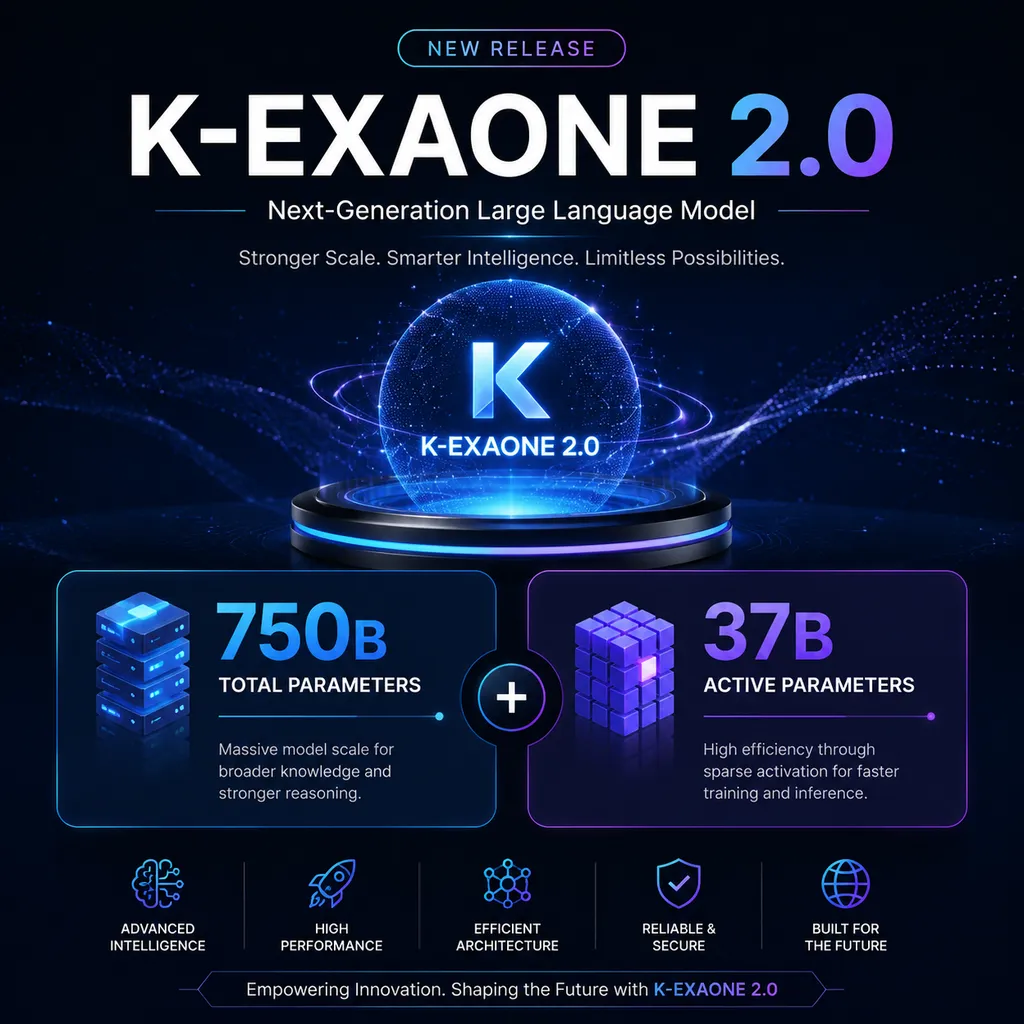
On July 31, LG AI Research released K-EXAONE 2.0 on Hugging Face. With 750B total parameters and 37B activated per inference pass, the model is more than three times larger than the first-generation K-EXAONE and is now the largest AI foundation model in South Korea.
More notably, LG has not kept the model locked inside the company or made it available only through a cloud API. Instead, it has released the model under the Apache 2.0 license. For developers and businesses, this means the model can be studied, modified, and used in commercial projects without the common “research only” restriction or additional commercial licensing requirements—at least from a licensing perspective.
K-EXAONE 2.0 is the second-generation model developed under the “Sovereign AI” foundation model project led by South Korea’s Ministry of Science and ICT. Its objective is clear: South Korea does not want to be merely an application market for overseas large models. It wants a foundational model that domestic companies can deploy, fine-tune, and continue training.
750B Is Huge, but Only 37B Is Used at a Time
K-EXAONE 2.0 uses a hybrid-attention Mixture-of-Experts (MoE) architecture. To understand the model, it is important to distinguish between two figures: 750B is the total parameter count, while 37B is the number of activated parameters that actually participate in computation when processing each token.
Think of it as a large consulting firm with 7,500 experts. The firm has an extensive knowledge base, but when it receives a specific question, it does not bring everyone into the meeting. Instead, a routing system selects the roughly 370 most relevant experts. This is the value of MoE: it allows model capacity to keep expanding without making inference costs grow linearly with the total parameter count.
The first-generation K-EXAONE had 236B total parameters and 23B activated parameters. The second generation expands the total parameter count to 750B—more than three times the original—while increasing activated parameters only from 23B to 37B, or roughly 1.6 times. In other words, LG’s most aggressive expansion is in “knowledge capacity,” not in the theoretical amount of computation per token.
The core specifications can be summarized as follows:
K-EXAONE 1st generation: 236B total parameters / 23B activated parameters
K-EXAONE 2.0: 750B total parameters / 37B activated parameters
Total parameter growth: More than 3x
Activated parameter growth: Approximately 1.6x
Open-source license: Apache 2.0
This does not mean that deploying a 750B MoE model requires storing only 37B parameters. Although only some experts participate in computation during inference, the complete weights generally still need to be stored in GPU memory, system memory, or tiered storage. Routing and cross-device communication between experts are also required. The 37B figure mainly determines the amount of computation per step, while 750B determines the difficulty of weight storage and multi-GPU scheduling.
Therefore, although K-EXAONE 2.0 is open source, it is not a model that ordinary developers can download and run on a single consumer GPU. Even with low-bit quantization, 750B weights still require considerable storage. Achieving high throughput and low latency also requires handling expert parallelism, tensor parallelism, GPU memory bandwidth, and inter-node communication.
The model’s earliest practical users will most likely be research institutions with multi-GPU servers, cloud service providers, and organizations in finance, manufacturing, and the public sector that require on-premises deployment—not individuals with personal workstations.
Benchmark Gains Come From More Than “Adding Parameters”
According to results disclosed by LG, K-EXAONE 2.0 achieved an average score of 70.1 across 24 benchmarks, compared with 63.3 for the first-generation model. On a relative basis, this represents an improvement of more than 10%. Across three major coding and agentic coding benchmarks, performance improved by approximately 30%.
This improvement has more practical significance than the title of “South Korea’s largest model.”
Expanding a large model from 236B to 750B total parameters is not unusual. The real challenge is making the additional experts work effectively. If MoE routing is not trained adequately, some experts may remain overloaded while others are barely used. The model may look larger without delivering a corresponding increase in capability. The across-the-board gains on 24 benchmarks at least suggest that LG did more than mechanically scale up the model. Its training data, routing strategy, attention architecture, or post-training process were likely adjusted systematically.
The roughly 30% improvement in coding and agentic coding also aligns with the direction of current model competition. Vendors are no longer competing only on chatbot leaderboards. They are now focused on whether models can understand large codebases, modify code across multiple files, invoke search and terminal tools, and verify their own results over multiple execution rounds.
For an agent to complete a task such as “identify the fault, modify the code, run tests, and continue fixing issues based on the error messages,” it needs long-context processing, structured instruction following, code generation, and tool-use capabilities. If any one of these components is unreliable, the task may fail midway. LG’s emphasis on coding and tool-use capabilities indicates that K-EXAONE 2.0 is not aimed merely at being a Korean-language chatbot, but rather a foundation model that can be more readily integrated into enterprise workflows.
Comparisons With Chinese Models Should Be Taken With a Grain of Salt
In cross-model tests published by LG, K-EXAONE 2.0 outperformed GLM-5.1 in long-context understanding; surpassed both GLM-5.1 and Qwen3.5 in agentic tool use; and delivered instruction-following performance comparable to GLM-5.1, DeepSeek V4 Pro Max, and Qwen3.5.
If these results can be reproduced in independent testing, K-EXAONE 2.0 would be more than the leading domestic model in the South Korean market—it would have entered the competitive tier of Asia’s top open-source models. Tool use is particularly important because it directly affects whether a model can connect to browsers, databases, code execution environments, and internal enterprise systems. It is also crucial for moving agentic products from demonstrations into production.
However, benchmark scores provided by vendors at launch should not be treated as equivalent to real-world production performance. Four questions deserve particular attention:
- What precision, inference framework, and prompt templates were used in testing?
- Were all models given the same tool descriptions, context budgets, and retry limits?
- Did the coding tasks include problems that may have appeared in the training data?
- Did the long-context tests measure information retrieval, or cross-section reasoning and sustained execution?
MoE models are also more sensitive to inference configurations. With the same weights, different routing implementations, quantization methods, and parallelization strategies can produce significant differences in speed and output quality. LG’s results demonstrate the model’s upper bound, but developers will need to wait for the community to provide additional tests covering throughput, GPU memory usage, quantization loss, and real-world multilingual tasks.
In other words, K-EXAONE 2.0 has earned a seat at the table, but whether it can consistently outperform GLM, Qwen, or DeepSeek cannot be determined from a few columns of scores in launch materials alone.
“Sovereign AI” Is the Central Theme of This Release
K-EXAONE 2.0 was supported by the Sovereign AI Foundation Model Project of South Korea’s Ministry of Science and ICT. Sovereign AI does not simply mean hosting servers within a country. It means ensuring that a country retains sufficient autonomous control over model weights, training data, computing infrastructure, and industrial applications.
South Korea’s need for this capability is easy to understand. Korean has an honorific system, complex verb endings, and expressions that depend heavily on context. Local laws, manufacturing terminology, and corporate organizational structures are also difficult to cover organically with English-language data. General-purpose international models may “support Korean,” but supporting a language is not the same as building high-quality training data and evaluation systems around it.
This is also where LG has an advantage. It is not a startup focused solely on models, but part of an industrial conglomerate spanning electronics, chemicals, telecommunications, manufacturing, and other sectors. If the model can be integrated into R&D, supply chains, customer service, equipment maintenance, and materials analysis, its value may emerge first not in consumer chat products, but in more specialized enterprise scenarios that are harder for outside observers to see.
The Apache 2.0 release also ensures that this sovereign model does not remain confined to a government project. South Korean universities can study it, local software companies can create quantized versions, domain-specific fine-tunes, and inference services around it, and enterprises can evaluate it in controlled environments without sending sensitive data to overseas proprietary APIs.
This is what makes K-EXAONE 2.0 more important than merely setting a new parameter-count record: for the first time, South Korea has produced a foundation model with an internationally competitive posture in scale, licensing, and publicly reported benchmark performance.
Open Source Does Not Mean an Ecosystem Already Exists
Of course, uploading the weights to Hugging Face is only the first step. Whether a large model is actually adopted by developers also depends on engineering details beyond the model itself.
Developers will need to watch the following:
- Whether major inference frameworks can quickly provide stable support, especially for expert parallelism and multi-node deployment;
- Whether usable FP8, INT8, or lower-bit quantized versions become available, and how much capability is lost after quantization;
- Whether the model’s chat templates, tool-calling formats, and structured outputs are stable;
- Whether LG continues to disclose training methods, evaluation configurations, and known limitations;
- Whether the community can build fine-tuning datasets and derivative models for Korean, English, and other languages.
The barrier to entry for a 750B MoE model is high. Without a mature inference stack, the model may remain accessible only to a small number of laboratories and cloud providers despite its permissive license. By comparison, smaller models that can run on a single machine or a limited number of GPUs often find it easier to accumulate applications, plugins, and fine-tuned variants.
For now, K-EXAONE 2.0’s clearest strengths are its capacity, benchmark performance, and open license. Its clearest weakness is deployment cost. It proves that LG can train a large MoE model, but it has not yet proved that the model can serve users at scale at a sufficiently low cost.
A Meaningful Ticket to the Table
Overall, K-EXAONE 2.0 is not an ordinary “large-parameter release” relying on the 750B figure to generate attention. Its 37B activated parameters show that LG is attempting to balance capacity with inference cost. Its improvements in coding, long-context processing, and tool use also align closely with the agentic use cases that developers currently care about. Meanwhile, the Apache 2.0 license gives the community room to continue optimizing and commercializing the model.
It is not yet a model that everyone can deploy, and there is not yet enough independent evaluation to prove that it comprehensively outperforms Chinese models. But for South Korea’s AI industry, it is already a meaningful ticket to the table: the country now has its largest domestic foundation model and has chosen to bring it into the global open-source ecosystem, where it can be tested against developers’ real-world workloads.
What determines K-EXAONE 2.0’s future influence will not be whether its parameter count can grow further, but whether the community can make this enormous model cheaper and more stable to run, and whether LG can continue delivering models, tooling, and transparent evaluations. Parameter records last only for a while; ecosystems determine how far an open-source model can go.
References
- ITHome: South Korea’s Largest AI Foundation Model—LG AI Research Releases the 750B-Parameter K-EXAONE 2.0—Provides the model’s release date, architecture, parameter scale, license, and major benchmark results.
- Linux.do: Discussion of the K-EXAONE 2.0 Release—A community repost and discussion of the model’s specifications and release information.