
3,000 lines of code beat 500,000 lines — Fudan’s GenericAgent is open source
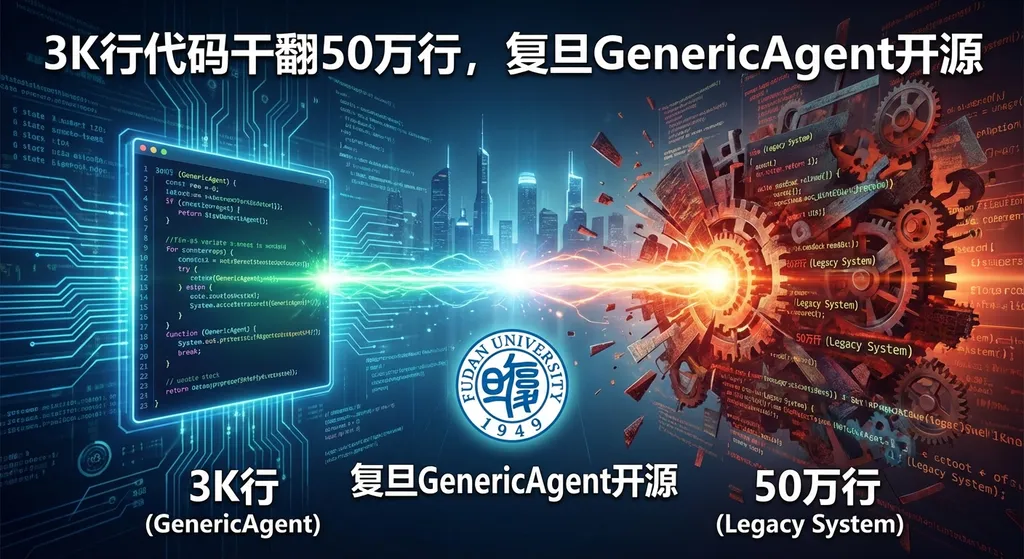
Fudan University and Shenzhen-based company KuaKua Qingling have jointly open-sourced the self-evolving intelligent agent **GenericAgent**. With only about 3,300 lines of code, it achieves self-organization, self-learning, and self-evolution capabilities. Token consumption has been reduced sixfold, and it can now autonomously control a browser, post on social media, and even interact with humans.
Fudan University’s Knowledge Factory Lab, together with Shenzhen-based company KuaKua Elite, has officially open-sourced a project called GenericAgent, a self-evolving general-purpose intelligent agent. The project quickly attracted attention within the developer community for a simple reason — it consists of only about 3,300 lines of code, with its core modules containing just a few hundred lines, yet it delivers capabilities that traditional agent architectures typically need around 500,000 lines of code to achieve.
This is not just another wrapper. At the architectural level, it’s doing something genuinely worth examining.
First, what exactly can it do?
GenericAgent is positioned as a “self-evolving general-purpose agent,” with three key attributes: self-organization, self-learning, and self-evolution. Specifically, it can:
- Read the screen autonomously and understand the UI elements and content displayed
- Control keyboard and mouse like a human — clicking, typing, scrolling
- Write and execute code
- Browse and interact with the web autonomously
- Even post updates on social media and interact with users
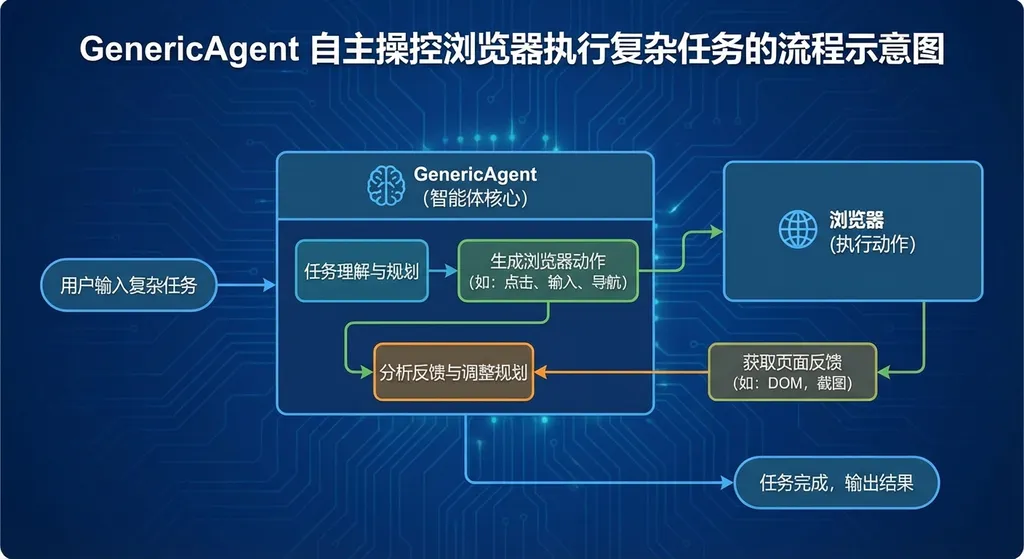
Indeed, the Fudan team demonstrated a scenario where GenericAgent autonomously posted on a social feed and interacted with friends. This might sound like a gimmick, but what it really showcases is the agent’s full mastery of complex GUI operation chains — from identifying interface elements and understanding interaction logic to planning operation steps and handling feedback, all done automatically.
3,300 lines of code — how is that possible?
This is the most interesting part.
Traditional agent frameworks such as early AutoGPT and BabyAGI, or later various Agent frameworks, often face a major issue: to cover enough scenarios, the codebase expands dramatically, modules become tightly coupled, and maintenance costs skyrocket. Many of these frameworks run into tens or even hundreds of thousands of lines of code, making them difficult to read or extend.
GenericAgent takes the opposite route — pursuing radical simplicity. Its core design philosophy can be summarized as:
Shift complexity from code to semantics.
In practice, GenericAgent uses Markdown and a semantic file system to enable continuous model learning. Instead of hardcoding logic into source files, it defines operational standards (SOPs), memory storage, and skill descriptions through structured Markdown documents. The code only handles the core scheduling and execution logic, while the “knowledge” and “experience” are stored semantically in documents.
This leads to a major advantage: small codebase = contextual advantage.
What does 3,300 lines of code mean? It means you can feed the entire project directly into a large model — letting the model fully comprehend its architecture and logic. For any developer, reading and understanding the entire codebase in an afternoon is achievable. This would be unimaginable with frameworks containing hundreds of thousands of lines.
Its memory and skill system is also quite interesting. Based on the repository structure, it maintains a dedicated memory/ directory containing various SOP guides, such as:
tmwebdriver_sop.md— standard procedures for Web driver operationsljqCtrl_sop.md— operational guidelines for control logic
These SOP documents essentially serve as the agent’s “muscle memory.” When encountering a new scenario, the agent can consult existing SOPs to plan its actions; when it masters new skills, it can consolidate that experience into new SOPs. This is the meaning of “self-evolution” — not through model retraining, but through continuous accumulation and refinement of operational knowledge.
Sixfold reduction in token consumption — what this means
For developers actually running agent tasks, token consumption is a very real concern.
Current mainstream Agent frameworks often require a huge number of tokens to maintain context, perform multi-round reasoning, and execute tool calls. Even moderately complex browser operation tasks can easily consume tens or hundreds of thousands of tokens. According to GPT-4o or Claude pricing, this could cost several dollars per run.
GenericAgent claims to reduce token consumption by six times. If accurate, this means the same task drops from several dollars to less than one — a qualitative shift for teams aiming to deploy agents at scale. It turns agents from “toys” into “usable tools.”
This reduction mainly stems from its minimalist architecture and improved contextual efficiency. Less code means shorter system prompts; highly structured SOP documents boost retrieval efficiency; and the system avoids repeatedly loading massive contextual information for every execution. It’s a simple yet effective optimization.
Developers running agent tasks via API can use OpenAI Hub — one key granting access to GPT, Claude, Gemini, DeepSeek, etc., with OpenAI-format compatibility, allowing flexible model switching based on task characteristics to further optimize costs. Simpler UI recognition tasks can use cost-effective models, while complex reasoning can switch to Claude or GPT-4o.
A typical example call:
from openai import OpenAI

client = OpenAI(
    api_key="Your OpenAI Hub Key",
    base_url="https://api.openai-hub.net/v1"
)

# Use Claude for complex task planning
planning_response = client.chat.completions.create(
    model="claude-sonnet-4-20250514",
    messages=[
        {"role": "system", "content": "You are a task-planning agent. Decompose the user's goal into actionable steps."},
        {"role": "user", "content": "Open a browser, search for the latest AI papers, and compile their summaries."}
    ]
)

# Use DeepSeek for cost-effective subtask execution
execution_response = client.chat.completions.create(
    model="deepseek-chat",
    messages=[
        {"role": "system", "content": "Based on the following steps, generate specific browser control instructions."},
        {"role": "user", "content": planning_response.choices[0].message.content}
    ]
)
This “plan with strong models, execute with light ones” hybrid strategy — combined with GenericAgent’s low-token architecture — keeps operational costs impressively low.
Browser control: Chrome plugin + CDP Bridge
One of GenericAgent’s standout features is its web control capability. The project provides a Chrome plugin (in the assets/tmwd_cdp_bridge directory) that uses the Chrome DevTools Protocol (CDP) for fine-grained browser control.
CDP is Chrome’s underlying debugging protocol, also used by tools like Puppeteer and Playwright. By directly integrating through the CDP Bridge, GenericAgent can:
- Retrieve page DOM structures and rendering data
- Simulate real user input events
- Capture screenshots for visual understanding
- Intercept and modify network requests
Interestingly, developers in the community have started discussing how to “distill” GenericAgent’s web control code for use with Claude Code — essentially transferring GenericAgent’s accumulated browser operation knowledge and SOPs into a format usable by another agent. This kind of cross-agent knowledge transfer validates the portability of GenericAgent’s semantic memory system.
How does it compare to similar projects?
The agent space is crowded. Let’s make a quick comparison:
| Project | Code size | Core feature | Token efficiency | Learning curve | |----------|------------|---------------|------------------|----------------| | GenericAgent | ~3.3K lines | Self-evolving, semantic memory | High (6× optimized) | Low | | AutoGPT | Tens of thousands | General autonomous agent | Medium | Medium | | OpenInterpreter | A few thousand | Code execution focused | Medium | Low | | Browser Use | A few thousand | Browser automation | Medium | Low | | Claude Code | Closed-source | Coding assistant agent | High | Low |
GenericAgent stands out as both minimal and general-purpose. Most minimalist projects only handle narrow scenarios (e.g., browser control or code execution), while GenericAgent’s semantic SOP system theoretically allows expansion to any context.
That said, the project is still at an early stage. Developers in the community have commented “marking this, waiting for updates,” showing recognition of its potential but cautious optimism regarding maturity. How far its “self-evolution” can go and how stable it remains under real-world complexity remain open questions.
Key takeaways for developers
-
The philosophy of minimalist architecture is worth studying. Even if you don’t use GenericAgent, its principle of “shifting complexity from code to semantics” is valuable. In the era of large models, traditional software engineering paradigms are being reconsidered — less can indeed be more.
-
The SOP-driven self-evolution mechanism holds promise. If agents truly improve by accumulating SOPs, their growth curve could become steep. Each user interaction adds experience, forming a positive feedback loop.
-
Token optimization is critical for production viability. A sixfold reduction, if consistently validated, could make previously cost-prohibitive agent applications feasible.
-
Cross-agent knowledge transfer is an intriguing direction. The community’s experiments in distilling GenericAgent’s knowledge for other agents hint at a future ecosystem where agents don’t just compete — they learn from each other.
In conclusion
With just 3,300 lines of code, Fudan’s team has demonstrated an important truth: in the era of large models, an agent framework’s core competitiveness lies not in sheer code volume but in architectural elegance and effective integration with LLM capabilities.
Of course, open-source projects gain real value through community validation. Whether GenericAgent can evolve from “eye-catching concept” to “truly useful tool” depends on its iteration speed and ecosystem growth.
But for now, it provides an excellent reference point: agent frameworks don’t necessarily need to grow heavier — sometimes, returning to simplicity helps them go further.
References
- GenericAgent community discussion thread – Linux.do — Developers share their technical insights and experience using GenericAgent


