Inkling-Small: Smaller, Yet Stronger

Thinking Machines Lab releases the full weights of Inkling-Small. This 276B MoE model activates only 12B parameters, yet outperforms the 975B Inkling on some reasoning and agent benchmarks.
Inkling-Small: Smaller, Yet More Powerful
Thinking Machines Lab officially released Inkling-Small on July 30, making the full model weights available. The model has 276B total parameters but activates only 12B during inference. Despite this, it approaches—and even surpasses—the 975B-parameter Inkling across multiple reasoning, tool-use, and instruction-following benchmarks.
This is the first time Inkling-Small has truly become available to developers since it was previewed alongside Inkling in mid-July. The model is now integrated into Thinking Machines' Tinker fine-tuning service, while text, image, and audio interactions are also available in Tinker Playground.
Judging by parameter count alone, Inkling-Small may look like a compressed version of Inkling. But based on the officially published results, it is closer to a reformulated iteration: it retains the original model's long-context, multimodal, and variable-reasoning capabilities while using an improved pretraining dataset and training methodology to make more efficient use of a smaller compute budget.
276B Is Not Small—the Key Is That Only 12B Are Used at a Time
Inkling-Small continues to use Inkling's mixture-of-experts architecture, or MoE. Although the model has 276 billion parameters, it does not invoke all of them when processing each token. Instead, a routing mechanism selects a subset of experts to participate in the computation, resulting in 12 billion parameters being activated in practice.
It can be thought of as a consulting firm with a large number of specialized teams. Whenever a task arrives, the entire company does not need to attend the meeting; the problem only needs to be assigned to the most relevant teams. The firm's overall knowledge capacity remains large, but the computational cost of each task depends on how many people actually participate.
The core specifications of Inkling and Inkling-Small are as follows:
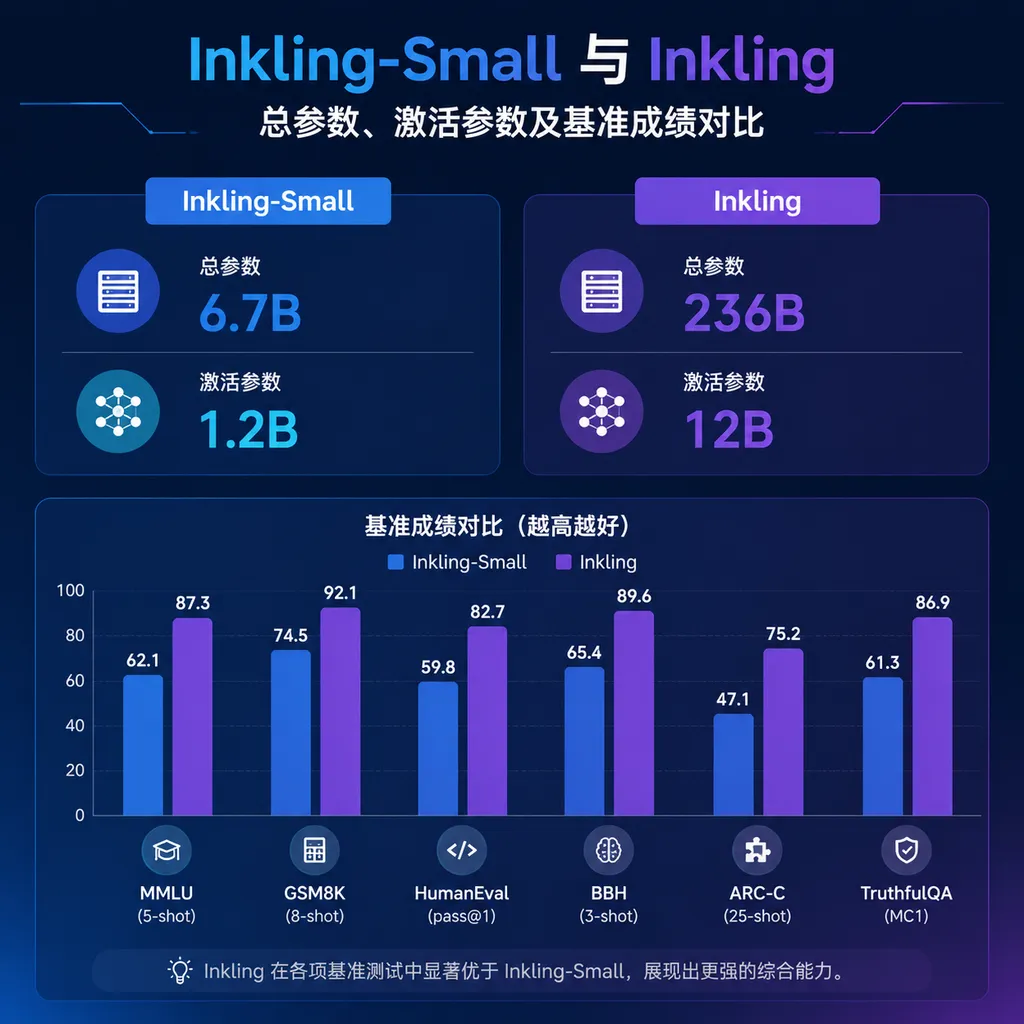
| Model | Total Parameters | Activated Parameters | Maximum Context | Input Modalities | | --- | ---: | ---: | ---: | --- | | Inkling | 975B | 41B | Up to 1M tokens | Text, images, audio | | Inkling-Small | 276B | 12B | Up to 1M tokens | Text, images, audio |
The company describes Inkling-Small as being roughly one-quarter the size, a characterization that works better as product positioning than as a strict mathematical conclusion. At 276B, it is about 28% the size of 975B, while 12B is about 29% of 41B. It is indeed significantly smaller, but it remains far from what ordinary developers would call a "small model."
The 12B activated parameters of an MoE model also cannot be directly equated with a dense model containing only 12B total parameters. Fewer parameters participate in matrix computations during inference, but all expert weights must still be stored and scheduled. VRAM capacity, inter-GPU communication, expert parallelism, and routing efficiency all affect the actual deployment cost.
In other words, Inkling-Small reduces the primary compute required per token; it does not magically turn 276B weights into a 12B model that fits comfortably on a consumer GPU. The fact that it was trained on NVIDIA GB300 NVL72 systems also indicates that it remains a data-center-class model.
Fewer Parameters, Yet a 1.9-Percentage-Point Lead on HLE
Among the results published by Thinking Machines, the most striking is Humanity's Last Exam. Inkling-Small scored 31.6%, compared with Inkling's 29.7%—a lead of 1.9 percentage points.
The company also states that Inkling-Small's test-time compute curve remains above Inkling's across different reasoning budgets. This means that when the two models receive similar inference-token or compute budgets, the smaller model achieves higher test scores rather than merely catching up with the larger model by thinking for longer.
Inkling-Small demonstrates greater efficiency in tasks such as agentic tool use, reasoning, and instruction following as well. On some reasoning and agent benchmarks, it matches or exceeds Inkling while competing with other models in a similar weight class.
This does not mean that a 276B model has defeated a 975B model across every capability. A single benchmark can easily be affected by training-data distribution, prompt templates, sampling parameters, and evaluation procedures, while internal evaluations cannot replace independent testing. The 1M-token long context, multi-turn tool-use stability, non-English capabilities, and audio performance in particular still require further validation by the community now that the weights are available.
Still, the existing results at least demonstrate an increasingly clear trend: model capability is not determined by parameter count alone. Data quality, data mixture, training curriculum, routing design, and post-training methods can entirely offset a several-fold difference in parameter count.
Thinking Machines' explanation points in the same direction. Inkling-Small uses improved pretraining data and a revised training recipe, while both models share a scalable post-training stack. It is not an Inkling model that has mechanically had three-quarters of its parameters cut away, but a smaller version retrained using lessons learned from training the larger model.
What Really Matters Is the Cost Curve, Not Being the "Best Small Version"
The most noteworthy aspect of Inkling-Small is not another attractive leaderboard score, but its attempt to shift the cost curve of high-capability MoE models downward.
In real-world applications, models are often not called upon to answer one-off difficult questions. Instead, they repeatedly perform large volumes of moderately difficult tasks, such as:
- Coding agents continuously reading repositories, modifying code, and running tests;
- AI evaluators assessing response quality and instruction adherence in batches;
- Synthetic-data pipelines continuously generating, filtering, and rewriting training samples;
- Enterprise agents reading long documents and orchestrating operations across multiple internal tools;
- Multimodal systems analyzing screenshots, charts, or audio and then producing structured text.
In these scenarios, a few hundred milliseconds of latency and the cost per million tokens can add up to substantial infrastructure spending. If Inkling-Small can maintain a task success rate close to Inkling's while activating only 12B parameters, its value is not that "the model is four times smaller," but that the same budget can support more rounds of inference, tool use, or data generation.
Variable reasoning intensity is therefore more practical than a high score alone. Developers can assign smaller reasoning budgets to simple classification tasks and reserve compute for code repair, complex planning, or long chains of tool calls. Compared with using the highest reasoning setting for every request, this capability translates more readily into a means of controlling costs in production environments.
However, the company currently emphasizes computational efficiency, while actual throughput cannot be assessed solely by activated parameter count. If an MoE model experiences uneven expert loads or cross-node communication bottlenecks, or if the inference framework is not optimized for its routing method, system overhead may consume its theoretical computational advantage. The truly persuasive data going forward should include VRAM usage at different quantization levels, time to first token, sustained generation speed, concurrent throughput, and long-context costs.
1M Context and Native Multimodality Remain Intact
Inkling-Small does not sacrifice Inkling's primary product capabilities in order to reduce its size. It still supports a context window of up to 1 million tokens and can natively process text, image, and audio inputs before generating text output.
The word "natively" is important here. It means that image analysis, chart comprehension, and audio transcription are not handled merely by attaching a separate recognition model and feeding its results back into the language model. Instead, they are incorporated into the same model capabilities and post-training process. For agents that need to understand meeting recordings, screenshots, and long documents simultaneously, this makes it easier to maintain contextual consistency than stitching together multiple models.
However, the 1M-token context should be regarded as a capacity limit rather than a performance guarantee. The ability to accept 1 million tokens does not mean the model can reliably locate every detail within that range, nor does it mean every request should fill the entire context window. Long contexts increase initial processing time, cache usage, and inference costs, so production systems still need retrieval, summarization, chunking, and context management.
Inkling-Small is therefore better positioned not as an "unlimited-memory model," but as a foundation model that allows developers to process extremely large code repositories, document collections, or multimodal records when necessary.
Full Weights Are Available, but It Cannot Yet Simply Be Called Fully Open Source
Thinking Machines has released the full weights for Inkling-Small, allowing developers to evaluate, fine-tune, and integrate the model themselves rather than being restricted to a vendor API. The model's simultaneous addition to the Tinker fine-tuning service makes the company's strategy clear: attract developers with open weights, then serve their training needs through a managed fine-tuning and experimentation platform.
However, "open weights" and "open source" are not exactly the same concept. Determining whether a model is truly open source also requires examining whether its license permits commercial deployment, redistribution, and the release of derivative models, as well as the extent to which the training code, data composition, and training process are disclosed. For enterprise users, downloading the weights is only the first step; license review and deployment compliance are equally important.
From a competitive standpoint, Inkling-Small does not automatically become a new open-source benchmark merely because it comes from a US team. The open-model market is evolving rapidly, and Chinese model vendors have already become highly competitive in reasoning, coding, long-context capabilities, and deployment costs. Thinking Machines' own materials on Inkling also do not claim that the model comprehensively leads both closed and open models across every dimension.
Therefore, "a smaller version of America's strongest open-source model" is more of an attention-grabbing label. What Inkling-Small truly needs to prove is whether it can consistently deliver a better performance-to-cost ratio than peer models in independent evaluations, real-world serving throughput, and fine-tuning usability.
This Release Matters More to the Industry Than Simply Adding Parameters
Over the past two years, foundation-model releases have routinely used larger total parameter counts to generate attention. But in the MoE era, parameter-count figures have become increasingly easy to misinterpret. Developers need to consider at least four sets of numbers simultaneously: total parameters determine weight capacity, activated parameters affect per-token compute, context length defines request boundaries, and real-world throughput determines the final bill.
The significance of Inkling-Small lies precisely in the fact that it does not treat "smaller" as synonymous with a simple downgrade. Its 276B total parameters still provide substantial expert capacity, its 12B activated parameters reduce per-request computation, and its updated data recipe and post-training restore capability. This approach is closer to what the industry needs than continuing to push total parameter counts into the trillions.
Of course, it is still too early to declare it a drop-in replacement for a much larger model. The official benchmarks require third-party replication, the hardware threshold for hosting the full weights remains high, and its audio, multilingual, long-context, and high-concurrency serving capabilities have yet to be thoroughly tested.
But if community testing confirms its advantages, Inkling-Small will offer model teams a very direct lesson: training a smarter, more deployable midsize MoE may be more useful than building yet another parameter-count record holder.
As of July 31, Inkling-Small has moved from preview to a full-weight release. What determines its standing from here will not be the number 276B, nor the label "a smaller Inkling," but how many GPUs developers actually save after deploying it in coding agents, evaluation pipelines, and synthetic-data systems—and whether its task success rate can withstand long-term operation.
References
- ITHome: Inkling-Small Debuts, Delivering Similar AI Performance at Roughly One-Quarter the Scale—Covers the model's release, parameter configuration, open-weight availability, and official benchmark results.