Fei-Fei Li Acquires Robot Training Facility

World Labs acquires robotics simulation company SceniX and launches the R2S2R training and evaluation engine. The race for physical AI data is shifting from collecting more real-world trajectories to generating interactive, verifiable worlds.
Fei-Fei Li Buys a Robot Training Ground
World Labs is officially moving into robot training.
The spatial intelligence company founded by Fei-Fei Li announced on July 21 that it had acquired robotics simulation startup SceniX. On July 28, it revealed the first technical result of the companies' integration: R2S2R, a scalable engine for training and evaluating robot policies. The transaction value and specific terms have not been disclosed.
This is not simply an acqui-hire, nor is it merely an attempt to bolt a physics engine onto an existing world model. World Labs wants to advance from "generating a realistic-looking 3D world" to "generating a world that a robot can enter, interact with, make mistakes in, and continue learning from."
If the defining theme of physical AI over the past two years has been data collection, the next phase of competition may come down to who can create more "useful worlds" at lower cost. Here, "useful" does not mean merely photorealistic. It means doors can be pushed open, ropes deform under force, cups collide with the floor when dropped, and every action taken by a robot receives credible feedback.
From Marble to SceniX, World Labs Adds the Missing "Physics"
World Labs was previously best known for world-generation technologies represented by Marble: models that build explorable 3D spaces from text, images, or other inputs, allowing users not merely to watch a video but to move through a generated environment and observe the scene from different perspectives.
For robots, however, a space that merely "looks right" is far from enough.
Even a visually convincing scene may not be suitable for training a robotic arm. A cardboard box on a table may be nothing more than a texture, with no mass, coefficient of friction, or articulated structure. A rope may appear to sway without actually obeying stable laws of dynamics. If a robot trains in such an environment, it can easily learn opportunistic strategies that work only in the simulator and immediately fail in the real world.
This is precisely the layer that SceniX supplies.
The company does not manufacture humanoid robots or compete in complete robot systems. Instead, it creates virtual training and testing environments for robots, covering interactive data generation, policy training, performance evaluation, and testing for failures and extreme conditions before real-world deployment. The question it seeks to answer is not "What does the room look like?" but "How does the world change after the robot nudges a cup?"
SceniX's founding team spans computer graphics, 3D vision, and robot learning. In its published research, PhysTwin attempts to reconstruct interactive digital twins of deformable objects from sparse video, while BoxTwin learns the dynamics of complex objects that exhibit both articulated motion and material deformation. These are precisely the kinds of objects that traditional simulation struggles with: rigid blocks are easy to model, but boxes filled with miscellaneous items, flexible hoses, and containers that deform under force are difficult to calibrate manually, parameter by parameter.
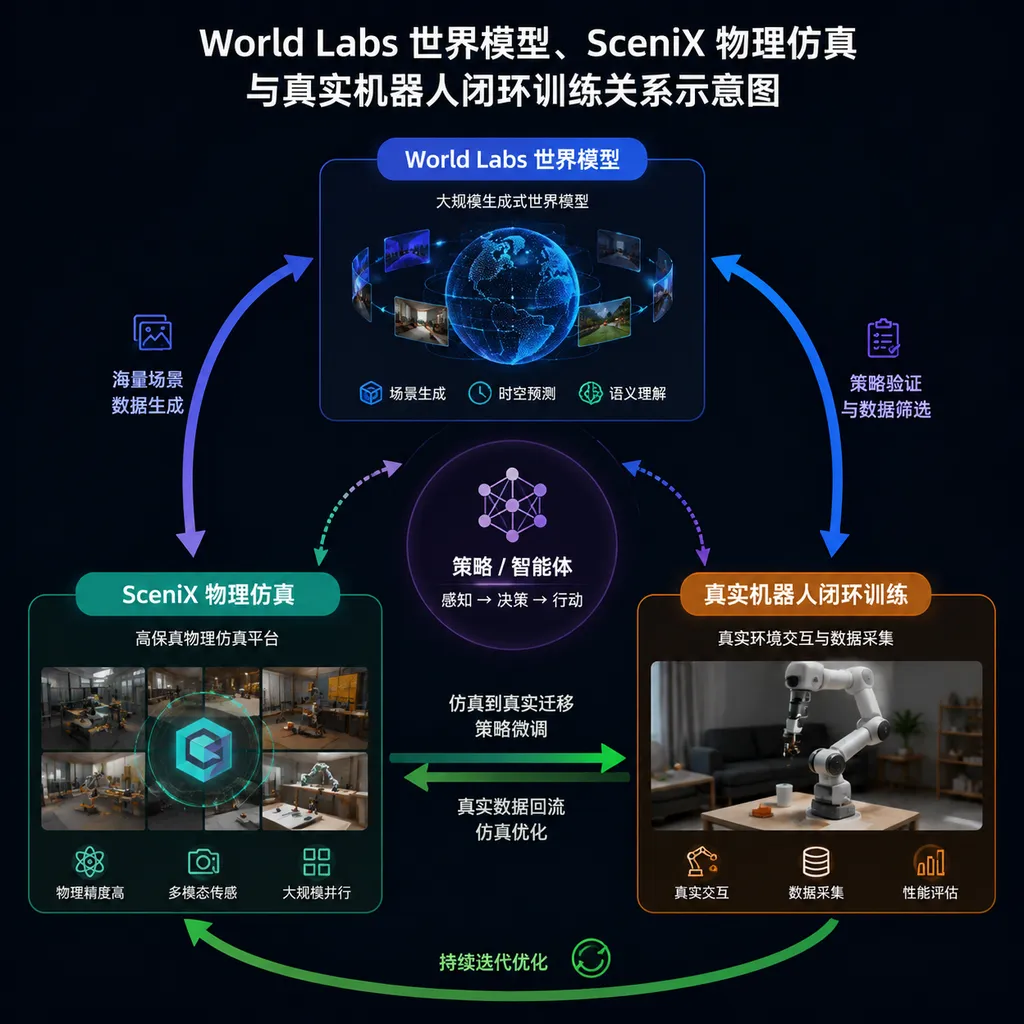
The logic behind the acquisition is therefore clear: World Labs generates and understands spaces, while SceniX gives objects within those spaces learnable, interactive physical states. Only by combining the two do they approach a world model capable of genuinely training robots.
R2S2R: Not Simply Replicating Reality
R2S2R, the first system unveiled following the integration, can be understood as Real-to-Sim-to-Real: moving from the real world into simulation, then deploying trained and screened policies back into the real world.
It broadly consists of four consecutive stages:
- Reconstruct scenes from videos, images, sensor data, and limited interactions captured in real environments;
- Generate different object layouts, initial states, and disturbances within the simulated environment;
- Train and evaluate robot policies at scale, exposing failure modes in advance;
- Deploy the policies to real hardware, then use real-world execution results to refine the simulation and models.
The key is not the name of the process, but whether the final stage truly closes the loop.
Traditional simulation often follows a "model once, use indefinitely" approach. Engineers first construct a digital scene by hand and then have robots train repeatedly within it. Once the real factory changes its packaging materials, lighting, or fixtures, the gap between simulation and reality continues to widen.
R2S2R takes a different approach: real-world data is no longer merely a training set; it also calibrates the generator and validates the simulation. New failures encountered by robots in the real world are fed back into the virtual environment to create new training scenarios. Weaknesses discovered in simulation are then subjected to limited validation on real hardware.
Therefore, "shifting from collecting data to creating worlds" does not mean that real-world data is no longer important. Quite the opposite: its role has changed—from fuel that must be accumulated endlessly into a benchmark used to calibrate, constrain, and validate generated worlds.
This resembles the evolution of data for large language models. Early competition centered on who could scrape more of the web; later, the industry began relying on synthetic data, reinforcement learning, and automated verification. Physical AI is harder, however. Whether a piece of text is acceptable can be judged by rules or models, but whether a robot action is safe and effective must ultimately obey the real world's geometric, material, and dynamic constraints.
The Value of Simulation Lies Not in How It "Looks," but in Whether It Predicts Real-World Performance
In the experiments disclosed by World Labs, each robot-policy checkpoint underwent 2,000 trials in simulation: 1,000 in-distribution tests and 1,000 out-of-distribution tests. The corresponding real-world evaluation consisted of 100 trials, including 50 in-distribution and 50 out-of-distribution tests.
In other words, most screening can be completed in simulation first, with simulated trials conducted at 20 times the scale of real-world trials. According to the results presented by the company, policy success rates in simulation were highly correlated with performance on real hardware. The relative rankings among policies were also preserved, and the spatial distributions of certain successes and failures were consistent across both environments.
This matters far more than a video showing "a robot opening a drawer in a virtual kitchen."
The real question robotics simulation must answer is not whether its visuals can fool the human eye, but whether it can help R&D teams make decisions. For example, if Policy A outperforms Policy B by eight percentage points in simulation, does it remain superior after deployment on real hardware? If training plateaus at 100,000 steps, does the same plateau occur in reality? Do the table corners where the robot frequently fails in simulation correspond to risky areas in the real environment?
As long as simulation can reliably preserve these relative relationships, it has engineering value. It may not need to replicate reality frame by frame, but it can narrow 100 candidate policies down to five, reserving the most expensive and dangerous hardware experiments for the final round.
However, the currently disclosed results still resemble a technical preview more than a comprehensive product validation.
World Labs has not yet provided systematic benchmarks spanning more robot embodiments, task categories, and complex environments. Nor has it disclosed specific correlation metrics, simulation costs, training throughput, or customer deployments. Sim-to-real correlations across a small number of tasks do not directly prove that the system can generalize to warehouses, homes, outdoor environments, and industrial production lines.
A more practical concern is that robot failures usually occur under long-tail conditions: transparent or reflective materials, severe occlusion, sensor drift, actuator wear, and interactions among multiple deformable objects. The more freely worlds are generated, the harder it becomes to maintain consistent physical states. A world that looks plausible but is physically incorrect may be more dangerous than a simple traditional simulator because it can more easily lead developers to misjudge a policy as production-ready.
Why Robotics Companies Are All Competing for "World Generators"
Robot training has long been constrained by three costs: real equipment is expensive, manual resets are slow, and dangerous scenarios are difficult to reproduce.
To teach a robotic arm to grasp an ordinary cardboard box, a research team can still have operators repeatedly reposition the object. But to train a robot to handle collapsing shelves, liquid spills, tire slippage, or people suddenly entering its path, it is impossible to manufacture accidents endlessly in the real world. Even when the data can be collected, the distribution of scenarios is often overly concentrated, causing the robot to memorize a particular laboratory rather than learn how to solve the task.
Generative world models offer another path to scaling: use limited real-world data to capture scene structure and physical cues, then automatically vary object positions, materials, lighting, task objectives, and disturbances to generate training and testing environments in bulk.
This could bring three changes to the infrastructure of physical AI:
- Data production shifts from recording reality to orchestrating it. Teams do not merely collect records of what robots have done; they actively generate the conditions under which robots are most likely to fail.
- Evaluation shifts from fixed test sets to dynamic adversarial testing. World models can continuously probe the boundaries of a policy rather than having robots repeat the same set of challenges.
- Models, simulators, and real robots are no longer separate. Generated environments pose the problems, policy models take action, and real robots provide the final feedback.
This is also the broader industry significance of World Labs' acquisition of SceniX: world models are no longer merely content-generation tools. They are becoming data engines, training grounds, and testing platforms within the robotics development stack.
The Next Competition Is Over Who Can Create More "Useful Worlds"
The physical AI industry broadly follows three approaches.
The first is to expand real-world data collection. Companies deploy more teleoperation equipment, robot farms, and real production lines, using human demonstrations to obtain high-quality trajectories. Such data is the most reliable, but it is expensive and slow to scale, while dangerous and rare events are particularly difficult to capture.
The second is to use traditional physics simulation. Engineers build environments using CAD, rigid-body engines, and manually configured parameters. The advantage is that these environments are controllable and interpretable; the disadvantage is that scene creation is costly, with limited coverage of soft bodies, complex contacts, and open-world settings.
The third is the generative approach on which World Labs and SceniX are betting: models reconstruct spaces and dynamics from real-world observations, automatically generate interactive scenes, and continuously calibrate them using feedback from real robots.
These three approaches will not replace one another. A more likely outcome is that a small amount of high-value real-world data will establish ground truth, traditional engines will provide explicit physical constraints, and generative models will expand scenario scale and long-tail coverage.
The real moat is not "how many rooms can be generated." A visual model can easily generate 10,000 kinds of kitchens, but if the resistance of every drawer is unreliable, those 10,000 kitchens offer almost no training value for robots. Physical AI needs worlds that satisfy four conditions simultaneously: credible spatial structure, interactive object states, verifiable dynamic outcomes, and a feedback loop from the real world.
The acquisition can therefore be summarized with a more direct formula:
Physical AI capability = Generative world model quality × Interactive physical states × Real-world closed-loop efficiency.
If any one of these factors approaches zero, the overall result rapidly collapses.
World Labs Must Now Prove It Has a Product
After completing a major funding round in February, World Labs already commands a sufficiently high valuation and correspondingly high market expectations. The acquisition of SceniX shows that the company is not content to remain a 3D content-generation platform. It wants to enter the more capital-intensive and challenging robot-training market, which is also more closely tied to real industrial spending.
This is the right direction. Compared with simply generating navigable 3D scenes, robot training has clearer customers, cost items, and performance metrics: whether it can reduce the number of tests on real hardware, detect failures in advance, and shorten deployment cycles for new tasks can all be quantified.
But it will also force World Labs out of the comfort zone of demo videos.
Robotics customers are unlikely to care whether a model can generate a beautiful living room. They care more about how much data must be collected to create a digital twin, how many days it takes to deploy a new production line, whether the simulator supports existing policy frameworks, and exactly how strong the correlation is between simulated evaluations and real-world failures. What will ultimately determine SceniX's value is not the sophistication of its academic concepts, but whether customers can avoid breaking a few robots and reduce production-line downtime by a few hours.
The acquisition therefore deserves attention, but it is too early to declare the physical AI data problem solved. What World Labs has demonstrated so far is a technical path: use generated worlds to expand the scale of training, use real-world feedback to constrain those generated worlds, and allow robots to learn continuously by cycling between the two.
The next stage will show whether R2S2R can expand from a handful of demonstration tasks to different hardware platforms, materials, and long-duration deployments. If it can, the robotics industry's data bottleneck will shift from "Do we have enough real-world trajectories?" to "Who has the most reliable system for generating and validating worlds?"
At that point, the leader may not be the company with the largest fleet of data-collection robots. It may instead be the company best at creating failures, explaining them, and automatically turning them into data for the next round of training.
References
Due to restrictions on linked domains, the official World Labs announcements and original Chinese-language reports are not linked directly here. Event dates, technical names, and experimental data have been cross-checked against World Labs' July 21 acquisition announcement, its July 28 technical blog post, and the materials cited in the source text.
- Zhihu: Search for content related to World Labs and SceniX — Used to review discussions in the Chinese-language community about the acquisition, world models, and robotics simulation.
- Reddit: Search for discussions related to World Labs and SceniX — Used to supplement public discussions among overseas developers about the transaction and its technical direction.