CausalVLBench Challenges Visual Causality

CausalVLBench has recently reignited discussion in the community: multimodal models can describe images, but they may not necessarily distinguish among correlation, intervention, and counterfactuals. What it adds is not just another leaderboard, but a causal reasoning benchmark that visual intelligence must pass before it can be trusted with real-world decision-making.
CausalVLBench Puts Visual Causality to the Test: Seeing an Image Does Not Mean Understanding It
Recently, the visual causal reasoning benchmark CausalVLBench has once again entered the machine learning community’s spotlight. This work targets a longstanding weakness of large vision-language models (LVLMs) that general-purpose leaderboards have largely obscured: models can accurately describe an image and generate plausible-sounding explanations, but are they actually establishing causal relationships based on visual evidence, or merely dressing up linguistic priors as answers?
As of August 2, 2026, this question is even more worth asking than when the paper was first released. Over the past year, multimodal models have continued to improve in resolution, context length, video understanding, and tool use, while their demonstrations increasingly make them appear to “understand the world.” Yet in robotics, autonomous driving, industrial inspection, medical imaging, and agent-based operations, recognizing “what happened” is only the starting point. The truly costly challenge is determining “why it happened” and “what would happen if a certain condition changed.”
The value of CausalVLBench lies in its attempt to evaluate these two capabilities separately.
It Tests Causal Levels, Not Image Recognition
Traditional visual question answering usually focuses on objects, attributes, positions, and actions: What is on the table? Who is standing by the door? In which direction is the red car traveling? More difficult questions may require a model to integrate multiple visual cues, but the answers can generally still be extracted directly from the current image.
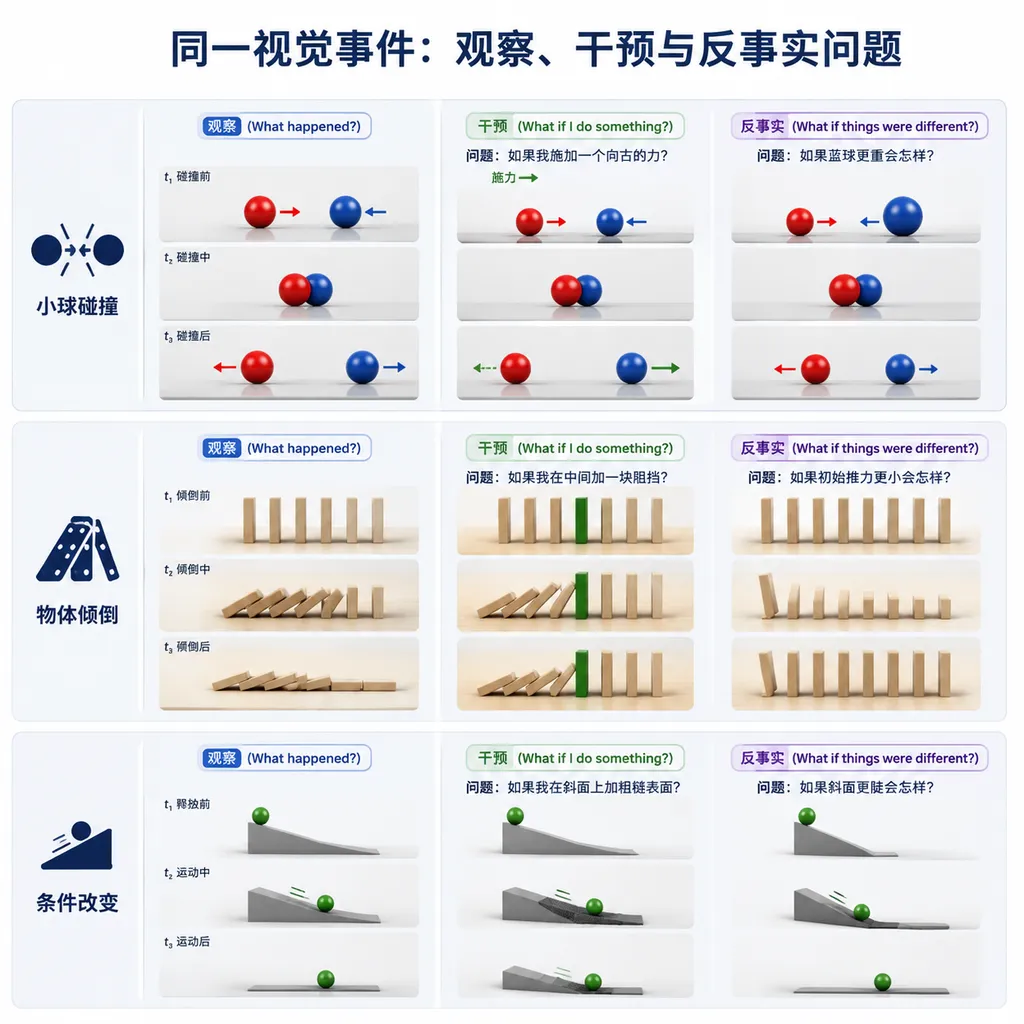
Causal reasoning is different. It requires a model to move beyond identifying “what appears together in the image” and answer “which event caused which outcome.” This involves at least three levels:
- Observation and association: Identifying relationships between variables in events that have already occurred, such as water spilling after a cup falls over.
- Interventional reasoning: Deliberately changing a condition and then determining how the system would change, such as whether water would still spill if the cup were secured in place.
- Counterfactual reasoning: Given an outcome that has already occurred, reasoning about a world that did not happen, such as whether the tabletop would still be wet if the hand had not touched the cup.
This framework is consistent with the hierarchy commonly used in causal inference. The lowest level identifies associations in data; the next level answers “what would happen if something were done”; and the highest level answers “what would have happened if it had not been done.” For a model, these are not merely different phrasings of the same question.
For example, an image may show wet ground and a person holding an umbrella. A language model can easily rely on common sense to answer, “Because it rained.” But if the image actually shows that a street-cleaning truck has just passed and the person is using the umbrella for shade, then although the answer is fluent, its causal chain is wrong. Ordinary VQA may only check whether the final response sounds reasonable. A causal benchmark must ask whether the model used the decisive evidence in the image and whether it can update its conclusion accordingly when the conditions are changed.
CausalVLBench Fills a Blind Spot in Existing Leaderboards
CausalVLBench corresponds to the paper titled “CausalVLBench: Benchmarking Visual Causal Reasoning in Large Vision-Language Models,” available as arXiv:2506.11034. Strictly speaking, what has attracted attention here is not a “new model,” but a new yardstick for evaluating models. In the context of model releases, it is more like an update to the capability coordinate system: leaderboards are beginning to require models to demonstrate that they understand causality, rather than merely continuing to increase parameter counts and visual tokens.
Existing multimodal evaluations have roughly three types of shortcomings.
The first is that perception and reasoning are conflated. When a model answers incorrectly, it may have failed to see something, or it may have seen it and reasoned incorrectly. When a model answers correctly, it may not have used the image at all, instead guessing a frequent answer from the question text. The final accuracy score makes it difficult to identify at which level the problem occurred.
The second is that causal questions can be solved through common-sense shortcuts. If a dataset consistently presents patterns such as “dark clouds cause rain” or “collisions cause objects to fall,” a model can achieve a respectable score by relying on textual co-occurrence. What it has learned may simply be which two terms frequently appear together in internet corpora, rather than the causal structure of the visual scene.
The third is that only the final answer is evaluated, without checking whether the reasoning is faithful. Large models are highly proficient at generating explanations after the fact. Once an answer has been guessed from common sense or option patterns, the model can work backward to produce a plausible rationale. Such an explanation is rhetorical support for the answer, not a record of the actual decision-making process.
CausalVLBench attempts to refocus attention on visual causal reasoning itself. Through causal questions at different levels, it examines whether models can identify events and dependencies from visual input and maintain consistent reasoning when interventional or counterfactual conditions are introduced. Its significance lies not merely in adding a batch of more difficult questions, but in changing the definition of what it means to “answer correctly.”
The Greatest Concern Is “Saying the Right Thing for the Wrong Reason”
Typical failures by large vision-language models on causal questions do not always take the form of nonsense. More often, the answers sound so natural that users are unlikely to notice the errors.
1. Mistaking Temporal Order for Causality
Event A occurring before event B does not mean that A caused B. Videos and sequential images are particularly prone to creating this illusion. If a light turns on after someone presses a button, the button may control the light—or the button press may simply coincide with an automatic sensor activating it. If a model does not identify the intermediate mechanism, it can easily translate temporal order directly into a causal arrow.
2. Being Distracted by Salient Objects
Multimodal models often focus their attention on objects that are large, brightly colored, or semantically salient, while overlooking the small cue that actually determines the outcome. For example, if a machine stops operating, the most conspicuous element in the image may be an operator, while the real cause could be an emergency-stop switch in the corner, a broken belt, or an instrument-panel alarm. A model can correctly describe most of the scene and still fail on the critical causal variable.
3. Failing to Truly “Recompute” the Counterfactual World
A counterfactual question cannot be solved by simply replacing “would” with “would not” in the original answer. The model must hold other conditions constant, change only the variable specified in the question, and then propagate the effects again. If changing one local condition causes the model to rewrite unrelated factors as well, it indicates that the model is not maintaining a stable scene model, but merely telling a new story.
4. Allowing Linguistic Common Sense to Override Visual Evidence
When asked, “Why did the glass break?” a model can easily answer, “Because it fell to the floor.” But if the image shows the glass still on the table with a hammer beside it, the correct answer must follow the visual evidence rather than the most frequent linguistic association. Such conflict samples are especially important for evaluation because they directly reveal whether the model is actually looking at the image or merely invoking textual priors.
Why Benchmarks of This Kind Are Difficult to Build
Visual causal evaluation is more difficult to construct than ordinary image classification. Causal relationships often cannot be confirmed from a single frame: an overturned chair cannot tell you whether someone pushed it over, the wind blew it over, or it was already lying on the ground. If a dataset relies on static images, it must provide sufficient context. If it uses video, it introduces additional variables such as temporal localization, camera cuts, and action recognition.
Annotation is equally challenging. Multiple causes may jointly produce an outcome, while proximate and root causes are not the same. The direct cause of a motor stopping may be a power outage; the outage may have been caused by a blown fuse; and the fuse may have blown because of an overload. If a question does not specify which causal level it is asking about, multiple answers may all be reasonable.
Counterfactual questions must also control variables. A well-designed question should alter only the specified condition while leaving the rest of the background unchanged. Otherwise, a model’s incorrect answer may result from the question itself admitting multiple plausible worlds. In other words, causal benchmarks test not only the model, but also whether the dataset creators have clearly specified their causal assumptions.
Therefore, the quality of work such as CausalVLBench should not be judged solely by sample size and leaderboard rankings. Several more critical design considerations should also be examined:
- Whether questions can be answered correctly from text alone, and whether the dataset includes samples in which linguistic priors conflict with visual evidence;
- Whether observational, interventional, and counterfactual tasks are genuinely separated into distinct levels rather than being paraphrases of one another;
- Whether perception errors, relation-extraction errors, and causal-reasoning errors are distinguished;
- Whether annotations allow multiple reasonable causal chains, and whether the evaluation rules rely too heavily on string matching;
- Whether model-generated explanations remain consistent with the final answer, the visual evidence, and changes in conditions.
For Developers, Error Slices Are More Useful Than the Overall Score
If CausalVLBench is used only to produce an overall leaderboard, much of its value will be wasted. What developers truly need is diagnostic information.
If a multimodal system performs consistently on observational questions but declines markedly on interventional questions, visual encoding may not be the main bottleneck. The problem is more likely to lie in state updates and relationship propagation. If a model can provide the correct answer but cannot consistently identify the causal chain, it may be relying on shortcuts and could pose greater risks when deployed in out-of-distribution scenarios. If the answer reverses after a slight change in prompting, the current capability is not yet reliable enough to support high-risk decisions directly.
For model teams, these error slices can inform training in reverse: they can add samples where visual evidence conflicts with linguistic priors, incorporate controlled intervention data, require models to identify evidence before answering, or use supervision from structured causal graphs instead of simply adding more general-purpose image-text pairs.
For application teams, CausalVLBench is better suited as a template for model-selection testing than as a deployment threshold that can be adopted unchanged. Robotics teams should supplement it with contact, occlusion, and object-dynamics scenarios. Industrial teams should add equipment states and failure chains. Medical teams must distinguish image correlations, pathological mechanisms, and clinical interventions rather than treating benchmark scores as direct evidence of clinical reliability.
From an engineering perspective, a more practical approach is not to have a VLM perform all reasoning independently, but to place it within a verifiable pipeline: the vision model extracts objects and events, a tracking module maintains temporal state, rules or causal graphs constrain variable relationships, and the language model then organizes the final answer. End-to-end models may appear more elegant, but observable and replayable modular systems are often more reliable when real-world actions and accountability are involved.
It Does Not Duplicate Fine-Grained Visual Reasoning Benchmarks
In recent years, multimodal evaluation has begun to shift from “seeing the main object” toward “reasoning from fine-grained evidence.” Work such as VER-Bench, for example, examines whether a model can identify small but critical visual cues and evaluates evidence coverage, reasoning quality, and the relevance of the evidence to the answer.
CausalVLBench addresses an adjacent but distinct concern. Fine-grained evidence evaluation asks whether the model found the specific screw, crack, or instrument reading that supports the conclusion. Visual causal evaluation goes a step further by asking what role that evidence plays in the causal chain and whether changing it would alter the outcome.
The former is more like “finding the fingerprint” in a criminal investigation; the latter is more like proving “what mechanism connects that fingerprint to the outcome of the case.” Real-world systems require both. If the model overlooks critical evidence, causal reasoning cannot begin. If it finds the evidence but cannot distinguish causes, conditions, and accompanying phenomena, it can still reach dangerous conclusions.
Leaderboards Should Not Be Overinterpreted at This Stage
CausalVLBench points to an important direction, but no single benchmark can prove that a model has acquired general causal capabilities. A model may adapt to a particular visual style, question template, or causal structure, yet still degrade significantly when faced with longer videos, open-world settings, and environments with more hidden variables.
Moreover, “causality” in tests is often predefined and simplified by the dataset. The real world does not provide a clean table of variables, nor does it proactively tell a model which conditions should remain unchanged. An agent must first abstract variables from continuous perception and then form an intervenable world model. This is far more difficult than answering a carefully designed counterfactual multiple-choice question.
Therefore, the most appropriate assessment of CausalVLBench is: It is not the endpoint of visual causal reasoning, but it makes measurable a problem that has long been concealed by fluent language.
This is an important step. Over the past two years, advances in multimodal models have rapidly commoditized “recognition, description, and summarization.” The next stage of competition will not be merely about seeing more clearly, but about maintaining a consistent world model under changing conditions. If models cannot reliably distinguish correlation from causation, they will struggle to move safely from chat windows into laboratories, factories, and physical environments.
For developers in China, mainstream multimodal models can already be accessed uniformly through OpenAI-compatible aggregation APIs such as OpenAI Hub, so the barrier to comparative evaluation is not high. However, what deserves comparison is not only the answer score from a single call, but also evidence citation, prompt sensitivity, counterfactual consistency, stability across repeated runs, and refusal boundaries.
Ultimately, a model’s ability to explain does not mean it understands; its ability to guess the correct outcome does not mean it knows why. CausalVLBench’s greatest value is that it forces multimodal models to reveal the gap between the two.
References
- Reddit: CausalVLBench Research Discussion: A recent machine learning community discussion of this visual causal reasoning benchmark.
- Zhihu: Recent Advances in Multimodal Large Models and an Introduction to Visual Causal Evaluation: Additional coverage of related evaluation directions, including VQA-Causal and VCR-Causal, providing background on the development of visual causality benchmarks.