Qwen3.8-Max Launches with 2.4 Trillion Parameters
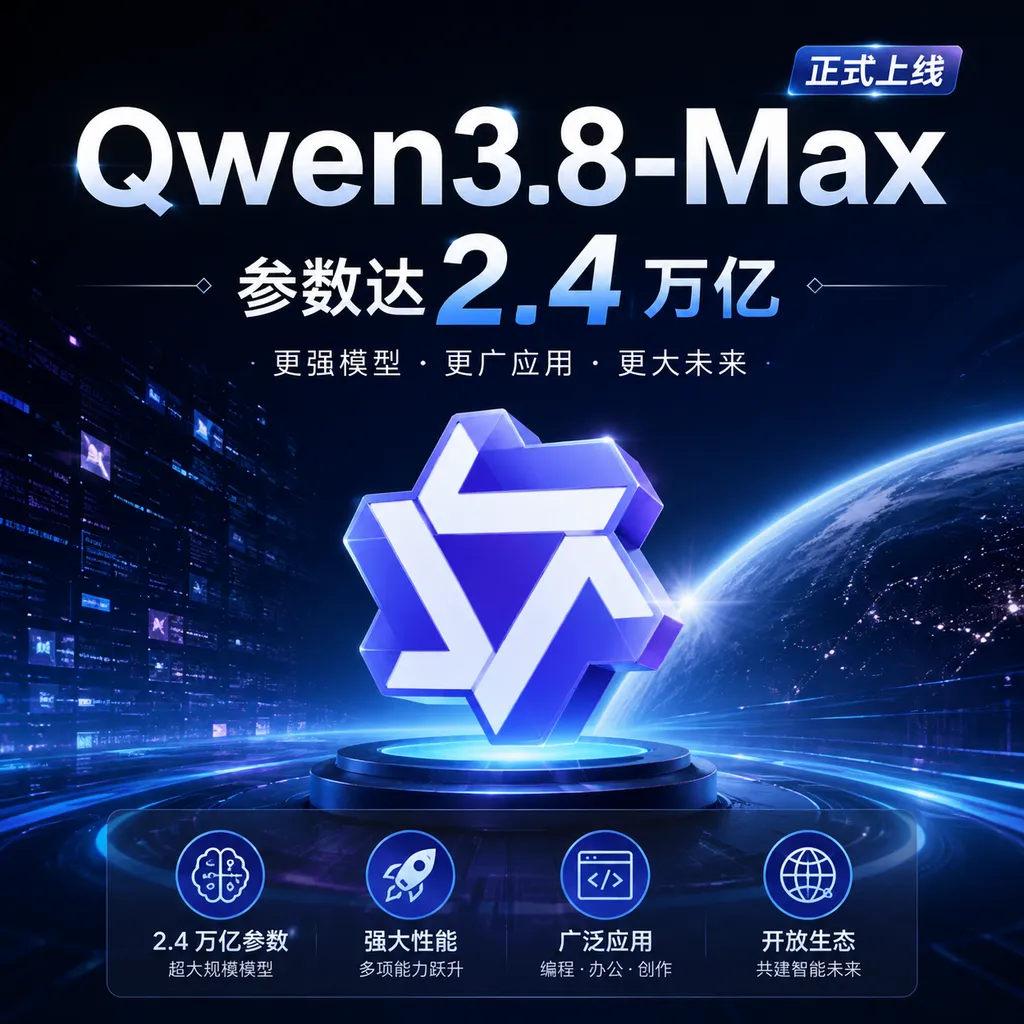
Alibaba officially launched Qwen3.8-Max today, with API access now available. In China, input and output are priced at RMB 12 and RMB 36 per million tokens, respectively. The flagship model’s weights are expected to be released next week, but its 2.4 trillion parameters also raise the deployment threshold to the cluster level.
Alibaba Brings Its 2.4-Trillion-Parameter Model to the API
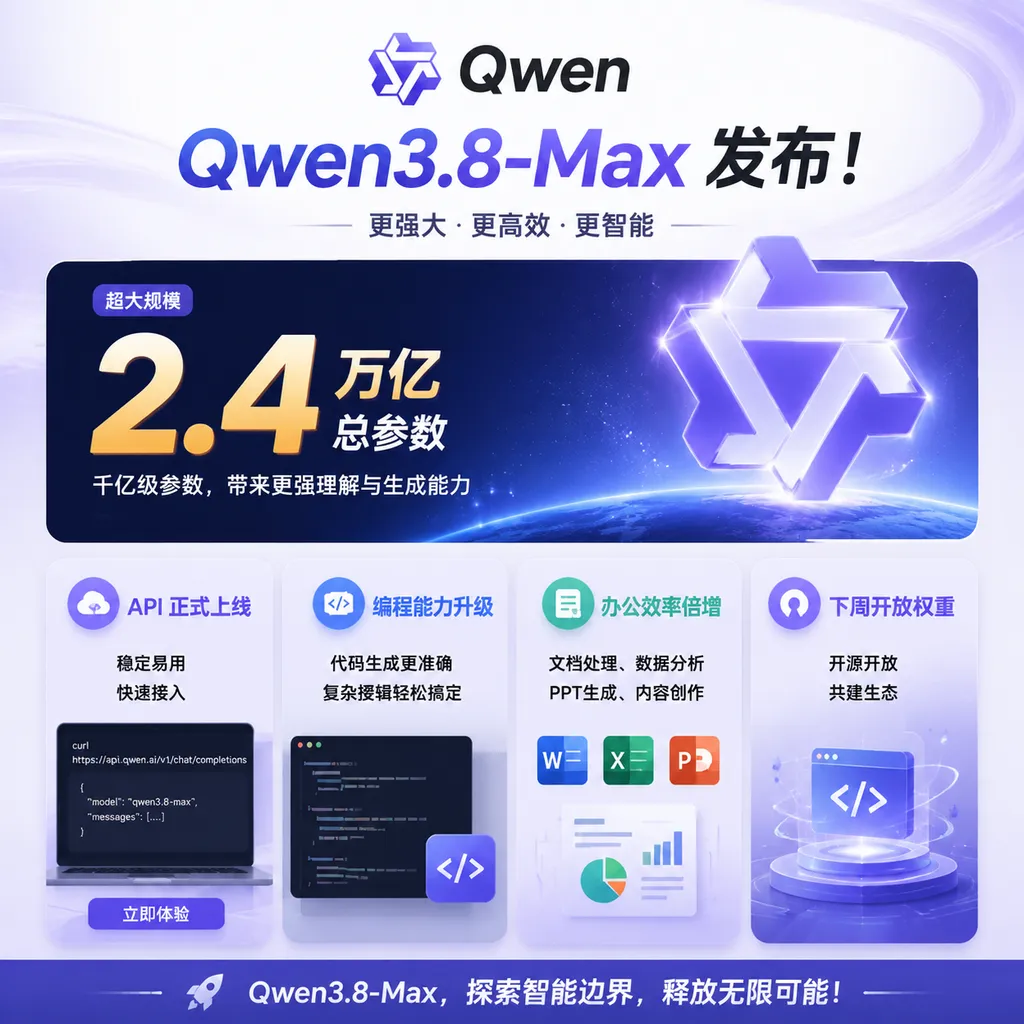
On August 3, Alibaba officially released Qwen3.8, its next-generation foundation model. The flagship Qwen3.8-Max has 2.4 trillion total parameters. The model’s API is now available on the Qianwen AI platform and has been integrated into “Qianwen Office,” the Agent product Alibaba launched alongside it.
Alibaba’s priorities for Qwen3.8-Max are clear: rather than competing solely on chat capabilities and test scores, the model focuses on programming, real-world office work, long-horizon tasks, and multimodal agents. According to the company, the new model can complete complex, open-ended objectives end to end with minimal human intervention.
More importantly for developers, this is not merely a preview. A preview version of Qwen3.8-Max became available in Token Plan, Qoder, and QoderWork around July 19. This release marks the launch of the official version and the opening of API access. Alibaba also said that the Qwen3.8-Max model weights are expected to be released next week, while Qwen3.8-27B—a size better suited to practical deployment—will be open-sourced at the same time.
In one sentence: What makes Qwen3.8-Max truly impactful is not the figure “2.4 trillion,” but Alibaba’s attempt to simultaneously open up three paths: a flagship API, an office Agent, and open model weights. It aims to compete with Claude for high-value Coding and Cowork tasks without abandoning Qwen’s long-standing strategy of expanding through an open-source ecosystem.
However, “opening up 2.4 trillion parameters” does not mean developers will be able to easily install the model in their data centers next week. For the vast majority of teams, the API will remain the more practical entry point.
Pricing Has Been Announced, and Output Remains the Largest Cost
The publicly listed domestic API pricing for Qwen3.8-Max is:
- Input: RMB 12 per million tokens
- Output: RMB 36 per million tokens
- Implicit cache hits: RMB 1.5 per million tokens
At these prices, a task consuming 100,000 input tokens and 10,000 output tokens would cost approximately RMB 1.56, excluding other billable items. Of that amount, input would cost RMB 1.20 and output RMB 0.36. If all 100,000 input tokens qualified for cache hits, the input cost would fall to approximately RMB 0.15, bringing the total to around RMB 0.51.
This matters for codebase analysis, long-document review, and office Agents. Such tasks often require repeatedly including system prompts, company policies, project documentation, and historical context. Caching is not merely a nice-to-have; it is a cost lever that determines whether these tasks can operate at scale.
Alibaba also used Anthropic’s Opus 5 as an international pricing reference, stating that Qwen3.8-Max’s input and output prices are approximately 40% and 24% of Opus 5’s, respectively. Those figures are attractive, but they do not automatically imply better cost-effectiveness. Whether a model is truly cheaper ultimately depends on how many rounds of interaction and tool calls are required to complete the same task, as well as how much rework is needed after failures.
If an Agent costs half as much but requires three additional rounds to deliver, neither the bill nor the latency will look any better. Conversely, if Qwen3.8-Max can genuinely reduce the frequency of human intervention in long-running tasks, its business value will far exceed the benefit of simply lowering the per-token price.
The Parameter Count Is Huge, but Do Not Equate Total Parameters with Per-Inference Cost
The 2.4 trillion figure refers to total parameters. It does not necessarily mean that every parameter is used for every token. The currently available release information does not fully disclose the model architecture, the number of parameters activated per inference, the expert-routing method, or the precision configuration. It is therefore impossible to determine how much slower or more expensive it is than the previous generation based solely on the total parameter count.
This is also one of the easiest traps to fall into when evaluating ultra-large model releases: total parameters are like the number of employees in a company, while active parameters are closer to the number of people actually assigned to each project. The former reflects model capacity; the latter has a more direct impact on compute requirements, throughput, and inference costs.
Even without discussing active parameters, however, the engineering threshold for 2.4 trillion weights remains extremely high. As a rough estimate:
- Storing all weights in FP16 would require approximately 4.8 TB;
- Even with 4-bit quantization, the theoretical weight size would still be around 1.2 TB;
- Actual operation would also require quantization metadata, KV cache, communication buffers, and inference framework overhead;
- Cross-GPU and cross-node communication, as well as expert load balancing, would also significantly affect real-world throughput.
Therefore, even if Qwen3.8-Max’s weights are released as planned, it will primarily be relevant to cloud providers, large enterprises, and specialized inference service providers. For ordinary development teams, the Qwen3.8-27B model being open-sourced at the same time may be more important. It may not match the flagship model’s capability ceiling, but it is far more likely to be practical for multi-GPU single-server setups, private deployments, and low-cost fine-tuning.
That is also why Alibaba is releasing models at two sizes. Max demonstrates the upper limit of capability, while 27B expands developer access. Releasing only a 2.4-trillion-parameter model would generate attention but make widespread deployment difficult. Adding a 27B model gives the ecosystem a real chance to gain momentum.
Second on Arena, but the Ranking Alone Does Not Fully Explain Real-World Capabilities
On the third-party Arena leaderboard updated on August 3, Alibaba said that Qwen models ranked behind only Anthropic’s Claude series overall, placing them in the global top tier.
This result deserves attention. Arena uses blind user voting, making it more representative of real-world preferences than benchmarks that allow models to optimize for fixed question sets. For general conversation, writing style, and instruction following, it is usually more informative than any single benchmark.
However, “second only to Claude” is still a statement that requires context. At a minimum, developers need to know:
- Which Arena category this refers to—overall, coding, long-text, or vision tasks;
- Whether the submitted model was the official or preview version, and whether the sampling parameters were consistent;
- Whether the model is stable in tool use, structured output, and recovery during long-running tasks;
- Whether the ranking difference is statistically significant rather than merely reflecting adjacent positions on the leaderboard.
For Coding and Cowork models, producing one polished answer is not enough. The real challenge is whether the model can maintain its objective after working continuously for dozens of minutes, modify files correctly, invoke tools, handle exceptions, and ultimately deliver a result that can be verified and accepted.
Claude’s long-standing advantage in high-end programming and Agent tasks is not merely the result of high code-generation scores. It has developed a relatively complete experience in large-scale code reading, controlling the scope of modifications, maintaining long-context consistency, and interacting with tools. If Qwen3.8-Max is to truly replace Claude, the key is not how many positions it gains on a particular leaderboard, but whether it can achieve consistently high success rates in real codebases and enterprise workflows.
From “Answering Questions” to “Delivering Results”
Alibaba’s repeated emphasis on real-world office work, long-horizon tasks, and multimodal agents indicates that Qwen’s competitive focus has shifted.
Earlier large models primarily delivered a block of text; next-generation Agent models need to deliver a result. For example:
- Read a set of financial spreadsheets, verify anomalous data, and generate presentation materials;
- Analyze an entire codebase, locate bugs, modify the code, and run tests;
- Organize meeting recordings, chat logs, and project files, then update the project plan;
- Operate across multiple websites and internal systems to collect and enter information.
The difficulty of such tasks lies not in any single step, but in the number of steps, the extended state that must be maintained, and the accumulation of errors. If the model misreads a field in the first step, the mistake may not surface until the tenth. If a tool call fails midway and the model cannot retry or roll back, the entire task chain may collapse.
Alibaba’s integration of Qwen3.8 into “Qianwen Office” therefore does more than provide the model with another product entry point. It also tests the model against real-world workflows. The API provides the capability components, while the Agent product combines the model, tools, permissions, files, and execution environment. Launching both at the same time has more practical significance than releasing only a chat interface.
That said, “minimal human intervention” remains a goal that requires ongoing validation, not a conclusion that can be confirmed from a launch-event demonstration. Enterprise scenarios also depend on permission isolation, audit logs, data residency, failure recovery, and result traceability. These capabilities are usually not determined by the foundation model alone.
The API Is Available Today; Open Weights Are Coming Next Week
Three easily confused concepts need to be distinguished here.
First, an open API does not mean free access. Qwen3.8-Max is currently a commercial service billed by token, and developers are purchasing hosted inference capabilities.
Second, announcing that weights will soon be released does not necessarily make the model open-source software in the strict sense. Whether it can be freely used commercially, redistributed, fine-tuned, or offered as a hosted service will depend on the specific license released next week, not merely on the word “open-source.”
Finally, downloadable weights do not mean low-cost deployment. The storage, GPU memory, and cluster communication requirements associated with 2.4 trillion total parameters will put the model beyond the reach of most teams. Quantizing, pruning, or distilling it will also require additional engineering work.
Developers should therefore prepare in two ways:
- Prepare an API evaluation set. Do not limit testing to a few algorithm questions. Select real codebases, enterprise documents, and long-running workflow tasks, and record success rates, token consumption, latency, and the number of human interventions.
- Wait for the open-source details. Pay close attention to the license, model architecture, active parameter count, context length, inference framework support, quantization options, and recommended hardware—not just the downloadable weight files.
If a team already uses the OpenAI format to wrap model calls, it should continue to decouple the model-routing layer from business logic. Whether the model is later accessed through the official platform or an aggregation platform such as OpenAI Hub, teams should rely on the real-time model list, actual model IDs, and supported capabilities. In particular, they should verify whether tool use, structured output, multimodal input, and cache billing are fully passed through rather than looking only at API endpoint compatibility.
Qwen Is Bringing Its Open-Source Advantage into the High-End Model Competition
Qwen’s traditional strengths have been its broad range of model sizes, reliable Chinese-language capabilities, large developer ecosystem, and ability to quickly enter cloud services, end-user devices, and private deployment scenarios. Its weakness has been that Claude still holds stronger mindshare in the high-value market for complex programming and long-horizon Agents.
Qwen3.8-Max is clearly intended to close that gap. Its 2.4 trillion parameters provide a sufficiently eye-catching scale narrative, the Arena ranking serves as evidence of capability, API pricing lowers the barrier to testing, Qianwen Office provides a path to commercialization, and next week’s release of the weights further strengthens the ecosystem.
This combination is more complete than releasing a large model on its own.
The real dividing line, however, will emerge only after developers have tested it: Can Qwen3.8-Max work reliably in large codebases? Can it execute dozens of consecutive steps without deviating from the objective? Can it deliver equivalent quality at a lower cost than Claude? And can it be deployed efficiently once the weights are released?
If the answers to most of these questions are yes, Qwen3.8-Max will represent a major upgrade in the push by Chinese models into the high-end Coding and Agent markets. If its advantages ultimately remain confined to parameter count and leaderboard position, then 2.4 trillion will be little more than an expensive and eye-catching number.
At least for now, Alibaba has put its cards on the table: the API is available today, the flagship weights are coming next week, and the 27B version brings the barrier back down to a level developers can realistically reach. What matters next is no longer the capabilities described at the launch event, but the completion rate on real-world tasks.
References
- ITHome: Alibaba’s Qwen3.8-Max Model Officially Launches with 2.4 Trillion Total Parameters—Contains key information including the official release date, API pricing, Arena performance, and expected timing for the release of the model weights.
- Zhihu: Introduction to the Qwen3.8-Max-Preview Model—A third-party overview of the preview version, model positioning, and application directions. Specific technical specifications should still be based on official release information.