
AionUi 1.9.14: Multi-Agent Collaboration Is No Longer Just a Demo
The latest version of AionUi introduces a multi-agent collaboration mechanism, supporting various architectural models such as roundtable and leader-staff. It solves engineering challenges related to context synchronization and parallel reasoning, enabling AI agent team collaboration to move from concept to practical application.
AionUi 1.9.14: Multi-Agent Collaboration Is No Longer Just a Demo
The idea of multi-agent collaboration has been around for nearly two years, yet truly usable products remain scarce. Most so-called “multi-agent” systems are either serial invocations disguised as collaboration or have chaotic context management—after a couple of rounds, they begin to babble nonsense.
The multi-agent collaboration mechanism introduced in AionUi 1.9.14 marks a meaningful step forward in this area. It doesn’t just let several agents talk in turn; it truly implements multi-architecture support, context synchronization, and parallel reasoning. Based on community feedback, this update has solved many of the pain points developers previously encountered.
The Engineering Challenges of Multi-Agent Collaboration
Before discussing what AionUi has achieved, let’s first talk about why multi-agent collaboration is so hard to get right.
A developer shared his experience building an early multi-agent prototype:
“I designed several architectures based on scenarios—roundtable (agents with equal weight), anonymous review, leader-staff workflow, synchronized alignment, etc.—but the details were full of pitfalls. Defining how agents communicate under different architectures, managing the context… I eventually gave up.”
This statement highlights three core difficulties of multi-agent systems:
1. The complexity of architectural design
Different tasks require different collaboration modes. Code review fits the anonymous review architecture to avoid mutual influence among agents; complex projects suit the leader-staff model, where a primary agent delegates tasks; brainstorming needs a roundtable setup, allowing all agents to speak equally.
The problem is that these architectures are not simple configuration options—they involve message routing, decision weighting, conflict resolution, and other mechanisms. You must define clear communication protocols for each architecture; otherwise, the agents will end up “talking past each other.”
2. The nightmare of context management
Context management is already tricky for a single agent. In multi-agent scenarios, the problem multiplies exponentially.
Suppose you have three agents working on a task: Agent A does requirement analysis, Agent B handles technical design, and Agent C implements the code. Agent C needs A and B’s outputs but not their intermediate reasoning. Giving C all the context would explode token consumption; giving only the conclusions risks misinformed decisions due to missing background.
To make matters worse, there’s context synchronization. When Agent A revises its understanding of the requirements, should this update sync to B and C? If so, how to ensure consistency? If not, how to prevent agents from acting on outdated information?
3. Coordination in parallel reasoning
Serial execution is simpler but slower; parallel execution is faster but error-prone.
For example, two agents might modify the same file simultaneously, or one agent’s output might depend on another’s unfinished results. You need dependency management and conflict resolution—yet the mechanism can’t be too heavy, or the overhead will cancel out the benefits of parallelism.
These are not theoretical concerns but real engineering challenges. That’s why most “multi-agent” products either support only a handful of fixed modes or revert parallelism to serial execution for “consistency.”
AionUi’s Solution
The core of AionUi 1.9.14’s multi-agent mechanism lies in three main design concepts:
1. Native support for multiple architectures
AionUi includes several built-in collaboration architectures and also allows custom definitions:
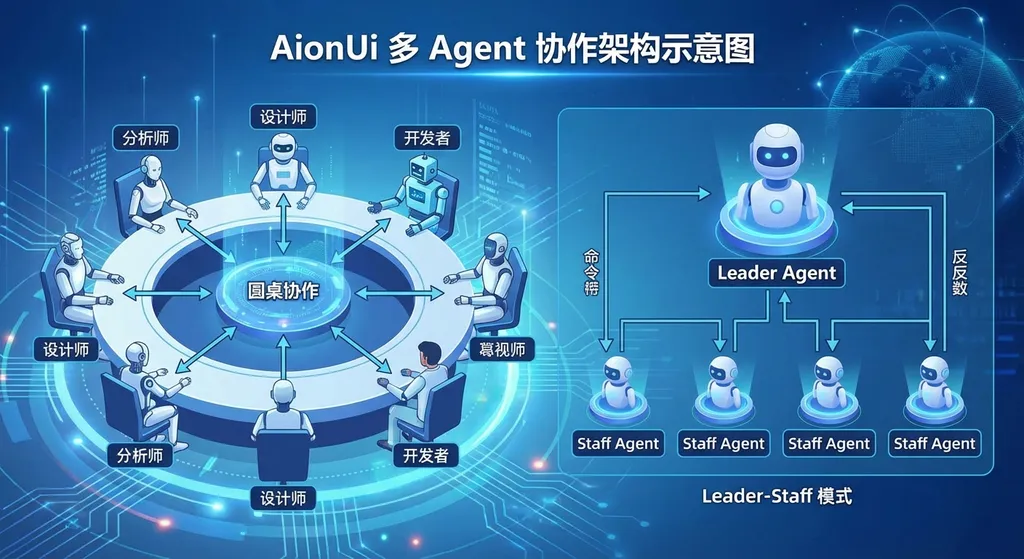
- Round Table: all agents have equal weight and take turns speaking; suitable for brainstorming and multi-perspective analysis
- Anonymous Review: agents can’t see each other’s identities, only outputs, avoiding authority bias
- Leader-Staff Architecture: one main agent assigns tasks and integrates results; others handle specific tasks
- Alignment: agents repeatedly discuss until they reach consensus; suitable for high-consistency scenarios
These aren’t just configuration switches—they include full message routing and decision logic. For example, in the leader-staff mode, outputs from staff agents go to the leader, who decides whether to refine or reassign tasks.
Community feedback suggests this design solves real-world problems. One user noted: “I tried a multi-agent meeting with randomly assigned models—there were lots of mistakes... it’s best to define which model to use beforehand, not let agents decide.” This shows that AionUi lets agents choose models autonomously, but that flexibility can sometimes cause issues.
This reflects a classic trade-off in multi-agent systems: more autonomy yields flexibility but also more errors; stricter control brings stability but reduces creativity. AionUi opts for the former—demanding more from developers but offering higher potential.
2. Layered context management
AionUi structures context management in layers:
- Global Context: information shared by all agents, such as project goals, tech stack, and constraints
- Session Context: context for a specific collaboration session—task descriptions, intermediate results, decision history
- Private Context: each agent’s unique reasoning process and internal state
With this approach, agents access only what they need. For instance, in coding, an agent may need the technical plan (session context) and project constraints (global context) but not the details of requirement discussions (other agents’ private context).
More importantly, AionUi implements incremental context synchronization. When one agent updates shared context, others receive only a “change notification.” Each agent can decide whether to fetch the full update based on its needs.
This seemingly simple design has major performance implications. In a collaboration with 5 agents, full context sync would consume over 5× the tokens of a single agent. Incremental sync can cut this to 2–3×, with even greater savings in complex tasks.
3. Dependency-aware parallel scheduling
AionUi’s parallel reasoning doesn’t just start all agents at once—it dynamically schedules based on task dependencies.
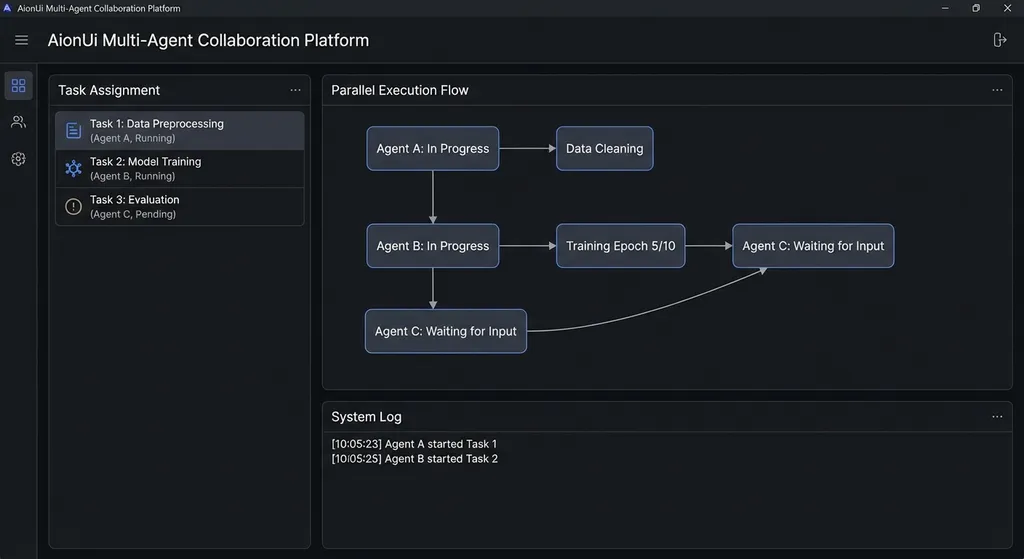
The system analyzes task dependencies and builds a DAG (directed acyclic graph). A task only runs once its upstream dependencies finish. This maximizes parallelism while preventing invalid reasoning from missing context.
For example, in developing a web app:
- Agent A handles requirements
- Agent B designs the database (depends on A)
- Agent C designs APIs (depends on A)
- Agent D does frontend (depends on C)
- Agent E does backend (depends on B and C)
Here, A must finish first, then B and C can run in parallel, and D and E run next (E waits for B and C). AionUi’s scheduler automatically handles this.
For conflict resolution, AionUi uses an optimistic locking mechanism: if two agents modify the same resource simultaneously, the later one gets a conflict notice and re-runs based on the latest state. This works well in most cases but slows down under high-conflict scenarios (e.g., multiple agents editing the same file repeatedly).
Real-World Experience
Community feedback confirms that AionUi’s multi-agent system solves real issues—but it also has downsides.
Pros:
- True parallelism: agents really work concurrently, significantly improving speed on complex tasks
- Reliable context handling: no “memory loss” or outdated reasoning
- Flexible architecture: different collaboration modes suit different tasks
Cons:
- Model selection often needs manual control: as noted before, agent-autonomous model choice can backfire, especially with some Gemini models
- Hard to debug: tracing which agent or stage caused problems can be challenging
- Cost control: parallel execution invokes multiple models at once—token and API costs rise fast
A typical use case is code refactoring: one agent analyzes existing code, one plans the refactor, one implements, one tests. These can run partly in parallel—for example, after analysis, design and test creation can proceed together.
But this also exposes a weakness: if the design agent changes something that affects the analysis, the process must roll back. AionUi currently lacks proper rollback support—you must intervene manually or restart.
Comparison with Other Solutions
There are quite a few multi-agent projects around, but most remain conceptual or handle only limited cases.
AutoGPT/BabyAGI: these tools act more like single agents decomposing tasks, not true multi-agent collaboration. Subtasks execute in series without distinct agent identities or contexts.
LangChain Multi-Agent: LangChain provides a basic framework but leaves message routing, context control, and conflict resolution to developers. It’s more a toolkit than a ready-to-use system.
CrewAI: a framework focused on multi-agent collaboration, with architecture similar to AionUi’s. However, CrewAI is purely code-based—no visual interface—and requires more developer expertise. AionUi’s advantage lies in its GUI that visually shows agent interactions.
Microsoft Autogen: academically popular and supports complex interactions, but primarily aimed at research. Its engineering maturity lags behind AionUi, and its code/file handling is limited.
AionUi sits between a framework and a product—it’s more usable than pure frameworks (thanks to UI presets) but still flexible thanks to customization options. That balance is developer-friendly, though the learning curve is steeper than a simple chat tool.
Technical Details
While AionUi hasn’t open-sourced its core multi-agent scheduler, documentation and discussions suggest some implementations:
Message passing: AionUi likely uses a message queue per agent, with a central scheduler routing messages per architecture rules. This decouples agents; each just sends/receives messages.
Context storage: Layered context needs efficient storage/retrieval. AionUi probably uses an in-memory database like Redis for active data, with persistent storage for full history. Incremental updates may track version or timestamps.
Dependency analysis: Building a task-DAG needs static or runtime analysis—static is fast but rigid; runtime is accurate but slower. AionUi may combine both: static for declared dependencies, runtime for inferred ones.
Model invocation: AionUi supports GPT, Claude, Gemini, DeepSeek, etc. Different agents may use different models, handled through a unified model call layer abstracting API differences.
Using an OpenAI Hub-style aggregator makes model switching easy in AionUi—for example, analysis with Claude (strong reasoning), implementation with DeepSeek (fast coding), and testing with GPT-4 (stable). Such hybrid use balances cost and performance.
Example showing multi-model configuration in code:
from aionui import MultiAgentSession, Agent, RoundTableArchitecture

# Configure agents with different models
analyst = Agent(
    name="analyst",
    role="Requirement Analysis",
    model="claude-3-5-sonnet-20241022",  # Use Claude for reasoning
    api_base="https://api.openai-hub.net/v1",
    api_key="your-openai-hub-key"
)

developer = Agent(
    name="developer",
    role="Code Implementation",
    model="deepseek-chat",  # Use DeepSeek for coding
    api_base="https://api.openai-hub.net/v1",
    api_key="your-openai-hub-key"
)

reviewer = Agent(
    name="reviewer",
    role="Code Review",
    model="gpt-4o",  # Use GPT-4 for review
    api_base="https://api.openai-hub.net/v1",
    api_key="your-openai-hub-key"
)

# Create a roundtable session
session = MultiAgentSession(
    agents=[analyst, developer, reviewer],
    architecture=RoundTableArchitecture(),
    task="Refactor the user authentication module for better security and maintainability"
)

# Run the collaboration
result = session.run()
print(result.summary)
This example demonstrates basic AionUi multi-agent usage. In real situations, you’d further configure system prompts, context-sharing rules, and conflict-handling strategies.
Suitable Scenarios and Limitations
Multi-agent collaboration isn’t a silver bullet—it has specific use cases and limits.
Best suited for:
- Parallel development of complex projects (frontend, backend, database in parallel)
- Decision-making needing multiple perspectives (e.g., technical reviews from various angles)
- Large-scale code refactoring (analysis, planning, implementation, testing)
- Document authoring and review (drafting, technical validation, language refinement)
Not ideal for:
- Simple tasks where coordination cost outweighs benefits
- Strictly sequential workflows with little parallel opportunity
- Human judgment-heavy decisions—agents can draft options but not substitute final calls
- Real-time systems requiring millisecond responses—coordination latency is too high
A counterexample is simple code completion—using multiple agents is overkill: slower and more expensive. A well-prompted single agent works better.
Cost also matters. Parallel execution scales token consumption with agent count. With expensive models like GPT-4, expenses can skyrocket. Hence hybrid models—using premium ones for core steps and cheaper ones for support—become crucial.
Future Improvements
AionUi’s system still has room for growth:
1. Smarter model recommendation
Currently, agent self-selection often errs, while manual assignment is rigid. A possible improvement: auto-recommend models by task type—Claude for reasoning, DeepSeek for code, GPT-4 for math.
2. Better debugging tools
Multi-agent processes are complex; visualizing each agent’s reasoning, message flow, and context changes would help troubleshooting and optimization.
3. Cost optimization
Introduce fine-grained cost control, e.g., per-task token limits or cost-based model fallback to cheaper options.
4. Rollback and retry
If an agent produces bad output, the system should support retrying or rolling back to a previous state. Currently, only manual intervention or restart works.
5. Human-in-the-loop collaboration
Invite human confirmation at key decision points—e.g., human review before finalizing technical design—to avoid strategic misdirection.
These aren’t just feature additions—they involve rethinking the philosophy of multi-agent systems: fully autonomous vs. human-assisted? Maximize average performance or control worst-case behavior? There are no universal answers—only continuous exploration.
Final Thoughts
AionUi 1.9.14’s multi-agent mechanism represents one of the first mature engineering implementations in a field full of demos. It’s imperfect and still has pitfalls—but it proves multi-agent collaboration can move from concept to practicality.
For developers, it’s worth trying—especially for complex projects. But be mentally prepared: multi-agent isn’t magic. You must understand dependencies, design collaboration structures wisely, and spend time debugging and optimizing.
If you just need a chat assistant, a single agent suffices. But if you want AI to truly participate in complex software workflows, multi-agent collaboration is a promising direction. AionUi offers a solid starting point—the rest depends on how you use it.
References
- AionUi V1.9.14: Many updates, focusing on multi-agent collaboration - Linux.do – Official update notes and community feedback
- AionUi GitHub Repository – Source code and technical documentation


