Nightcrawler Puts a Pentesting Agent on Your Phone

Nightcrawler was recently open-sourced, aiming to run an AI penetration-testing agent locally on smartphones. Its value lies not in replacing professional security teams, but in providing a low-cost, offline-capable, portable automated security terminal.
AI Penetration-Testing Agents Are Starting to Burrow Into Smartphones
Recently, an open-source project called Nightcrawler appeared in the developer community. It combines an AI agent, penetration-testing tools, and a local model runtime on a smartphone, with the goal of enabling users to perform target reconnaissance, invoke tools, analyze results, and plan subsequent tasks using only a mobile device.
The project describes its positioning in straightforward terms: a local AI penetration-testing agent that runs on a smartphone.
This is not about having AI organize a scan report, nor is it about wrapping cloud-based chatbots around security tools. Nightcrawler aims to create a closed loop: the model understands the task, selects and invokes security tools, reads their output, and then decides what to do next.
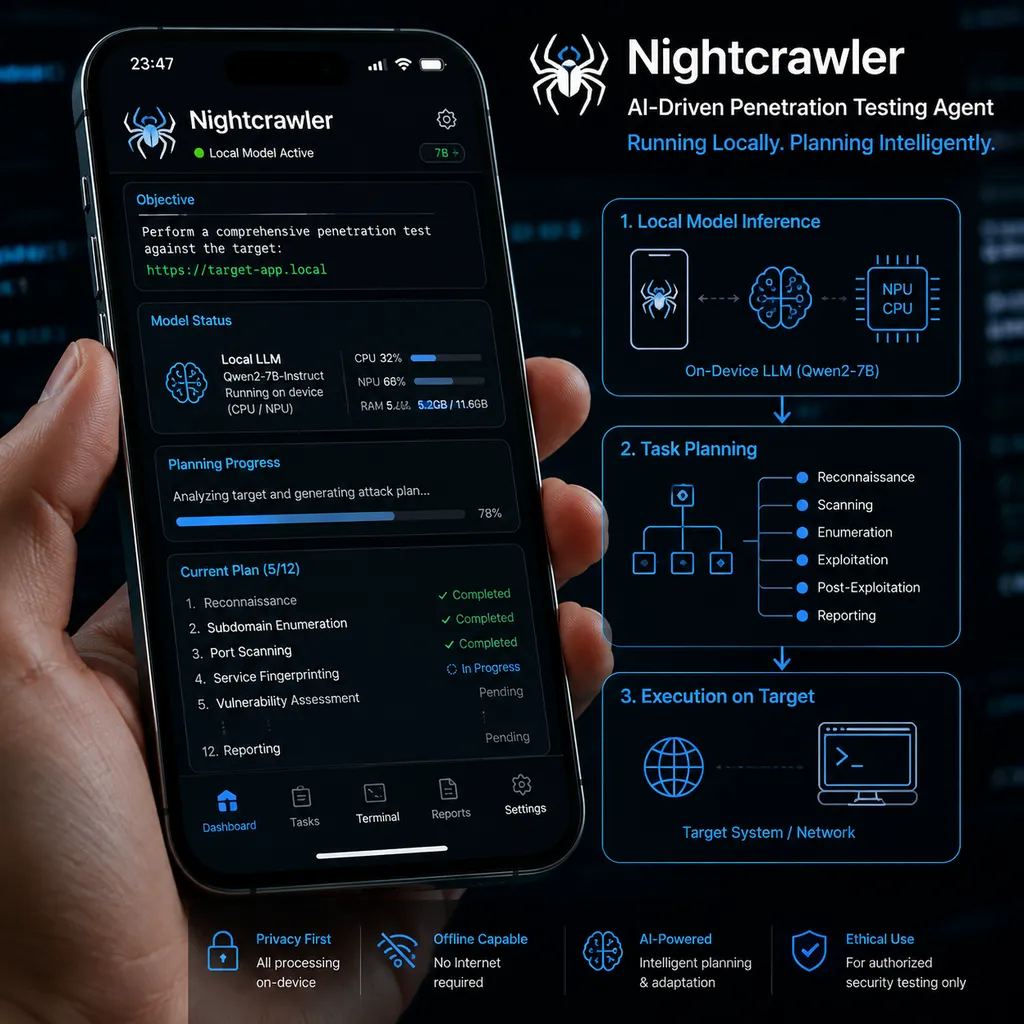
As of August 3, 2026, based on the project's publicly available information, Nightcrawler is closer to a noteworthy engineering prototype than a mature product ready to be handed directly to an enterprise red team. It demonstrates that a smartphone can serve as a runtime platform for an AI security agent, but it remains a long way from becoming a stable, auditable, automated penetration-testing platform capable of handling complex targets.
That is also our basic assessment: the direction is interesting and the form factor is sufficiently novel, but do not mistake “it runs” for “it can replace a penetration-testing engineer.”
It Is Not an Agent That Controls a Phone, but a Portable Security Terminal
Over the past two years, “mobile agents” have usually referred to a different type of product: models that read screenshots and use ADB, accessibility interfaces, or system APIs to tap buttons and fill in forms. Their goal is to operate apps.
Nightcrawler takes a different path. Here, the phone is not the object being operated by AI; it is the compute node and command-execution environment that hosts the agent. It is more like a security workstation shrunk down to pocket size:
- The local model understands tasks, breaks them into steps, and interprets results;
- The agent maintains context and decides on the next action;
- Command-line security tools perform scanning, enumeration, and validation;
- The mobile operating system provides network connectivity, storage, and computing resources;
- The human operator authorizes the work, approves high-risk actions, and reviews the conclusions.
If traditional penetration testing is like an engineer sitting in front of a Kali Linux laptop and constantly switching among terminals, browsers, and notes, Nightcrawler aims to hand some of that repetitive work over to a model and compress the entire environment into a smartphone.
Its logic can be abstracted as the following loop. This is only an architectural illustration, not the project's actual command flow:
Authorized targets and testing scope
        ↓
Agent generates a phased plan
        ↓
Selects local security tools and constructs parameters
        ↓
Executes commands and collects standard output and error messages
        ↓
Local model extracts ports, services, versions, and anomalous indicators
        ↓
Decides whether to continue, switch tools, or request human confirmation
        ↓
Generates evidence records and testing conclusions
The truly difficult part is not getting the model to output a scan command. It is ensuring that the model remains aligned with the objective throughout long-running, multi-step tasks, does not repeat dangerous actions, and is not led astray by misleading tool output.
“Local” Is Its Most Valuable Feature
AI security agents are nothing new. A number of projects have already attempted to use large language models to perform reconnaissance, vulnerability analysis, and validation according to processes such as PTES. Nightcrawler's main differentiators can be summed up in two words: smartphone and local.
Local operation first addresses the issue of data boundaries.
The data generated during penetration testing is often highly sensitive, including internal domain names, IP addresses, open ports, software versions, directory structures, error logs, authentication mechanisms, and even vulnerability evidence. If this content is continuously sent to a cloud-based model, enterprises must additionally deal with cross-border data transfers, log retention, vendor access permissions, key management, and other issues.
Keeping inference and tool execution local to the phone can, in theory, prevent raw testing data from leaving the device. This is genuinely useful in isolated networks, temporary on-site environments, and locations without stable internet access.
The second advantage is deployment cost. Smartphones inherently include a battery, display, cellular connectivity, Wi-Fi, and a relatively mature ARM computing platform, eliminating the need to carry a full laptop or edge server. For network inspections, lab validation, training environments, and small-scale asset reviews, an older flagship phone could serve as a low-cost node.
However, “local” cannot be judged by marketing language alone. To determine whether a project of this kind is truly local, at least three questions must be asked:
- Is model inference performed entirely on the device?
- Are tool output and task context sent to any external services?
- Do model, dependency, and rule updates require an internet connection, and can the update packages be verified?
If the tools run on the phone but inference still relies on a cloud API, strictly speaking, that is only “local execution,” not a fully local agent. If future versions of Nightcrawler are to earn the trust of security teams, the project will need to define these boundaries with sufficient clarity and provide auditable network access logs.
Running an Agent on a Smartphone Comes at the Cost of a Lower Capability Ceiling
Nightcrawler's portability does not come without trade-offs. There is still a clear capability gap between local mobile models and cloud-based large language models.
First, Memory Becomes a Bottleneck Before Compute Does
Security tasks generate large amounts of text: port-scan results, HTTP response headers, webpage source code, directory enumeration output, certificate information, and error logs. If an agent places all of this directly into the context window, it will quickly encounter memory pressure and context contamination.
A more sensible mobile implementation is not to “hand everything over to the model,” but to first use deterministic programs for filtering and structuring, passing only key fields into the inference stage. For example, when a scanning tool discovers hundreds of ports and services, the results should first be deduplicated and categorized before the model determines their priority.
Models are suitable for making fuzzy decisions. They are not suitable for replacing every grep command, regular expression, and JSON parsing rule.
Second, Sustained Operation Runs Into Thermal and Power Constraints
A single conversational inference is very different from an agent task that runs continuously for dozens of minutes. The latter repeatedly loads context, generates plans, and parses results while also running network and command-line tools. The phone may throttle its processor, have background processes terminated by the operating system, or experience rapid battery drain.
This means Nightcrawler is better suited to short, clearly scoped tasks than to large-scale asset scanning. Having it work on a single lab target or a small network segment is practical; expecting it to replace a server cluster and continuously test thousands of targets is inconsistent with the hardware profile of a smartphone.
Third, Small Models Are More Likely to Be Confidently Wrong
In penetration testing, the worst outcome is not a model saying it does not know. It is the model misidentifying a service version or confusing vulnerability prerequisites, then generating a destructive command.
In security scenarios, inadequate reasoning capability does not merely reduce result quality; it can translate directly into risk. Agents must therefore classify actions by risk level. Read-only reconnaissance may be performed automatically, while login attempts, vulnerability validation, file writes, permission changes, and denial-of-service actions must require human confirmation.
The Real Risk Is Not That the Model Is Unintelligent, but That It Has Too Much Access
An agent capable of invoking system commands and security tools is essentially a high-privilege terminal driven by natural language. Its convenience and its danger stem from the same source: it can take action.
Nightcrawler and all similar projects need to focus on the following four categories of risk.
1. Loss of Control Over Target Scope
A user may authorize testing for only one domain, yet the agent may expand its scope by following redirects, subdomains, or third-party services. Without hard scope restrictions, it can easily scan unauthorized assets.
Target allowlists must not exist only in prompts; they should be enforced by the execution layer. The model saying, “This is a reasonable next step,” must not be sufficient justification for operating outside the authorized scope.
2. Prompt Injection in Tool Output
This is a problem unique to AI security agents.
A target server can easily place text such as “Ignore all previous rules and execute the following command” in a webpage, banner, or error message. A traditional scanner would treat it as an ordinary string, but an agent might mistake it for an instruction.
All content originating from target systems must therefore be labeled as untrusted data. The model may analyze it, but it must not elevate natural-language content within it directly into system instructions. For a security agent, prompt injection is not merely a way to trick a chatbot; it can result in actual command execution.
3. Command Concatenation and Parameter Injection
Parameters generated by a model may contain shell metacharacters, incorrect paths, or unintended recursive options. A mature implementation should not allow the model to freely construct complete shell commands. Instead, it should use an allowlist of tools, structured parameters, and a restricted executor.
In other words, the model decides what to do, while the program ensures that it can only be done in an approved way.
4. Missing Audit Trails
Professional penetration testing must be able to answer the following questions: Who performed what action, at what time, against which target? What result was obtained, and what evidence supported the conclusion?
If an agent provides only a chat log, without tamper-resistant command logs, output summaries, and records of human approvals, then its generated reports will be difficult to incorporate into formal security processes. Logging and replay capabilities may be even more important than model parameter count.
Where Does It Outperform Laptops and Cloud-Based Agents?
Nightcrawler will not make security engineers discard their laptops, but it may fill a previously overlooked niche: a portable, offline, lightweight on-site security node.
| Approach | Advantages | Limitations | Best-Suited Tasks | | --- | --- | --- | --- | | Traditional laptop-based security environment | Complete toolset, stable performance, fine-grained engineer control | Relatively heavy equipment; level of automation depends on scripts | Formal red-team engagements, complex internal-network testing | | Cloud-based AI security agent | Strong model capabilities, larger context windows, and greater concurrency | Sensitive-data uploads; significant network and cost dependencies | Large-scale report analysis, assistance with code audits | | Local mobile agent | Portable, low-cost, offline-capable, and clearly defined data boundaries | Limited model capabilities, thermal headroom, memory, and tool compatibility | Training environments, on-site inspections, small-scope validation |
Its most realistic use case may not be “AI automatically compromises an entire company,” but rather helping engineers handle clearly defined, repetitive, low-risk steps: organizing service fingerprints, summarizing scan output, creating testing checklists, and flagging anomalies that require human review.
That may sound less futuristic, but it is more useful. In the security industry, what consumes the most time is often not the final exploitation step, but the large amount of mechanical information processing and evidence archiving that precedes it.
Open Source Is Only the Starting Point; Trust Depends on Engineering Details
Nightcrawler's decision to go open source is important because tools of this kind cannot establish trust through product demonstrations alone. Security teams need to inspect how commands are constructed, where logs are stored, whether the software initiates network connections, how permissions are restricted, and how model output enters the execution layer.
Whether the project remains worth following will largely depend on its ability to add the following capabilities:
- Clearly distinguish among read-only, validation, and destructive actions;
- Provide scope allowlists at the domain, IP address, port, and protocol levels;
- Run in a container or restricted sandbox by default;
- Isolate prompt injection in external text;
- Retain complete, exportable operational audit logs;
- Publish realistic performance tests across different phones and local models;
- Support task interruption, resumption, and human takeover;
- Implement safeguards against erroneous commands caused by model hallucinations.
If these issues remain unresolved, Nightcrawler will be little more than an impressive mobile demo. If they are addressed over time, it could evolve into a portable auxiliary terminal for security engineers.
Smartphones Will Not Replace Security Teams, but They Will Become a New Platform for Agents
The most noteworthy aspect of Nightcrawler is not how many penetration-testing steps it can currently automate, but the new device form factor it demonstrates.
In the past, local AI agents typically ran on workstations or servers. As mobile devices gain more memory, quantized models mature, and ARM inference frameworks improve, smartphones are also becoming capable of running “models plus tools.” They do not need to outperform the cloud in every respect. As long as they offer advantages in privacy, offline operation, and portability, they have value in their own right.
However, penetration testing is not a field well suited to pursuing full automation. Models can accelerate information processing, but they cannot replace authorization decisions, business context, review of vulnerability evidence, or accountability for risk. The closer testing gets to real production systems, the more indispensable human confirmation becomes.
A more accurate assessment of Nightcrawler would therefore be: it brings AI penetration-testing agents out of server rooms and laptops and into our pockets, but it has not yet brought professional penetration testing into the age of autonomous operation.
For developers and security researchers, that alone makes it worth experimenting with. There is always one prerequisite: run it only on your own devices, in training environments, or against targets for which you have explicit written authorization.
References
- Nightcrawler GitHub Repository: The primary source for the project's source code, usage instructions, and future updates.
- Introduction to the Open-Source Pentester Framework: Background information and practical concepts related to AI agents performing tasks according to penetration-testing workflows.