Hoplite Brings the Coding Agent to the Cloud

YC S26 startup Hoplite recently launched, aiming to standardize repository integration, task execution, and runtime management for cloud-based coding agents. The real focus is not on code generation, but on whether it can address security, evaluation, and observability.
Cloud Coding Agents Are Evolving from Capability Demos into Deployable Products
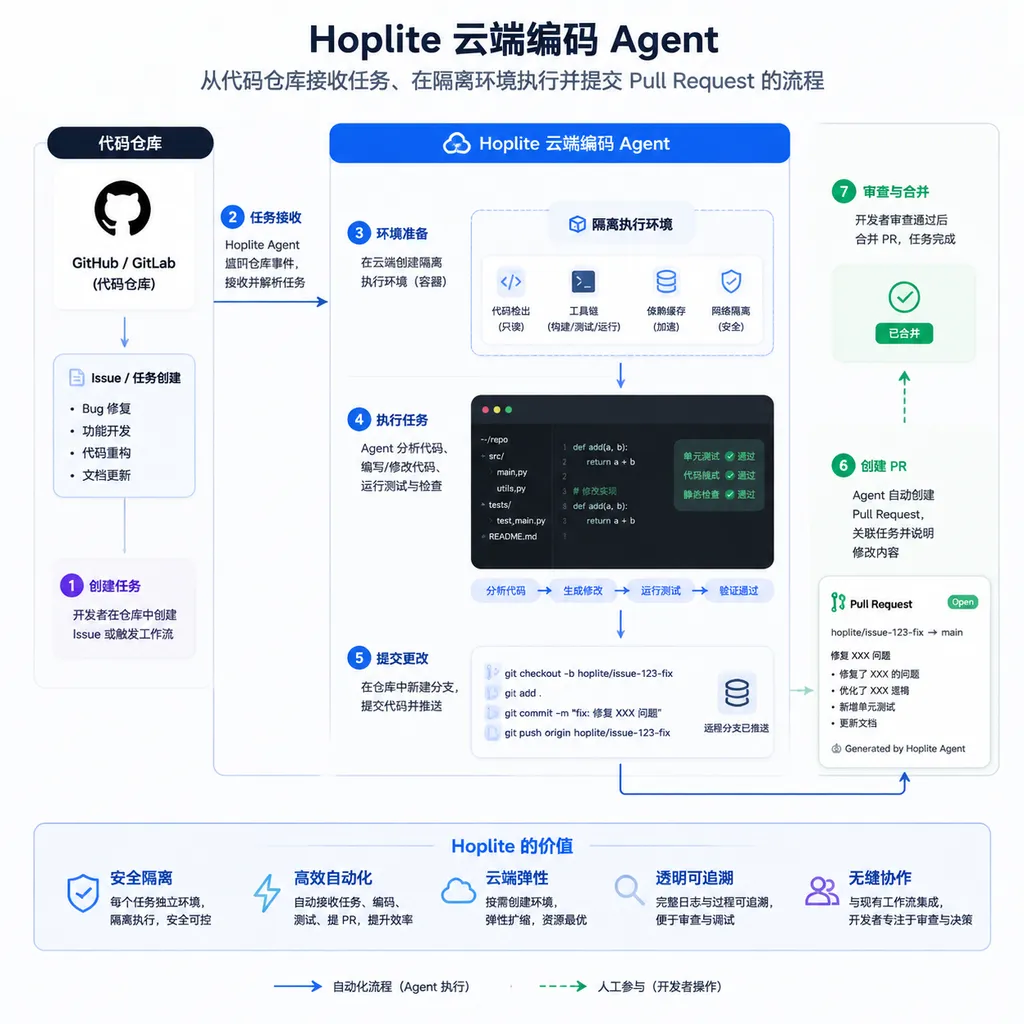
Hoplite, recently unveiled as a YC S26 startup, has launched a cloud coding agent deployment product for development teams. Its core value proposition is straightforward: enable teams to quickly deploy cloud coding agents to existing code repositories and have them collaborate with current agents or development workflows.
This does not sound like yet another Cursor, nor is it simply another chat window added to an editor sidebar. Hoplite is targeting the less glamorous infrastructure layer behind coding agents—the layer that determines whether they can actually enter a team’s production environment: connecting to code repositories, provisioning isolated runtime environments, assigning tasks to agents, managing credentials and execution states, and ultimately enabling agents to submit code changes for review.
In other words, it is not trying to sell a smarter programmer, but a system that allows “AI programmers” to be hired, scheduled, and managed at scale.
This Productization Effort Is Not About Building Yet Another Model
Over the past two years, the capabilities of coding agents have expanded rapidly. Early products focused primarily on code completion. They then became capable of making changes across files, running tests, and locating errors. More recently, agents have begun attempting to independently read issues, modify repositories, and open pull requests.
But moving from a local demo to persistent execution in the cloud requires an entire engineering system.
When a local agent fails, a developer can open a terminal, provide additional context, or rerun it. A cloud agent handling dozens of repositories and hundreds of tasks simultaneously must confront an entirely different set of problems:
- Which image, dependencies, and permissions should each task use?
- Should the agent be allowed to read production secrets?
- How can conflicts be avoided when multiple tasks modify the same branch?
- How should execution time, model calls, and compute resources be billed?
- When a task fails, should it be retried, rolled back, or handed over to a human?
- Who approves the pull requests opened by the agent, and who is responsible for the final code?
- When models or prompts change, can historical tasks still be reproduced reliably?
The market in which Hoplite operates is fundamentally about solving these problems. Its public information remains limited, and there is not yet enough evidence to confirm whether it already provides a complete set of enterprise capabilities such as secret management, network policies, audit logs, evaluation systems, and fine-grained permissions. However, given its positioning around “deployment to existing repositories,” these capabilities will sooner or later become mandatory items on the product roadmap rather than optional features.
This leads to our initial assessment of Hoplite: the direction is right, and it is closer to where team budgets are allocated than yet another editor plugin. However, the real barrier is not getting an agent to run, but keeping it from causing trouble while running continuously.
It Is More Like CI for the Agent Era Than a Cloud IDE
One way to understand Hoplite is to compare it with CI systems such as GitHub Actions.
Traditional CI receives deterministic instructions: check out the code, install dependencies, run tests, and build an image. The workflow may fail, but each step is generally predefined. A coding agent, by contrast, may receive only a single sentence, such as: “Fix the intermittent duplicate-charge issue on the checkout page and add regression tests.”
The latter must independently carry out a sequence of uncertain operations:
- Read the repository structure and project documentation;
- Search for relevant business logic and historical commits;
- Infer the path that caused the issue;
- Modify multiple files;
- Run tests and continue making adjustments based on errors;
- Summarize the changes, risks, and verification results;
- Open a pull request and wait for human review.
A cloud coding agent platform can therefore be understood as “CI with reasoning capabilities.” The core object in CI is the pipeline, while the core objects in an agent platform are tasks, context, and execution traces.
This difference also means that traditional task success-rate metrics are insufficient. Passing tests does not necessarily mean the fix is correct, and runnable code does not necessarily meet business expectations. At a minimum, a production-grade platform must retain records of what the agent saw, which tools it invoked, why it modified particular files, and whether it received human instructions during execution.
If Hoplite only provides one-click container startup and automatic code submission, existing CI/CD platforms could easily replicate it. It can create genuine product value only if it turns execution traces, human intervention, task evaluation, and repository policies into a unified control plane.
Compared with Local Coding Tools, the Cloud Model Is About Throughput
Tools such as Cursor and Windsurf remain centered on the developer’s local workstation. Their strength lies in high interaction density: developers can select code, add requirements, and immediately inspect the resulting changes. This model is well suited to highly complex tasks that depend heavily on context.
Cloud agents address a different need: allowing tasks to progress in parallel in the background.
Typical use cases include:
- Upgrading dependencies and fixing deprecated APIs in bulk;
- Adding unit tests to legacy modules;
- Handling large volumes of small, well-defined issues;
- Fixing linting, type-checking, and documentation problems;
- Synchronizing configurations or security patches across multiple repositories;
- Generating initial PRs based on requests submitted by product, operations, or support teams.
Developers do not need to monitor every step the agent takes. Instead, they intervene at key points, much as they would when reviewing code submitted by a colleague. What the team gains is not merely faster completion of an individual task, but increased concurrent throughput.
This is also the most easily underestimated aspect of cloud coding agents. They may not be able to independently complete the most difficult architectural designs, but they can work through the long-standing backlog of relatively well-defined tasks that no one wants to do. For engineering teams, such tasks are often far more numerous than projects that involve “building a complex system from scratch.”
The Paxos Case Demonstrates Demand, but It Should Not Be Counted as Hoplite’s Achievement
The reference materials also mention an internal cloud coding agent at Paxos called “Hoplites.” Paxos stated that this internal system at one point contributed approximately 15% of the company’s code commits and gradually added capabilities such as task planning, scheduled execution, and the ability to provide additional instructions through Slack while a task was in progress.
This case is highly representative. Enterprises often begin by asking agents to handle miscellaneous chores, but quickly move on to demanding task queues, mid-execution course correction, cross-team triggers, and traceable deliverables. Once agents enter real workflows, the question rapidly shifts from “Can they write code?” to “Can they be managed?”
However, it is important to note that there is currently insufficient public information to prove that Paxos’s internal Hoplites system and the newly launched Hoplite product are the same product or are directly related. Their names are similar, but Paxos’s share of code commits should not be treated as customer data for Hoplite.
The case is better understood as evidence from the demand side: large technology teams are willing to build such platforms internally, while Hoplite is attempting to package a type of internal system that only a small number of companies currently have the capacity to build into a product that more teams can purchase directly.
The Real Challenges Are Permissions, Evaluation, and Accountability
Cloud agents are more sensitive than local tools because they need access to source code, dependent services, and development credentials without continuous human supervision. A mature product must answer at least three questions.
First, What Exactly Is the Agent Allowed to Access?
Allowing an agent only to read a repository carries a completely different level of risk from allowing it to execute arbitrary shell commands. Real-world deployments must also distinguish among repository-level tokens, cloud service credentials, test databases, and third-party API keys.
Ideally, each task should run in an ephemeral, isolated, least-privilege environment. The environment should be destroyed when the task ends, secrets should never be written to logs, and outbound network access should be restricted by domain or service. Otherwise, a single prompt-injection attack or malicious dependency could turn a coding assistant into an entry point for a supply-chain attack.
Second, How Can the Platform Prove That the Agent Got It Right?
Agent output is probabilistic. Running the same task again may result in different files being selected or a different implementation being generated. After an underlying model is updated, task performance may fluctuate even if the repository itself has not changed.
This requires the platform to establish evaluation mechanisms that go beyond unit tests, such as:
- Whether the task modified files within the expected scope;
- Whether it introduced new dependencies or licensing risks;
- Whether it reduced test coverage;
- Whether it triggered security scans or performance regressions;
- The human-review acceptance rate and rework rate;
- Which types of repositories, languages, and tasks are most likely to fail.
Without this evaluation layer, “deploying agents” simply means moving experimental scripts onto a server.
Third, Who Takes Over After a Failure?
An agent is not a deterministic build tool. It may get stuck while installing dependencies, or it may continue modifying code based on an incorrect assumption. The platform must allow developers to provide additional context during execution, terminate an unproductive path, or request replanning, rather than forcing them to wait until the task finishes before clicking “retry.”
Human intervention is not a sign that an agent is insufficiently advanced. On the contrary, it is an essential emergency brake for any production system. Who is allowed to intervene, how the intervention is recorded, and who approves the modified task will all affect whether the platform can be adopted by regulated industries and large enterprises.
Hoplite Faces Stiff Competition
Cloud coding agents have already become a crowded market. Model vendors, code-hosting platforms, AI IDE companies, and independent startups are all converging on the same position: expanding from code generation to the execution of complete software tasks.
Hoplite’s opportunity lies in remaining neutral with respect to models and agents. Teams are unlikely to use only one coding agent in the future. Some models excel at understanding large codebases, some are less expensive, and others are better suited to visual frontend tasks. If an independent deployment layer can unify repository permissions, task queues, auditing, and evaluation, it could become the control plane for multi-agent environments.
However, a neutral platform can also be squeezed by both upstream and downstream players. Code-hosting platforms inherently control repositories, issues, permissions, and CI data; model vendors control reasoning capabilities and inference costs; and AI IDEs own the developer entry point. Hoplite must demonstrate that an independent layer not only supports more agents, but also significantly reduces operations and governance costs.
At present, the most important question is not how many models it supports, but whether it can later disclose the following information:
- Supported code-hosting platforms and solutions for private enterprise repositories;
- Runtime isolation and network security mechanisms for agents;
- Whether custom images, tools, and task templates are supported;
- Capabilities for execution tracing, cost tracking, and quality evaluation;
- Pricing for concurrent tasks and how failed tasks are billed;
- Depth of integration with existing CI systems, issue trackers, and team communication tools.
Conclusion: The “Picks and Shovels” Strategy Makes Sense, but Product Maturity Remains Unproven
Hoplite’s launch reflects a shift in focus within the coding-agent market. Competition is no longer centered solely on who can generate better-looking code, but on who can bring agents into real repositories safely, reliably, and cost-effectively.
Products of this kind offer clear value. Many teams can already use an agent to complete an individual task, but lack the resources to build their own execution environments, permission systems, task queues, audit logs, and evaluation platforms. If Hoplite can reduce all of these steps to a single repository authorization flow and a small amount of policy configuration, it has the potential to become development infrastructure rather than merely another AI tool.
Caution is still warranted at this stage. Launching an agent in the cloud is not difficult. The real challenge is ensuring that, after one thousand consecutive tasks, the team still knows what the agent did, how much it cost, and which results can be trusted. Hoplite has identified the right problem. What it must prove next is that it offers not merely “easier execution,” but “easier control.”
References and Further Reading
- GitHub: Search for Cloud Coding Agent Projects — For exploring the open-source ecosystem related to cloud coding agents, execution sandboxes, and repository automation.
- Reddit: Search for Discussions of the Hoplite Cloud Coding Agent — For tracking follow-up discussions in the developer community about Hoplite’s launch and similar products.
- Stack Overflow: AI Agent Questions — A community reference for issues related to agent tool use, permission controls, and engineering integration.