AWS Deploys Superblocks in a Private Cloud
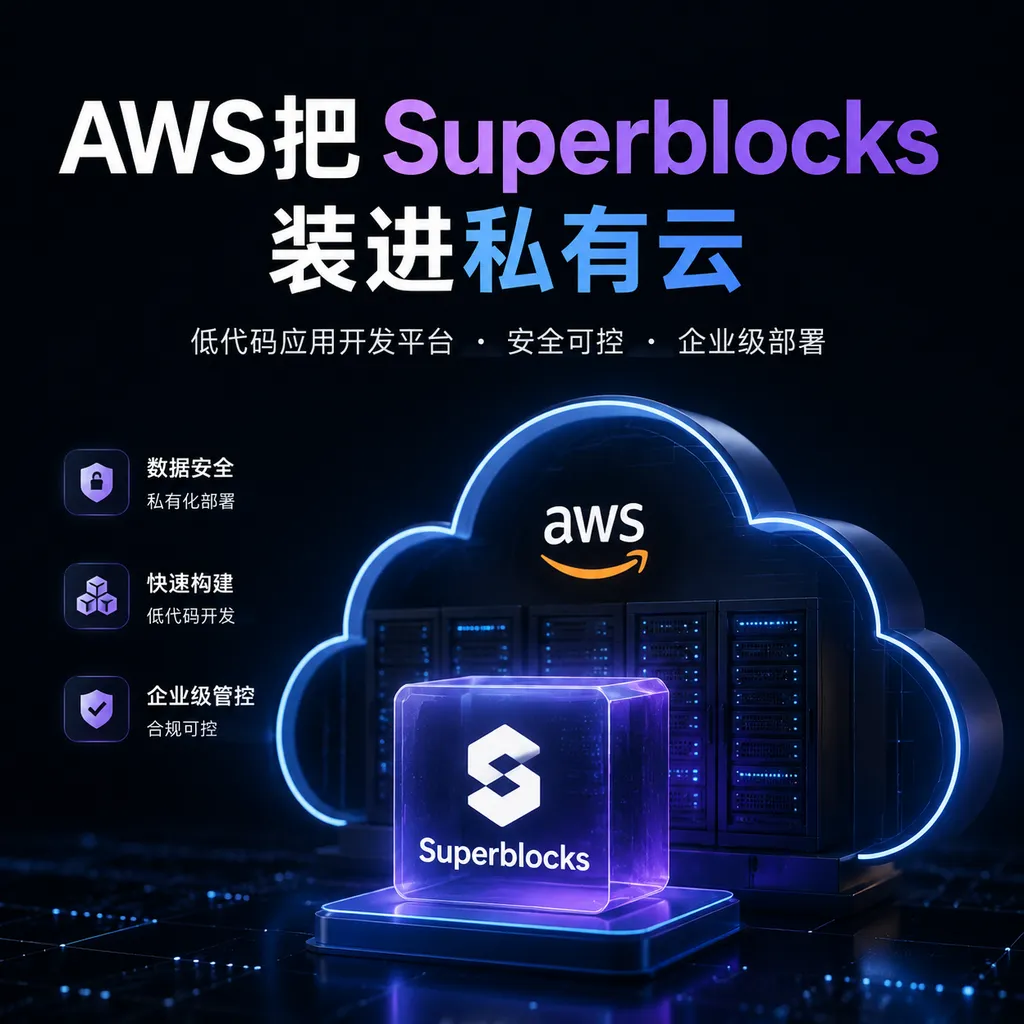
AWS now supports embedding Superblocks’ Vibe Coding tool into customers’ private clouds. This further frees enterprise AI applications from dependence on a single model, though new points of lock-in may shift to cloud platforms and governance layers.
Vibe Coding Is Beginning to Enter Truly Sensitive Enterprise Territory
On August 3, AWS began supporting the deployment of Superblocks’ Vibe Coding tools within customers’ private cloud environments. At first glance, the change merely moves the deployment location from a SaaS vendor’s cloud into an enterprise’s own AWS account and network perimeter. In reality, however, it addresses one of the hardest obstacles for generative AI entering production systems: whether enterprises are willing to hand their database schemas, internal APIs, business logic, and access credentials over to external AI tools.
Superblocks itself is designed for enterprise application development. Its core use case is not generating a demo webpage, but building internal admin panels, operations tools, approval workflows, and data applications. Such applications often connect directly to production databases, identity systems, CRMs, ticketing platforms, and payment or order services. How quickly code can be written is only the first layer of the problem. What truly determines whether a product can go live is where the data flows, who can access which resources, and whether every operation can be audited.
Embedding Vibe Coding tools in a customer’s private cloud means that an AI development assistant is no longer inherently a black box sitting outside the enterprise’s infrastructure. It can operate closer to the data, permissions, and runtime environment, while being more readily incorporated into existing IAM, network isolation, secrets management, and logging systems.
The significance of this move goes beyond giving Superblocks another deployment option. It sends a broader signal: the AI application layer is becoming further decoupled from the underlying models, with models gradually receding from being the product itself into the role of replaceable inference engines.
“Embedded in a Private Cloud” Does Not Simply Mean Moving the Interface into a VPC
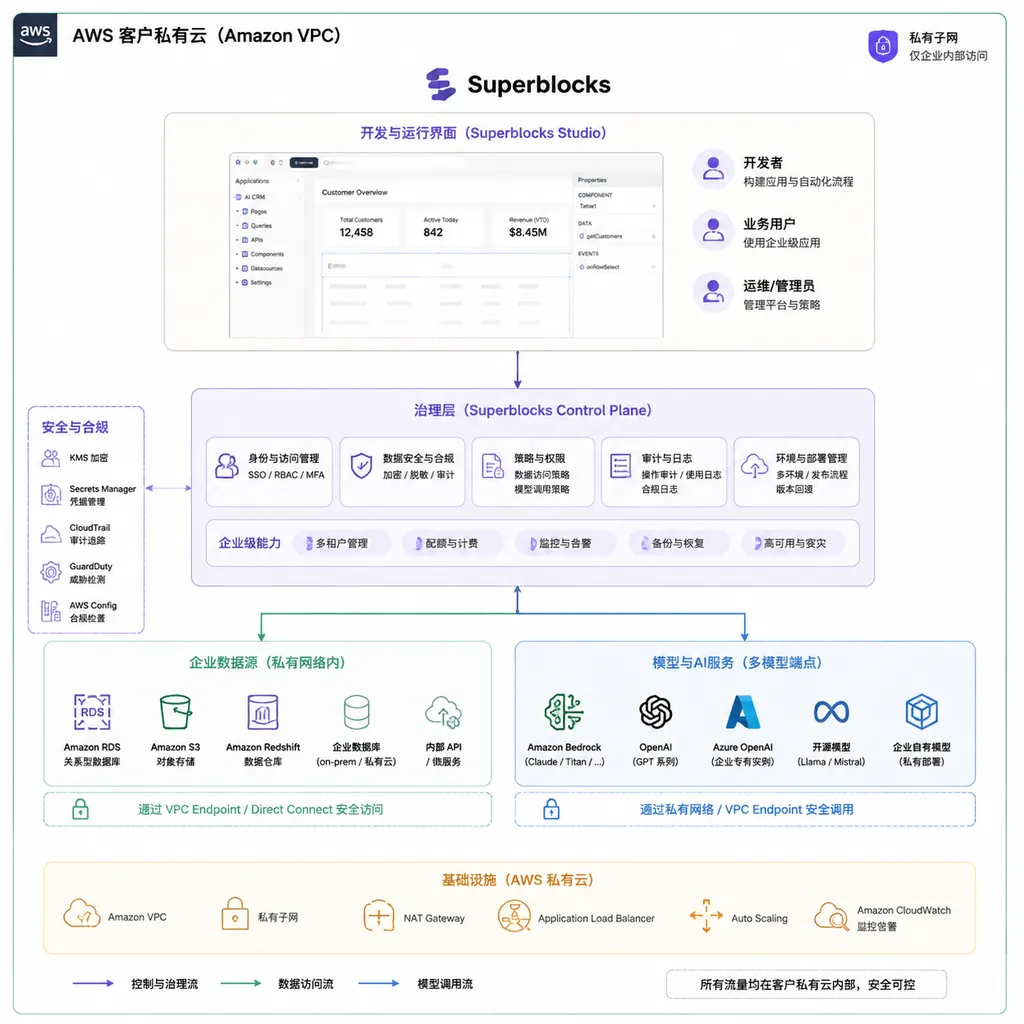
Here, “private cloud” more precisely refers to an AWS account, VPC, and security perimeter controlled by the customer. It should not be understood simply as an enterprise’s on-premises data center, nor does it necessarily mean that the full model weights are deployed within the customer’s network.
What enterprises truly care about is how the data plane and control plane are divided. A production-grade AI development tool will interact with at least the following types of information:
- Database table structures, field names, and sample data;
- Internal API definitions, business workflows, and error logs;
- Natural-language requirements entered by users and conversation histories;
- AI-generated code, SQL, configurations, and execution results;
- Access credentials for Git repositories, cloud resources, and third-party systems;
- Developer identities, approval records, and application release histories.
Traditional cloud-based Vibe Coding products generally require this context to leave the customer’s environment, with retrieval, orchestration, and model calls handled by a vendor-hosted control plane. Even if the vendor promises not to use the data to train models, security teams must still address issues such as cross-boundary data transfers, retention periods, subprocessors, and incident response.
Once the tool is embedded in the customer’s private cloud, a more sensible architecture is to keep connectors, executors, context retrieval, and sensitive logs within the customer’s environment wherever possible. Only filtered prompts or intermediate results are sent to model endpoints. Enterprises can also use IAM roles, outbound network rules, KMS keys, and audit logs to restrict what the AI tool can see, what it can modify, and where it can send information.
However, “running inside a VPC” does not automatically mean secure. Development and procurement teams still need clear answers to several questions:
- Are prompts, code, and execution logs sent back to Superblocks’ control plane?
- Is model inference performed over the public internet, a dedicated connection, or a private endpoint?
- Can the vendor remotely access the customer environment, and is such access subject to approval and auditing?
- When generated code is executed, does it use the developer’s identity, the application’s identity, or a shared high-privilege role?
- Can data retention, telemetry, and diagnostic reporting be disabled independently?
- When a customer deletes an application, are vector indexes, caches, and backups deleted as well?
If these boundaries are not clearly defined, a so-called private deployment may merely place an execution agent inside the VPC while leaving core orchestration, telemetry, and context processing under the control of an external SaaS platform. For enterprises with stringent compliance requirements, the distinction is substantial.
AI Applications Are Beginning to Treat Models as Replaceable Components
The more noteworthy aspect of this partnership is that the relationship between applications and models is changing.
First-generation generative AI products were typically built around a specific model: prompts were optimized for it, tool-calling formats depended on it, and safety policies and evaluations were tied to it. Once the model was replaced, the output structure, latency, cost, and even the types of errors could all change, forcing the application layer to be rewritten as well.
Enterprise AI architecture is now gradually taking shape across three layers:
| Layer | Primary Responsibilities | What Enterprises Actually Care About | | --- | --- | --- | | Application layer | Interfaces, business processes, permissions, and data connections | Whether it can solve specific business problems | | Orchestration and governance layer | Context, routing, tool calls, evaluation, and auditing | Whether it is stable, secure, and observable | | Model layer | Understanding, generation, reasoning, and multimodal processing | Quality, cost, latency, and availability |
Superblocks occupies the first two layers, while AWS is attempting to control infrastructure, governance, and model access simultaneously. As for which model is used at the bottom layer, it can theoretically be selected dynamically based on the task: complex code generation can be assigned to a more capable model, field extraction to an inexpensive small model, sensitive tasks to enterprise-approved endpoints, and batch processing to an option with lower throughput costs.
This resembles the way database applications gradually became independent of specific hardware. Developers ultimately care about SQL interfaces, transactional semantics, and availability—not which physical disk happens to execute each query. Models are undergoing a similar process of becoming infrastructure: applications invoke capabilities and service levels without having to bind the product’s identity to a specific model name.
OpenAI-compatible APIs, multi-model routing, and unified authentication are accelerating this shift. Aggregation layers such as OpenAI Hub address cross-model access, while the combination of AWS and Superblocks goes a step further by bringing model selection into the enterprise network, permissions, and application development system. Both point toward the same trend: models remain important, but they no longer inherently control the application layer.
AWS’s Strategy: The Models Do Not Have to Win Every Time, but the Workloads Must Stay
AWS has always occupied a distinctive position in the generative AI race. It has its own cloud infrastructure and AI services, provides access to multiple models through Amazon Bedrock, and is also a major cloud partner of Anthropic. Rather than betting on a single model, AWS would prefer to become the infrastructure layer through which enterprises access, deploy, and govern a variety of models.
Supporting Superblocks inside customers’ private clouds fits this strategy well.
Enterprises may reassess which models they use every few months. The model with the best coding capabilities today may no longer lead next quarter, while cost, context length, and compliance requirements will continue to change. If AWS relied solely on a particular model to compete for developers, it would bear the risk created by shifting model rankings. Conversely, as long as the applications, data, identities, and auditing systems all run on AWS, replacing the underlying model will not cause the workload to leave AWS.
In other words, AWS does not necessarily need to rank first with every model release. It wants to become the layer that does not get replaced when models are switched.
Superblocks also stands to benefit. The front-end experience in the Vibe Coding market is easy to replicate: generating pages from natural language, modifying components, and connecting APIs are no longer difficult capabilities to obtain. The real moat is shifting toward enterprise system integration, permission models, version management, observability, and deployment options. By entering customers’ private clouds, Superblocks is selling more than “building applications through chat.” It is selling an enterprise application production pipeline that security teams can accept.
This Is Not the Same Contest as Cursor or Claude Code
Comparing every Vibe Coding product side by side can make it easy to overlook that they target different deliverables.
Cursor, Claude Code, and similar coding agents primarily serve developers, operating on code repositories, terminals, and development toolchains. They can write complex code, but deployment still depends on a team’s own testing, CI/CD, and cloud deployment systems.
Superblocks is closer to an internal enterprise application platform. After users describe their requirements in natural language, the goal is usually to quickly generate a business application that can connect to real data and permission systems. It may not replace professional development environments, but it can eliminate much of the glue work between an internal tool entering the requirements queue and going live.
Private-cloud embedding is therefore more valuable to Superblocks than it would be to an ordinary code-completion tool. A coding assistant that occasionally reads a repository and an application platform that maintains long-term connections to production databases and continuously executes queries represent entirely different levels of risk.
Its direct competitors are not limited to other Vibe Coding startups. They also include low-code platforms, cloud vendors’ AI development tools, and enterprise-built agent platforms. Superblocks’ strengths lie in its application-building experience and enterprise connectors, while AWS’s advantage is the identity, networking, and resource infrastructure that customers already have in place. Their combination reduces the cost of establishing a new AI operating perimeter within the enterprise.
But the trade-off is equally clear: the deeper the deployment, the harder the migration.
Model Decoupling Does Not Mean the Absence of New Lock-In
“Decoupling from models” sounds as though vendor lock-in is disappearing, but the reality is more complicated. The lock-in is merely moving up from the model layer.
Once an enterprise places application logic, permission policies, model routing, evaluation data, audit records, and deployment processes into a single platform, it may be able to replace GPT with Claude, Gemini, or another model at any time—but replacing the platform itself may still be difficult. What is truly hard to migrate is usually not an individual API call, but the governance rules and business state that have accumulated around that API.
In the future, enterprises will need to consider three types of portability:
- Model portability: Whether the same task can be switched between different models without rewriting the application;
- Cloud portability: Whether the application can leave a specific VPC, IAM environment, and set of managed services;
- Platform portability: Whether workflows, connectors, evaluation sets, and permission definitions can be exported.
Of these, model portability is the easiest to demonstrate and market. Platform portability is the one with the highest long-term cost.
Moreover, supporting multiple models does not mean that they are interchangeable without distinction. Different models still vary significantly in their tool-calling behavior, the stability of their structured outputs, context handling, and refusal policies. To achieve genuine model decoupling, the orchestration layer must provide a unified contract and use continuous evaluation to determine whether a given model is suitable for a particular task.
For example, a workflow that generates SQL cannot merely assess whether the answer looks reasonable. It must also check:
- Whether it references nonexistent fields;
- Whether it bypasses row-level permissions;
- Whether it generates costly full-table scans;
- Whether it includes write operations or dangerous statements;
- Whether the success rate declines after a model upgrade;
- Whether failures can automatically fall back to another model or human approval.
Without these mechanisms, so-called model routing merely turns the vendor name into a configuration option. The application will still behave unpredictably whenever the model is changed.
This Path Is Closer to Revenue Than Simply Building “More Powerful Models”
Over the past two years, the most eye-catching aspect of Vibe Coding has been generation speed: creating a website with one sentence or generating an application in minutes. But enterprises will not hand over production data simply because a demo is fast. Products that actually win budget must answer questions about permissions, deployment, accountability, and auditing.
AWS bringing Superblocks into customers’ private clouds shows that this market is beginning to shift from personal productivity tools toward enterprise infrastructure. The winners may not be determined by who can generate a page the fastest, but by who can keep AI-generated applications running reliably in production and establish clear lines of responsibility when something goes wrong.
Our assessment is that this is a material positive for Superblocks and a validation of its strategic direction: general-purpose model capabilities are becoming increasingly easy to obtain, while the value of enterprise AI products will become more concentrated in data connectivity, execution environments, and governance systems. AWS, meanwhile, is further strengthening its narrative as a neutral infrastructure provider—no matter how model rankings change, applications should ideally continue running in its cloud.
But the words “private cloud” are no substitute for an architectural review. When adopting such tools, enterprises should map the entire model-calling chain, control-plane location, telemetry scope, and permission identities into a data-flow diagram, rather than merely checking whether “VPC” appears on the deployment page. Only when sensitive context, execution permissions, and audit records are genuinely under the customer’s control does this form of embedding become more than SaaS in different packaging.
Over a longer time horizon, the decoupling of AI applications from models is almost irreversible. Model update cycles are too fast, price differences are too large, and no single vendor can permanently monopolize every task. Application platforms will increasingly resemble scheduling systems: business workloads run at the top, models are selected at the bottom, and the layer in between is responsible for constraining unstable probabilistic outputs into production-ready software behavior.
That middle layer is precisely what AWS and Superblocks are advancing through this initiative.
References
- Superblocks GitHub organization page: Used to review Superblocks’ public projects, development tools, and related technical assets.
- AWS Samples GitHub organization page: AWS’s official collection of examples, useful for understanding common deployment patterns involving VPCs, identity and access management, generative AI, and enterprise applications.
- Stack Overflow: Amazon VPC questions: Technical discussions from the developer community about VPC network isolation, private endpoints, and connectivity within the cloud.