
OpenAI Releases GPT-5.4-Cyber: The First Large Model Dedicated to Cybersecurity

OpenAI released GPT-5.4-Cyber yesterday, the first specialized large model deeply fine-tuned for cybersecurity scenarios. It supports advanced workflows such as binary reverse engineering but is only available to vetted security experts.
OpenAI Releases GPT-5.4-Cyber: The First Large Model Dedicated to Cybersecurity
Yesterday (April 14), OpenAI released GPT-5.4-Cyber, their first large language model deeply fine-tuned for cybersecurity scenarios. This model is based on GPT-5.4, which was released in March, but with significant adjustments to permission and capability boundaries—it can perform binary reverse engineering and malware analysis, operations strictly restricted in general-purpose models.
But don’t rush to try it yet—the model isn’t open for free use. OpenAI has placed it under the Trusted Access for Cyber (TAC) program, limiting availability to vetted security vendors, researchers, and critical infrastructure defenders. Individual users must verify their identity on the official website, and enterprise customers must apply through designated representatives. Feedback suggests the review bar is quite high—some complained that “it looks tough to pass,” while others asked if a New Zealand driver’s license could be used for verification.
Why Build a “Reduced Refusal Boundary” Model?
The core change in GPT-5.4-Cyber is its “lowered refusal boundary.” General-purpose large models are designed to prevent misuse and thus refuse many security-related requests—if you ask how to reverse engineer a binary file, it will likely reply, “I can’t help with that.” But for real security researchers, that capability is an essential part of daily work.
This conflict became even more pronounced after the release of the GPT-5 series. Starting with GPT-5.2, OpenAI introduced “cyber-specific safety training,” and by GPT-5.4 the model’s cyber capability level was marked as “high.” As model capabilities grow, the asymmetry between defenders and attackers becomes clearer—if only attackers have access to the strongest tools, defenders are automatically at a disadvantage.
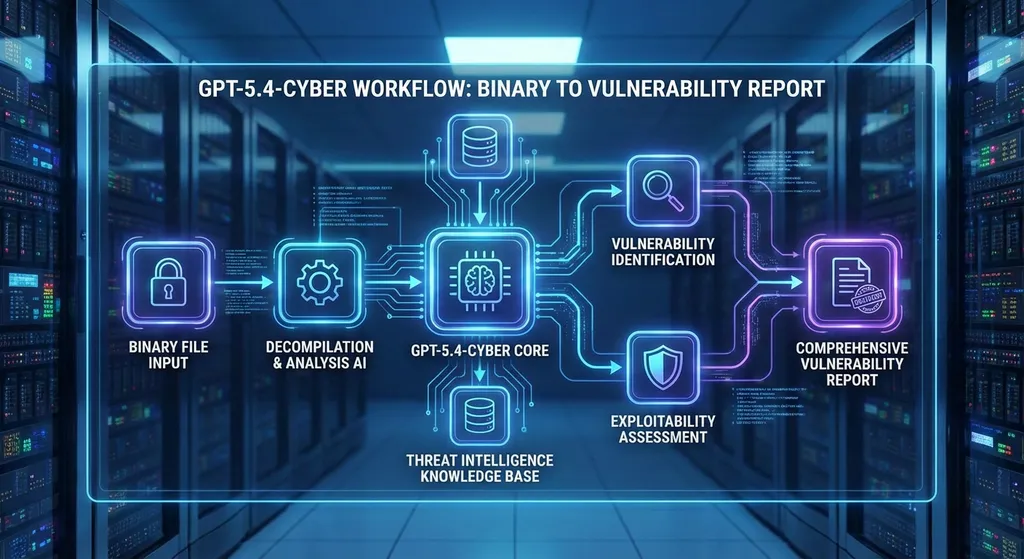
OpenAI’s solution: create a version specifically for defenders, grant it broader access, but tightly control who can use it. GPT-5.4-Cyber supports workflows like:
- Binary reverse engineering: Analyze compiled software to identify malicious code and vulnerabilities
- Vulnerability research: Test and validate security flaws in controlled environments
- Threat intelligence analysis: Process and correlate large-scale security data
- Security education: Conduct training and exercises in dual-use scenarios
Technical Details: More Than Just Fine-Tuning
GPT-5.4-Cyber isn’t just GPT-5.4 with a few extra rounds of security dataset training. According to OpenAI, the model includes targeted optimizations across several dimensions:
1. Context window and tool use
GPT-5.4 already supports a 1-million-token context window—particularly valuable for security analysis. You can feed the entire codebase, log files, and network data into the model at once for global analysis. GPT-5.4-Cyber further enhances tool use, achieving higher accuracy with fewer tool calls in the Toolathlon benchmark.
In practice, this means: traditional vulnerability scanners may produce reports listing hundreds of potential issues, but you must manually identify the high-risk ones. GPT-5.4-Cyber can automatically read the scan results, analyze contextual code, query vulnerability databases, assess impact, and finally output a prioritized remediation plan—all in just a few tool calls.
2. Token efficiency and inference speed
Compared with GPT-5.2, GPT-5.4 is far more token-efficient, requiring fewer tokens to solve equivalent problems. This is crucial in security scenarios, which demand frequent iterative analyses—say, when reverse engineering obfuscated malware. Greater token efficiency means faster responses and lower costs.
OpenAI also offers a /fast mode in Codex, boosting token generation speed by 1.5×. For real-time security operations such as analyzing logs during an active incident, that speed increase can be game-changing.
3. Search and information integration
GPT-5.4-Cyber inherits GPT-5.4’s enhanced web browsing capability. In BrowseComp tests, GPT-5.4 demonstrated improved persistence, conducting multiple rounds of searches and summarizing key content from vast datasets. This is extremely useful for threat intelligence analysis—security analysts often need to aggregate information from public sources (blogs, vulnerability databases, social media). GPT-5.4-Cyber can automate that process.
Deployment Strategy: Iterative Access vs. Blanket Restrictions
OpenAI is using a “limited and iterative” deployment strategy for GPT-5.4-Cyber. The logic is: rather than imposing blanket restrictions, give the people who genuinely need it stronger tools—but with tight access controls.
Specifically, OpenAI defined three access tiers:
- Individual security researchers: Must verify identity on the official site and submit proof of work and intended use.
- Corporate security teams: Apply through a company representative with details on team size, operations, and security needs.
- Critical infrastructure defenders: Highest priority; OpenAI will proactively reach out and offer access.
The key idea is reliance on objective standards, not subjective judgment. OpenAI emphasizes verified identifiers and automated checks rather than manual assessments of one’s “good intentions.” In theory, this approach is fairer, but in practice, it may be quite strict—community feedback indeed suggests concern about the high review threshold.
OpenAI specifically labels this model as intended for legitimate defensive cybersecurity work, excluding offensive use. However, that boundary can be blurry in real-world practice—the same reverse engineering tools can serve both defensive and offensive purposes. OpenAI is betting that access control and usage monitoring will keep the risks within acceptable limits.
Benchmarking Claude Mythos: The Battle of Vertical Models Begins
GPT-5.4-Cyber inevitably invites comparisons with Anthropic’s Claude Mythos. While Anthropic hasn’t officially released a dedicated cybersecurity model, its naming and positioning point in the same direction: deeply optimized vertical models for specialized domains.
That trend is interesting. Over the past year, large model vendors have competed around general-purpose benchmarks—who has the higher scores, who has the longer context. Now they’re realizing that general models may not perform best in specialized contexts. Cybersecurity is a textbook example: what you need isn’t just “intelligence,” but “bravery”—bravery to analyze malware, test exploits, and give potentially risky recommendations.
Technically, GPT-5.4-Cyber and Claude Mythos may diverge. OpenAI’s strength lies in tool use and computer control—GPT-5.4 is its first general model with native computer operation, ideal for automated security testing. Anthropic’s edge lies in reasoning depth and alignment—Claude 3.5 Sonnet excels in complex reasoning, and if that’s applied to cybersecurity, it could yield unique advantages in threat analysis and vulnerability research.
Ecosystem Building: More Than Just a Model Launch
OpenAI also introduced several supporting initiatives with the GPT-5.4-Cyber release, signaling that cybersecurity is a long-term strategic focus—not just another model launch.
Codex Security Tool
Launched earlier this year, Codex Security continuously monitors codebases and suggests fixes. According to OpenAI, it has already helped remediate more than 3,000 high and critical vulnerabilities. The number may seem modest, but since the tool focuses only on high-risk issues and launched recently, the impact is likely far greater.
Codex Security identifies and analyzes vulnerabilities in context—it doesn’t merely flag problems but considers project architecture, best practices, and code context to produce directly usable fixes. This is particularly valuable for small teams lacking dedicated security engineers.
Cybersecurity Grant Program
OpenAI’s Cybersecurity Grant Program, started in 2023, funds security research and tool development. Details remain limited, but strategically, OpenAI aims to build a security ecosystem around its models—encouraging researchers and developers to build security tools on top of GPT, creating a positive feedback loop.
Three Core Strategies
OpenAI summarizes its cybersecurity vision in three pillars:
- Democratized access: Equip legitimate defenders with advanced defensive capabilities
- Iterative deployment: Balance capability and risk via limited rollouts and ongoing monitoring
- Ecosystem resilience: Build tools, grants, and community infrastructure
These sound ambitious, but implementation will face challenges. “Democratized access” and “restricted access” seem inherently contradictory—you can’t open access to everyone while keeping it controlled. OpenAI’s bet on “objective standards” still needs real-world verification.
API Usage Example: Integrating the Model into Applications
While GPT-5.4-Cyber is currently available only through TAC authorization, it should follow OpenAI’s standard API format. Once approved, you could invoke it via OpenAI Hub like this:
import openai

# Configure OpenAI Hub
openai.api_base = "https://api.openai-hub.net/v1"
openai.api_key = "your-openai-hub-key"

# Call GPT-5.4-Cyber for binary analysis
response = openai.ChatCompletion.create(
    model="gpt-5.4-cyber",
    messages=[
        {
            "role": "system",
            "content": "You are a professional security researcher specializing in binary reverse engineering and malware analysis."
        },
        {
            "role": "user",
            "content": "Analyze the disassembly code of this binary file, identifying suspicious system calls and network communications:\n\n[disassembly code]"
        }
    ],
    temperature=0.3,  # Security analysis needs deterministic output
    max_tokens=4000
)

print(response.choices[0].message.content)
For multi-round analyses, you can combine tool calls:
tools = [
    {
        "type": "function",
        "function": {
            "name": "query_vulnerability_database",
            "description": "Query known vulnerability databases",
            "parameters": {
                "type": "object",
                "properties": {
                    "cve_id": {"type": "string"},
                    "keyword": {"type": "string"}
                }
            }
        }
    },
    {
        "type": "function",
        "function": {
            "name": "analyze_network_traffic",
            "description": "Analyze network traffic data",
            "parameters": {
                "type": "object",
                "properties": {
                    "pcap_data": {"type": "string"},
                    "filter": {"type": "string"}
                }
            }
        }
    }
]

response = openai.ChatCompletion.create(
    model="gpt-5.4-cyber",
    messages=[
        {
            "role": "user",
            "content": "Analyze the behavior of this suspicious process and determine if it’s malware."
        }
    ],
    tools=tools,
    tool_choice="auto"
)
OpenAI Hub supports unified calls across major large models, making it easy to compare performance on security analysis tasks by switching the model parameter. Note that GPT-5.4-Cyber’s access is independently managed—you must pass TAC review before enabling it in OpenAI Hub.
Pricing and Cost Considerations
OpenAI hasn’t announced separate pricing for GPT-5.4-Cyber, but based on GPT-5.4’s tiering, we can infer a few things. GPT-5.4 has a higher per-token rate than GPT-5.2, but its improved token efficiency offsets the cost. In high-context and multi-turn tasks like security analysis, efficiency translates directly into savings.
OpenAI offers three pricing tiers:
- Standard API: For general use
- Batch and Flex: Half the standard rate, for non-real-time bulk analysis
- Priority: Double the rate, offering faster response times
For 24×7 Security Operations Centers (SOCs), Priority may be essential. For research or offline tasks like vulnerability studies and threat analysis, Batch mode is more economical.
Controversies and Risks: Can This Boundary Hold?
The release of GPT-5.4-Cyber inevitably brings controversy. The central question: how can you ensure a “lower-refusal” model won’t be misused?
OpenAI’s answer is “strict access control + continuous monitoring.” But in practice, that’s not foolproof:
- Limits of identity verification: Confirming someone’s credentials doesn’t guarantee ethical behavior. Insider threats are an ongoing issue.
- Knowledge diffusion: Even if the model itself is secured, knowledge learned from it can spread uncontrollably.
- Escalating asymmetry: If only “good actors” have access, “bad actors” will try to bypass controls or build their own tools—escalating the cyber arms race.
OpenAI is clearly aware of these risks. They emphasize iterative deployment—start small, monitor usage, and adjust strategy. This cautious stance makes sense but means widespread access is unlikely soon.
On a broader level, GPT-5.4-Cyber symbolizes a pivotal shift in AI safety: from “blanket restriction” to “tiered access.” This shift is inevitable—as models grow more powerful, rigid censorship becomes untenable. But where to balance openness and safety remains unsolved.
For Developers: New Tools, New Opportunities
For developers and researchers in cybersecurity, GPT-5.4-Cyber could reshape workflows. Key use cases include:
Automated vulnerability discovery
Traditionally, vulnerability discovery demands heavy manual effort—reading code, understanding logic, constructing test cases. GPT-5.4-Cyber can automate much of this: detecting suspicious code patterns, generating proof-of-concept (PoC) exploits, and assessing exploitability. It won’t eliminate humans but can greatly boost efficiency.
Threat intelligence automation
Security teams process massive volumes of intelligence from vendors, open-source communities, and social channels. GPT-5.4-Cyber can automatically collect, correlate, and analyze such data to surface meaningful threats—and even map them to your specific systems.
Security training and simulations
GPT-5.4-Cyber can generate realistic attack scenarios for exercises. Compared to traditional red-vs-blue simulations, AI-driven scenarios are more diverse, realistic, and cost-efficient—you don’t need to hire specialized penetration testers for high-quality simulations.
Code audit assistance
Codex Security has already shown AI’s potential in code auditing. GPT-5.4-Cyber goes further by understanding business logic to detect logical and design flaws, not just known vulnerability patterns—especially useful for auditing complex systems.
Final Thoughts
The release of GPT-5.4-Cyber marks a new stage for vertical applications of large models. This isn’t just a technical decision, but a strategic one: should AI companies deeply customize for specific industries—and if so, where should the boundaries lie?
OpenAI’s answer: yes, but carefully. Choosing cybersecurity as the first vertical is smart—it has clear social value (protecting critical infrastructure) and a defensible moral boundary (defense vs. offense). Whether that line can stand will take time to prove.
For developers, GPT-5.4-Cyber brings both opportunity and responsibility. If you gain access, remember: with great power comes great responsibility. Every action you take with this tool can impact the security ecosystem as a whole.
OpenAI Hub already supports GPT-5.4-series models, and once you pass TAC review, you can use GPT-5.4-Cyber directly there. Even if most developers can’t yet access it, understanding its capabilities and constraints helps you grasp the direction of AI in cybersecurity.
References
- OpenAI launches cybersecurity-specialized AI model GPT-5.4-Cyber, rivaling Claude Mythos - IT Home – Detailed coverage from IT Home
- OpenAI releases cybersecurity-specialized model GPT-5.4-Cyber - Linux.do – Developer community discussions and access experiences
- GPT-5.4 Makes Its Debut - OpenAI Official – Official introduction to the GPT-5.4 base model
- GPT-5.4 Released: OpenAI’s First Unified Model - Zhihu – In-depth analysis of GPT-5.4’s technical features


