Tencent Hy3 Free Trial Extended Again Through the End of August

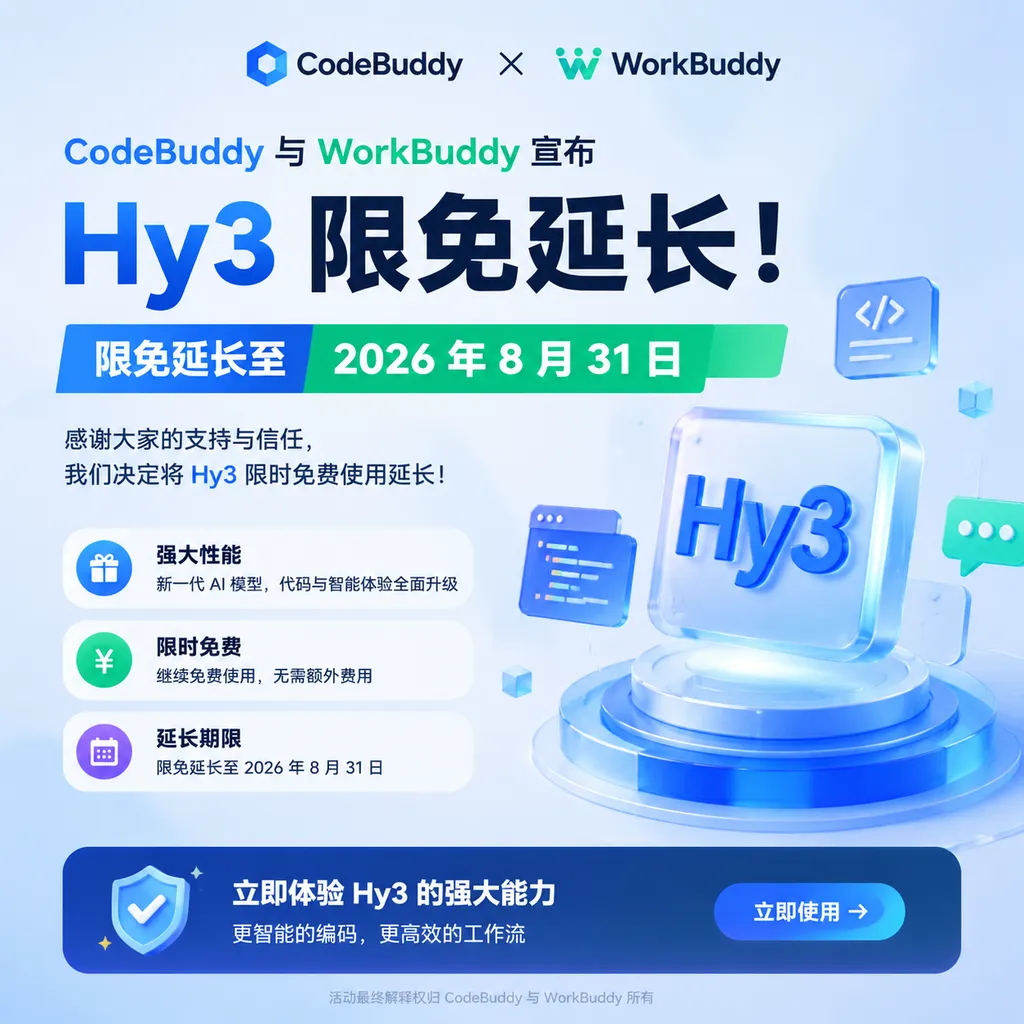
Tencent has extended the free trial period for the Hy3 model in CodeBuddy and WorkBuddy until August 31. However, free does not mean unlimited: users may need to queue during peak hours, and image and video tasks will still consume credits.
Tencent has extended Hy3’s free trial for another month.
On August 4, Tencent’s CodeBuddy and WorkBuddy announced that the limited-time free access to the Hy3 model in both products would be extended through August 31, 2026. This is already the second extension since Hy3’s release. The model was released and open-sourced on July 6, with the initial trial originally scheduled to last about two weeks. On July 20, Tencent pushed the deadline back to August 5. Now, one day before that extension was due to expire, the free-access window has once again been extended through the end of the month.
For users who have already made Hy3 their default coding or productivity model, the most immediate change is that they will not need to rush to switch models in August or reduce usage because of credit costs. At the same time, Tencent has made two boundaries clear: the free quota is not unlimited, and Hy3 is not a multimodal model.
Free Through the End of the Month, but Not Unlimited
This time, Tencent did more than announce a new deadline. It also provided specific details about the resource rules for the free trial.
Because of the large number of participating users, CodeBuddy and WorkBuddy will allocate a daily free Hy3 quota. When demand is high, requests may be placed in a queue, and the product page will display when the quota will reset or become available again. The official announcement did not specify a uniform, fixed number of tokens, nor did it promise that every user would always receive the same throughput.
This means users need to distinguish between “limited-time free access” and “unlimited usage”:
- The free-access period has been extended through August 31, referring to the duration of the campaign;
- Daily availability remains subject to resource scheduling, and requests may be queued during peak periods;
- Once the daily allocated quota has been reached, users must wait until the reset time shown on the page;
- The free access applies to calls to Hy3’s text model and does not automatically cover charges incurred by other models.
For individual developers who occasionally ask CodeBuddy to complete a function, explain a repository, or generate test cases, these restrictions are unlikely to pose a significant obstacle. However, if a team plans to use it as a reliable batch-processing engine—for example, to continuously scan large codebases, generate documentation in bulk, or run multiple agents around the clock—the free trial should not be treated as a predictable production resource.
This is the most noteworthy detail of the extension: Tencent is willing to continue trading free access for usage and feedback, but it has not presented the trial quota as an unlimited compute subsidy. The queuing mechanism may affect responsiveness to some extent, but it is more transparent than suddenly tightening the rules midway through the campaign.
Image and Video Tasks Will Still Consume Credits
Another potential source of confusion is the boundary of Hy3’s capabilities.
Tencent has explicitly stated that Hy3 is currently a large language model and does not yet support multimodal capabilities. If users initiate image, video, or similar generation tasks in CodeBuddy or WorkBuddy, the system will switch to the corresponding multimodal model rather than having Hy3 handle the task itself. These calls will continue to consume credits under the standard rules.
From the product interface, users may appear to be continuing to enter requests in the same conversation window, while model routing has actually changed behind the scenes. For example:
- Asking Hy3 to read requirements, break down tasks, and generate a written plan may fall within the scope of this free-access campaign;
- Asking the product to generate a promotional image based on that plan requires an image model, and credits will be charged as usual;
- Asking it to analyze a screenshot or understand video content likewise cannot simply be treated as a free Hy3 call;
- If a workflow includes both text reasoning and multimodal generation, only some stages may be free.
This kind of “unified front end, multiple models on the back end” product design is already common. For ordinary users, it eliminates the hassle of manually switching models. For developers and enterprise users, however, it means they must pay attention to where each task is actually routed. Seeing Hy3 in the model selector does not mean the entire agent pipeline is executed by Hy3, nor does it mean the whole pipeline is free.
295B Total Parameters, 21B Activated Per Inference
Released and open-sourced on July 6, Hy3 is Tencent Hunyuan’s current-generation model focused on reasoning, agents, and long-context tasks. It uses a mixture-of-experts, or MoE, architecture, with 295B total parameters, approximately 21B parameters activated per inference, and support for a maximum context length of 256K.
The 295B and 21B figures need to be considered together.
An MoE model does not run all 295B parameters for every token. Instead, it selects a subset of “experts” to participate in computation based on the input. It can be thought of as a large organization with multiple specialist teams: the company’s total headcount is substantial, but only the teams best suited to a given task are assigned to it. This preserves a large capacity for knowledge and capabilities while keeping the computational cost of each inference under control.
However, activating fewer parameters does not mean deployment costs are equivalent to those of a conventional 21B dense model. The complete weights still need to be stored and loaded, while expert routing, memory bandwidth, and cross-device communication also affect real-world performance. Tencent handles these infrastructure concerns for users of the Buddy products. For teams considering self-hosting the open-source weights, however, the total parameter count remains an unavoidable engineering cost.
The 256K context window is more directly relevant to practical CodeBuddy and WorkBuddy use cases. It allows the model to process more code, documents, and conversation history at once, such as:
- Reading multiple source files, API definitions, and test files simultaneously;
- Summarizing a collection of meeting notes, product materials, and requirements documents;
- Retaining context across long agent execution traces;
- Performing cross-section retrieval and synthesis over large repositories or lengthy materials.
However, maximum context length should not be equated directly with effective comprehension. Dumping hundreds of thousands of tokens into a prompt may not work as well as retrieving, filtering, and then sending selected content to the model. Long context solves the problem of “fitting it all in”; it does not automatically solve information noise, key-content localization, or reasoning stability. For developers, sensible file selection, context compression, and retrieval augmentation remain important.
“Fast-Slow Thinking Fusion” Is Better Suited to Agents Than Manual Model Switching
Tencent describes Hy3 as a model that integrates fast and slow thinking. The core value here is not simply labeling the model as capable of “deep thinking,” but attempting to strike a balance between response speed and complex reasoning.
Not every coding or office task requires a long reasoning chain. Completing boilerplate code, renaming variables, or extracting document titles should ideally produce an immediate response. Diagnosing a defect across multiple files, planning a refactor, or analyzing complex business constraints requires a larger reasoning budget. If every request uses heavy reasoning, latency and cost increase. If every request prioritizes instant responses, reliability on complex tasks becomes inadequate.
The point of integrating fast and slow thinking is to let the model choose an appropriate processing approach based on task difficulty, rather than requiring users to switch constantly between a “fast model” and a “reasoning model.” This is especially important for agents. When an agent executes a task involving more than a dozen steps, most steps are simple, while only a few critical points require deep reasoning. The ability to allocate reasoning resources dynamically directly affects the speed and cost of the entire workflow.
Of course, free access within these products does not prove that the model outperforms competitors on every task. Developers should focus instead on their actual workloads: whether code changes pass tests, whether tool calls are reliable, whether critical constraints are missed in long contexts, and whether repeated executions of the same task produce consistent results. Leaderboards and parameter counts can help with initial screening, but they cannot replace repository-level evaluations.
Repeated Extensions Look More Like a Battle for Users
Hy3’s free-access period was first extended from about two weeks to August 5, and then again to August 31. On the surface, this is a response to user demand. Behind it, however, is a clear battle for product distribution.
Model capabilities are rapidly converging, but default entry points in developer tools remain scarce. Once a model becomes the default choice in a user’s IDE, coding assistant, or workspace, it accumulates prompt habits, project context, and workflow dependencies. Even if charging resumes later, migration will involve more than simply changing a model name.
Data previously disclosed by Tencent also demonstrates the boost from free access: by mid-July, Hy3’s total call volume had grown by more than 68 times compared with the previous-generation Hy2. After launch, it also quickly captured a relatively high share of usage in Tencent products such as ima and WorkBuddy. Free access naturally amplifies usage, but the fact that users continued to request extensions at least suggests that the product has moved beyond the “try it once and leave” stage.
For Tencent, extending the campaign by another month offers three layers of benefits:
- Collecting more feedback from real-world coding, office, and agent scenarios for Hy3;
- Using CodeBuddy and WorkBuddy to establish Hy3 as users’ default model choice;
- Testing compute-supply and commercialization boundaries through mechanisms such as queuing and daily quotas.
The extension is therefore neither a simple giveaway nor a signal that the service will remain free indefinitely. It is more like a large-scale test with built-in resource controls: users receive a low-cost trial, while Tencent gains usage volume, retention data, and product feedback.
How Developers Should Use This Month
For those who simply want to try Hy3, the August window is already long enough. For those who want to determine whether it belongs in a long-term workflow, a few rounds of conversation will not be sufficient.
A more effective evaluation approach is to choose a set of tasks with verifiable outcomes:
- Use the same real-world repository to test code explanation, defect diagnosis, and cross-file modifications;
- Ask the model to generate unit tests, then run them to verify the results;
- Compare Hy3 with the models you currently use in terms of time to first token, completion time, and successful modification rate;
- Embed key facts in long documents and check whether the model can retrieve them consistently;
- Monitor tool calls, retry counts, and context loss during long, multi-step agent tasks;
- Record whether requests are queued during peak periods and whether the daily quota covers routine usage.
Enterprise teams in particular should not ignore cost assessments simply because the service is currently free. Credit rules, throughput limits, and service reliability after the free period ends will determine whether it can enter production workflows. When comparing models, it is also better to calculate the total cost of completing an acceptable task rather than comparing only the price per million tokens.
Our Assessment
This extension is a tangible benefit for CodeBuddy and WorkBuddy users, especially because it allows them to test Hy3 over a complete monthly cycle instead of rushing to a conclusion during a two-week trial. Its 295B-parameter MoE architecture, 21B activated parameters, and 256K context window give it a clear product position for coding, long-document, and agent tasks.
However, the campaign rules also send two clear signals. First, actual demand for Hy3 is already high enough to require daily quotas and queuing. Second, Tencent is still exploring the balance between acquiring users through free access and managing compute costs. Developers can treat this as a low-cost opportunity to evaluate the model, but they should not treat the current resource conditions as a formal commitment for the future service.
In short: the free-access period has indeed been extended, but what is really worth testing is not whether Hy3 can be used for free—it is whether Hy3 can complete tasks reliably in your codebase and workflows.
References
- ITHome: Tencent Extends Limited-Time Free Access to the Hy3 Model in WorkBuddy and CodeBuddy Through August 31—Includes official details on the extension period, daily free quotas, queuing during busy periods, and credit rules for multimodal tasks.