Hunyuan Hy ASR 3.0, Now Understanding Context
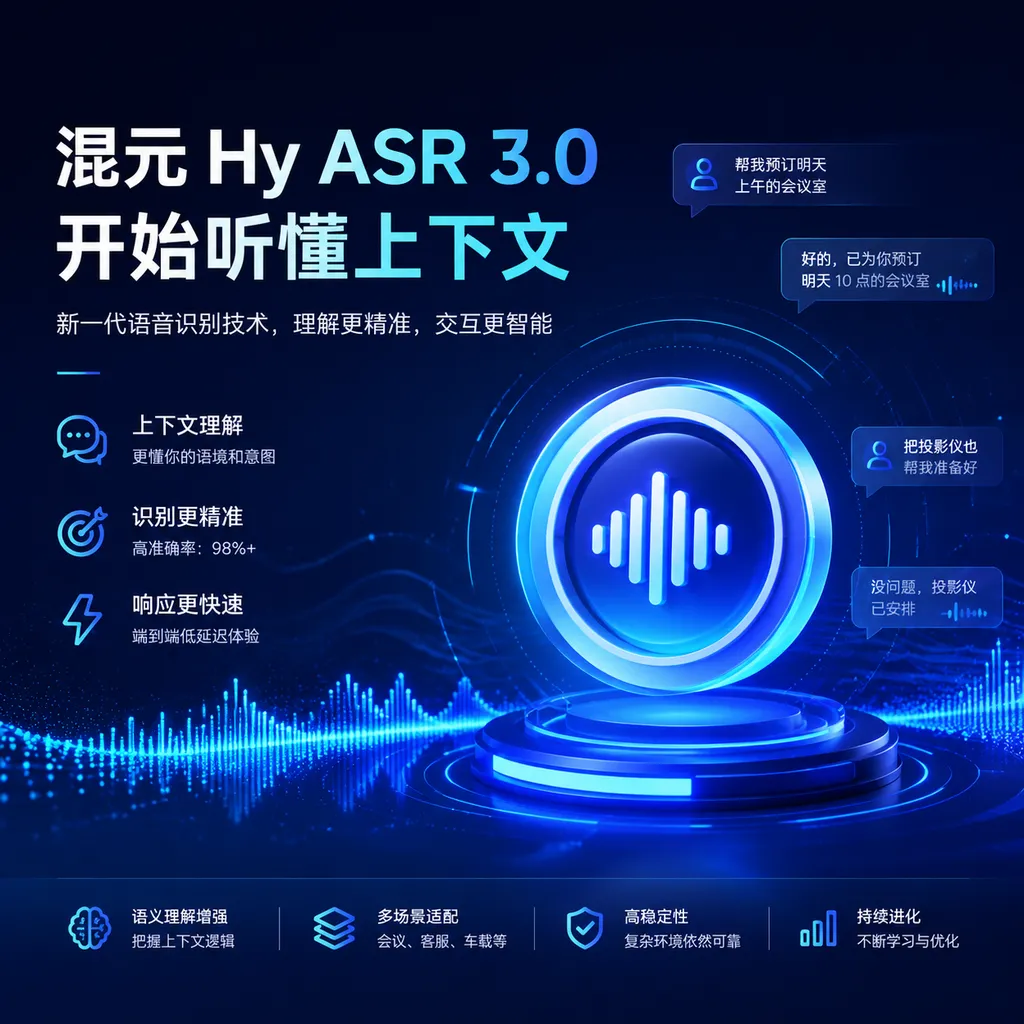
Tencent Hunyuan has released Hy ASR 3.0 Preview, achieving a word error rate (WER) of approximately 3% across most languages, while enhancing contextual awareness, semantic understanding, and robustness in complex scenarios through its MoE architecture and Hy3 language foundation model.
Hunyuan Hy ASR 3.0 Begins to Understand Context
Tencent Hunyuan released its next-generation speech recognition model, Hy ASR 3.0 Preview, on August 4, 2026. The focus of this upgrade is not simply to make speech-to-text faster, but to enable the model to combine contextual understanding during recognition to better capture the speaker’s actual intent.
According to publicly available evaluation results, Hy ASR 3.0 Preview has brought its word error rate (WER) for multilingual recognition down to around 3%: 3.34% for Mandarin Chinese, 2.62% for English, and 3.12% for Cantonese. If these metrics can be maintained in real-world business environments—especially in scenarios involving multi-person conversations, colloquial speech, dialects, and specialized terminology—Hunyuan’s speech recognition capabilities have moved beyond merely being “usable” and entered the stage of being “worth integrating for validation.”
However, one point must be made clear first: this is still a Preview version. A low WER on public evaluation datasets does not necessarily translate into the same final performance for customer-service recordings, meeting transcription, in-vehicle voice systems, or noisy environments. The truly interesting aspect of Hy ASR 3.0 lies not only in the numbers themselves, but also in its attempt to transform ASR from a simple front-end recognition module into a speech-understanding gateway with contextual modeling capabilities.
WER Nears 3%: Multilingual Performance Is the First Report Card for This Upgrade
The most common metric for speech recognition models is WER, or word error rate. Simply put, after an audio recording is transcribed into text, the fewer words the model inserts, omits, or recognizes incorrectly, the lower the WER.
For Chinese, the way WER is calculated is not exactly the same as for English. Chinese lacks naturally occurring spaces between words, and different segmentation methods applied to the same sentence may produce differences in the final metric. Therefore, a Mandarin WER of 3.34% alone cannot be directly interpreted as the accuracy rate for all scenarios, but it still indicates that the model has strong foundational recognition capabilities under relatively standard testing conditions.
Several key figures published for Hy ASR 3.0 Preview are as follows:
- Mandarin Chinese WER: 3.34%
- English WER: 2.62%
- Cantonese WER: 3.12%
- Overall multilingual performance: Most test results are controlled at around 3%
It is not surprising that the English WER is lower than that of Mandarin. English has clear word boundaries, and its public corpora and evaluation systems are more mature, making it generally easier for models to achieve stable results in standard English scenarios. Cantonese performance is more noteworthy. Cantonese includes regional pronunciation, colloquial vocabulary, modal particles, and Chinese-English code-switching, so its actual recognition difficulty is often greater than that of Mandarin. Achieving a WER of 3.12% indicates that the model’s training and adaptation for Cantonese scenarios go beyond simply transferring a Mandarin model.
For developers, the value of multilingual capabilities is not limited to “supporting more languages.” In real products, users frequently switch languages: an English product name may appear in a Chinese conversation, Mandarin technical terms may occur in a Cantonese customer-service interaction, and overseas Chinese users may mix Chinese, English, and dialects within a single sentence. If a model has to identify the language first and then switch models, the system pipeline becomes more complex, while latency and error rates also increase.
A unified ASR model with strong cross-lingual processing capabilities can reduce these engineering branches. This is particularly valuable for call centers, cross-border e-commerce, meeting records, and intelligent vehicle cabins, where a unified model means simpler deployment and more consistent post-processing logic.
From “Hearing Clearly” to “Understanding What This Sentence Means”
The boundary of traditional ASR is relatively clear: input audio and output text. Its task is to reproduce as accurately as possible what the speaker said, but it does not necessarily understand what the sentence means in the current context.
For example, a user might say: “Make the proposal we were just discussing a bit more conservative, but leave the budget unchanged for now.”
An ordinary transcription system might accurately output this sentence, but it would not know which part of the conversation “the proposal we were just discussing” refers to, nor would it know that “leave the budget unchanged for now” is a constraint on the previous task. For meeting minutes, intelligent customer service, and voice agents, this lack of context can directly affect subsequent execution.
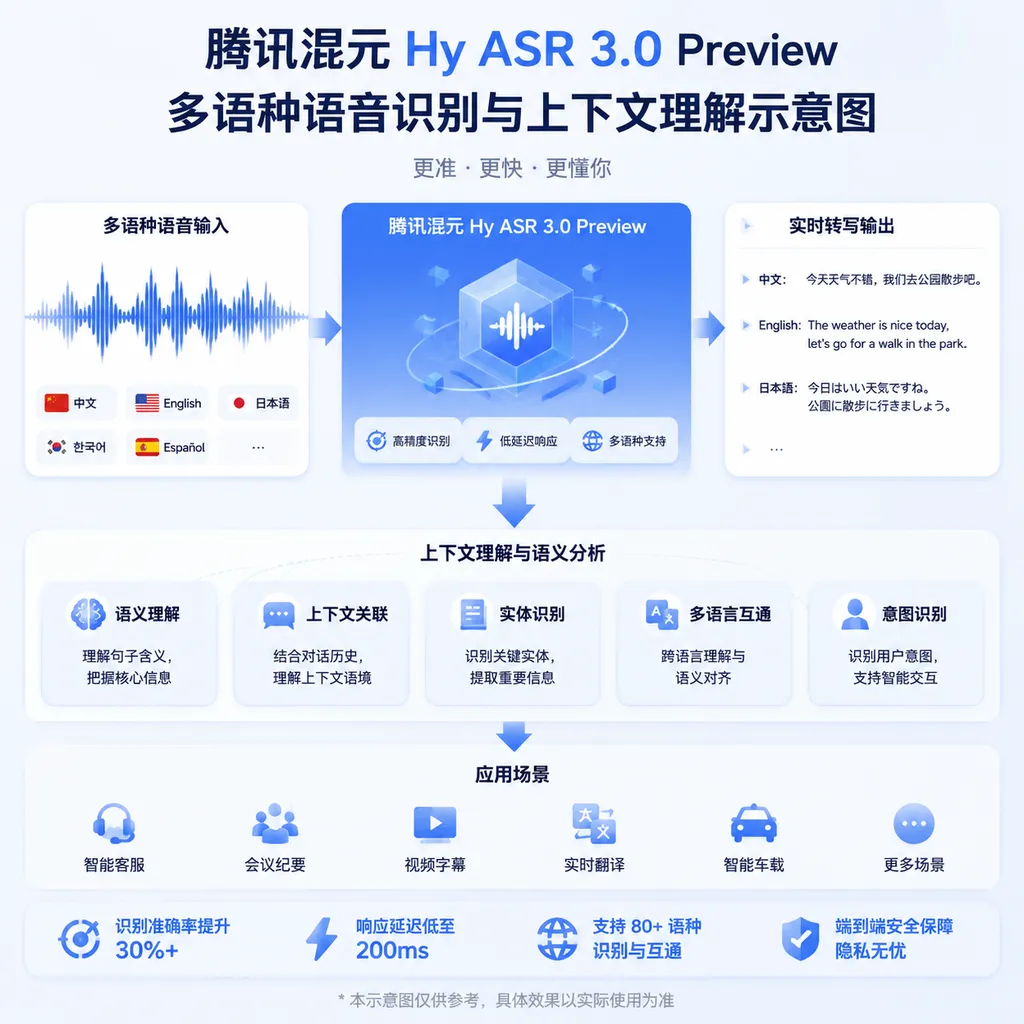
The upgrade direction of Hy ASR 3.0 Preview is to integrate speech recognition and language understanding more closely. According to the available materials, the model is built on the next-generation Hy3 language foundation and enhances language understanding, contextual modeling, and semantic reasoning capabilities. In other words, the model no longer focuses solely on the acoustic features of the current audio segment; it also uses preceding and following context to determine the most plausible meaning of a word or sentence within the current conversation.
These capabilities can address several long-standing challenges in voice products:
- Disambiguating homophones and near-homophones: Use context to select more appropriate words rather than relying solely on local pronunciation.
- Resolving references: Understand contextual references such as “what we just discussed,” “the previous one,” and “this version.”
- Correcting specialized terminology: Identify product names, personal names, company names, and technical terms based on the industry context.
- Restoring colloquial expressions: Handle pauses, repetitions, modal particles, and incomplete sentences, making the transcription more readable.
- Supporting multi-turn voice interactions: Provide more complete semantic input for subsequent question answering, retrieval, and tool calls.
This means that ASR output may no longer be limited to “raw transcribed text”; it may also become structured information interpreted through contextual judgment. For upper-layer applications, downstream large language models may no longer need to infer intent from a pile of noisy, fragmented colloquial speech, creating the possibility of a shorter voice-agent pipeline.
The Choice of an MoE Architecture: Controlling Inference Costs Rather Than Blindly Adding Compute
At the architectural level, Hy ASR 3.0 Preview adopts an MoE, or mixture-of-experts, architecture and upgrades its language foundation to Hy3.
The core idea behind MoE can be understood as follows: not all parameters inside the model work simultaneously on every request. Instead, based on the current input, the model selects the “experts” best suited to participate in the computation. When handling Mandarin, English, Cantonese, noisy environments, or specialized industry data, the model can activate different combinations of parameters.
The benefits are straightforward: while maintaining a large total parameter scale and strong capabilities, the model does not need to involve all parameters in every inference. This is particularly important for real-time speech recognition. Unlike offline text generation, ASR cannot tolerate very high latency. As users speak, the system must return intermediate results quickly; if recognition is noticeably delayed, a voice assistant may “interrupt,” wait too long, or suffer breaks in continuous dialogue.
However, MoE is not free. It increases the complexity of model routing, load balancing, and deployment scheduling. For speech services requiring large-scale concurrency, engineering teams must also pay attention to the following issues:
- Whether expert routing is stable and whether it may lead to uneven request distribution across languages or domains;
- Whether first-token latency and real-time streaming recognition latency meet business requirements;
- How expert parameters are loaded and unloaded when GPU memory is limited;
- Whether cross-segment context is lost during long-audio transcription;
- Whether inference costs per unit of audio duration remain manageable under high concurrency.
Therefore, the significance of Hy ASR 3.0’s adoption of MoE does not lie merely in having a more advanced architecture. Its ultimate value will depend on whether model quality, real-time performance, and resource consumption can be balanced simultaneously.
The Real Competition Lies in Complex Scenarios, Not Quiet Recording Studios
The performance gap between speech recognition models on clean recordings is narrowing rapidly. Today’s leading models can generally handle standard Mandarin and English, and WERs on public datasets are becoming increasingly low. The scenarios that usually distinguish models from one another are the following:
- Multiple people speaking simultaneously in a meeting room;
- Echo, compression artifacts, and background noise in telephone recordings;
- Users speaking quickly, pausing frequently, or self-correcting;
- Mandarin, Cantonese, English, and industry terminology appearing together;
- Audio containing large numbers of names, addresses, model numbers, and digits;
- The meaning of the same word changing with context during a long conversation.
The emphasis Hy ASR 3.0 Preview places on general-purpose recognition, contextual awareness, and robustness across scenarios indicates that Tencent Hunyuan’s goal is no longer merely to improve an offline evaluation score, but to validate the model within more complex product pipelines.
This is also where the competitive logic between speech models and text models is changing. In the past, when developers procured ASR services, they mainly compared recognition accuracy, price, and interface stability. Today, speech recognition is becoming the first layer of input for intelligent agents. If ASR misrecognizes a key entity, negation, or task constraint, even a powerful downstream LLM may make an incorrect decision.
For example, in a customer-service scenario, if the word “not” is omitted from “I don’t want a refund; I want an exchange,” the system may directly initiate a refund process. In medical recordings, misrecognizing a number or drug name carries even greater risk. In meeting scenarios, transcribing “do not release yet” as “officially release” could affect subsequent minutes and task assignments.
As a result, the evaluation criteria for speech recognition are expanding from “how many characters or words were incorrect” to “whether the key information required for the task was preserved.” Hy ASR 3.0’s emphasis on contextual understanding is directionally correct, but more public end-to-end task data is needed to demonstrate its benefits in these high-value scenarios.
What This Means for Developers
If your product already uses ASR, Hy ASR 3.0 Preview is worth adding to your test suite, but it is not advisable to replace your production model immediately. A more reasonable approach is to establish a small, reproducible evaluation process tailored to your business.
At a minimum, the following dimensions should be covered:
1. Do Not Test Only Average WER
Average WER can easily conceal critical errors. Error rates for names, numbers, addresses, product models, negation words, and proper nouns should be calculated separately. For customer service and enterprise applications, these words are more important than ordinary function words.
2. Treat Context as a Variable
Test the same word in different contexts, including short sentences, continuous conversations, and long meetings. Pay particular attention to whether the model can use preceding context to correct the current recognition result, rather than looking only at single-sentence results.
3. Test Streaming Capabilities
Offline full-segment recognition and real-time streaming recognition are two different products. Developers need to examine whether intermediate results roll back frequently, whether final results are stable, and whether end-to-end latency affects the interactive experience.
4. Add Real-World Noise
Do not rely only on recordings made with high-quality microphones. Add in-car noise, office reverberation, telephone compression, overlapping conversations, and far-field recordings to the test set to properly assess the model’s robustness.
5. Evaluate the Burden on Downstream Models
If Hy ASR 3.0 produces more complete text and clearer references, downstream LLMs may require less correction and intent clarification. Developers should compare token consumption, response latency, and task success rates across the entire pipeline, rather than looking only at the ASR component’s standalone metrics.
Three Issues to Keep in Mind with the Preview Version
The first is the gap between public evaluations and real-world business environments. Evaluation datasets generally have clearly defined audio quality, speaker counts, and task boundaries, while production environments are full of long-tail problems. Dialects, industry jargon, and overlapping speech in particular still require independent validation.
The second is that the model’s capabilities and service offering have not yet been fully clarified. Current public materials mainly describe the model’s capabilities and evaluation results. Developers still need to wait for more complete information about interfaces, pricing, concurrency, streaming protocols, audio formats, and data compliance. For enterprise users, these engineering conditions are just as important as model metrics.
The third is that contextual understanding may lead to “overcorrection.” ASR’s usual goal is faithful transcription, but a model with language-understanding capabilities may tend to revise colloquial speech based on context, complete sentences, or even make uncertain content sound more coherent by “guessing.” In meeting records, legal evidence collection, and medical scenarios, fluency does not necessarily equal accuracy. Products must distinguish between “raw transcription” and “semantic organization” as two different outputs.
Assessment: Hunyuan Is Turning ASR from a Component into a Gateway
From a technical perspective, the upgrade represented by Hy ASR 3.0 Preview follows a consistent direction: continued improvements in multilingual recognition, a transition to the Hy3 language foundation, the adoption of an MoE architecture, and the inclusion of contextual modeling and semantic reasoning as core evaluation dimensions for speech recognition capabilities.
This is more meaningful than simply announcing a lower WER. The bottleneck in voice products is no longer entirely that they “cannot hear clearly”; it is that they “still cannot execute correctly after hearing clearly.” If ASR can provide more stable contextual information, voice assistants, meeting agents, customer-service systems, and voice search will all benefit.
Of course, the Preview version still has some distance to go before becoming the default choice for developers. It must use more real-world data, public testing, and large-scale services to prove that it is not only accurate, but also low-latency, cost-efficient, stable in its output, and consistently reproducible across different businesses.
At least based on this release, however, Hunyuan’s competitive focus has shifted from “building a speech model that can transcribe” to “building a speech gateway that enables agents to understand the world.” This direction is closer to the practical needs of the next stage than continuing to pursue a single leaderboard metric.
References
- Tencent Hunyuan Official GitHub Organization Homepage: For reviewing Tencent’s related open-source projects and any models or toolchain materials that may be published subsequently.
- 36Kr, “Tencent Hunyuan Releases the Latest Speech Recognition Model Hy ASR 3.0 Preview”: Provides publicly available information about this release and the WER figures for Mandarin, English, and Cantonese. The original report’s domain is outside the reference-link scope permitted for this article, so no external link is included.
- Official Tencent Hunyuan materials: Introduce technical directions including the Hy3 foundation, MoE architecture, contextual understanding, and robustness across multiple scenarios. The relevant official-page domains are outside the reference-link scope permitted for this article, so no external links are included.
Note: This article was compiled based on publicly disclosed information available as of August 4, 2026. The final capabilities, interface format, and commercial terms of Hy ASR 3.0 Preview are subject to subsequent official updates from Tencent Hunyuan.