Alibaba Cloud Container Agent Starts Charging Fees
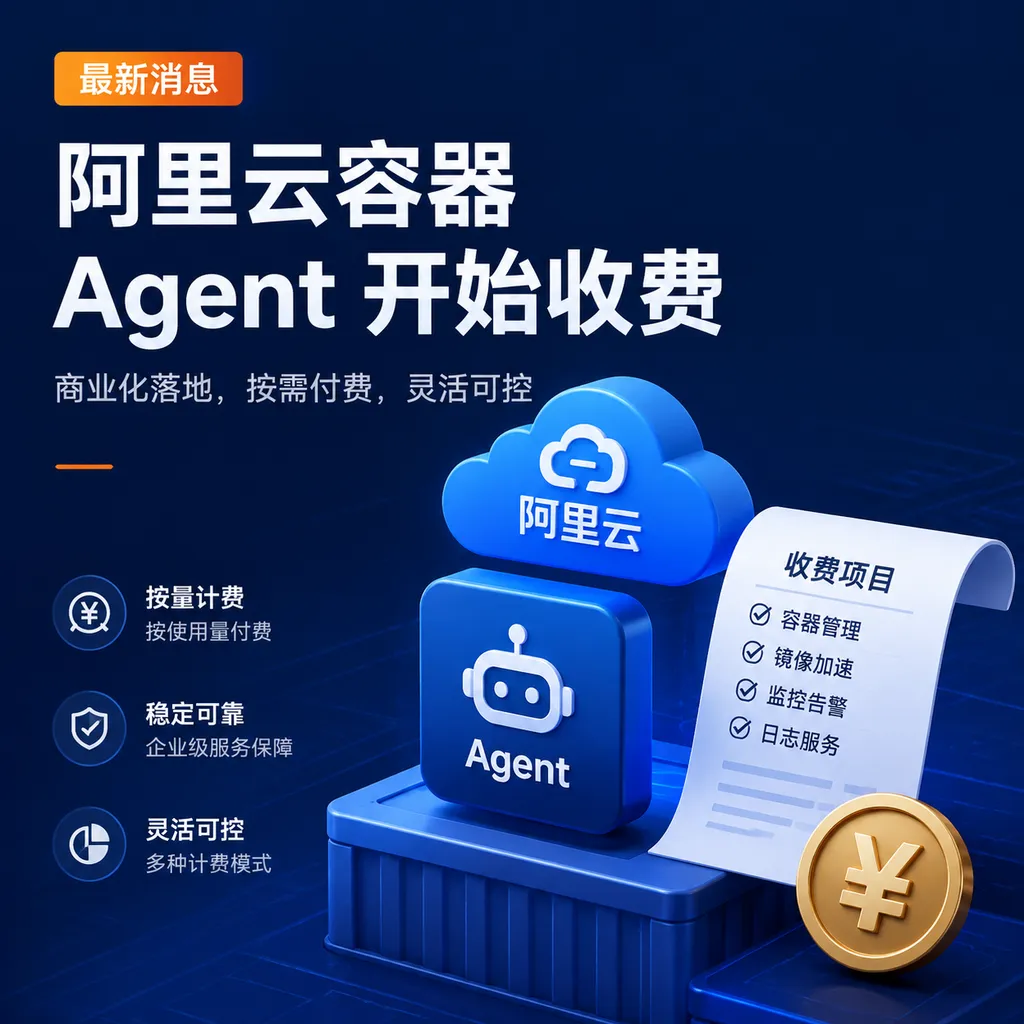
Alibaba Cloud announced that Container Service Agent will become commercially available on September 3, adding a Skills Center and IM channels. Model resource consumption will be uniformly converted into points for billing, with a pay-as-you-go price of RMB 0.05 per point.
Alibaba Cloud Container Agent Begins Charging: Model Usage Billed by Credits
Alibaba Cloud will move its Container Service Agent from free preview to commercial operation this September. According to information released by Alibaba Cloud on August 4, the Container Service Agent will begin charging at 10:00 a.m. Beijing time on September 3, 2026, while also adding features such as a Skills Center and IM channels.
The charges will mainly cover three types of capabilities: conversations, autonomous intelligent operations and maintenance, and scheduled tasks. When users query cluster status, troubleshoot faults, perform operational actions through the Agent, or ask it to run tasks on a schedule, the underlying model resource consumption will be converted into Credits for billing.
This means Alibaba Cloud is not simply charging by “account” or “number of calls.” Instead, it has broken down the cost of using the Agent into a unit of measurement more closely aligned with model inference costs. The more complex the task, the longer the call chain, and the more steps requiring model involvement, the more Credits may be consumed.
You Are Not Buying a Membership for the Agent Itself, but Paying for Model Consumption
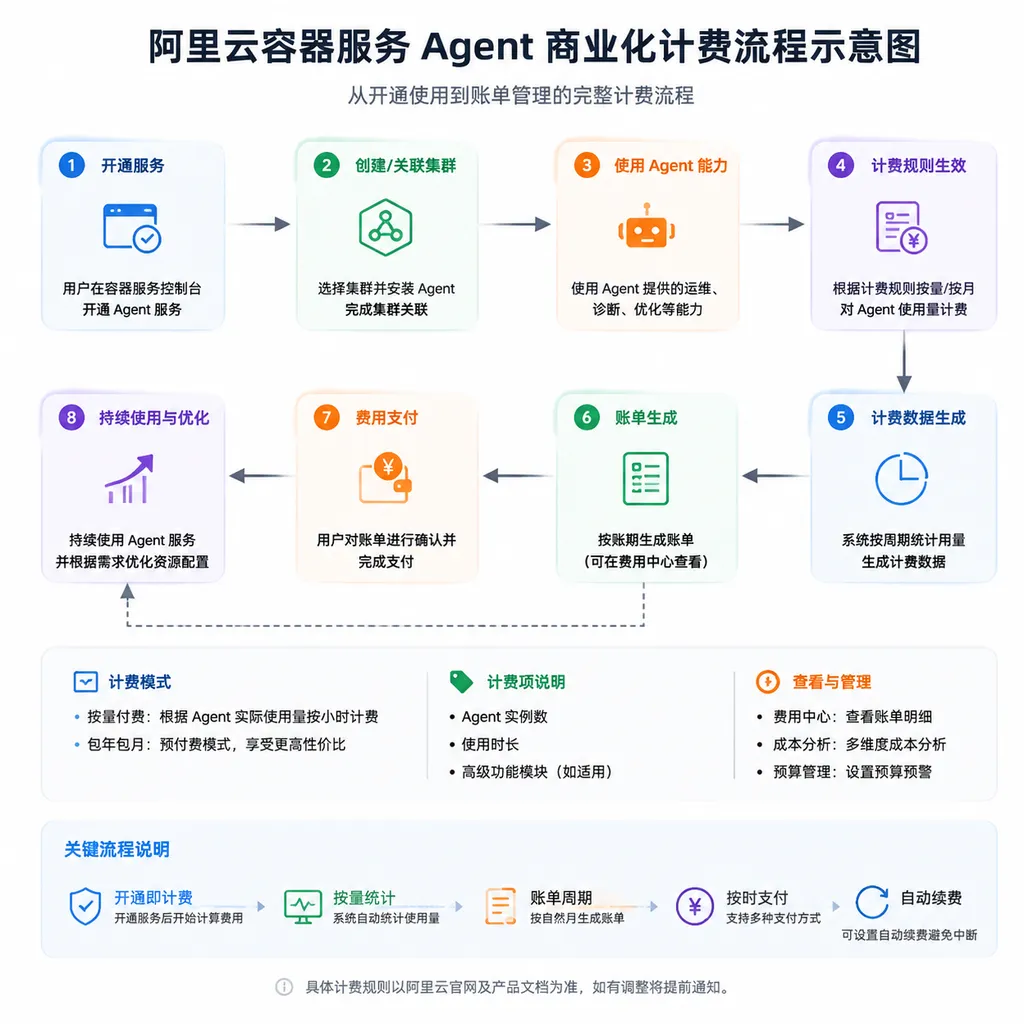
Alibaba Cloud currently lists a pay-as-you-go price of RMB 0.05 per Credit. Users can settle charges based on actual consumption, or purchase prepaid resource packages in advance to obtain a lower unit price. The two methods can be used together.
According to the rules published by Alibaba Cloud, the cost can be understood as:
Actual cost = Actual Credits consumed × RMB 0.05 per Credit
However, this formula only answers the question of “how much does a Credit cost?” It does not directly answer “how many Credits does a task require?” This is the part enterprise users need to pay the most attention to.
The Container Service Agent is designed not for simple question answering, but for operations and maintenance tasks in environments such as Kubernetes, ACK managed clusters, and the ACS Container Compute Service. A seemingly ordinary request such as “Help me investigate why a Pod keeps restarting” may involve reading workload configurations, querying events, checking container logs, examining node resources, analyzing probe status, and possibly continuing to call remediation tools. The number of reasoning rounds and tools used by the model will ultimately affect Credit consumption.
Therefore, Credits are more like a way for the cloud provider to convert a string of opaque model-calling charges into a unified unit of measurement for product users. For developers, this is more consistent with how Agents operate than simply charging per request, but it also means that cost forecasting will not be as straightforward as it is for traditional API calls.
New Skills Center and IM Channels: The Product Is Moving from Answering Questions to Taking Action
This commercialization involves more than a billing change. Alibaba Cloud will also add a new Skills Center and IM channels to the Container Service Agent.
The value of the Skills Center lies in taking what the Agent can do beyond natural-language descriptions and organizing it into reusable capability modules. For operations and maintenance teams, these capabilities typically correspond to a set of fixed procedures, such as:
- Querying the status of clusters, nodes, and namespaces;
- Checking resources such as Pods, Deployments, and Services;
- Analyzing container logs, events, and the causes of abnormal exits;
- Assisting with the diagnosis of CPU, memory, network, or disk issues;
- Performing certain standardized operations and maintenance actions;
- Triggering inspections or task execution at fixed times.
IM channels may turn the Agent from a feature in the console into an “operations and maintenance team member” within the team collaboration workflow. If it can receive issues in enterprise IM tools, return diagnostic results, and perform operations within the scope of its authorization, the entry point will be more natural than the cloud console.
However, more entry points do not mean that the Agent can replace SREs. Dangerous operations in container environments often have cascading effects: deleting the wrong workload, modifying the wrong network policy, or restarting nodes during peak hours could all cause production incidents. After commercialization, enterprises should pay greater attention to the Agent’s permission boundaries, approval mechanisms, operation auditing, and failure rollback—not just whether it can answer questions.
“Autonomous Intelligent Operations and Maintenance” Is the Capability Most Worth Watching—and the Easiest to Lose Control Of
Alibaba Cloud has explicitly included “autonomous intelligent operations and maintenance” within the scope of charges. The key is not whether the Agent can provide a troubleshooting recommendation, but whether it can decompose tasks on its own and continuously call tools.
Traditional cloud operations and maintenance tools are more like a menu: the user selects an inspection item, the system runs a script, and then returns the result. An Agent is closer to an operator capable of formulating a troubleshooting path on the fly. For example, when a user reports that “latency for an online API has suddenly increased,” the Agent might first check monitoring data, then compare deployment versions, inspect node load, container logs, and the status of dependent services, and finally provide possible root causes.
The advantages of this model are clear: it reduces the need for operations personnel to switch back and forth among multiple consoles, log systems, and monitoring pages. For smaller teams, an Agent may even take on some overnight inspections and initial fault-response work.
However, its cost can also rise rapidly with task complexity. A request that only reads status should not be considered the same type of call as an autonomous task requiring multiple rounds of tool calls and cross-resource correlation analysis. More importantly, the Agent’s reasoning process may be uncertain: the same type of issue may trigger different numbers of tool calls at different times and under different cluster conditions.
If enterprises plan to use the Agent over the long term, they should ideally manage tasks in tiers:
- Low-risk queries: Cluster status, resource lists, log summaries, and similar requests can be permitted by default;
- Medium-risk diagnostics: Change analysis, capacity assessments, and fault localization require the basis for operations to be recorded;
- High-risk execution: Scaling, restarting, deletion, network policy changes, and similar actions must require human confirmation.
This is not only a security requirement; it also helps control Credit consumption. Consolidating high-frequency, repetitive, and clearly defined tasks into fixed skills is generally more cost-predictable than having the Agent plan from scratch every time.
Existing User Settings and Historical Tasks Will Not Be Cleared
Alibaba Cloud says that the commercialization adjustment will not affect existing users’ settings or historical task records. This is important for teams that have already integrated the Container Service Agent into their daily inspection workflows; at least they will not need to rebuild their tasks because the product is transitioning to paid service.
However, “data and configurations will be retained” does not mean “the service will continue to be automatically available.” Alibaba Cloud’s documentation provides further details about service activation after commercialization: existing users will need to activate the service for their accounts after commercialization takes effect and select the corresponding payment plan. If activation is not completed, they may be unable to continue using the relevant features. When new users use the service for the first time, the system will also verify whether the service has been activated.
There is a timing discrepancy that developers should note: Public news from Alibaba Cloud and several media outlets on August 4 listed 10:00 a.m. on September 3 as the effective time, while the Alibaba Cloud documentation has at times shown 12:00 a.m. on August 7. The two times are inconsistent and may correspond to an early documentation update, different product versions, or an adjustment to the announcement. Enterprise users should not plan their budgets solely based on media reports. They are advised to confirm the actual effective time for their accounts, the billing plan, and the rules for resource packages in the console. If the service is used with production clusters, they should also complete activation and permission checks in advance.
For Developers, the Real Change Is That the Cost Model Has Changed
In the past, when the Container Operations and Maintenance Agent was in free preview, teams could treat it as a low-cost experimental tool: asking it to analyze logs, summarize events, and try performing several operations before deciding whether to incorporate it into their workflows.
After commercialization, testing and production will become two separate accounting categories. Scheduled tasks are particularly important because they may continue running without anyone paying attention. If the task frequency is set too high, or if every inspection triggers complex model analysis, Credit consumption can accumulate quickly.
Before migrating formally, three steps are recommended:
1. Inventory Tasks Before Purchasing Resource Packages
Classify existing conversations, autonomous operations and maintenance tasks, and scheduled tasks by frequency, risk, and call depth. Record the average execution time, number of tool calls, and expected benefits for each type of task. Without a usage baseline, purchasing resource packages directly can easily result in buying too much or too little.
2. Set Budgets and Alerts for Scheduled Tasks
For overnight inspections, log analysis, and periodic diagnostics, set a maximum execution frequency, Credit budget, and anomaly alerts. If a task continues looping because its fault context is overly complex, the system needs to be able to stop it promptly rather than consuming resources indefinitely.
3. Integrate the Agent as a Production System, Not a Chatbot
Clearly define the service account, RAM permissions, accessible cluster scope, executable API actions, and human approval points. At the same time, retain the Agent’s inputs, model outputs, tool calls, and final change records to facilitate subsequent audits and incident reviews.
Alibaba Cloud’s Strategy: Embedding Model Capabilities into Cloud Resource Management
From a product strategy perspective, the commercialization of the Container Service Agent is not surprising. Cloud providers are embedding large models into computing, container, database, and security products instead of keeping them in standalone chat windows. What users purchase is no longer just a model, but a complete service consisting of “the model plus tools plus cloud-resource context.”
The difference between these products and general-purpose large-model APIs is that they have access to the actual state of cloud environments and can call cloud APIs. For users, writing fewer scripts and checking fewer consoles may be more valuable than purchasing model calls separately. For cloud providers, Agents can deepen the use of console features and bring model inference costs into the existing cloud-service billing system.
However, whether this can truly generate stable revenue depends on two factors. First, can the Agent consistently deliver reliable results during real incidents? Second, will enterprises accept the Credit price? If users find that the Agent can only generate troubleshooting suggestions while they still need to perform most of the work manually, charging based on model consumption will seem expensive. Conversely, if it can shorten recovery times and reduce the need for overnight on-call coverage, enterprises will generally be willing to pay for those outcomes.
For now, Alibaba Cloud’s approach—“free activation, settlement by Credits, and resource-package discounts”—appears primarily intended to lower the barrier to initial adoption while converting heavy users into ongoing paying customers. For light users, pay-as-you-go billing is more flexible. For teams that have already incorporated the Agent into daily operations and maintenance, resource packages may be more cost-effective, provided that Alibaba Cloud further discloses Credit consumption for different task types and provides usage statistics.
Conclusion: Confirm the Effective Time First, Then Assess Whether Scaling Up Is Worthwhile
The commercialization of Alibaba Cloud’s Container Service Agent marks the beginning of a transition in cloud-based intelligent operations and maintenance—from “bundled capability” to “payment based on model resources.” Its value lies not in generating a few extra commands for developers, but in whether it can connect observability, analysis, decision-making, and execution into a controllable closed loop.
For teams already using the service in ACK or ACS environments, the most important next step is not to immediately decide whether it is “expensive,” but to confirm three things: when the account will begin incurring charges, how many Credits existing tasks will consume, and exactly how much operational authority the Agent has.
If none of these three factors has been quantified, the Agent remains merely a convenient experimental tool. Only when cost, permissions, and benefits can all be continuously monitored can it become part of a production operations and maintenance system.