
Cloudflare Mesh: AI Agents Can Now Form Networks
Cloudflare launches the Mesh private network solution, enabling AI Agents to connect to enterprise intranets like humans and directly access databases and APIs. This is the first large-scale private network solution designed for AI Agents.
Cloudflare Mesh: Now AI Agents Can Form Networks
Cloudflare released Mesh yesterday—a private networking solution specifically designed for AI agents. The key point isn’t that there’s yet another VPN alternative, but that it solves a new problem: when AI agents start performing large-scale tasks, how can they securely access enterprise internal resources?
Traditional private network solutions—whether Tailscale or ZeroTier—are designed around people connecting to devices. Mesh is different: it treats AI agents as first-class citizens in the network. Agents running on Cloudflare Workers can access the entire private network directly through Workers VPC binding, with no need to manually configure tunnels or open ports.
Why This Is Needed Now
AI agents differ from traditional applications in that they act autonomously. For example, a support agent might need to query a CRM database, call internal APIs, or read from a documentation system. These interactions occur dynamically—you can’t predict ahead of time which resources the agent will access.
Previously, you either had to expose these services to the public internet (with API gateways and authentication) or allow access through a jump host. The former is risky from a security standpoint; the latter is complex to configure. Mesh takes a different approach by placing the agent directly inside the private network, handling access control at the network layer.
The logic is straightforward: since an agent needs to work like an employee, give it the same network permissions as an employee. The difference is that agent access patterns are harder to predict, requiring more fine-grained access control and auditing capabilities.
How It Differs from Tailscale
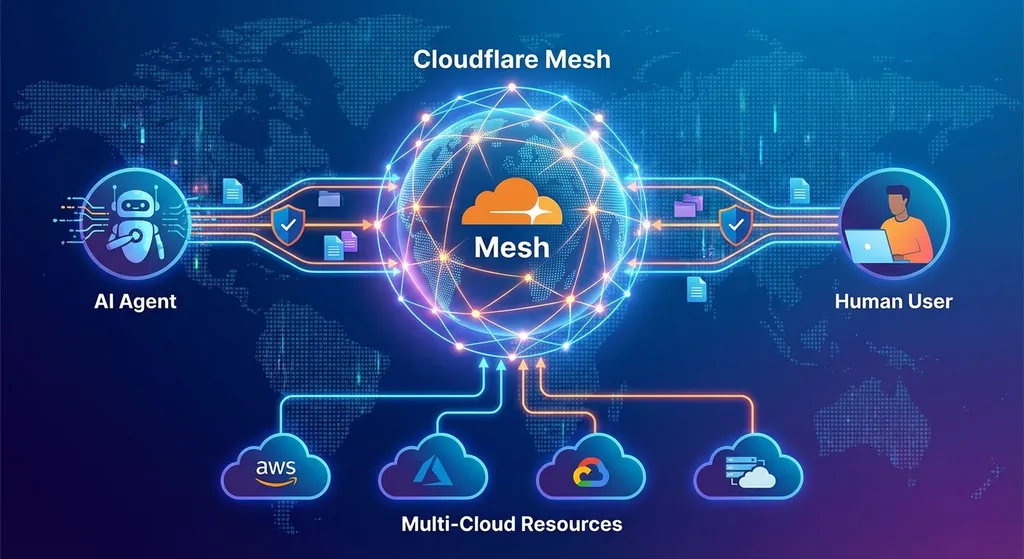
Tailscale is a peer-to-peer network where each node has its own IP—ideal for use cases like "my laptop connects to the company server." Mesh is more like a virtual LAN, focusing on unifying different environments (local devices, AWS, GCP, Cloudflare Workers) under one network layer.
Key differences:
- Deployment Speed: Mesh claims it can bridge multi-cloud environments within minutes, without needing to configure VPN gateways in each cloud.
- Agent Support: Tailscale lacks optimizations for serverless environments; Mesh’s Workers VPC binding allows agents to access private networks directly, with no persistent connections needed.
- Scale: Cloudflare’s network spans 310 cities, and Mesh inherits that infrastructure, theoretically supporting larger-scale deployments.
However, Tailscale’s advantages lie in maturity and ecosystem features: it has a full ACL system, SSH integration, and MagicDNS. Mesh is still a new product—many implementation details remain unclear.
Technical Implementation Details
Workers VPC Binding
This is Mesh’s core feature. Typically, serverless functions need a NAT gateway or VPC connector to access private resources, establishing a connection on each invocation. Workers VPC binding lets functions run directly within the private network context—accessing internal resources feels as simple as reading local variables.
From a developer’s perspective, code might look like this:
export default {
  async fetch(request, env) {
    // env.DB is a private database exposed via VPC binding
    const result = await env.DB.query('SELECT * FROM users WHERE id = ?', [userId]);
    return new Response(JSON.stringify(result));
  }
}
Behind this env.DB could be a PostgreSQL instance on AWS RDS—but to the Worker, it’s just an accessible object. Cloudflare’s infrastructure abstracts away all network-level complexity.
Cross-Cloud Bridging
Another selling point of Mesh is rapid multi-cloud connectivity. Traditionally, you’d configure VPN gateways in every cloud and then set up IPsec tunnels—messing with route tables, firewall rules, and BGP configurations. It’s error-prone and tedious.
Mesh simplifies this by deploying lightweight connectors in each cloud environment. These connectors establish encrypted connections to Cloudflare’s edge network, and Cloudflare handles routing. From the user’s view, you just install an agent, add a few config items, and the network is up.
The benefit is offloading complexity to Cloudflare’s network layer. The downside: you must trust Cloudflare’s routing logic, and all traffic goes through Cloudflare’s edge nodes—so you’ll need to consider latency and cost.
Security Model
Mesh’s security model follows zero trust principles—each connection must verify identity and permissions. For AI agents, this means:
- Identity Binding – Each agent has a unique identity (usually via Worker service binding).
- Least Privilege – Agents can access only explicitly authorized resources; all other access is denied by default.
- Audit Logs – Every access is recorded, including which resources were accessed and what actions were performed.
This mechanism aligns with Cloudflare’s existing Access product, but it’s extended from human users to agents. Effectiveness depends on the granularity of control—if permissions only go as far as “this agent can access this database,” that’s insufficient. Ideally, control should reach down to “this agent can only read certain fields in specific tables.”
Ideal Use Cases
Mesh’s most direct use case is for enterprise internal AI agents, such as:
Support Agents – Need access to CRM, ticketing, and knowledge-base systems, usually within private networks. Mesh lets them query data directly without syncing to the public internet or building dedicated APIs.
Data Analysis Agents – Require connections to multiple data sources (data warehouses, business databases, log systems) that may span different clouds. Mesh unifies them under a single network layer so agents don’t worry where data resides.
DevOps Agents – Need access to Kubernetes clusters, CI/CD systems, and monitoring platforms with strict access control. Mesh provides a unified access layer.
Less suitable cases include agents mainly calling public APIs (e.g., search engines, weather) or infrastructure hosted entirely in one cloud—using the provider’s native VPC might be simpler. Mesh’s value lies in cross-environment integration and scalable agent management.
Integration with Existing Tools
If you already use other Cloudflare products, Mesh fits right into the ecosystem:
- Workers AI – Run models directly in Workers, then use Mesh to access private data.
- AI Gateway – Monitor agent API calls and manage cost and rate limits.
- Firewall for AI – Guard against prompt injection and data leaks.
In combination: run agents on Workers, connect them to private resources via Mesh, and protect with Gateway and Firewall. If you’re already in the Cloudflare ecosystem, this is a natural extension.
On other platforms (e.g., AWS Bedrock or Azure OpenAI), integration is less straightforward. While Mesh’s connector theoretically enables access, deep integrations like Workers VPC binding are exclusive to Cloudflare Workers.
Practical Considerations
Cost
Cloudflare hasn’t announced Mesh pricing yet, but it’ll likely follow existing product logic. Workers are billed per request and CPU time; Mesh may add data transfer fees. Agents that frequently handle large volumes of data could incur significant costs.
Migration also carries a cost. If you already use a private network (self-hosted VPN or Tailscale), switching to Mesh means reconfiguring networks and permissions—potentially complex for large organizations.
Performance
All traffic passes through Cloudflare’s edge network, so latency depends on the distance between your resources and the nearest Cloudflare node. For globally distributed apps, this may improve performance (given Cloudflare’s 310 city presence); for regional apps, it might add extra hops.
Bandwidth is another concern—agents handling large files or streams may not perform as well through Cloudflare’s network. Real-world testing is needed.
Debugging & Monitoring
When agents fail, you’ll need insight—is it code, permissions, or network issues? Mesh’s observability tools haven’t been disclosed yet. Ideally, it would provide detailed connection logs including latency, error codes, and accessed resources.
Cloudflare dashboards are typically solid, but Mesh being new means tooling might lag. If you rely on external monitors like Datadog or Grafana, integration may require custom work.
The Bigger Picture
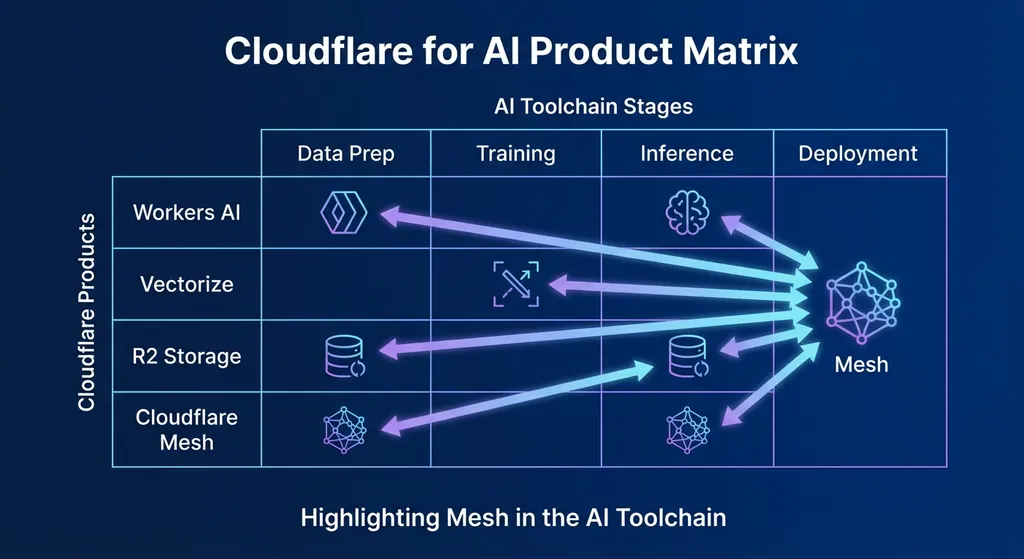
Mesh is part of Cloudflare’s broader AI infrastructure strategy. Over the past year, Cloudflare has launched several AI products—Workers AI (inference), Vectorize (vector database), AI Gateway (API management), and Firewall for AI (security). Mesh fills the missing piece: private networking.
The goal is to let developers build complete AI applications entirely on Cloudflare—from inference to data storage to networking. For Cloudflare, it’s a step toward transforming from a CDN and security provider into a computing platform.
For developers, the upside is a consistent toolchain—simpler setup and management. The downside is vendor lock-in; deep reliance on Cloudflare’s ecosystem raises switching costs.
At an industry level, Mesh signals a trend: infrastructure is being optimized specifically for AI agents. Traditional networking was designed for humans and apps, while agents—with autonomy, unpredictability, and massive concurrency—require new architectures. Cloudflare may be first among major vendors to propose this, but certainly won’t be the last.
Relationship with OpenAI Hub
OpenAI Hub users will mainly use Mesh to allow agents to access private data sources. For example, if an agent needs to query an internal database to generate responses, the process would be:
- Connect the database to the Mesh private network
- Deploy a middleware on Cloudflare Workers that accesses the database via VPC binding
- The agent calls the Worker’s API to retrieve data
Code example (Worker side):
export default {
  async fetch(request, env) {
    const { query } = await request.json();

    // Access private database via VPC binding
    const context = await env.DB.query(
      'SELECT content FROM docs WHERE embedding <-> $1 < 0.3',
      [query]
    );

    // Call OpenAI Hub API
    const response = await fetch('https://api.openai-hub.net/v1/chat/completions', {
      method: 'POST',
      headers: {
        'Authorization': `Bearer ${env.OPENAI_HUB_KEY}`,
        'Content-Type': 'application/json'
      },
      body: JSON.stringify({
        model: 'gpt-4',
        messages: [
          { role: 'system', content: 'You are a customer service assistant.' },
          { role: 'user', content: query },
          { role: 'system', content: `Related documents: ${context}` }
        ]
      })
    });

    return response;
  }
}
The benefit: the database remains private—no exposure to the public internet. Only processed results traverse outward via the OpenAI Hub API, not raw data.
Key Open Questions
- Permission Granularity: How fine-grained can Mesh access control get—down to tables, fields? This affects enterprise usability.
- Multi-Tenant Isolation: How are multiple agents within an organization isolated? Can one compromised agent impact others?
- Compliance: Industries like finance and healthcare require strict data residency. How does Mesh route traffic—can it ensure specific geographic confinement?
- Fault Handling: What happens if a Cloudflare node fails—does Mesh automatically reroute?
These remain unanswered until the product matures.
Conclusion
Mesh is an intriguing product solving a real pain point: enabling AI agents to securely access enterprise internal resources. Its implementation is elegant—treating agents as first-class network members with access similar to human users.
However, it has clear limitations:
- Vendor Lock-In – Deep Mesh adoption tightly binds you to Cloudflare.
- Maturity – As a new product, many details and tools remain incomplete.
- Cost – Routing all traffic through Cloudflare may be expensive.
For teams already building AI apps on Cloudflare Workers, Mesh is a natural extension. For others, switching tech stacks just for Mesh requires careful consideration.
Either way, Mesh points to a broader direction: infrastructure purpose-built for AI agents. The trend is just beginning—and we’ll likely see many similar products emerge soon.
References
- Cloudflare Mesh Released: Build Your Personal Private LAN - Linux.do – Discussion on Mesh within the Linux.do community, including comparisons with Tailscale.


