NVIDIA's Autonomous Driving Foundation Model Now Available for Commercial Use

NVIDIA Alpamayo 2 Super was recently made available for commercial use. This 32-billion-parameter Reasoning VLA aims to tackle the most challenging long-tail scenarios in L4 autonomous driving through reasoning, 360-degree perception, and closed-loop training.
32-Billion-Parameter Model Officially Enters Commercial Autonomous Driving Development
As of August 4, 2026, NVIDIA has made Alpamayo 2 Super available for use in commercial projects.
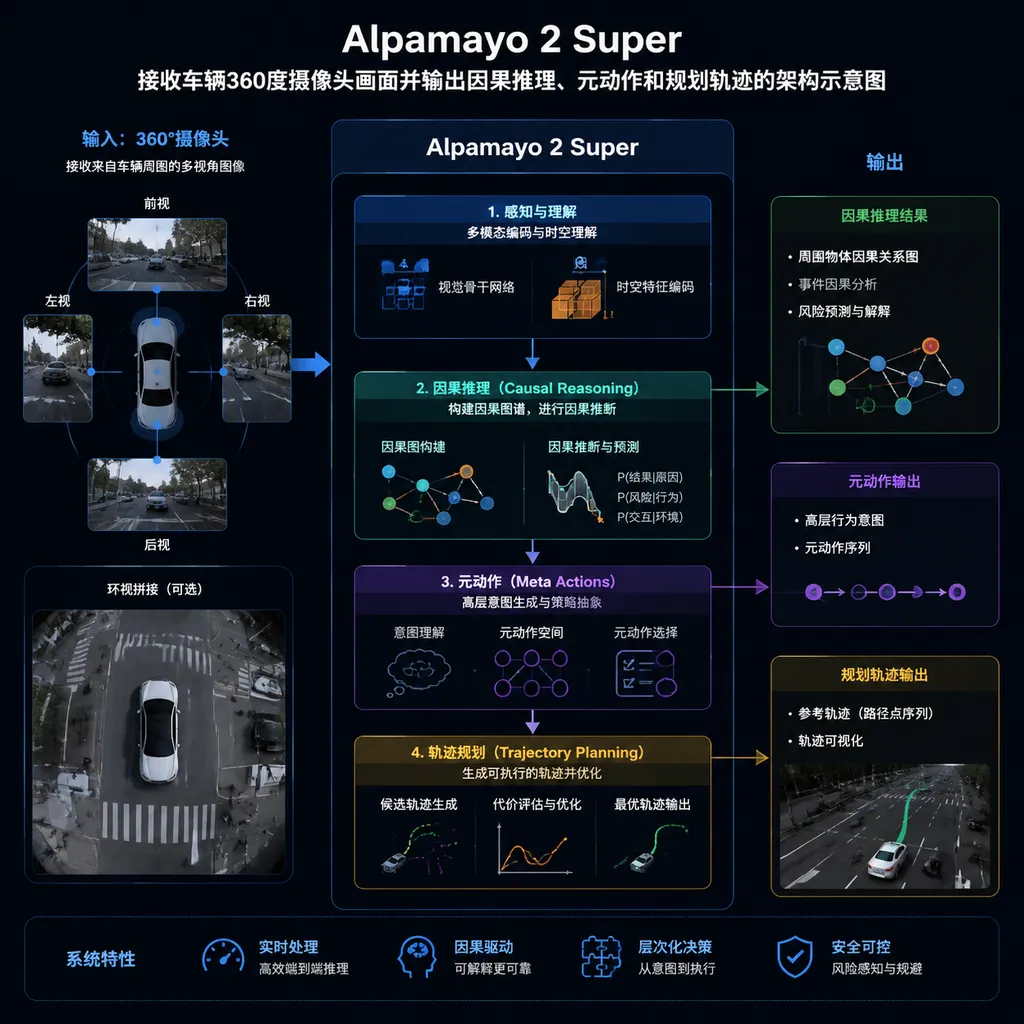
Designed for Robotaxi and Level 4 autonomous driving R&D, it is a 32-billion-parameter vision-language-action reasoning model (Reasoning VLA). Built on NVIDIA’s Cosmos world foundation models, it can process multi-view visual data from around a vehicle, understand traffic scenarios, explain causal relationships, and output trajectories as well as higher-level driving actions such as yielding, changing lanes, and stopping.
What deserves the most attention is not simply that the parameter count has increased from 10 billion in the previous generation to 32 billion, but that NVIDIA is advancing autonomous driving models from “seeing objects and predicting trajectories” toward “understanding why the vehicle should drive this way.”
A conventional perception model can identify a vehicle ahead, while a trajectory prediction model can estimate where it will go in the next second. Alpamayo 2 Super aims to go one step further: determine why that vehicle suddenly slowed down, whether a pedestrian may be occluded nearby, and whether the ego vehicle should continue following, yield in advance, or stop altogether.
This is precisely the hardest part of autonomous driving.
The Real Challenge in Autonomous Driving Is Not Normal Road Conditions
Most driving data collected on urban roads is actually rather “boring”: driving straight, following another vehicle, stopping at red lights, and starting when the light turns green. Given enough data, imitation learning models can usually learn these behaviors well.
The problem is that safety is often determined by scenarios that occur only rarely. For example:
- A parked van blocks the view of a child crossing the road;
- The vehicle ahead suddenly crosses the lane line and merges because of construction cones, without signaling;
- Reflections on the road on a rainy night make lane markings difficult to distinguish from the edges of puddles;
- Traffic lights fail at an intersection, and a traffic officer’s hand signals conflict with the default right-of-way rules;
- An ambulance approaches from the rear side while the vehicle is changing lanes in a complex intersection;
- A cyclist looks back, then drifts toward the lane without actually beginning to turn.
These situations are difficult to cover with a simple “detection–prediction–planning” pipeline. A detector may correctly identify vehicles, pedestrians, and traffic cones, but it does not understand the causal relationships among them. A trajectory predictor may also generate several mathematically plausible paths without understanding which one indicates that risk is increasing.
The core value of Alpamayo 2 Super is that it turns these long-tail judgments into trainable reasoning tasks.
Rather than merely answering “What is in the scene?”, it must answer three questions that more closely resemble a driver’s decision-making process:
- What is happening? Identify road users, road structure, and abnormal conditions.
- Why is a response necessary? Establish causal chains among occlusion, right of way, behavioral intent, and potential risk.
- What should happen next? Generate high-level actions and executable trajectories for downstream planning and control modules.
This does not mean the model already understands the world like a human driver. It does, however, show that NVIDIA is no longer satisfied with breaking autonomous driving into a collection of isolated, specialized models.
From Forward-Facing Views to 360-Degree Panoramic Reasoning
The most direct changes in Alpamayo 2 Super compared with previous versions are the increase in model size to 32 billion parameters and the expansion of its inputs from forward-facing cameras to 360-degree multi-view perception covering the front, sides, and rear.
This is not simply a matter of connecting a few more video feeds.
Multi-camera data in autonomous driving must be aligned spatially and temporally. If the forward-facing camera sees the vehicle approaching an on-ramp while a side-rear camera simultaneously sees another vehicle accelerating into the blind spot, the model must understand both observations as constraints on the same lane-change decision—not as unrelated images.
The 360-degree input is especially relevant to three types of maneuvers:
- Lane changes: The system must consider not only the distance to the vehicle ahead, but also the relative speed of vehicles approaching from the rear side;
- Merging: It must account for lane narrowing, available gaps in the target lane, and whether other vehicles are willing to yield;
- Intersection traversal: It must process not only the traffic lights ahead, but also cross traffic, cyclists and other non-motorized road users, and vehicles behind that may be pressuring it to proceed.
The increased parameter count provides greater capacity for cross-view spatial modeling, causal reasoning, and multitask output. According to information disclosed by NVIDIA, the 32-billion-parameter version has been enhanced over its predecessor in logical reasoning for long-tail scenarios, 3D spatial understanding, and trajectory prediction.
However, tripling the parameter count does not directly translate into tripling driving capability. The real-world performance of an autonomous driving model depends heavily on training-data coverage, sensor calibration, closed-loop evaluation, and vehicle-control interfaces. A model that provides impressive explanations in offline video question-answering may still fail after being integrated into a vehicle because of latency, accumulated errors, or control limitations.
A more accurate characterization of Alpamayo 2 Super, therefore, is not “an autonomous driver ready for direct deployment,” but a foundation model for perception, reasoning, and planning research.
Meta-Actions Deserve More Attention Than Trajectories
Alpamayo 2 Super adds Meta-Action outputs, including high-level driving decisions such as yielding, changing lanes, and stopping.
Many end-to-end autonomous driving models have traditionally predicted future trajectory points directly. This approach is straightforward, but it has an obvious drawback: the model indicates where the steering wheel should point without explaining what it is actually trying to do.
Meta-actions add a layer of “driving intent” between natural-language reasoning and low-level trajectories. For example:
- Scenario assessment: A vehicle on the right is forcing its way into the lane;
- Meta-action: Slow down and yield;
- Trajectory output: Reduce longitudinal speed while remaining in the current lane;
- Control execution: Convert the trajectory into steering, braking, and propulsion commands.
This layer is useful for engineering teams.
On the one hand, it makes model outputs easier to debug. When the vehicle behaves abnormally, developers can determine whether the error originated in scene understanding, meta-action selection, trajectory generation, or control execution. On the other hand, meta-actions also provide an interface for rule-based systems: companies can prohibit certain actions, establish safety priorities, or switch to conservative strategies when model confidence is insufficient.
Compared with fully black-box end-to-end control, this design is better suited to the realities of Robotaxi deployment today. Automakers and regulators will not trust a model based on a trajectory alone; they need auditable intermediate evidence.
Of course, interpretable output does not necessarily represent genuine causality. A large model may generate an explanation that sounds plausible even if that explanation does not reflect the model’s true internal basis for generating the trajectory. Developers still need counterfactual testing to verify whether the model’s meta-actions and trajectories change appropriately when, for example, a pedestrian is removed or the speed of a vehicle approaching from the rear side is altered.
Automated Annotation Compresses Months of Work into Days
Alpamayo 2 Super also offers another practical benefit: it can serve as a data-generation model, producing reasoning annotations for smaller autonomous driving models.
NVIDIA has equipped it with automated reasoning annotation capabilities that include 2D Grounding. When the model describes risks and causal relationships, it can ground its reasoning in specific regions or objects within an image rather than merely outputting text detached from visual evidence.
For example, instead of only stating, “The vehicle needs to slow down because there is a risk of a pedestrian crossing,” it can associate that judgment with the region containing a pedestrian partially occluded by another vehicle. For autonomous driving data teams, such annotations can simultaneously include:
- Scene semantics;
- Object location;
- Cause of risk;
- Recommended action;
- Basis for the future trajectory.
NVIDIA says this approach can reduce some annotation cycles from months to days. The actual figure will still depend on dataset size and human-review standards, but the underlying direction is sound: a 32-billion-parameter model does not necessarily need to be deployed directly in a production vehicle. It can instead serve as a “teacher model” in the data center, with its capabilities distilled into smaller, lower-latency in-vehicle models.
This may create commercial value faster than putting a large model directly into a car.
In-vehicle deployment must contend with power consumption, cooling, deterministic latency, and functional-safety constraints. Offline annotation and model evaluation are far less restrictive: they can use larger GPU clusters and allow models more time for reasoning. These foundation models are especially appealing to companies that have accumulated vast amounts of fleet video but lack high-quality labels for long-tail scenarios.
The Model Is Only Middleware; Closed-Loop Training Is the Key
Alpamayo 2 Super does not stand alone. NVIDIA is also building a complete pipeline for generating long-tail scenarios and training autonomous driving systems:
- AlpaGym: A high-throughput closed-loop reinforcement learning framework that provides training feedback based on the model’s driving outcomes in simulation;
- OmniDreams: A generative world model used to create interactive, continuously evolving closed-loop driving scenarios;
- Omniverse NuRec: A system that reconstructs data collected by real-world fleets into editable 3D scenes and adapts them to different vehicle and sensor configurations;
- Alpamayo 2 Super: Responsible for scene understanding, reasoning, annotation, evaluation, action generation, and knowledge distillation.
Together, these components form what NVIDIA truly intends to sell to the industry.
Collecting long-tail data exclusively on real roads is extremely inefficient. A company may drive millions of kilometers and encounter only a small number of valuable edge cases. Even when such cases occur, safely reproducing them for repeated testing is difficult. Neural reconstruction can bring real-world cases into simulation, world models can generate variations in weather, road users, and road structure, and AlpaGym can then allow the driving model to make repeated attempts and update its strategy based on collisions, comfort, and compliance with traffic rules.
It is more like a driving school for autonomous systems: rather than having the model memorize a single crash video, it generates thousands of variations around the same class of risk, forcing the model to learn how to handle it consistently.
This is the clearest distinction between Alpamayo 2 Super and ordinary vision-language models. The latter often stop at video understanding or driving-related question-answering, whereas NVIDIA is attempting to integrate its reasoning model into a complete loop spanning data generation, closed-loop simulation, reinforcement learning, and in-vehicle distillation.
Open for Commercial Use Does Not Mean Ready to Deploy
Making the model “available for commercial use” lowers the barrier to experimentation and productization, but developers need to distinguish among several concepts:
First, an open model does not mean there are no licensing restrictions. Before downloading the weights, fine-tuning, distilling, redistributing, or integrating the model into a commercial system, companies should still review the applicable license, acceptable-use policy, geographic restrictions, and terms governing derivative models. Autonomous driving is a high-risk application, so companies cannot rely solely on the phrase “commercial use permitted.”
Second, commercial use of the model does not mean the system has passed safety certification. Alpamayo 2 Super can serve as an R&D component, but a Level 4 system still requires redundant perception, localization, prediction, planning, control, remote assistance, fail-safe degradation, and safety validation. No single foundation model can replace comprehensive safety engineering.
Third, open weights do not mean low cost. Processing multiple video streams with a 32-billion-parameter model imposes substantial requirements on memory, throughput, and data pipelines. Even if companies do not deploy the model directly in vehicles, they must still bear the costs of inference clusters, video decoding, cross-view alignment, and high-quality evaluation.
Fourth, reasoning capabilities must be validated in closed-loop testing. Autonomous driving is not a static benchmark. One model action changes subsequent world states, and a small early error may become amplified several seconds later. Meaningful metrics should include disengagement rate, collision rate, traffic-violation rate, comfort, reaction latency, and cross-region generalization—not merely average trajectory error.
NVIDIA’s Advantage Extends Beyond the Model
If evaluated solely against other open vision-language models, Alpamayo 2 Super may not outperform them across every general-purpose task. Its moat comes from NVIDIA’s broader infrastructure stack: GPUs, in-vehicle computing platforms, Cosmos world models, Omniverse simulation, neural reconstruction, and autonomous driving development tools.
In other words, Alpamayo 2 Super is not an isolated release of a model weight file; it is the reasoning hub of NVIDIA’s autonomous driving platform.
This also explains its emphasis on multitask capabilities. The model can generate trajectories while also performing automated annotation, scene understanding, model evaluation, and knowledge distillation. For NVIDIA, a 32B teacher model used by multiple automakers for training and evaluation has greater platform value than securing a single in-vehicle model deployment.
For development teams, its three most practical applications may be:
- Using it as an offline analyzer and automated annotator for long-tail scenarios;
- Using it as a policy model or evaluator in closed-loop simulation;
- Using it as a teacher model to distill reasoning and planning capabilities into smaller in-vehicle networks.
Having a 32-billion-parameter model take direct control of an entire vehicle is, by contrast, not the safest starting point at this stage.
Assessment: The Direction Matters More Than the Parameter Count
The significance of Alpamayo 2 Super is not that the autonomous driving industry now has another larger model, but that open models are beginning to cover driving reasoning and planning—areas that were previously relatively closed.
It addresses a genuine pain point: the bottleneck to further expansion of Level 4 autonomous driving is no longer simply whether systems can recognize vehicles and lane markings, but whether they can handle low-frequency, high-risk, hard-to-reproduce long-tail events in a verifiable and scalable way.
NVIDIA’s answer is to use large models to generate reasoning and actions, world models to create scenarios, neural reconstruction to reproduce real roads, and closed-loop reinforcement learning to evaluate decision outcomes. This combination is more compelling than simply increasing the model’s parameter count.
Yet the industry remains far from truly solving the long-tail problem. Whether world-model-generated scenarios sufficiently reflect real-world physics, whether reasoning text faithfully represents model decisions, how much capability smaller distilled models can retain, and how systems will satisfy functional-safety and regulatory requirements will all determine whether Alpamayo 2 Super ultimately serves only as an R&D tool or becomes a foundational layer for production autonomous driving.
At least for now, it looks more like an important foundational module than a turnkey Level 4 solution.
Making it available for commercial use gives more automakers, Robotaxi companies, and research teams the opportunity to validate this approach. What matters next is not its reasoning score on a leaderboard, but whether it can reduce the cost of producing long-tail data and continuously lower disengagements and accident risk in closed-loop simulation and real-world fleet testing.
References
- Zhihu: NVIDIA’s Technical Exploration in Autonomous Driving — An overview of Alpamayo 2 Super, Cosmos world foundation models, and NVIDIA’s autonomous driving technology stack.