Mistral Releases Open 3B Multimodal Moderation Model

Mistral recently released Shieldstral, a 3B-parameter open-weight model that supports both text and image moderation. Its real value lies not in replacing every safety system, but in enabling developers to deploy content moderation within their own infrastructure.
Mistral Has Opened Up Its Multimodal Content Moderation Model
As of August 4, 2026, Mistral has recently released Shieldstral, a 3-billion-parameter content safety moderation model that processes both text and images, and made it available with open weights.
This release is noteworthy not because there is now one more 3B model, but because Mistral has brought a capability long packaged by cloud providers as a black-box API—multimodal content moderation—into the open-weight ecosystem, where it can be privately deployed, inspected, and customized.
Over the past two years, open models have rapidly caught up with closed models in capabilities, but the safety moderation layer has remained relatively closed. Developers can download generative models, yet they often still have to send user inputs, uploaded images, and model responses to third-party moderation APIs. In fields such as healthcare, finance, enterprise knowledge bases, and online communities for minors, this not only increases latency but also introduces additional risks related to cross-border data transfers and regulatory compliance.
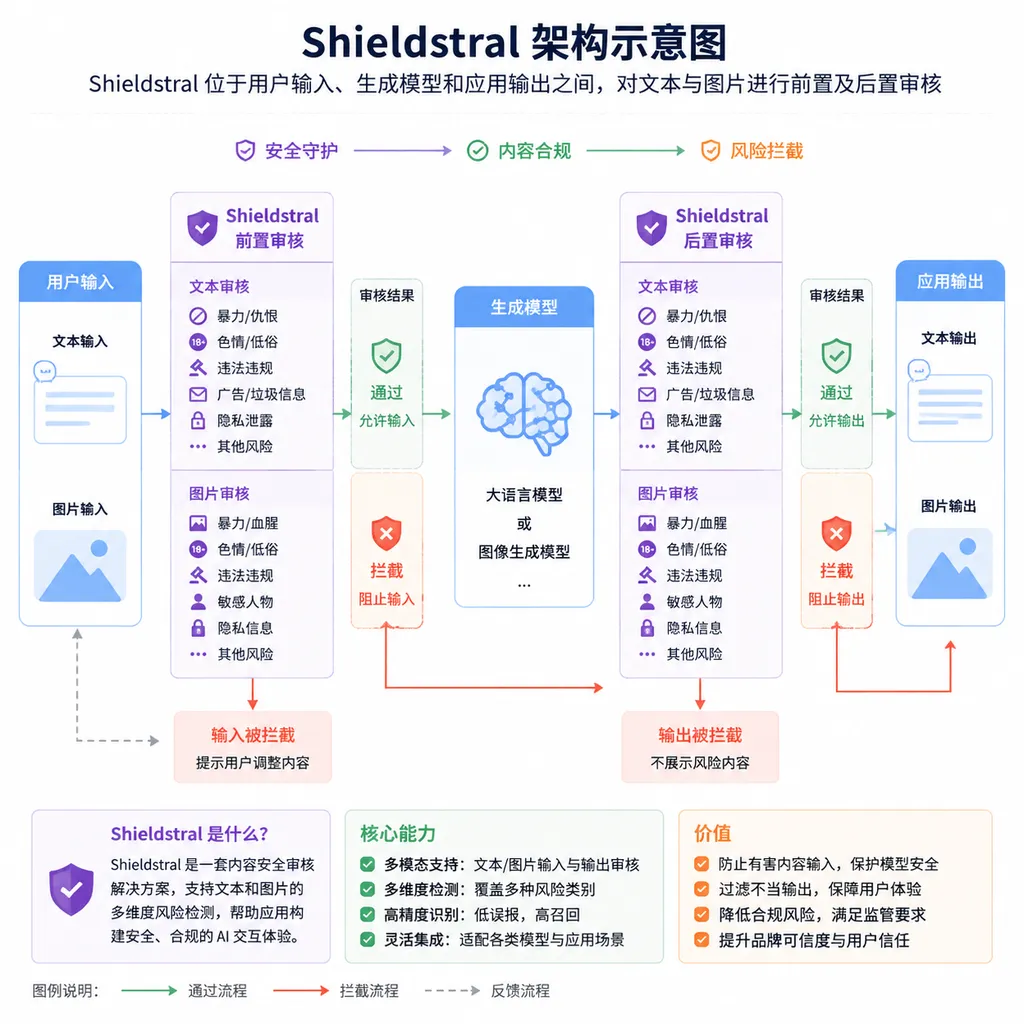
Shieldstral attempts to fill this gap. It is relatively compact, can process both text and images, and is suitable for deployment before and after a generative model as a locally operated “security gatekeeper.”
The Key Is Not 3B, but That “Multimodal Moderation Can Run Locally”
Traditional text moderation is relatively straightforward: given a piece of content, the model determines whether it involves violence, hate, sexual content, self-harm, illegal activity, or other risks. With multimodal applications, the problem becomes much more complicated.
An image that appears harmless on its own may become harassment, a threat, or extremist propaganda when paired with a sentence. Similarly, the true meaning of an apparently ordinary piece of text may only become clear when considered alongside the people, symbols, weapons, or scenes shown in an image. Memes, screenshots, posters, and images containing text are especially difficult because risky meaning is often distributed across visual elements, OCR text, and context.
Shieldstral is positioned to process all this information in a single pass, rather than first using a vision model to describe an image and then passing that description to a text moderation model. The latter is like asking one person to look at an image and recount it, then asking another person to make the decision—details will inevitably be lost along the way. Native multimodal moderation is more like having a moderator review the entire post directly.
This is particularly useful for the following types of applications:
- Social and community products: Moderating user posts, profile images, screenshots of comments, and memes;
- AI image applications: Checking generation prompts, reference images, and final outputs together;
- Intelligent customer service: Processing accident photos, screenshots of identification documents, or abusive content uploaded by users;
- Products for minors: Identifying sexual innuendo, bullying, and self-harm risks that emerge from combinations of text and images;
- Internal enterprise applications: Enforcing basic safety policies without sending raw data outside the internal network;
- Agent systems: Checking webpage screenshots, tool outputs, and content an agent is preparing to send.
The key question is not whether Shieldstral can beat large closed models on every moderation benchmark, but that it moves deployment from a cloud API into an environment controlled by the developer. With 3 billion parameters, it has the potential to run on a single-GPU server or edge node, and possibly even on more resource-constrained devices after quantization.
For a moderation model, having fewer parameters is not necessarily a major disadvantage. Moderation is not open-ended writing. Its goal is typically to understand the input, identify risks, and output a limited category or risk determination. It is more like a combination of a classifier and a language model than a model expected to perform long-chain reasoning. As long as recall, false-positive rates, and cross-lingual stability meet business requirements, a smaller model may actually be more suitable, because the moderation layer intercepts nearly every request, magnifying both cost and latency.
Open Weights Matter More Than “Yet Another Moderation API”
Mistral already provides a commercial Moderation model service, and Mistral Moderation 2 in its existing product lineup emphasizes long-context processing and jailbreak detection. Shieldstral is not simply its successor or predecessor. Instead, they represent two different approaches: the former emphasizes open weights and local control, while the latter is a hosted commercial service with a more comprehensive feature set.
For developers, open weights offer at least four practical benefits.
1. Data Does Not Have to Leave Your Own Infrastructure
Moderation interfaces often handle some of the most sensitive data in a system. User-reported content, screenshots of private conversations, medical descriptions, and internal documents may all pass through the moderation pipeline. When the model can be privately deployed, raw content no longer has to be sent to an external provider first, making compliance boundaries much clearer.
2. Policies Can Be Tailored to the Business Instead of Enforcing a Universal Set of Values
Gaming platforms, financial communities, and children’s education products do not define risk in the same way. A combat screenshot from a game may need to be blocked in a social app for minors, while being entirely normal on a game guide website.
Open weights give teams the opportunity to adapt the model using their own data and to set different thresholds around its outputs. This does not mean every capability can be changed arbitrarily, but teams are no longer limited to a single fixed policy supplied by the vendor.
A common business policy can be abstracted as follows. This is merely an example policy configuration for a local moderation system, not API invocation code:
{
  "policy": {
    "sexual_minors": "block",
    "self_harm": "human_review",
    "violence": {
      "text": "warn",
      "graphic_image": "block"
    },
    "hate_or_harassment": "human_review"
  },
  "default_action": "allow",
  "store_raw_content": false
}
In a real production deployment, the model should only provide risk signals, while the final action should be determined by a policy engine. A moderation model should never have direct authority over irreversible actions such as account bans, reporting users to law enforcement, or deleting data.
3. Costs and Latency Are More Predictable
Cloud moderation APIs are usually priced by request volume or input volume. In high-frequency user-generated content applications, every input and output must be moderated, meaning the number of moderation calls may even exceed the number of calls to the primary model. Self-hosting requires teams to bear the costs of GPUs, operations, and scaling, but under consistently high traffic, per-unit costs are generally easier to control.
Latency is even more important. If the primary model, visual moderation, and text moderation each call a different service, a single request must make round trips across multiple network nodes. Deploying a 3B moderation model in the same region as the application allows it to serve as a synchronous pre-check, while also enabling batch processing in certain scenarios.
4. Model Errors Are Easier to Audit
The rules behind closed moderation APIs may change whenever the provider updates the service. Developers typically see only the classification result, making it difficult to explain why the model suddenly began blocking a particular type of content. Open weights do not automatically solve the explainability problem, but teams can at least pin a specific version, build regression datasets, and test changes in false-positive rates before upgrading.
This is particularly important for moderation systems: if a generative model occasionally gives an incorrect answer, the user may simply try again; if a moderation system begins generating false positives at scale, the entire product may become unusable.
“Open Weights” Does Not Automatically Mean “Open Source”
This release should be viewed with some restraint.
The industry often refers to any downloadable model weights as “open source,” but strictly speaking, open weights only mean that developers can obtain and run the model files. Whether the training data, complete training code, data-cleaning process, annotation guidelines, and safety fine-tuning methods are public is a separate question. Whether the model can be used commercially or offered as a hosted service also depends on Shieldstral’s specific license and model card.
The 3B, 8B, and 14B models in the Mistral 3 family use the Apache 2.0 license and natively support text and images. However, the fact that Shieldstral belongs to the same product family as Mistral 3 does not mean their licensing terms can automatically be assumed to be identical. Teams preparing for commercial use should still verify the following items individually:
- Whether the weights license permits commercial deployment and redistribution;
- Whether using the model to train other models is restricted;
- Whether the model may be offered externally as a hosted API service;
- Whether the model card specifies additional acceptable-use terms;
- What compliance obligations apply to fine-tuned models and their outputs.
There is often an entire license agreement between “downloadable” and “available for unrestricted commercial use.”
The Advantages of a 3B Model Are Clear, and So Is Its Ceiling
Shieldstral is well suited to serve as one layer of a safety system, but it should not be treated as a complete content governance solution.
First, smaller models generally have limited ability to understand metaphors, sarcasm, coded language, and emerging internet culture. Multimodal inputs further magnify the problem: low-resolution images, obscured text, altered symbols, stitched screenshots, and cross-lingual memes may all evade the model.
Second, moderation models are themselves vulnerable to adversarial attacks. Attackers can insert barely perceptible text into images, use homophones to avoid risky keywords, or conceal their true intent within large amounts of harmless content in a long context. A model with public weights may even make it easier for attackers to search for edge cases offline. Openness therefore brings transparency, but it also places red teams and attackers on the same starting line.
Moreover, multilingual support cannot be evaluated solely by counting how many languages a model can understand. Content safety is highly dependent on regional culture. The same word may have completely different risk levels across countries, communities, and contexts. Simply translating an English moderation policy into other languages will usually produce large numbers of false positives and false negatives.
A sensible production approach is therefore not to let “one inference decide everything,” but to use a layered process:
- Rules and hash databases block clear, recurring high-risk content;
- Shieldstral performs large-scale initial semantic screening;
- High-risk or low-confidence samples are reviewed by a more capable model;
- Outcomes involving bans, law enforcement, or personal safety are escalated to humans;
- Appeals and misclassification samples are continuously collected to build a business-specific regression test set.
This architecture may appear more complicated, but it is more reliable than relying on any single model. Safety moderation is fundamentally a systems engineering problem, not a model leaderboard project.
What Developers Should Actually Test
Official benchmarks can only show how a model performs on predefined datasets. They cannot directly tell you whether it is suitable for your product. Teams preparing to deploy Shieldstral should establish at least four groups of tests.
The first is a normal-content dataset. The most easily overlooked metric in a moderation system is not risk recall, but the false-positive rate for normal content. If the model classifies large amounts of medical discussion, news reporting, artwork, and game screenshots as high risk, the product experience will deteriorate rapidly.
The second is a business-specific risk dataset. Do not rely solely on public English-language datasets. Include the languages, screenshot ratios, image dimensions, and content types found in the real user environment. An e-commerce comments section and a role-playing community require completely different test sets.
The third is an adversarial dataset. This should include misspellings, homophones, inserted spaces, Unicode variants, text embedded in images, cropping, rotation, and multi-turn contextual manipulation. Moderation models must deal with people actively attempting to evade the rules, so testing cannot cover only “well-behaved policy violations.”
The fourth is a version regression dataset. Fix a set of critical samples and rerun them whenever the quantization scheme, inference framework, prompt template, or model version changes. INT8 or INT4 quantization of a 3B model may significantly reduce resource requirements, but whether it degrades visual-detail recognition or boundary-case classification must be measured in practice.
At a minimum, the following metrics should be tracked:
- Recall and precision for each risk category;
- False-positive rates for normal content;
- Performance differences across languages, regions, and input modalities;
- Per-request latency, throughput, and GPU memory usage;
- Performance changes on low-resolution images and long texts;
- The proportion of cases requiring human review and the success rate of user appeals.
If only one metric can be selected, prioritize false negatives and false positives at a business-acceptable threshold rather than a generic average accuracy score.
An Important Piece of the Puzzle, but Not a Universal Shield
The significance of Shieldstral is that the open-model ecosystem is finally beginning to fill in the safety infrastructure that is “less exciting, but determines whether a product can actually launch.”
In the past, the open-weight community primarily competed on generation, reasoning, coding, and multimodal understanding. Application teams often had to assemble the safety layer themselves from rules or rely on APIs from closed-model providers. By opening up a 3B multimodal moderation model, Mistral will force other model vendors to reconsider: if generative models can be deployed locally, why must moderation models remain inside black-box cloud services?
Our assessment is that Shieldstral is best suited to two types of teams: enterprises whose data cannot leave their controlled environment but that still require text-and-image moderation, and internet products with high request volumes that want to reduce the cost of baseline moderation. For low-traffic projects, using a mature hosted service may still be easier. For high-risk use cases, a 3B model should not bear sole responsibility for final decisions.
It is not a shield that blocks every risk. It is more like a security gate that can finally be opened up, modified, and deployed in your own data center.
That alone is significant.
References
- Hugging Face: Search for Shieldstral-Related Models — For finding public model weights, model cards, licenses, and subsequent community-derived versions.
- Hugging Face: Official Mistral AI Model Organization Page — The official source for releases and version information on Mistral’s open-weight models.
- Reddit LocalLLaMA: Discussion of the Ministral 3B and 8B Release — A historical community discussion of the capabilities, licensing, and local deployment value of Mistral’s small models.