GLM-5.2 Catches Up to the Frontier, but Safety Lags Behind

SaferAI’s latest evaluation finds that Zhipu’s GLM-5.2 is approaching the capabilities of frontier closed-source models, but still lacks critical safety mitigations. Open weights have narrowed the performance gap while also amplifying the governance challenges arising from model proliferation.
GLM-5.2 Is Closing the Capability Gap, but the Safety Gap Has Not Disappeared Along With It
On August 4, a new assessment by the AI safety organization SaferAI put GLM-5.2 under a different spotlight: this open-weight model from Zhipu AI’s Z.ai is approaching the capabilities of closed-source frontier models, but its safety evaluations, risk mitigations, and deployment governance still fall well short of what would be expected for a model at its capability level.
This is not simply a case of “open source is unsafe.” More precisely, the capabilities of open-weight models are now advancing faster than the industry can build safety guardrails around them.
In the past, the safety issues of open models were often obscured by their performance gap. Even if refusal policies were removed from a model capable only of writing boilerplate code and answering basic questions, the risks were relatively limited. GLM-5.2 changes the equation: when a model can make complex code changes, execute long chains of tool calls, and even perform agentic tasks to some extent, downloadable, fine-tunable weights and offline operation are no longer merely deployment advantages. They also mean that platform-level guardrails can be bypassed or removed entirely at any time.
“Approaching the Frontier” Is Fair, but It Does Not Mean Catching Up Across the Board
Recent developer tests and community feedback suggest that GLM-5.2’s most significant improvements are concentrated in coding, frontend generation, and agentic workflows.
On engineering-oriented benchmarks such as SWE-bench Pro and DeepSuite, GLM-5.2 has already entered the top tier. Some public tests claim that only a small score gap remains between it and today’s strongest closed-source coding models. It also substantially outperforms some open-weight competitors on agentic coding tasks that emphasize end-to-end problem-solving.
These results have practical value. For enterprise development teams, whether a model can understand dependencies in a real codebase, modify multiple files, run tests, and continue fixing problems based on error messages matters far more than scoring two points higher on a conventional question-answering leaderboard. GLM-5.2 currently looks more like a lower-cost engineering machine that can run for extended periods than a chatbot that merely appears clever in single-turn demonstrations.
But “approaching the frontier” does not mean “catching up across the board.” A more reasonable assessment at present is:
- The gap is already very small on well-defined coding tasks. These tasks provide clear feedback: whether code runs and whether tests pass can be verified quickly, making it easier for model teams to optimize specifically for them.
- GLM-5.2 is highly competitive in frontend and visual-style generation. Some community tests show that it can generate polished webpages in a single pass, making it suitable for prototypes, campaign pages, and internal tool development.
- Its stability during long-running autonomous tasks still needs further observation. Truly difficult agentic tasks involve more than generating the next block of code. The model must also decide when to search, when to call tools, when to roll back, and how to revise its plan after a failure.
- Public leaderboards cannot substitute for real-world validation of high-risk cybersecurity capabilities. A model’s ability to identify vulnerabilities in a provided code snippet does not mean it can autonomously discover attack surfaces, chain multiple vulnerabilities, and construct a complete attack path.
In other words, GLM-5.2 has demonstrated that open-weight models can enter the frontier models’ “working range,” but this does not justify concluding that it has reached the very front in every dimension. Leading closed-source models still retain an advantage, particularly on tasks with no standard answer that require sustained decision-making.
The Real Problem Is Not Refusal, but the Inability to Recall Weights After Release
The safety gap emphasized by SaferAI should not be interpreted simply as “GLM-5.2 answers more sensitive questions.” Refusal behavior is only the outermost layer. Frontier-model safety includes at least four additional dimensions:
- Pre-release dangerous-capability evaluations: Whether the model has undergone dedicated testing for cyberattacks, biological risks, autonomous replication, deceptive behavior, and other hazards.
- Model-level mitigations: Whether safety alignment was incorporated during training and whether stable, difficult-to-bypass restrictions were placed on high-risk capabilities.
- Deployment-time controls: Whether authentication, rate limits, anomalous-use detection, audit logs, and account suspension mechanisms are in place.
- Release and governance mechanisms: Whether the team publicly discloses risk boundaries, red-team findings, known flaws, and the capability thresholds that would trigger a delayed release or suspension of deployment.
Closed-source APIs are not inherently safe, but vendors can at least update models, restrict tool permissions, freeze accounts, or withdraw versions after discovering problems. Open weights are different: once model files have been downloaded and mirrored around the world, the original developer can no longer modify or recall them uniformly.
This is the core of the controversy surrounding GLM-5.2.
If an open model has only moderate capabilities, its “irrevocability” is mostly a theoretical risk. But if it is already approaching the strongest closed-source models and can analyze code at scale, call external tools, and execute tasks for extended periods, that irrevocability becomes a real governance constraint. Anyone can fine-tune the model again, remove its refusal behavior, modify its system prompt, or connect it to an automation framework without proper permission isolation.
Open weights transfer control to deployers, but they also transfer safety responsibility to deployers. The problem is that most teams downloading a model receive only the weights and inference scripts—not a mature risk assessment, monitoring, and incident-response framework.
Open Weights Do Not Mean Fully Open Source
Discussions of GLM-5.2 also involve an easily overlooked conceptual issue: open-weight models are not the same as open-source software.
With traditional open-source software, the source code, build process, and dependencies are generally available for inspection, enabling developers to audit the logic and reproduce results. Even when an open-weight model uses a permissive license, it may not disclose its training data, data-cleaning rules, complete training recipe, safety-alignment data, or benchmark-contamination status.
Therefore, the ability to download GLM-5.2 does not mean developers can fully answer the following questions:
- How did a particular dangerous capability emerge during training?
- Does the model’s refusal behavior primarily come from the base model, post-training, or the inference service?
- Has the model memorized specific sensitive data?
- Does a benchmark improvement reflect general capability or engineering optimization targeted at the test set?
- Will secondary fine-tuning undermine the model’s original safety boundaries?
This is also why safety assessments cannot be based on the license alone. The MIT License addresses rights to use, modify, and commercialize the model. It does not certify the model’s safety, nor does it mean the model has a fully auditable and reproducible supply chain.
It Remains Highly Attractive to Enterprises
The safety controversy will not prevent GLM-5.2 from entering enterprise procurement lists. On the contrary, the combination of improved capabilities and permissive licensing directly addresses the core needs of government agencies, state-owned enterprises, and large companies in China: private deployment, keeping data within controlled environments, vendor replaceability, and immunity to changes in external API policies.
In the past, enterprises primarily chose open models to save money. Now, the rationale is shifting toward business continuity.
Closed-source models may change their prices, reduce service coverage, alter content policies, or simply discontinue a particular version. Once an open-weight model is deployed on an enterprise intranet, the business will not suddenly grind to a halt because a remote vendor changed its rules, as long as the inference infrastructure remains operational. For regulated industries, that certainty has value in itself.
However, self-deploying GLM-5.2 is no lightweight undertaking. Based on configurations disclosed by the community, its 753B-class MoE weights require approximately 1.5 TB of storage and GPU memory resources, generally necessitating distributed inference across multiple machines. Although MoE activates only a subset of parameters for each inference pass, reducing per-run compute, it does not make the full set of weights disappear.
More practical options at this stage include:
- Large enterprises with existing clusters and clear compliance requirements can evaluate private deployment;
- Small and midsize teams should first use APIs to validate task success rates rather than hastily purchasing an entire hardware stack for a rapidly evolving model;
- Comparative testing should use real codebases and internal tasks rather than relying solely on public leaderboards;
- Permission isolation, tool invocation, and audit logging should be validated before the model is allowed into production agentic workflows.
For teams that simply want to compare GLM quickly with GPT, Claude, Gemini, DeepSeek, and other models, conducting A/B tests through an aggregator such as OpenAI Hub that supports the OpenAI-compatible API format is easier than overhauling inference infrastructure from the outset. Model names and available versions should still be verified against the live catalog.
Developers Should Be Most Wary of “High-Privilege Agents”
The safety risks of GLM-5.2 do not mean it should not be used; they mean that the way it is used must evolve. A model used only for text summarization and an agent with shell access, database write permissions, cloud-platform credentials, and automated commit capabilities pose risks on entirely different scales.
At a minimum, enterprises should add the following layers of protection when deploying it:
1. Apply the Principle of Least Privilege to Tool Calls
Do not hand production administrator credentials directly to an agent. Use separate identities for different tasks, and restrict the repositories, directories, database tables, and cloud resources each identity can access. If read-only access is sufficient, do not grant write access. If the task can be performed in a test environment, do not connect the agent directly to production.
2. Treat Model Output as Untrusted Input
Model-generated SQL, shell commands, Terraform configurations, and code patches should all undergo static analysis, sandboxed execution, or human approval. Strong performance on coding leaderboards is not a reason to bypass the validation steps of the traditional software supply chain.
3. Isolate External Content from System Instructions
When an agent reads webpages, emails, issues, or documents, assume that they may contain prompt injections. External text should not be able to alter system objectives, request secrets, or expand tool permissions.
4. Maintain Replayable Audit Logs
Retain the model version, system prompts, tool parameters, execution results, and approval records. When an incident occurs, the team must be able to determine what the model did, why it had the relevant permissions, and which data was affected.
5. Reassess Each Specific Version
Future quantized, fine-tuned, and community-derived versions of GLM-5.2 cannot share the same safety conclusions. Quantization generally affects capabilities more than safety, but secondary fine-tuning can substantially alter refusal behavior and tool-use patterns. Similar model names do not imply identical risk boundaries.
Safety Assessments Must Also Avoid Exaggeration in the Other Direction
The fact that open models lag in safety safeguards does not automatically mean that closed-source models have solved the safety problem.
Closed-source labs control accounts, logs, and model updates, but outsiders have less ability to independently inspect their training data and internal evaluations. System cards published by vendors may also disclose results selectively. API-level refusals can create a false sense of safety: a model may appear to reject dangerous requests while still exposing the same capabilities through complex prompts, combined toolchains, or extended conversations.
Assessments of GLM-5.2 should therefore avoid two extremes:
- Its openness, low cost, and strong coding benchmark scores do not mean it has comprehensively defeated closed-source frontier models;
- Its incomplete safety governance should not obscure the real value of open weights for controllable deployment, data sovereignty, and vendor replaceability.
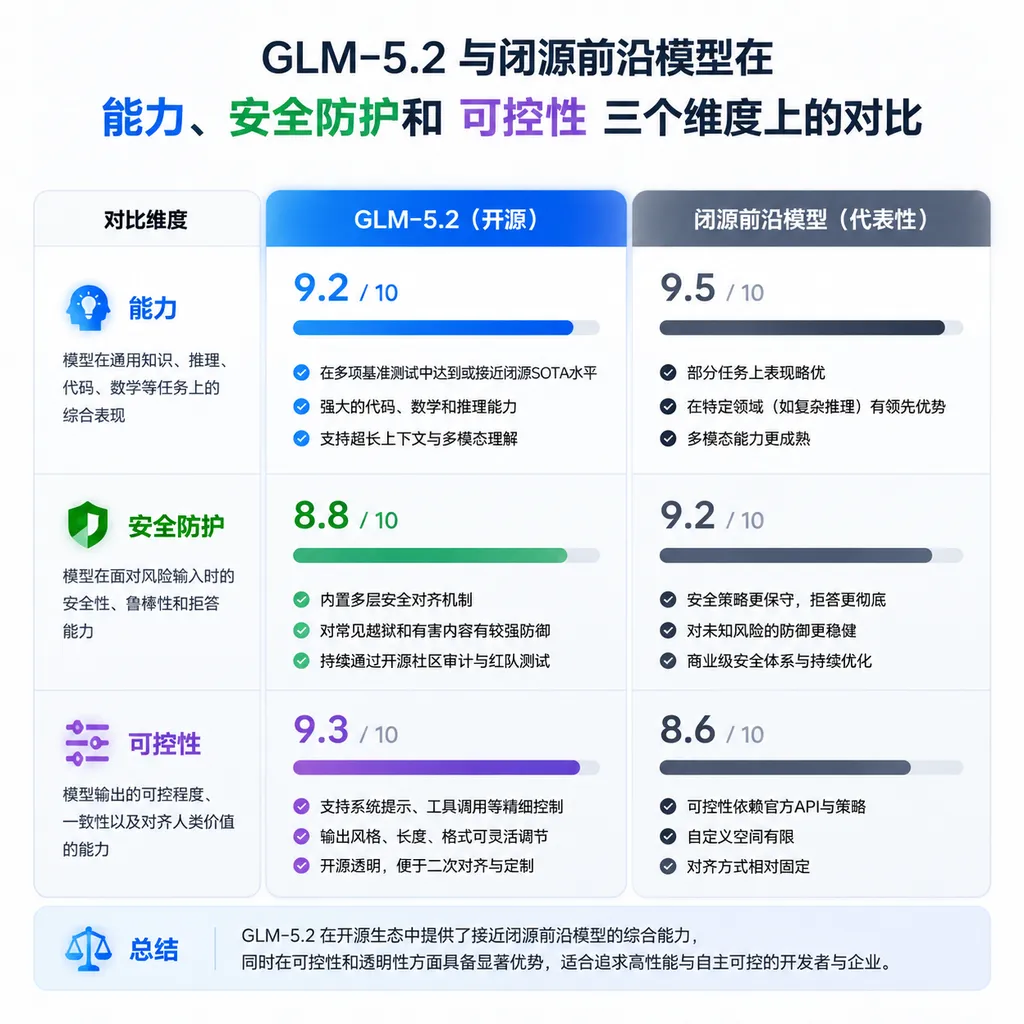
A fairer comparison is to evaluate capability, safety, and controllability separately. GLM-5.2 has made clear progress in capability and deployment control, but the safety evidence and governance support provided by its publisher have not yet caught up with its capability level.
The Next Competition Among Open Models Will Be About Who Can Close the Safety-Engineering Gap First
What truly makes GLM-5.2 noteworthy is not merely which models it surpasses on a particular leaderboard, but the shortening catch-up cycle for open-weight models. Multiple model iterations within four months suggest that the lead held by closed-source models increasingly resembles a window measured in months rather than a permanent generational gap.
Going forward, open-model teams can no longer treat safety as an issue exclusive to closed-source companies. The closer a model gets to frontier capabilities, the greater the need for comprehensive dangerous-capability evaluations, red-teaming methodologies, model cards, deployment baselines, and incident-response plans. Otherwise, the community receives an increasingly powerful engine without matching brakes, a dashboard, or a maintenance manual.
The conclusion regarding GLM-5.2 is therefore clear: it is a model worth testing and has genuine competitive strength in coding and enterprise private-deployment scenarios, but it is not yet a safety component that can be granted high-level permissions unconditionally.
Open weights are catching up with frontier capabilities. The question now is how long it will take governance and safety engineering to catch up with them.
References
- With Fable 5 Removed Worldwide, GLM 5.2’s Approach to Opus 4.8 Is “Highly Significant”: A community discussion of GLM-5.2’s capability positioning, the value of open weights, and the supply risks associated with closed-source models.