Qwen Image 3.0: ¥0.18, Bringing Fierce Competition to Production
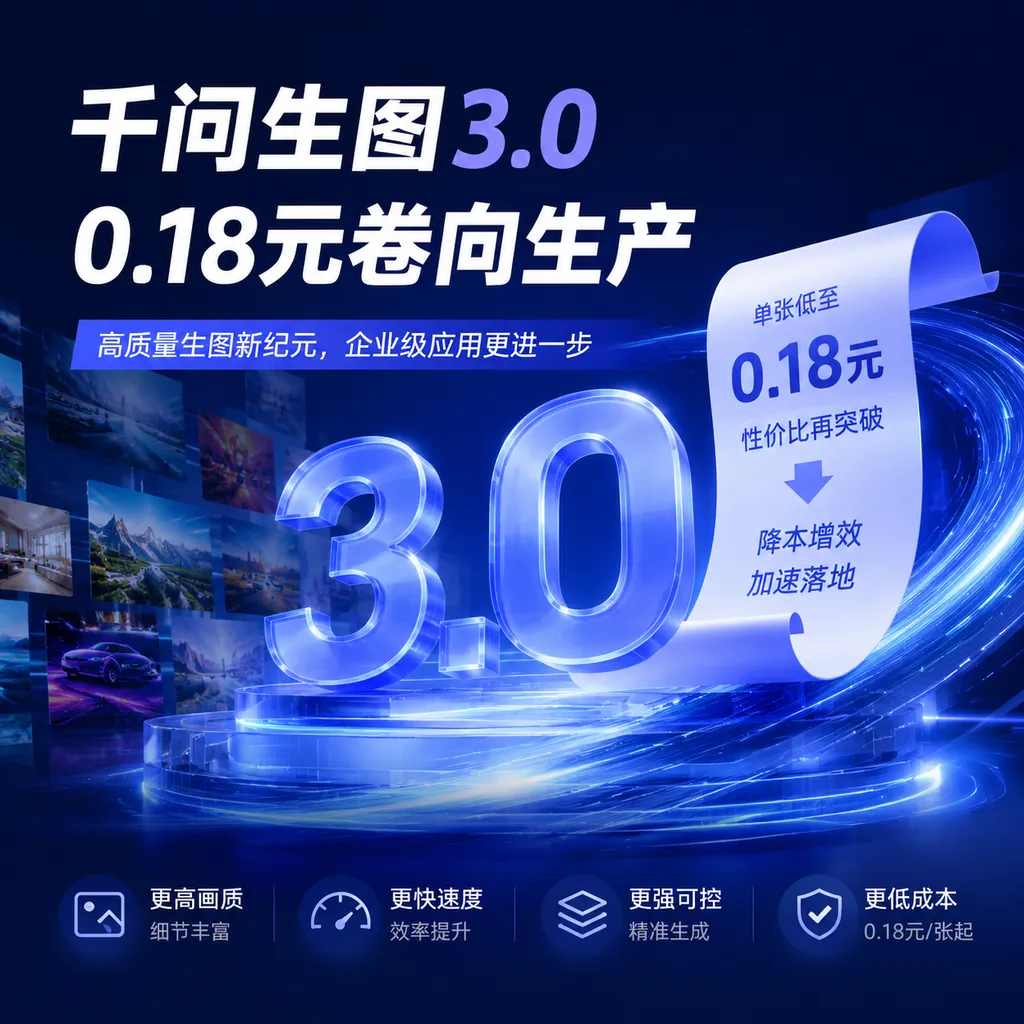
Qwen-Image-3.0 launched in full yesterday, with APIs for both Pro and Standard made available simultaneously. Rather than continuing to compete on aesthetics, what deserves more attention is its complex layout capabilities, small-text rendering, and production-grade pricing starting at RMB 0.18 per image.
Qwen-Image-3.0 Is Now Officially Available—and No Longer Sells Just “Good Looks”
On August 4, Alibaba officially launched its third-generation image generation model, Qwen-Image-3.0, on the Qwen AI platform. It is now available to all users. Two versions were released simultaneously: the flagship Qwen-Image-3.0-Pro and the standard Qwen-Image-3.0-Standard. APIs are available for both, with text-to-image generation priced from RMB 0.18 per image. Overseas developers can access the models through Qwen Cloud.
The focus of this upgrade is not to build yet another image model that is better at atmospheric portraits or has a stronger grasp of “cinematic lighting.” Qwen-Image-3.0 is attempting to solve a more practical—and more difficult—problem: Can the generated images be used directly in real-world work?
According to information disclosed by Alibaba, the new model supports inputs of up to approximately 4.5K tokens and can handle information-dense layouts such as newspapers, exam papers, PowerPoint slides, storyboards, and nine-panel knowledge grids. It can render small text at approximately the 10-pixel level and supports native text generation in 12 languages. Alibaba has also emphasized its ability to simulate interfaces for websites, games, livestreams, and other applications, as well as microscopic details such as pores, strands of hair, and material textures.
Qwen-Image-3.0 currently ranks first among Chinese models on Arena.ai’s latest text-to-image leaderboard. For developers, however, a more important question than its ranking is whether it can turn “AI art” into an image generation component that can be reliably embedded into business workflows.
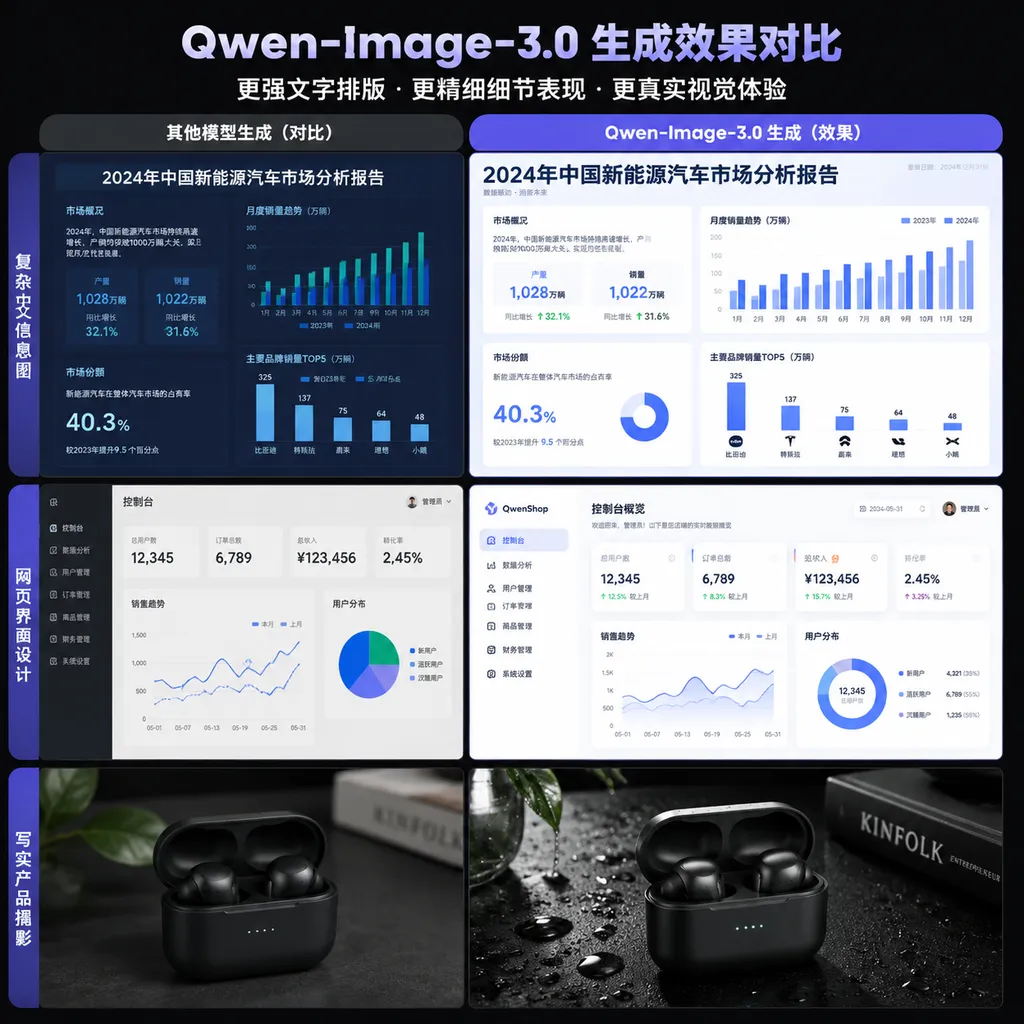
Pro and Standard Launch Together as Alibaba Establishes Clear Product Tiers
Rather than releasing a single model, Qwen-Image-3.0 has offered both Pro and Standard versions from day one. This type of tiering is nothing new, but it is particularly important for image generation APIs.
Real-world workloads for image models generally fall into two categories.
The first consists of final deliverables that require a high success rate, such as primary e-commerce images, brand posters, product packaging, teaching materials, and game concept art. For these tasks, per-image API costs are not the top priority. Rework caused by incorrect text, distorted people, or uncontrolled composition is far more costly. Pro is better suited to these high-value requests.
The second category includes large volumes of sketches, asset variations, feed illustrations, and internal previews. These tasks place greater emphasis on throughput and cost and allow users to select from multiple results, making Standard easier to integrate into batch-generation pipelines.
The publicly available information currently confirms only that pricing starts at RMB 0.18 per image. It does not yet provide a complete breakdown of pricing differences between the two versions across resolutions, dimensions, generation latency, and concurrency tiers. The starting price can therefore indicate market positioning, but it should not be treated as the final cost in a production environment.
The parameters that development teams still need to verify include:
- The stability gap between Pro and Standard when given the same prompt;
- Whether different dimensions, resolutions, and aspect ratios use uniform pricing;
- How many images can be generated per request;
- Peak concurrency, queue times, and timeout policies;
- Whether fixed random seeds are supported for reproducibility;
- Whether reference images, multi-image input, inpainting, and mask-based editing are supported;
- Generated-image retention periods, content moderation rules, and commercial-use terms.
Samples released alongside a model usually demonstrate the upper limit of its capabilities, while API restrictions and billing determine the engineering baseline. For developers, the latter is usually more important.
What 4.5K Tokens Means: Image Prompts Are Beginning to Resemble “Visual Programs”
The most distinctive upgrade in Qwen-Image-3.0 is the increase in input length to approximately 4.5K tokens.
Ordinary text-to-image prompts typically contain only a few dozen to a few hundred tokens: what the subject is, what style to use, what camera angle to adopt, and what kind of lighting to apply. Once the input expands to several thousand tokens, the prompt no longer merely describes an image. Instead, it defines an entire visual structure: where the title should go, what each of nine modules should say, what formulas, icons, and characters each module should contain, how colors should correspond to one another, and what hierarchical relationships should exist among the elements.
In other words, the prompt is evolving from a set of “drawing requirements” into a visual program that is not fully rigorous but is highly expressive.
Alibaba’s complex examples include generating an entire nine-panel knowledge grid in a single pass using an input of approximately 3.7K tokens. The content spans topics such as tunnel safety, spatial geometry, analysis of The Memorial on Dispatching the Troops, projectile motion, medical illustrations, group theory theorems, and DNA structure. The challenge is not simply to combine nine images, but to simultaneously achieve semantic separation, spatial layout, text rendering, and localized control over visual styles.
If these capabilities can be reproduced reliably, they could affect several existing product categories:
- Infographic generators: Instead of having a large language model write the copy and a front-end system apply a template, the model could directly generate a complete visual deliverable.
- Educational content tools: Generate illustrations for exam papers, concept diagrams, experimental procedures, and lecture pages in batches based on learning objectives.
- Low-fidelity prototyping tools: Use natural language to generate web pages, livestream interfaces, or game UIs containing real text.
- Comics and storyboard systems: Enter a complete story passage once and generate multiple panels, rather than invoking the model for each panel and stitching the results together afterward.
- Automated marketing collateral: Include product information, discount rules, brand guidelines, and channel-specific dimensions in a single task description.
However, long input does not mean that every constraint in a long instruction will be followed precisely. Image models remain probabilistic systems, not browser layout engines. A 4.5K-token context window raises the upper limit of task complexity; it does not guarantee that all text, formulas, and spatial relationships will be rendered with 100% accuracy.
Improved Small-Text Rendering Is the Most Valuable Part of This Generation
Over the past two years, image generation models have become highly proficient at producing visually striking images at first glance. But once text appears in an image, the problems quickly become apparent: missing strokes in Chinese characters, misspelled English words, inconsistent numbers, and product names that deform from one location to another.
That is why many so-called “one-sentence poster generators” still require users to return to Photoshop, Figma, or Canva to redo the typography. The model generates the background; the designer creates the finished product.
Qwen-Image-3.0 is moving in the right direction by positioning 10-pixel small-text rendering and support for 12 languages as core selling points. It is targeting not pure artistic creation, but tasks such as posters, PowerPoint slides, exam papers, menus, packaging, and user interfaces, where text itself is an integral part of the image.
If the model can raise text accuracy from “occasionally usable” to “deliverable in most cases,” its value will extend beyond fixing a few typos. It could eliminate entire stages of post-processing.
A traditional workflow often looks like this:
Large language model generates copy → Template engine handles layout → Image model generates assets → Human adjusts layers → Final image is exported
The ideal new workflow would instead be:
Structured business information → Qwen-Image-3.0 directly generates complete collateral → OCR and rule-based systems validate the output → Retry if necessary
The difference is not merely one of efficiency. The first workflow requires maintaining templates, fonts, layout rules, and asset libraries. The second delegates many visual decisions to the model. The trade-off is reduced determinism, which means enterprises cannot simply connect to a generation API; they also need OCR validation, brand-term checks, sensitive-content moderation, and automated retries.
In other words, the stronger the model’s text capabilities, the closer it comes to being a production tool. But the closer it comes to production use, the less developers can afford to neglect the surrounding engineering.
RMB 0.18 per Image Is Very Low, but Costs Should Not Be Calculated by API Calls Alone
The starting price of RMB 0.18 per image is highly aggressive. By the simplest calculation, generating 1,000 images would cost approximately RMB 180 in raw API fees, while generating 10,000 would cost approximately RMB 1,800. For e-commerce assets, editorial illustrations, and advertising variants, this price is already low enough to support large-scale experimentation.
However, the cost of image generation cannot be measured solely by how many images are returned successfully. If one deliverable requires an average of four generations, actual costs can quickly multiply once moderation, storage, and retries are included.
Monthly raw generation cost = Number of requests × Price per image
Cost per usable image = Total monthly cost ÷ Number of images that pass final validation

Example:
1,000 deliverables × Average of 4 generations × RMB 0.18
= RMB 720 in basic generation fees
If text-heavy assets have only a 50% first-pass acceptance rate, the price of each “usable image” is no longer RMB 0.18. After factoring in the Pro version, higher resolutions, image storage, CDN delivery, OCR verification, and manual sampling, production costs will be considerably higher.
That does not diminish the competitiveness of the pricing. Producing a structurally complex marketing poster manually typically costs far more than a few tenths of a yuan. If the model can eliminate even one round of layout work or rework, the economics already make sense.
A more reasonable way to evaluate Qwen-Image-3.0 is therefore not by its per-image API price, but by metrics such as:
- How many out of every 100 generated images require no manual edits;
- The character-level accuracy of specified text;
- Subject consistency across consecutive generations of the same product;
- The constraint-completion rate for complex prompts;
- P50 and P95 generation latency;
- Whether the success rate drops significantly during peak business periods.
Compared With Competitors, Qwen Has Chosen a More Pragmatic Path
Competition among leading image models currently falls into roughly three directions: some emphasize photographic realism and aesthetic quality, some focus on editing and consistency, while others strengthen text, knowledge, and complex layout capabilities.
Qwen-Image-3.0 clearly leans toward the third direction while also attempting to preserve photorealistic detail. This positioning is particularly well suited to the Chinese market, where Chinese-language posters, e-commerce detail pages, educational materials, and long-form social media graphics generally contain large amounts of text—and where Chinese characters are structurally more complex than Latin letters.
From a product-strategy perspective, Alibaba has not focused on “generating a cat that looks more like a professional photograph.” Instead, it has tackled newspapers, exam papers, PowerPoint slides, and web interfaces. These use cases may not be the easiest to promote on social media, but they are more likely to generate API usage and enterprise orders.
Of course, the high-density nine-panel grids, mathematical formulas, and nested interfaces in the official samples are all difficult showcase tasks. Developers should not treat a handful of successful examples as representative of stable service quality. The best testing approach is to use the messiest, longest, and most error-prone real-world data from their own businesses: price lists containing currency symbols, course posters containing rare characters, multilingual product packaging, and UI pages with strict positional relationships.
Only a model that passes these tests can be considered genuinely useful.
For Developers, It Is More Like a Foundation for Image Workflows
The full availability of the Qwen-Image-3.0 API means developers no longer need to limit themselves to experimenting with images inside a chat product. They can integrate the model into automated pipelines. The best early use cases are not fully unmoderated public-content publishing, but semi-automated scenarios with clearly structured inputs and validation rules.
For example, an e-commerce system could first read a product name, selling points, and promotional price, generate multiple visual drafts, and then use OCR to verify the price and brand terms. An education platform could generate knowledge diagrams from a course syllabus but verify formulas and answers before publication. A game studio could use Standard to batch-generate concept sketches, then send a small number of candidates to Pro or human artists for refinement.
The most sensible use of Pro and Standard may not be choosing one over the other, but arranging them in a cascading pipeline: Standard handles low-cost exploration, while Pro processes the final candidates. Simple tasks are routed to Standard by default, while requests involving long text, complex layouts, or high-value customers are upgraded to Pro.
This routing strategy is more suitable for production environments than sending every request to the most expensive model.
Verdict: Aggressive Pricing, but Success Will Depend on Stability
Qwen-Image-3.0 is an upgrade with a clear direction. Its 4.5K-token input capacity, 10-pixel small-text rendering, support for 12 languages, and complex interface simulation all point toward the same goal: enabling generated images to carry more real information rather than merely providing visual atmosphere.
The starting price of RMB 0.18 per image further lowers the barrier to experimentation. For content, e-commerce, education, advertising, and game development teams, the model deserves immediate inclusion in internal evaluations, especially for tasks involving dense Chinese text.
At this stage, however, leaderboards and official samples alone are not enough to declare that it can replace professional design workflows. Its constraint adherence in complex layouts, small-text accuracy, consistency across consecutive generations, API latency, and the actual gap between Pro and Standard all need to be validated through real-world usage.
This is also what makes Qwen-Image-3.0 particularly noteworthy: it is no longer competing with other image generation models solely over “who can draw prettier pictures.” It is beginning to compete for workloads currently handled by template engines, design software, and even human layout specialists.
The transition from toy to tool has never depended on slightly better aesthetics. It depends on requiring one less round of rework. Qwen-Image-3.0 has already brought pricing into the production-ready range. What it must prove next is that its stability has reached that level as well.
References
- Zhihu: Qwen-Image 3.0 Becomes an All-Purpose AI Worker, Generating Professional Visual and Text Materials with One Click — Introduces Qwen-Image-3.0’s long instructions, complex layouts, text rendering, and representative generation examples.