Connect to MCP on Alibaba Cloud with a Single Key
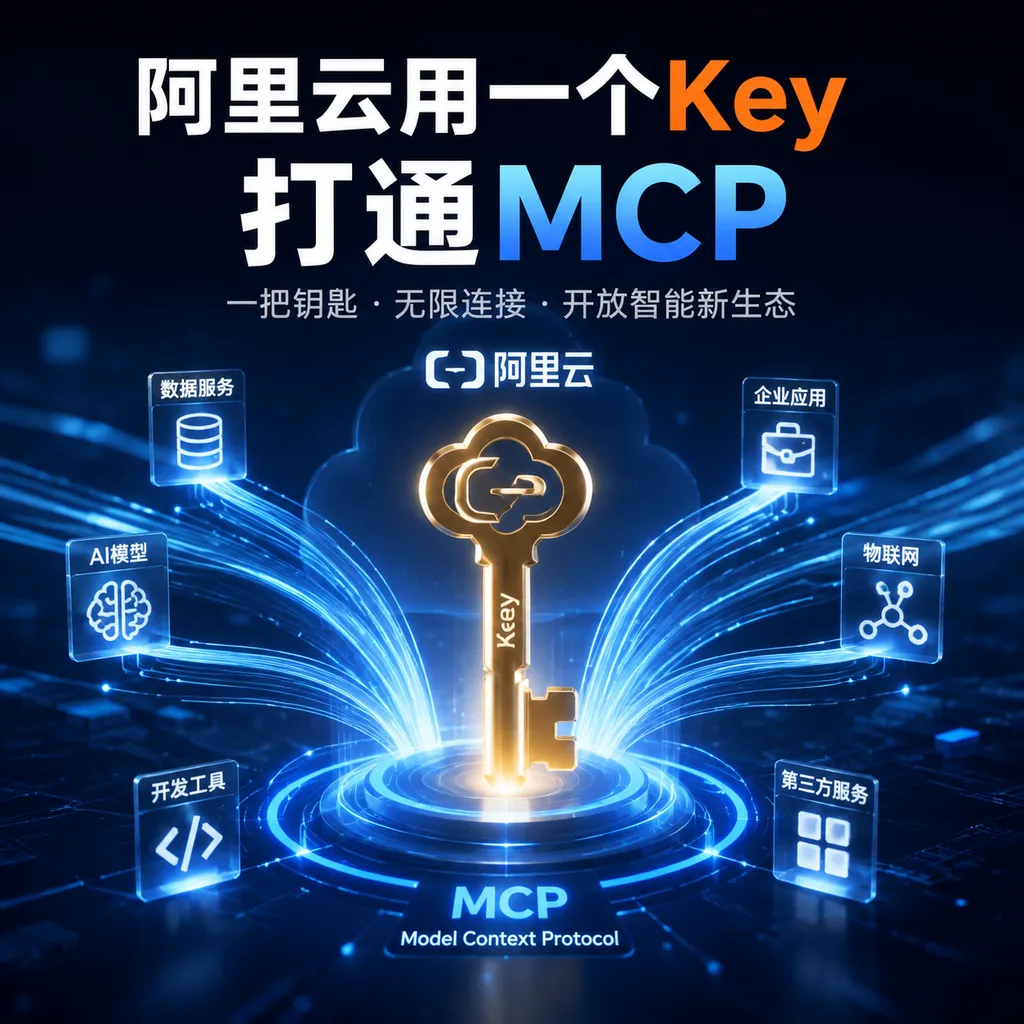
Alibaba Cloud today launched One Key MCP, enabling a single Bailian API key to access an initial batch of 14 third-party services while centrally handling authentication, metering, and billing. It lowers the integration cost for agents to invoke tools, but does not eliminate issues related to permission isolation, service quality, or platform lock-in.
One Key to Manage Every External Service Your Agent Calls
On August 5, 2026, Alibaba Cloud officially launched One Key MCP. Developers can use the same Alibaba Cloud Model Studio API Key to activate and call MCP services provided by multiple ecosystem partners on the platform, eliminating the need to apply for credentials, configure authentication, and handle billing separately for each provider.
The initial lineup includes 14 partners across six categories: e-commerce supply chains, geospatial and environmental data, finance and investment, legal and compliance, enterprise data, and logistics and vehicle services. One Key MCP is also compatible with mainstream coding agents such as Qoder, Codex, Claude Code, and Cursor, and can be used within Alibaba Cloud’s own agent development ecosystem.
This is not a new MCP protocol, nor is it yet another agent framework. More precisely, it adds a unified commercial and operational control plane on top of MCP services: the protocol enables agents to understand tools, while One Key MCP enables enterprises to purchase and manage those tools conveniently and securely.
MCP Standardized Interfaces, but Not Account Provisioning
MCP, or Model Context Protocol, addresses how models or agents discover tools, understand parameters, and initiate calls. Map queries, web scraping, database searches, and electronic contract signing can all be packaged as MCP tools with a standardized description format.
But a standardized protocol does not mean a standardized onboarding process.
Previously, if a team wanted its agent to call mapping, financial data, electronic signing, and logistics tracking services, it would typically still need to complete a conventional set of integration tasks:
- Register accounts separately through each provider’s console;
- Sign separate agreements and activate each service;
- Apply for each provider’s API Key or access token;
- Maintain different credentials, endpoints, and authentication headers in the agent configuration;
- Check usage, balances, and bills separately;
- Troubleshoot each service individually when credentials expired or interfaces changed.
These tasks are manageable when integrating two or three services. With more than a dozen, however, the problem shifts from “writing a few configuration files” to credential governance, financial reconciliation, and vendor management.
In enterprise environments in particular, developers may not have the authority to purchase external data directly, while finance departments are unlikely to welcome more than a dozen bills based on different pricing models. The more tools an agent can call, the more its underlying management starts to resemble traditional cloud computing, requiring identity, permissions, network boundaries, metering, and auditing.
One Key MCP targets precisely this unavoidable part of production deployment that no one wants to handle.
What Exactly Has Alibaba Cloud Unified?
According to information published by Alibaba Cloud, One Key MCP provides five core capabilities.
1. Unified Key
Developers can reuse their Model Studio API Key to access activated partner services, reducing the need to apply for, store, and rotate multiple sets of credentials.
This is particularly useful for locally running Claude Code, Codex, Cursor, or Qoder. Previously, every additional remote MCP Server could mean another token, another set of environment variables, and another permissions configuration. Now, at least within the Model Studio ecosystem, credential access has been consolidated onto a single platform.
2. In-Platform Activation
Third-party MCP services can be activated directly in the Model Studio MCP marketplace, without repeatedly switching to partner consoles.
“Fewer clicks” is only the surface-level benefit. The real value is that Alibaba Cloud is beginning to take responsibility for service aggregation, agreement confirmation, and the coordination of commercial relationships. Development teams deal with one point of access rather than 14 separate vendors.
3. Unified Metering and Billing
The platform centrally displays usage and costs, allowing enterprises to review calls and reconcile bills in one place.
It is important to note that unified billing does not mean unified pricing. Different MCP services may still charge per call, by data volume, by duration, or through service packages. Token costs generated by model inference are also generally calculated separately from MCP tool fees. One Key MCP unifies billing access and metering management; it does not force every service into the same pricing model.
4. Support for Multiple Types of Agents
The service supports calls through CLIs and public service endpoints. It can connect to coding agents such as Qoder, Codex, Claude Code, and Cursor, as well as more general-purpose agent and workflow systems.
This is important. If an MCP marketplace can only be accessed by the platform’s own agents, it remains a closed plugin store in essence. Only when external clients can connect can the service marketplace create reusable value across models and agents.
5. Security Controls
Alibaba Cloud provides end-to-end encryption and API Key-based IP allowlist and blocklist restrictions, limiting the network locations from which a key can initiate requests.
This is easier to govern than scattering third-party keys across developer computers, CI logs, and multiple configuration files. However, a unified key also concentrates risk: if a highly privileged key is leaked, the attack surface may expand from a single tool to every service activated for that key. Enterprises should still separate keys by environment and team rather than interpreting “one key” as a universal credential shared across the entire company.
The Initial 14 Services: The Number Is Not the Point
The initial One Key MCP partners and their capabilities are as follows:
| Category | Partner | Available Capabilities | | --- | --- | --- | | E-commerce supply chain | 1688 | Supplier matching, intelligent product selection, and procurement sourcing | | Geospatial and environmental data | AutoNavi Cloud Map, Qingyue Information | Geospatial data, traffic information, and environmental monitoring | | Finance and investment | East Money, Gildata, Today Investment, Yingmi Fund–Qieman AI, Longbai Data | Financial information, market data, and investment analysis | | Legal and compliance | Deli Technology, eSign | Legal research and electronic signing | | Industry and enterprise data | Beijing Shangqi Digital Technology | Industry and enterprise data queries | | Logistics and vehicles | Xiupai Technology, Annaqi Technology, Wangshang Technology | Logistics tracking and vehicle-related data |
Fourteen partners do not constitute a vast tool ecosystem. The number of publicly available MCP Servers on GitHub is far higher, and various agent clients can already install a wide range of community services directly.
However, rather than focusing on “another weather query” or “another wrapper around search,” Alibaba Cloud’s initial lineup targets fields rich in commercial data, such as finance, law, logistics, and supply chains. These capabilities often involve access requirements, authorization, billing, and compliance obligations that are difficult to address with open-source MCP Servers alone.
For example, a procurement agent could match requirements with 1688 suppliers and then use logistics data to estimate delivery progress. An investment research agent could retrieve financial information, generate an analytical summary, and run the content through compliance tools. The main obstacle in such tasks is usually not LLM inference, but whether the required data can be obtained legally, reliably, and continuously.
One Key MCP’s core competitive advantage, therefore, will not be “MCP support”—protocol compatibility will quickly become a baseline capability—but whether it can bring enough high-value service providers into a single transaction and governance system.
It Is More Like an API Gateway Plus an App Marketplace for the Agent Era
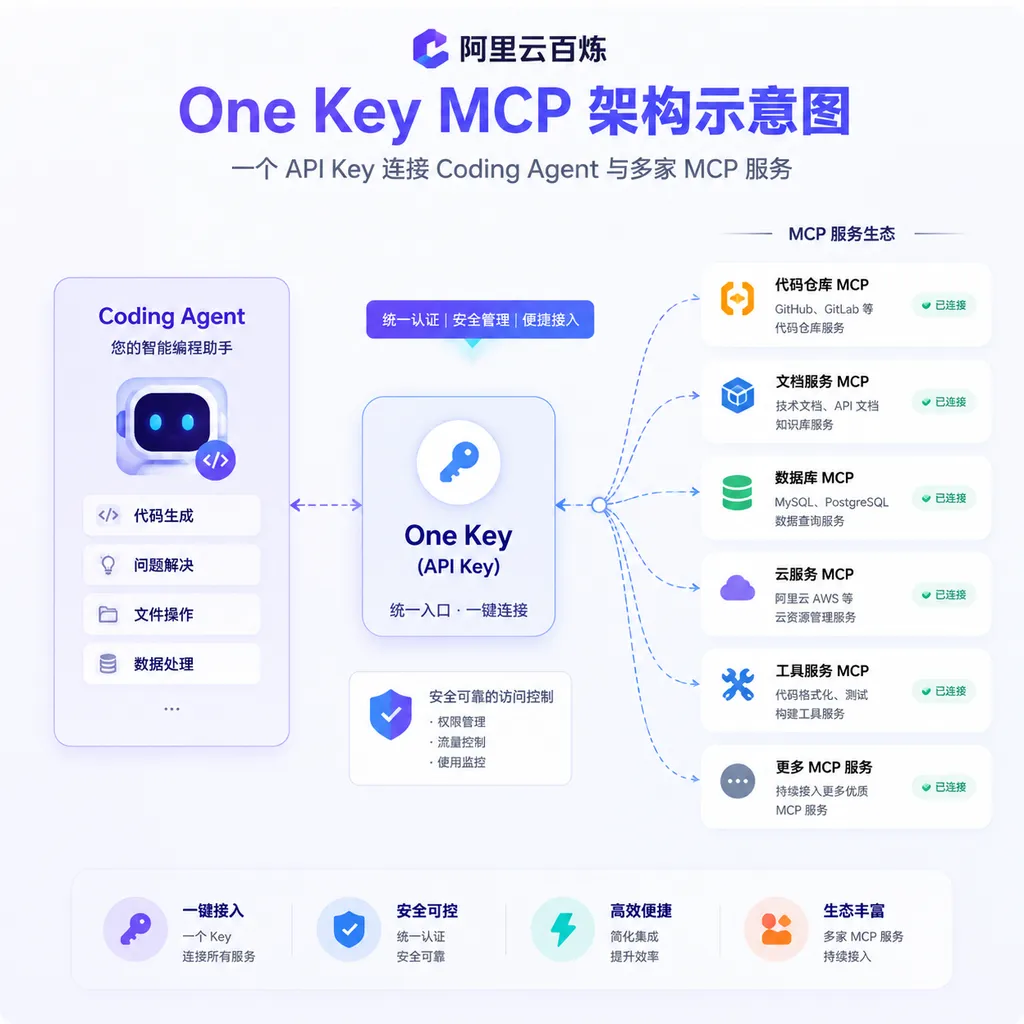
From a product-positioning perspective, One Key MCP can be divided into three layers:
- The top layer consists of agent clients: including coding agents, enterprise agents, and automated workflows;
- The middle layer is the Model Studio control plane: responsible for service activation, identity authentication, call metering, billing, and security policies;
- The bottom layer consists of specialized service providers: delivering real-world capabilities in mapping, finance, law, supply chains, logistics, and other fields.
This resembles a traditional API gateway, but the consumer has changed. In the past, API gateways primarily enabled application code to call backend interfaces. Now, the caller may be an agent capable of independently planning steps and using multiple tools in succession.
This creates an obvious change: call chains become longer and less predictable.
In conventional applications, engineers usually hard-code which API should be called and when. An agent, by contrast, might first query enterprise data and then call mapping, logistics, and signing services, with the exact path dynamically determined by the model based on context. A single user request may trigger multiple external calls, making costs, permissions, and failure retries harder to estimate.
A unified key alone is therefore not enough. The capabilities that will ultimately influence enterprise adoption include:
- Call quotas for individual agents, users, or projects;
- Fine-grained permissions at the tool level;
- Call-chain tracing and failure-cause diagnosis;
- Sensitive-parameter masking and cross-border data transfer controls;
- Cost budgets, alerts, and automatic circuit breakers;
- Availability and latency metrics for third-party services;
- Human approval mechanisms for high-risk actions.
If these capabilities fail to keep pace, One Key MCP will merely make integration faster. If they are fully implemented, it can become part of the enterprise agent infrastructure.
Useful for Developers, but Do Not Overestimate “One Key”
This service is highly practical for prototyping and small to midsize teams.
Developers can validate multi-tool agents without first studying every provider’s account system. For example, a supply chain assistant could use 1688 for sourcing and then check logistics tracking data. A legal workflow could first search regulations and contract clauses, then initiate electronic signing. Integration time could be reduced from days to a process focused primarily on debugging tool descriptions and agent prompts.
However, it does not solve every problem in the MCP ecosystem.
A Standardized Protocol Does Not Mean Standardized Tool Quality
Different services still define fields, error codes, rate limits, and response data differently. Whether an agent can reliably select the correct tool and fill in the right parameters also depends on how clearly the tool is described and whether the provider has optimized it for model-based calls.
The fact that a schema can be read does not mean the model can use it correctly.
Unified Authentication Does Not Mean Least Privilege
If a single Model Studio key has permissions for financial queries, enterprise data, and electronic signing, its permission scope may be too broad. Query tools and action-oriented tools should be separated in particular: checking logistics data and initiating a contract signing clearly should not share identical authorization policies.
Unified Billing Does Not Mean Predictable Costs
An agent may rapidly amplify tool costs because of planning errors, call loops, or retries. Enterprises need to consider not only the price per call, but also the actual number of calls triggered by each task and whether failed calls are billed.
Platform Convenience Also Creates Lock-In
Developers save the cost of integrating with 14 separate services, but they also move activation relationships, the key system, and billing to Model Studio. If they later want to switch platforms, they may still need to reestablish direct authorization and settlement relationships with each service provider.
This is not unique to Alibaba Cloud. It is a common trade-off for all aggregation platforms: accepting a degree of platform dependence in exchange for lower integration and governance costs.
The Next Round of Competition Will Not Be About the Number of MCP Connectors
MCP is rapidly becoming one of the de facto standards for agent tool use. Simply announcing “MCP support” is no longer enough to create differentiation. The next phase of competition among platforms will focus on four things:
- Whether they offer irreplaceable data and services, especially in specialized fields such as finance, supply chains, and law;
- Whether enterprises are willing to entrust production permissions to agents, including auditing, approval, isolation, and compliance capabilities;
- Whether failures can be diagnosed, rather than merely displaying a generic “tool call failed” message;
- Whether billing is sufficiently transparent, with clear separation among model token costs, MCP call fees, and cloud resource charges.
Alibaba Cloud has inherent advantages in China’s cloud resources, enterprise customer base, and commercial service ecosystem. One Key MCP extends these advantages into the agent tool layer, with a clear objective: models may come from different vendors, and agent clients may be Codex, Claude Code, or Cursor, but tool calls, data services, and billing should ideally remain within Model Studio.
This is a step closer to actual business operations than simply competing for model API usage.
Conclusion: MCP Is Evolving from a Technical Protocol into a Business
Over the past year, discussions around MCP have focused on “whether services can be connected.” One Key MCP focuses on “how services are activated, paid for, and managed after they are connected.” This means MCP is moving beyond an interface protocol in the developer community and into identity, transactions, and governance—the areas where cloud providers excel.
For developers, using one key to call multiple services is indeed convenient, especially for quickly validating cross-tool agents. For enterprises, the more important question is whether the platform can subsequently provide fine-grained authorization, comprehensive auditing, cost circuit breakers, and service-level guarantees.
At present, One Key MCP is more like a starting point: it places 14 services behind a single point of access, but the truly difficult part of putting agents into production remains ensuring that every autonomous call is compliant, controllable, and traceable.
References
- ITHome: Alibaba Cloud Launches One Key MCP, Compatible with Qoder, Codex, and More, Enabling One-Click Access to Multiple MCP Services — Covers the launch date of One Key MCP, its five core capabilities, compatible clients, and the initial 14 partners.