Xiaomi’s embodied AI model has finally open-sourced its deployment pipeline
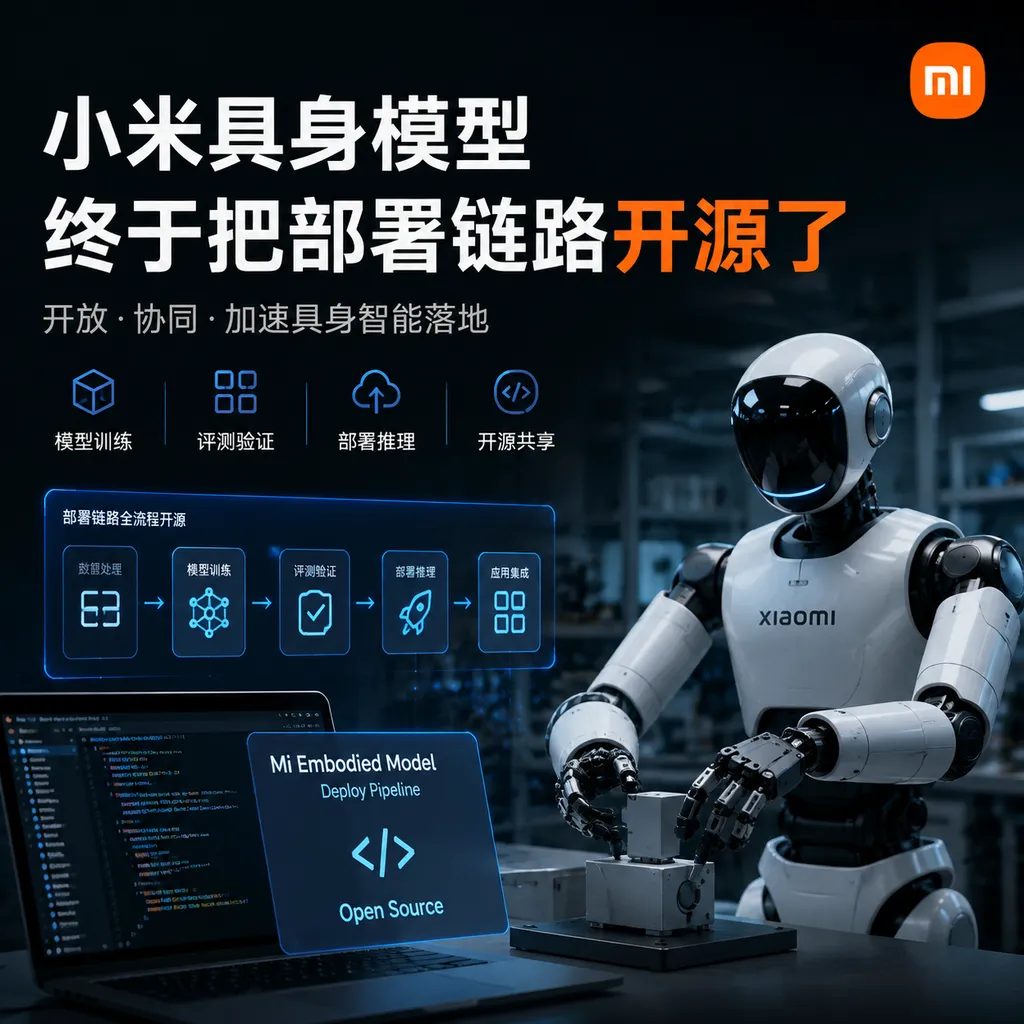
Xiaomi open-sourced Xiaomi-Robotics-1 today, releasing the model along with the full pipeline for post-training on physical robots, deployment, and evaluation. More important than its benchmark scores is its attempt to lower the engineering barriers to bringing robotics models from research papers into real-world robots.
Xiaomi officially open-sourced its embodied foundation model, Xiaomi-Robotics-1, today (August 5). According to information disclosed by the company, the model was pretrained on more than 100,000 hours of UMI data and post-trained on over 10,000 hours of cross-embodiment data. This release includes not only the model weights, but also code for real-robot post-training, model deployment, and benchmark evaluation.
This is the next step for Xiaomi-Robotics-1 following its release in July this year. For robotics developers, what truly matters is not simply the availability of yet another downloadable checkpoint, but Xiaomi’s attempt to open up the entire intermediate pipeline that takes a model from “running benchmarks” to “running on a real robot.”
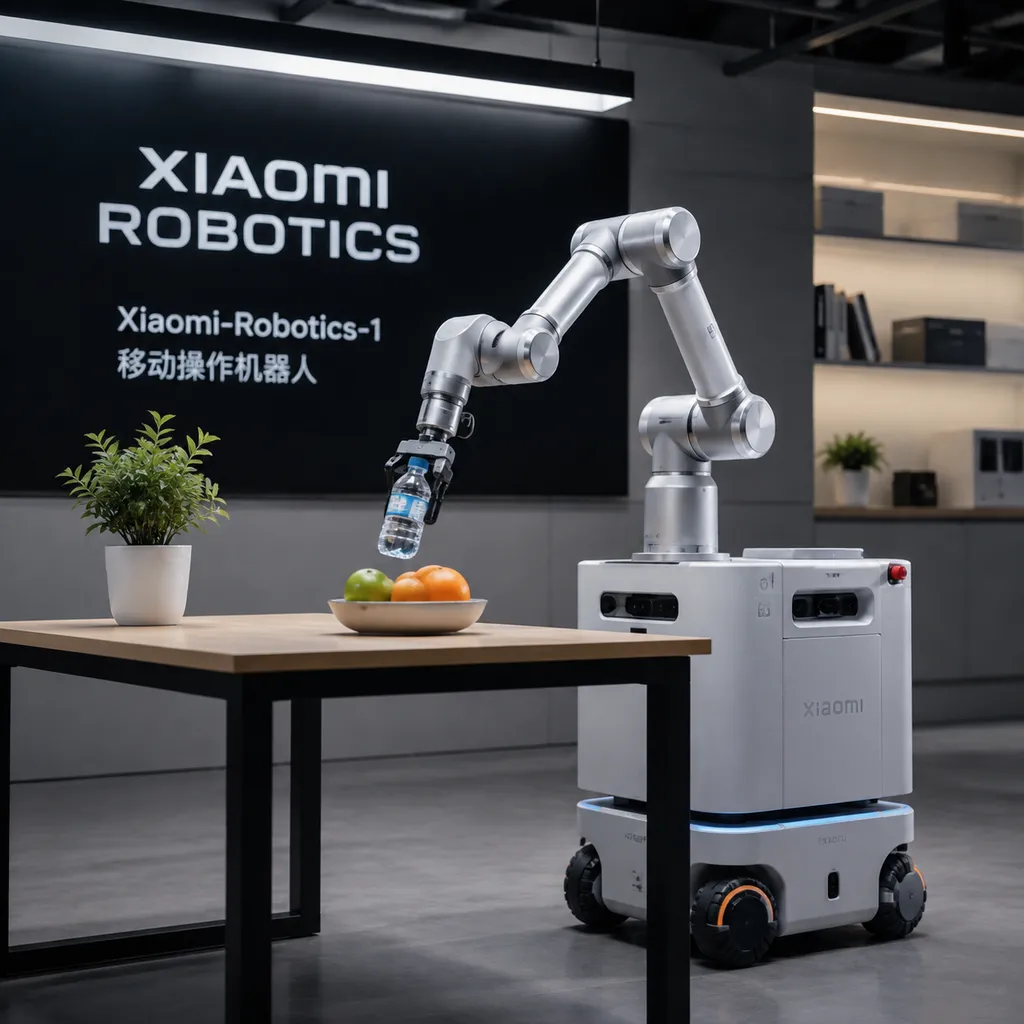
The Focus of the Open-Source Release Is Not the Weights, but the Last Mile
Over the past year, the embodied AI field has seen the release of a large number of vision-language-action models, commonly known as VLA models. They take camera images and natural-language instructions as input, then output actions that can be executed by robotic arms, grippers, or mobile bases.
The concept is not complicated: large language models predict the next token, while embodied models must predict the next sequence of actions. But the deployment challenges are on entirely different levels.
If a text model occasionally outputs a less-than-ideal word, it usually only affects the quality of the answer. If a robot predicts the end effector’s position just a few centimeters off, it may knock over a cup, collide with a table, or even damage the equipment. More troublesome still, robots differ in their number of joints, control frequency, camera placement, gripper design, and action space. A policy trained on a dual-arm robot cannot simply be copied over to a single-arm manipulator.
As a result, there has always been a long engineering pipeline between “open model weights” and “developers can reproduce the results”:
- How to convert real-robot data into the format required by the model;
- How to align camera, robot-base, and end-effector coordinate systems;
- How to map model outputs into the action spaces of different robots;
- How to handle control frequency, inference latency, and action smoothing;
- How to reproduce the evaluation results reported in the paper before deployment;
- How to adapt the model with a small amount of embodiment-specific data instead of training from scratch.
The value of Xiaomi-Robotics-1 lies in the fact that this release extends the open-source scope to include real-robot post-training and deployment workflows. It does not provide a fully assembled robot; rather, it is more like a set of engines, transmissions, and installation instructions. Developers still need to prepare their own hardware and data, but they no longer have to figure out from scratch how to connect the model to real devices.
However, the claim that it “covers the entire workflow from training to deployment” should be interpreted more precisely. Based on Xiaomi’s current disclosures, what is explicitly open includes model resources, real-robot post-training, deployment, and related evaluation code. This does not necessarily mean that the more than 100,000 hours of raw pretraining data, the complete data-cleaning infrastructure, and the pretraining compute environment are all available without restriction. Whether strict end-to-end reproduction is possible will depend on the repository’s data licenses, training configurations, dependency versions, and hardware adaptation documentation.
In other words, this release goes further than merely publishing demonstration videos or model weights, but whether it is truly “fully open source” will ultimately have to be verified by developers running the complete pipeline themselves.
100,000 Hours of UMI Data Addresses the Data-Scale Problem
Xiaomi-Robotics-1 uses a two-stage “pretraining + post-training” paradigm, similar to the mainstream approach used by today’s large models.
The pretraining stage is responsible for learning general capabilities. Given the current visual observations and a language instruction, the model must predict a sequence of actions that gradually transforms the environment from its current state toward the target state. For example, when instructed to “put the cup on the table into the tray,” the model must do more than recognize the cup and tray. It must also generate a continuous sequence of actions such as approaching, aligning, grasping, lifting, moving, and releasing.
According to Xiaomi, this stage used more than 100,000 hours of UMI data. UMI typically refers to manipulation data-collection approaches such as the Universal Manipulation Interface. The central idea is to reduce the cost of collecting real-world manipulation trajectories: visual and motion information is first recorded using portable or directly human-operated devices, and these trajectories are then converted into action data that robots can learn from.
The significance of this type of data is that it bypasses the efficiency bottleneck of pure teleoperation-based collection. Traditional robotics data collection often requires a person to sit at a control console and operate a robotic arm one trajectory at a time. The equipment is expensive, collection is slow, and operators tire easily. The UMI approach is more akin to first recording, at scale, “how humans would complete a task,” and then allowing the model to extract transferable action patterns from these large-scale demonstrations.
But data duration is not the only metric that matters.
Although 100,000 hours sounds substantial, actual performance still depends on task diversity, viewpoint coverage, action precision, the proportion of failure examples, the quality of language annotations, and whether there is extensive duplication across scenarios. Robotics data is far scarcer than web text, but it is also far more difficult to standardize. One hundred thousand hours of repeatedly wiping tables may not be as valuable as 10,000 hours covering hundreds of objects and environments.
Therefore, the data scale reported by Xiaomi demonstrates that this is not a small-sample experiment, but it does not by itself prove that the model possesses sufficiently strong open-world generalization capabilities. Developers should pay closer attention to the composition of the data, the sampling methodology, and the model’s performance on unseen tasks.
10,000 Hours of Cross-Embodiment Post-Training Determines Whether the Model Can Switch Robots
The second stage uses more than 10,000 hours of cross-embodiment data for post-training. “Cross-embodiment” is one of the most noteworthy keywords associated with Xiaomi-Robotics-1.
The robotics field has no highly standardized hardware platform comparable to x86 in the PC era. Robotic arms differ in their degrees of freedom, while grippers may have two fingers, three fingers, or dexterous hands. Some robots are fixed beside a table, while others are mounted on mobile bases. Cameras may be positioned on the robot’s head or attached to the wrist.
If switching to a different robot requires collecting massive amounts of new data and training an entirely new model each time, the commercial value of an embodied foundation model would be extremely limited. The very notion of a “foundation model” implies that the model must first acquire relatively general visual-understanding and action-generation capabilities, and then adapt to a target embodiment using a smaller amount of embodiment-specific data.
Cross-embodiment post-training is intended to address precisely this issue. The pretrained model can be thought of as a person who has learned from a vast range of driving scenarios, while different robots are like vehicles with different steering wheels, body dimensions, and power responses. Post-training does not teach the model what a road is all over again; it familiarizes the model with the new vehicle’s control interface.
This is also the basis for Xiaomi’s claim that the model is “ready to use out of the box.” However, this phrasing still carries a clear product-marketing flavor. In robotics, genuinely zero-configuration, out-of-the-box operation is almost nonexistent: camera calibration, control interfaces, safety boundaries, action normalization, and end-effector configuration cannot be skipped entirely. A more realistic interpretation is that developers can start from a model that already possesses general manipulation priors and adapt it to new equipment with relatively little data, rather than training from random initialization.
Leading Benchmark Results, but Simulation Rankings Should Not Be Equated With Real-Robot Capabilities
According to publicly available data, Xiaomi-Robotics-1 has achieved fairly strong results across several robotics benchmarks:
- On RoboCasa365, it achieved an average success rate of 57.4%, higher than the previous state of the art at 46.6%;
- In the RoboDojo simulation evaluation, it achieved an average score of 20.07 and an average success rate of 13.93%;
- On VLABench, it achieved an average success rate of 59.1% and an average progress score of 70.3%;
- On RoboCasa, it achieved an average success rate of 74.5%, outperforming models such as RLDX-1, Cosmos Policy, GR00T N1.6, Pi-0.5, and Pi-0-FAST in publicly reported comparisons.
At the very least, these figures indicate that Xiaomi-Robotics-1 is not relying solely on edited real-robot demonstration videos to create an impression of effectiveness. It possesses comparable task-completion capabilities in standardized environments. Evaluations involving compositional and unseen-task splits are particularly useful for determining whether the model has merely memorized fixed trajectories or has learned a certain degree of object relationships and action composition.
However, robotics benchmarks also have clear limitations.
First, visual noise, friction coefficients, and collision feedback in simulation environments remain more orderly than those in the real world. Second, different models may use different amounts of pretraining data, different vision encoders, and different test settings. Even if all of them report success rates, the comparisons may not be entirely apples to apples. Finally, succeeding at a task ten times does not mean a robot can perform it reliably thousands of times in a factory or home.
These leading results are therefore better viewed as a signal that the model is worth downloading and testing, rather than proof that general-purpose robotic manipulation has been solved. For teams working on actual deployments, long-term real-robot success rates, error-recovery capabilities, inference latency, and robustness to occlusion and lighting changes are often more important than leaderboard rankings.
What This Open-Source Release Can Save Developers
The most direct beneficiaries of Xiaomi-Robotics-1 broadly fall into three categories.
The first consists of universities and research teams. Complete evaluation code can reduce the cost of reproducing experiments and make it easier for researchers to replace the vision encoder, action head, or post-training method on a unified benchmark, rather than spending weeks assembling the necessary engineering scaffolding.
The second consists of robot hardware manufacturers. If the cross-embodiment post-training workflow is sufficiently clear, manufacturers can connect their own robotic arms or mobile manipulation platforms to the model and test how effectively it can adapt using a small amount of data. Compared with retraining a policy for every type of hardware, this approach is closer to a scalable product solution.
The third consists of embodied-application teams, such as developers working on warehouse picking, laboratory automation, and home service robots. They generally do not need to train a new foundation model. Instead, they need to quickly adapt an existing model to specific objects, environments, and action specifications. Deployment code, data-conversion tools, and reproducible configurations are often more useful than the model architecture itself.
Of course, the actual barrier to adoption will also depend on several details that developers still need to examine:
- Whether the licenses permit commercial use, as the model weights, code, and data components may use different licenses;
- The GPU memory requirements for training and inference, which determine whether an ordinary laboratory can perform post-training;
- Which robot interfaces are supported, and how much code must be modified to integrate a new embodiment;
- Whether the training data is available, without which some results can only be validated rather than fully reproduced;
- Whether the safety mechanisms are complete, including action limits, collision handling, and emergency stops;
- Whether the repository is continuously maintained, because a one-time upload and long-term usability are two different things.
These issues are less eye-catching than model leaderboards, but they will determine whether Xiaomi-Robotics-1 ultimately becomes a commonly used foundation for the research community or remains a high-profile project tied to its launch moment.
Xiaomi Needs a Robotics Model and Is Well Positioned to Turn It Into a Product
It is not surprising that Xiaomi is developing an embodied foundation model. Compared with startups focused purely on models, Xiaomi has smartphones, home appliances, vehicles, IoT devices, and manufacturing systems. It therefore has both potential hardware entry points and a large number of real-world scenarios in which robots could operate.
This means the long-term value of Xiaomi-Robotics-1 goes beyond topping robotic-arm leaderboards. If the model can transfer reliably across different embodiments, it could extend into factory operations, home-device control, mobile robots, and even humanoid robots. Xiaomi’s previously emphasized “Human × Car × Home” ecosystem also naturally requires a model layer capable of understanding visual environments and language instructions while executing physical actions.
However, ecosystem synergy is a possibility, not a capability that has already been realized. Home environments are far more complex than laboratories: objects constantly change, people may suddenly enter a robot’s motion range, and deformable clothing, transparent containers, and confined spaces can all cause vision and control systems to fail. Increasing an embodied model’s success rate from 60% to 90% may be achievable by scaling up data and model size; going from 90% to a deployable 99.9% often requires traditional control, sensor fusion, safety systems, and extensive engineering safeguards.
An Open-Source Release That Looks More Like “Infrastructure”
Amid the embodied AI boom, demonstration videos are no longer scarce. What remains scarce are reproducible, transferable, and deployable systems. The positive aspect of the Xiaomi-Robotics-1 release is that it does not focus solely on parameter counts or individual leaderboard results. Instead, it brings real-robot post-training, deployment, and evaluation into a single project.
This is the right direction.
The usefulness of an embodied foundation model is not determined by whether it can fold clothes or pour water once during a launch event. It is determined by whether third parties can install it on another robot, adapt it using their own data, and run it reliably in their own environments. Xiaomi has now provided the model and toolchain. The more important metrics to watch next will be how much data external developers need to adapt it to a new embodiment, what the deployment latency is, and whether the repository can continue to accept community feedback and contributions.
If these pipelines can truly be made to work, the significance of Xiaomi-Robotics-1 will extend beyond “Xiaomi has also released a robotics model.” It will indicate that China’s embodied models are beginning to shift from demonstrating capabilities toward providing reusable engineering infrastructure for developers.
References
- ITHome: Xiaomi Officially Open-Sources the Xiaomi-Robotics-1 Embodied Foundation Model — The primary source for information about Xiaomi’s open-source announcement, training-data scale, and release scope.
- GitHub: Xiaomi-Robotics-1 Project Repository — The official entry point for code, deployment workflows, evaluation tools, and future version updates.
- Hugging Face: Xiaomi-Robotics-1 Model Collection — The official download portal for model resources and related weights.