Meta Gets Muse to Actually Start Writing Code

Meta recently released Muse Code and Muse Spark 1.2, adding a dedicated coding model while upgrading its general-purpose multimodal model. The focus is no longer on code completion, but on bringing models into the complete development loop spanning the terminal, testing, browser, and code review.
Meta Launches Two Muse Product Lines at Once
Meta recently released Muse Code and Muse Spark 1.2, continuing to advance the Muse model family toward real-world software development workflows.
This update is not simply about adding a few coding capabilities to an existing model. Muse Code is explicitly positioned for programming scenarios, while Muse Spark 1.2 continues along the path of general-purpose, multimodal, and tool-calling capabilities. Viewed together, Meta’s product strategy is now quite clear: one model goes deep into codebases, while the other understands interfaces, documents, images, and external environments, then uses tools to complete tasks.
In other words, Meta is not merely trying to build an autocomplete model embedded in an editor. It is attempting to create a combination of models that can be called by IDEs, CLI agents, code review bots, and internal R&D platforms.
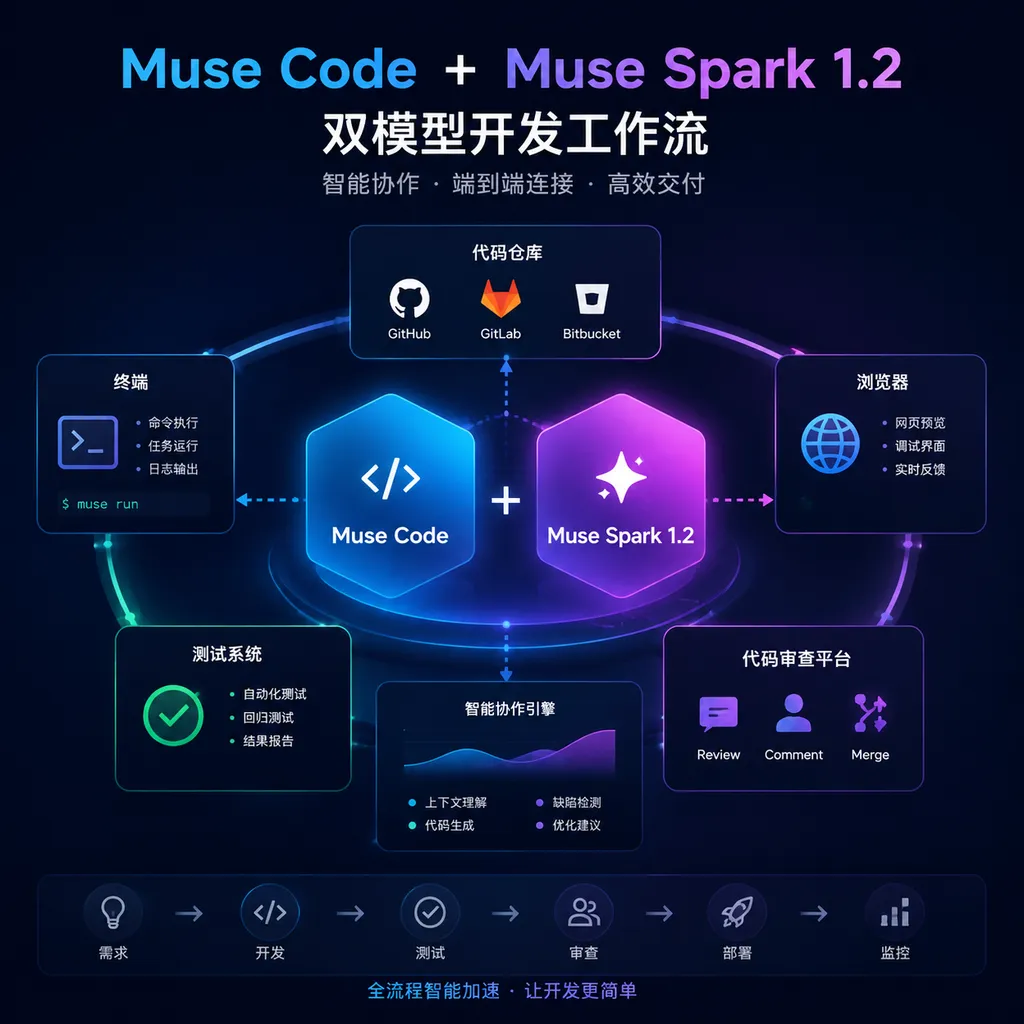
This shift deserves more attention than benchmark scores. Over the past year, the focus of competition in AI coding products has moved from “how accurately can the model write the next line of code?” to “can it complete a task in an unfamiliar repository?” The latter requires a model to read large numbers of files, understand dependencies, invoke a terminal, run tests, inspect failures, and repeatedly correct its work. Generating code is merely the cheapest part of the process.
Muse Code Targets Task Execution, Not Autocomplete
Judging from its name and Meta’s product positioning, Muse Code is intended to handle more specialized code generation and software engineering tasks. Here, “Code” should no longer be understood in the early code-model sense of generating a function from a comment. It should instead be viewed in the context of today’s coding agents.
A genuinely useful programming model must handle at least four types of problems:
- Repository-level understanding: It must read not only the current file, but also locate call chains, configurations, tests, and build scripts;
- Multi-file changes: When adding an interface, it must update types, implementations, tests, and documentation in sync rather than changing only one function;
- Tool interaction: It must be able to invoke search, terminals, compilers, testing frameworks, and version control systems;
- Failure recovery: After encountering an error, it must determine whether the cause is an implementation bug, an environment issue, or an invalid test assumption, and then decide what to do next.
None of these capabilities is new on its own. The difficulty lies in executing them continuously. Models can often produce a patch that appears correct, only to begin making repetitive changes after the third failed test run—or to introduce more subtle problems while trying to eliminate a single type error. Stability over long-running tasks is the true dividing line between programming models today.
This is precisely where Muse Code matters. Meta needs a specialized model to handle code reasoning, patch generation, and repository operations, rather than forcing a general-purpose model to balance visual question answering, content generation, and complex software engineering all at once. A specialized model may not win on every benchmark, but it is more likely to achieve a deployable balance among latency, cost, and tool-calling strategy.
For enterprise development teams, this balance is usually more important than a single benchmark result. If a model is 5% more capable but must read an entire monolithic repository for every task, consumes massive amounts of context, and cannot reliably produce structured tool parameters, it will struggle to enter a real CI workflow. Conversely, a slightly weaker model that is cheaper, faster, and more predictable may be better suited for test generation, dependency upgrades, code explanation, and preliminary review.
Spark 1.2 Connects Code to the Real Environment
Muse Spark 1.2 takes a different path.
The previous Muse Spark 1.1 had already demonstrated multimodal understanding, tool calling, and programming capabilities. Meta’s typical scenario was not simply generating webpage code. Instead, the model would run an application, capture screenshots, identify user-visible errors, return to the codebase to locate the issue, make changes, and then verify the result again.
This process closely resembles how human developers debug front-end applications:
- Start the application;
- Open the page and perform an action;
- Inspect screenshots, the console, and network requests;
- Locate the relevant code;
- Modify the implementation;
- Run it again to confirm whether the issue has disappeared.
The key here is not merely that the model “can see images,” but whether it can translate visual results into the next engineering action. A misaligned button could be caused by CSS, component state, browser compatibility, or data failing to load. If a multimodal model can only describe that “the button in the image is shifted to the right,” it offers limited value to development work. It must go further and map interface behavior to code implementation.
Spark 1.2’s continued emphasis on this direction indicates that Meta still sees general-purpose multimodal models as the environmental perception layer for agents. Muse Code can focus more deeply on repositories and patches, while Spark is better suited to reading product screenshots, design mockups, log dashboards, architecture diagrams, and documentation before deciding which tools to invoke.
This is also why a dual-model combination is more sensible than a single “all-powerful model.” Software development inputs have never consisted solely of code. They also include tickets, chat logs, monitoring alerts, design mockups, database schemas, and browser state. Even if a pure code model achieves a near-perfect HumanEval score, that does not mean it can independently resolve a production incident.
The Real Upgrade Is the Workflow, Not the Model Names
Judged solely by the release cadence, Muse Code and Spark 1.2 could easily be interpreted as Meta’s latest entry into the AI coding model race. Viewed from the perspective of product form, however, this update looks more like an effort to complete Muse’s commercialization strategy.
Spark 1.1 had already signaled Meta’s intention to offer paid model APIs. The addition of the specialized Muse Code now suggests that Meta is not content to keep Muse inside chat products. Instead, it wants to enter scenarios where developers pay directly, make frequent calls, and can easily measure output.
Code is one of the model API domains best suited for commercialization. The reason is straightforward: results can be tested, and time savings can be quantified. The quality of marketing copy is subjective, but whether a dependency upgrade compiles or a bug has been fixed usually has a clear answer.
However, this also exposes Muse to more demanding competition than chat models face.
Claude Code, Cursor, and a range of terminal agents have already taught developers that models cannot merely return code blocks—they must also search, edit, execute, and inspect on their own. OpenAI, Google, and numerous open-source model vendors are likewise strengthening their tool-calling and software engineering capabilities. Muse is not entering an empty market, but a crowded field where competitors are already differentiating themselves through agent harnesses, access controls, context management, and execution infrastructure.
Previous third-party tests of earlier Muse Spark versions also exposed this issue. In evaluations such as Terminal-Bench 2.0, which emphasize terminal operations and long-horizon execution, an earlier Spark version was reported at around 59 points, while leading competitors scored higher. This figure cannot directly represent Spark 1.2, nor should results from different tool configurations be compared mechanically. Nevertheless, it shows that Meta’s gap is not about whether its models “can write code,” but about continuity in long-running task execution.
Therefore, the usefulness of this upgrade cannot be judged solely by the single-turn benchmarks published by Meta. The following questions are more worth watching:
- After a dozen or more consecutive tool calls, do parameter formats remain stable?
- When changes span multiple directories, can the model maintain interface and type consistency?
- After a test failure, does it fall into an unproductive loop?
- When exposed to untrusted repository content, will it execute prompt-injection instructions?
- In a large codebase, how many tokens and how much time are required to produce the first usable patch?
- Can the model produce small patches that are easy for humans to review, rather than rewriting entire files at once?
These metrics are less impressive than “solving an algorithm problem,” but they directly determine whether a model can enter a production environment.
Developers Should Care More About Controllability
The more capable coding agents become, the more concentrated the engineering risks become as well.
Once a model has terminal access, its mistakes are no longer limited to generating code that does not run. It may delete files, modify lockfiles, read environment variables, or even treat malicious text inside a repository as system instructions. To truly serve enterprise customers, Muse Code and Spark 1.2 must be used in conjunction with sandboxes, permission approvals, secret isolation, and auditable logs.
A relatively robust execution architecture can be divided into three layers:
- Planning layer: Reads tickets and repository summaries and breaks down tasks, but does not directly execute high-risk commands;
- Execution layer: Modifies code and runs tests in temporary containers or isolated worktrees;
- Verification layer: Inspects diffs, test results, dependency changes, and potential security issues before deciding whether to hand the work over for human review.
There is another point that is easy to overlook: do not let the same model both write the code and make the final decision. Models can easily invent plausible justifications for their own implementations. Having Muse Code generate a patch and then using another model or static analysis tool to review it is usually more reliable than letting it review its own work. Spark’s visual capabilities can also be used for UI acceptance testing, but a passing screenshot does not mean there are no issues with data permissions, accessibility, or edge cases.
AI programming has not eliminated code review. It has merely expanded the scope of review from “code written by humans” to “the model’s plans, tool calls, and code changes.” If a team lacks sufficient test coverage, integrating a more powerful model will only produce difficult-to-verify changes more quickly.
API Integration Will Not Be the Hard Part—Model Routing Will
The Muse family targets API use cases, but as of publication, developers should still rely on the actual console for model identifiers, regional availability, pricing, and context limits. The code below only demonstrates a typical integration pattern for an OpenAI-compatible API. The model value is a placeholder; it does not indicate that the corresponding model is currently available on the platform and should not be used directly in production.
from openai import OpenAI
import os

client = OpenAI(
    api_key=os.environ["OPENAI_HUB_API_KEY"],
    base_url=os.environ["OPENAI_HUB_BASE_URL"]
)

response = client.chat.completions.create(
    model="YOUR_MUSE_MODEL_ID",
    messages=[
        {
            "role": "system",
            "content": "You are a code review agent. Analyze risks first, then propose the smallest possible changes. Do not execute high-risk commands without authorization."
        },
        {
            "role": "user",
            "content": "Review this repository's authentication middleware and generate a patch and test plan for the session expiration issue."
        }
    ],
    temperature=0.2
)

print(response.choices[0].message.content)
For API aggregation platforms, once the models are officially available, an OpenAI-compatible format can reduce integration costs. The genuinely complex part, however, is not the SDK but model routing. Routine code explanations can use a low-cost model, cross-repository refactoring can be assigned to a specialized model such as Muse Code, and design-to-code or webpage debugging tasks can be routed to a multimodal model such as Spark. Sending every request to the most expensive and capable model is usually not the optimal approach.
Developers should also record at least four types of data at the invocation layer: task success rate, number of tool calls, total token consumption, and the amount of human rework required. Tracking only model output speed can easily lead to the wrong conclusion. If an agent appears to complete a task in five minutes but an engineer then spends an hour reviewing and rolling back its work, it has not actually improved efficiency.
Meta Has Caught Up With the Direction, but Has Not Yet Proved It Leads
Muse Code and Muse Spark 1.2 are moving in the right direction: programming models must enter the toolchain, and multimodal models must be able to act on environmental feedback. Meta’s decision to split specialized coding capabilities and general-purpose environmental perception into two product lines is also more pragmatic than continuing to promote an all-powerful chat model.
But “moving in the right direction” does not mean “already leading.” Meta still needs to demonstrate Muse’s stability, cost efficiency, and security in real repositories, particularly during long-running execution, parallel tool calls, and failure recovery. Developers do not lack models capable of producing impressive demos. What they lack is a reliable executor that can automatically handle dozens of dependency upgrade tasks overnight and leave behind clear diffs and complete test records the next morning.
The most important takeaway from this release, therefore, is not that Muse has gained two more version numbers. It is that Meta has begun treating models as distinct components within a development system: Muse Code provides depth in code, while Spark 1.2 provides breadth in environmental understanding. Whether this combination can challenge products such as Claude Code and Cursor, which have already established user habits, will ultimately not be answered by official benchmark tables. It will be reflected in real teams’ merge rates, rollback rates, and cost per completed task.
References
- Hugging Face: Search for Muse Spark-related models and community resources — Used to check whether the community has published relevant model cards, integration projects, and discussion materials.
- Reddit: Search for Meta Muse Spark community discussions — Used to supplement discussions from developers about the Muse family’s capabilities, pricing, and real-world experience.