Prime Agent Turns Reasoning into Self-Improvement

Prime Intellect recently launched Prime Agent, a self-improving agent that uses recursive language models to process ultra-long contexts and creates a new reasoning loop through evaluation, reflection, and strategy updates.
Prime Intellect recently released Prime Agent. It is neither another repackaged chatbot nor merely an attempt to extend the context window. Instead, it seeks to combine two increasingly prominent technical approaches: using RLMs (Recursive Language Models) to decompose and process complex contexts, and enabling agents to modify their own reasoning strategies based on task outcomes.
As of August 5, 2026, Prime Agent is better viewed as an agent research prototype and architectural reference than as a mature product capable of directly replacing Claude Code, Codex, or general-purpose workflow platforms. What truly makes it noteworthy is the change in its reasoning loop: rather than merely calling tools repeatedly within a fixed prompt, the model begins treating its own “problem-solving program” as something that can also be optimized.
In short: traditional agents revise their answers within the loop; Prime Agent aims to go a step further and revise “how it arrives at those answers.”
RLM Does Not Mean Stuffing an Entire Dataset into the Context
Here, RLM stands for Recursive Language Model. It addresses an increasingly practical problem: even when a model’s context window has expanded to hundreds of thousands or even millions of tokens, feeding an entire code repository, log directory, or research corpus into it at once is usually still a poor approach.
The reason is not simply that the window is too small.
First, the effective utilization of long contexts is far below their nominal capacity. A model may have “seen” a passage without being able to retrieve it accurately at the correct point in its reasoning. Second, large amounts of irrelevant information dilute attention. Finally, extremely long inputs mean higher prefill latency and token costs. If an agent replays the entire context at every step, the bill can quickly become unmanageable.
The RLM approach is closer to how programmers handle large projects: instead of memorizing the entire repository, they first inspect the directory structure, search for symbols, extract relevant files, and then continue invoking the model on localized problems. The raw materials are kept outside the model, and the primary agent accesses them incrementally through code, retrieval, and subcalls.
A simplified recursive process looks roughly like this:
function solve(task, context, budget):
    view = inspect(context)
    plan = model(task, view)

    if plan.can_answer_directly:
        return plan.answer

    sub_tasks = plan.decompose()
    evidence = []

    for item in sub_tasks:
        local_context = retrieve(context, item)
        evidence.append(
            solve(item, local_context, budget - 1)
        )

    return model.synthesize(task, evidence)
The key point of this pseudocode is not recursion as a syntactic operation, but the shift in control over context. In ordinary long-context reasoning, the caller usually decides in advance what content to include. An RLM, by contrast, allows the model to decide during execution what to inspect next, how finely to divide the problem, whether to continue invoking submodels, and when to synthesize the results.
It is somewhat like transforming one enormous prompt into an external data structure that can be searched, sliced, and executed.
Prime Agent Adds Another Layer: Reflection After Reasoning
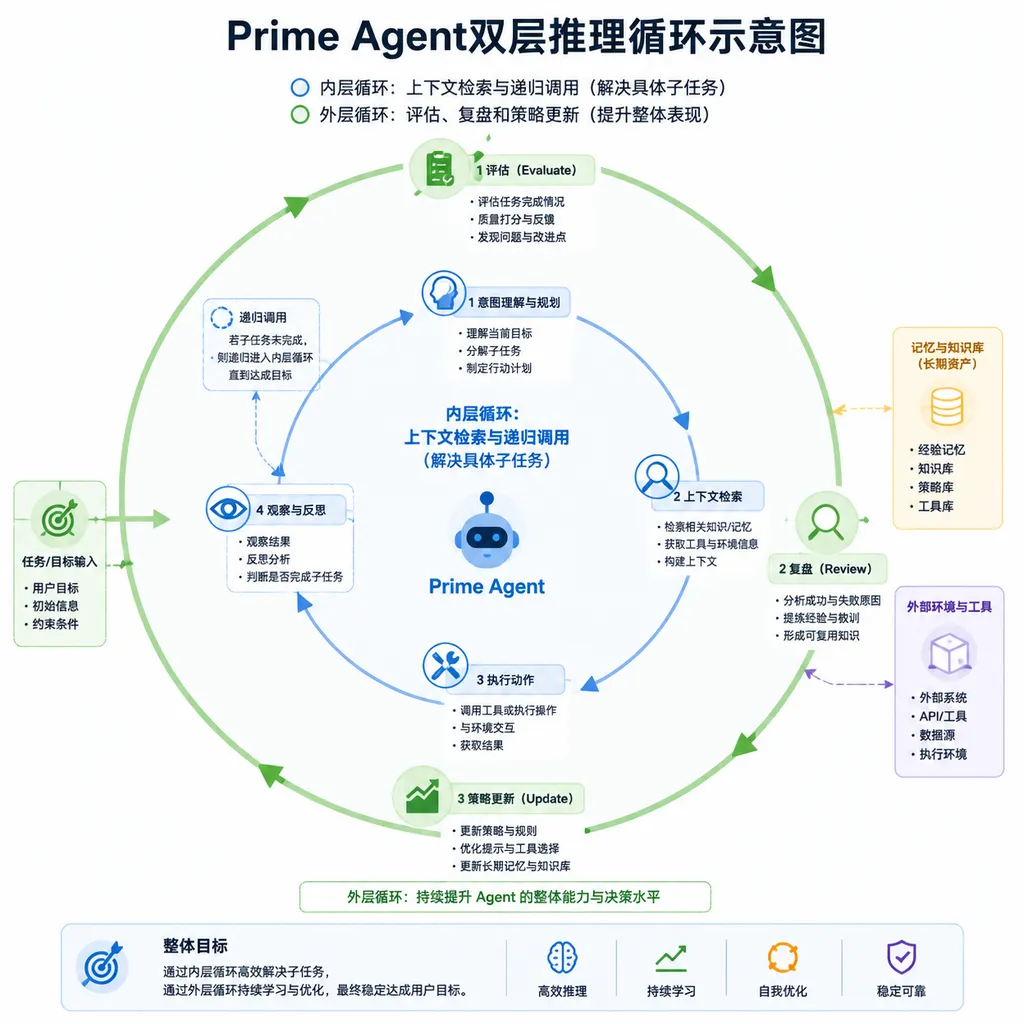
An RLM alone does not constitute self-improvement. RLMs primarily change how information is processed within a single task; Prime Agent goes further by adding a cross-episode evaluation and update loop.
Based on the design approach published by Prime Intellect, the system can be divided into two nested layers.
Inner Layer: Solving the Current Task
The inner loop handles standard agent operations, including:
- Inspecting external context rather than consuming all materials directly;
- Decomposing complex objectives into verifiable subtasks;
- Using code, retrievers, or other tools to locate evidence;
- Recursively invoking models within localized contexts;
- Synthesizing subtask results into a final output.
In a large codebase, this might involve first locating the entry-point module, then tracing the call chain, and passing only the relevant functions to subagents for analysis. In a research task, it might first create a topical index, then use separate subcalls to verify evidence, timelines, and conclusions.
Outer Layer: Examining Why the Attempt Succeeded or Failed
The outer loop does not answer the user’s question directly. Instead, it observes the complete trajectory: where the process went off track, which retrievals contributed nothing, which subtasks were scoped too broadly, which types of tool calls repeatedly failed, and whether the final result passed evaluation.
The system can then generate new strategy candidates, adjust the agent’s instructions, decomposition methods, tool-use rules, or context-management approach, and validate those changes on subsequent tasks.
Its abstract workflow can be written as follows:
strategy = initial_strategy

while training_or_evaluation_budget_available:
    trajectory = run_agent(strategy, task_batch)
    scores = evaluate(trajectory)
    diagnosis = reflect(trajectory, scores)
    candidates = propose_updates(strategy, diagnosis)
    strategy = select_best(candidates)
Accordingly, Prime Agent’s “self-improvement” is more accurately described as the iterative optimization of agent strategies and scaffolding. It does not mean that the foundation model is secretly updating its weights in production, much less that a model has suddenly gained an unconstrained ability to evolve itself.
This distinction is critical.
Many systems currently described as “self-improving” are actually modifying prompts, memory, routing rules, tool descriptions, code scaffolding, or task-decomposition templates. The underlying model weights often remain unchanged. These systems may still deliver substantial gains, but they are closer to automated agent engineering than to model evolution through continual pretraining.
Why This Approach Is Worth Watching Now
Over the past two years, improvements in agent products have come partly from stronger models and partly from engineers building increasingly complex workflows around them: planners, executors, verifiers, retry logic, memory modules, and model routers have been layered on top of one another.
The problem is that these workflows depend heavily on human expertise. Move to a different task domain, and the original decomposition granularity, prompts, and tool combinations may immediately stop working.
Prime Agent is attempting to answer the following question: Can an agent use task feedback to search for more effective workflows on its own?
This is particularly valuable in three types of scenarios.
1. Large Code Repositories
Coding tasks are naturally well suited to RLMs. Repositories have directories, symbols, dependencies, and call relationships. An agent can progressively narrow the scope through search instead of placing every file into the context.
When an outer improvement loop is added, the system can learn strategy-level lessons from failed patches. For example, it may discover that it consistently overlooks integration tests or modifies low-level interfaces too early, and then adjust the order of checks in subsequent tasks.
However, it is important to be wary of the gap between “appearing able to write code” and producing a patch that can actually be merged. Without containerized testing, static analysis, dependency isolation, and evaluation against real repositories, self-reflection can easily become one piece of natural language explaining another.
2. Long-Horizon Research and Intelligence Tasks
Research agents are especially prone to context bloat: search results, webpage snapshots, PDFs, and intermediate conclusions accumulate continuously. Traditional agents either forget early evidence or repeatedly place all materials back into the prompt.
RLMs can retain those materials in an external environment and recursively extract localized information only when needed. The outer evaluation loop can then check source coverage, conflicts among conclusions, and citation completeness, progressively improving the retrieval strategy.
This is more like a sustainable engineering solution than simply enlarging the context window.
3. Specialized Enterprise Agents
What enterprises truly need is usually not “the smartest general-purpose chat model,” but specialized agents that can reliably complete tasks using their own data, processes, and tools. Different companies have different ticketing standards, coding constraints, approval mechanisms, and knowledge structures. Foundation-model providers cannot optimize for all of them in advance.
If a Prime Agent-style loop works, enterprises could turn the outcomes of internal task execution into optimization signals. Instead of retraining an expensive large model, they could continuously improve how an agent invokes models, retrieves data, and uses tools.
This is also why Prime Intellect has long emphasized training environments, evaluators, and post-training infrastructure. The moat around agent capabilities may lie not only in model API keys, but also in the task environments and closed-loop validation systems that enterprises accumulate themselves.
How Is It Different from Common Agent Frameworks?
LangGraph, AutoGen, and various custom orchestration systems can also implement planning, tool use, retries, and multi-agent collaboration. Prime Agent did not invent these components from scratch.
The main difference lies in the optimization objective.
Common frameworks are more like building blocks for constructing workflows: nodes and edges are primarily designed by developers, and the model operates within the prescribed process. Prime Agent instead delegates part of the workflow design itself to an optimization loop, allowing the system to search for better reasoning strategies based on task trajectories.
The two can be compared as follows:
- Conventional agent frameworks: engineers write the program, and the model executes it;
- The Prime Agent approach: engineers define the environment, tools, and scoring rules, and the model attempts to rewrite its own problem-solving program within them.
This does not mean the latter is necessarily better. Fixed workflows have the advantages of stability, low cost, and auditability. For tasks such as invoice extraction, database queries, or standardized customer service, a clearly constrained state machine is often more reliable than a “self-improving” agent.
Prime Agent is better suited to tasks whose workflows are difficult to enumerate in advance but whose outcomes can still be verified, such as code repair, mathematical problems, research retrieval, and complex data analysis. For open-ended tasks without reliable verifiers, the outer loop may simply keep producing more confident versions.
The Real Bottleneck Is Not Generation, but Evaluation
The most easily overlooked question in self-improving systems is who determines whether an “improvement” has actually occurred.
If the evaluator itself is a similar language model, the system may learn to satisfy the evaluator rather than solve the real problem. This is classic reward hacking: the output format looks more like the reference answer, the explanation becomes longer, and the wording becomes more confident, so the score rises even though factual accuracy does not.
A trustworthy Prime Agent-style system requires at least multiple layers of validation:
- Deterministic validation: Unit tests, compilation results, mathematical checkers, and database constraints;
- Process validation: Whether required data was accessed, whether tool calls exceeded their permissions, and whether cited sources actually exist;
- Independent model evaluation: Cross-checking by different models or different prompt configurations;
- Human spot checks: Reviewing high-value, high-risk, and out-of-distribution tasks;
- Cost constraints: Accuracy improvements must be evaluated together with token usage, latency, and the number of tool calls.
The final point is especially important. If an agent improves its success rate from 70% to 75% but increases its call volume tenfold, it may not be worth deploying. RLMs can generate tree-shaped subcalls, while self-improvement adds the cost of candidate strategies, trajectory replay, and evaluation. Without depth limits, caching, budget controls, and early stopping, the system can easily become a way to “spend vast amounts of compute for a small score increase.”
Prime Agent’s future competitiveness cannot be judged solely by task scores. It must also be evaluated by how many tokens, model calls, and how much wall-clock time it consumes to achieve the same score.
Self-Modification Also Expands the Security Boundary
The primary risk of traditional agents is that the model may invoke tools incorrectly. A self-improving agent introduces an additional risk: it may modify the very strategies intended to constrain it.
If the system is allowed to update tool descriptions, system prompts, memory rules, or executable code, it must distinguish between components that can be optimized and components that form immutable security boundaries. Access controls cannot reside in prompts that the agent can overwrite on its own.
A production environment requires, at minimum:
- Keeping authentication, network permissions, and data access controls outside the model;
- Applying version control and differential review to strategy updates;
- Replaying candidate strategies in a sandbox rather than directly overwriting the production version;
- Retaining complete trajectories so that the reason a particular update was accepted can be identified;
- Preventing external documents from influencing the improvement loop through prompt injection;
- Setting hard limits on recursion depth, concurrent calls, and total cost.
Otherwise, self-improvement may also become self-amplification: an erroneous retrieval rule could be written into the long-term strategy and then recur across more tasks.
Current Assessment: The Direction Matters More Than Product Maturity
The most valuable aspect of Prime Agent is not that it proves agents can already improve themselves without limit, but that it presents a more sensible system architecture: the foundation model handles generation and judgment, the RLM manages vast contexts, the tool environment handles execution, evaluators provide feedback, and the outer loop then optimizes the agent’s strategy.
This is closer to a scalable software system than “put everything into one extremely long prompt and let the model think a little longer.”
However, it does not avoid the hardest problems in the agent field: whether evaluation signals are trustworthy, whether recursive calls are economical, whether improvements transfer to new tasks, and whether updated strategies remain safe. Especially in the absence of independent replication and standardized cost accounting, “self-improvement” remains a label that should be interpreted cautiously.
For developers, the most useful lesson right now is not to immediately replicate an agent that can modify its own prompts, but to first turn the task environment into a verifiable closed loop: preserve trajectories, define tests, isolate tools, quantify costs, and only then allow an optimizer to participate in strategy updates.
Without an evaluator, self-improvement is merely self-assessment; without permission boundaries, a recursive agent merely executes errors more deeply.
The direction proposed by Prime Agent is sound: competition among future agents may shift from “who has access to the stronger model” to “who has the better task environment, feedback signals, and strategy-optimization loop.” But between a research demonstration and a stable production system lies an entire body of evaluation, security, and cost engineering.
References
- AI Weekly Issue 225: RLMs and the Prime Intellect Technology Stack: Summarizes progress in using recursive language models to process large code repositories and introduces Prime Intellect’s technical background in reinforcement-learning environments, verifiers, and post-training tools.