HyperProbe Brings AI to the Production Floor
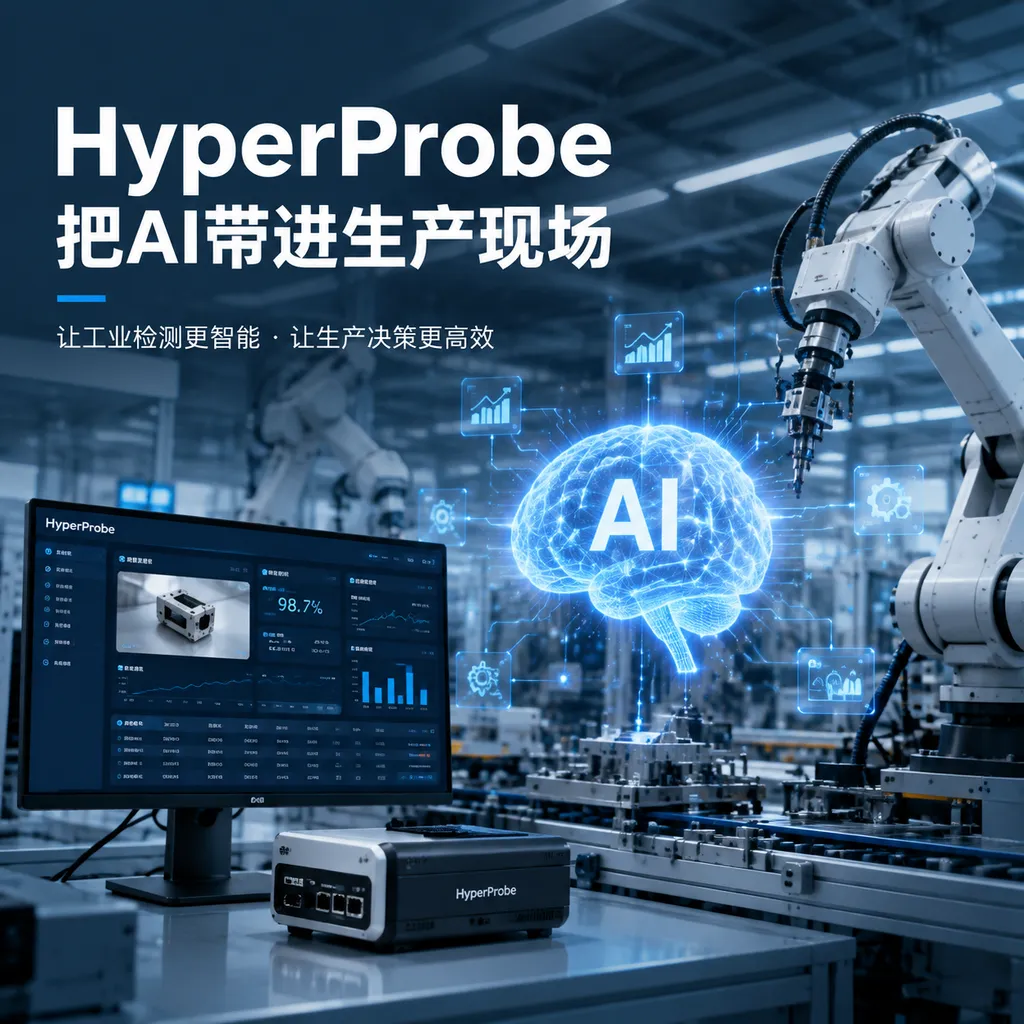
YC S26 startup HyperProbe has launched a read-only debugging agent for production environments, using dynamic probes to provide coding agents with real runtime evidence. This direction is more pragmatic than automated fixes, but read-only does not mean zero risk.
AI Agents Start Reading Production Instead of Guessing from Logs
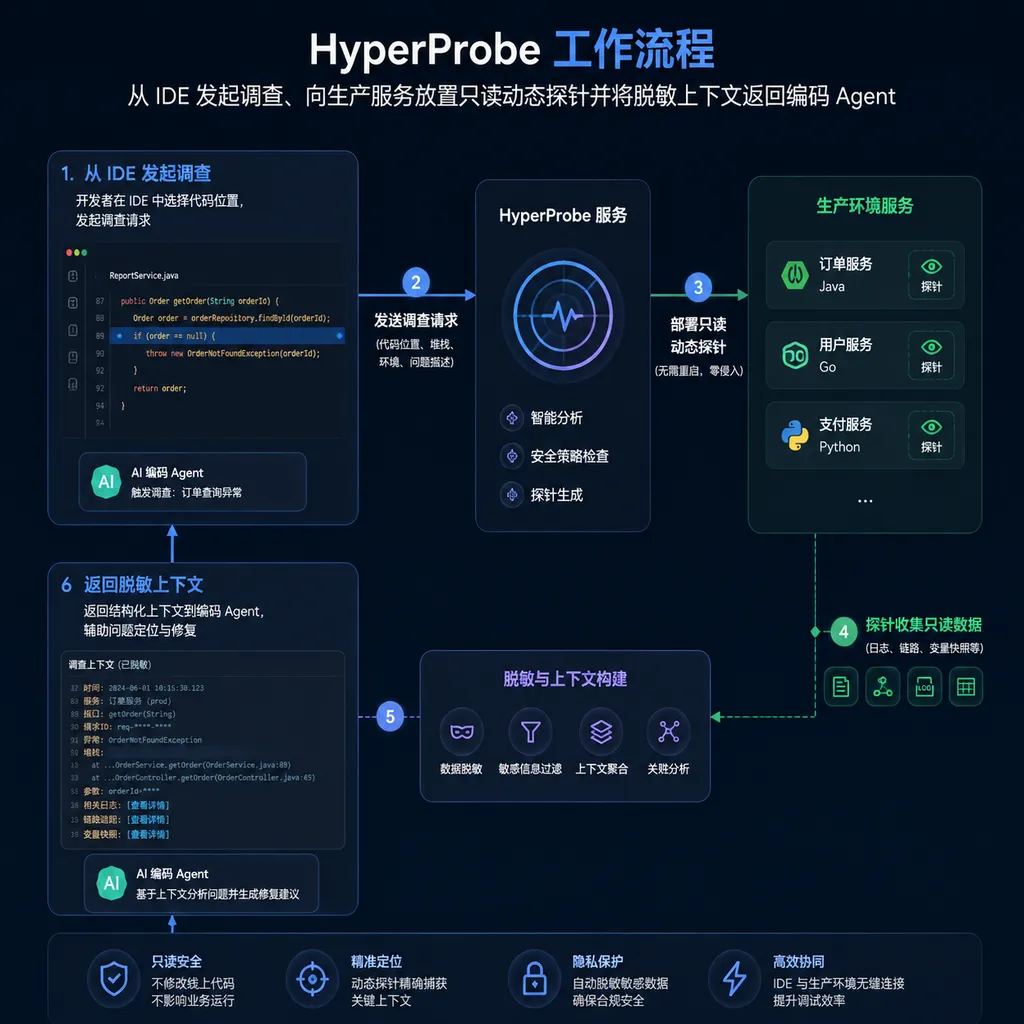
On August 6, 2026, YC S26 startup HyperProbe recently emerged from stealth, aiming to bring coding agents such as Cursor, Claude Code, and Codex out of the code repository and into real production environments. Developers can initiate investigations from their IDEs, where agents dynamically place probes in running services, capture variable states and execution context when triggered, and send sanitized data back to the model for analysis.
The first boundary it has drawn for itself is clear: read-only debugging, with no direct AI modifications to production systems.
That may sound less radical than “agents that automatically fix everything,” but it is closer to the kind of product enterprises are actually willing to purchase and deploy. The hardest part of a production incident is usually not that the model cannot read code, but that an entire layer of context separates the static logic in the code from what is happening in production: specific request parameters, tenant configurations, cache state, dependency return values, canary versions, and intermittent concurrency ordering. Without this evidence, even the most capable coding model can only guess based on logs and repository contents.
HyperProbe aims to fill this missing layer of production context.
It Is Not Just Another Log Chatbot
According to the information HyperProbe has released so far, its core workflow is not simply to feed logs into a large language model. Instead, it allows a coding agent to dynamically configure “non-destructive probes” as an investigation progresses. When a specified code path or condition is triggered, the probe collects local variables, exceptions, and relevant runtime state, sanitizes them, and returns the results to the agent.
Traditional troubleshooting can be understood as investigating a case through surveillance footage:
- The alerting system tells you that an endpoint’s error rate has increased;
- An engineer searches the logs and finds a null pointer exception;
- They compare it against the code and infer which variable might be null;
- They add more logging and redeploy;
- They wait for the issue to occur again.
Dynamic probes are more like temporarily adding sensors at the scene of the incident. There is no need to release a new version just to print one more field. Instead, the system observes a specified location at runtime and records the state when certain conditions are met.
For example, suppose a payment endpoint fails only for a specific tenant and currency when a cache hit occurs. Static code analysis might identify five or six possible causes. But if the agent can observe the branches taken by the failed request without pausing the service, and see that a configuration object is missing a field after being read from the cache, the scope of the investigation can be narrowed rapidly.
There are two types of agents here that are easy to confuse:
- Runtime agent: A Java Agent or Python telemetry agent, for example, that enters the application process, inserts observability logic, and collects evidence;
- AI agent: Responsible for proposing hypotheses, deciding what to observe next, and interpreting the collected results.
The former is the probe; the latter is the detective. Attaching a Java Agent to the JVM does not mean the program has suddenly acquired autonomous reasoning capabilities.
Publicly available information shows that HyperProbe has established the co.hyperprobe namespace on Maven Central, with related components described as a Java SDK Agent for observability and dynamic debugging. A third-party Python package index also listed hyperprobe-agent in late July. At the very least, this indicates that HyperProbe has built more than a conversational interface: it is developing a data-access layer that reaches into the runtimes of Java and Python applications.
However, the company has not yet disclosed enough detail about exactly which objects its probes can capture, how recursion depth is limited, how large objects and high-frequency calls are handled, or the extent of support for asynchronous tasks, thread context, and distributed traces. These details will determine whether the product can handle real incidents or merely complete demos.
“Read-Only” Is the Right Starting Point, but It Is Not a Free Pass
One of HyperProbe’s most commendable product decisions is that it does not begin by asking customers to hand shell access, database write access, Kubernetes administration, and deployment permissions over to a model.
Allowing AI to automatically restart instances, roll back versions, or modify data means a single reasoning error could escalate from an incorrect answer into a real incident. Restricting it to querying telemetry, setting observation conditions, and analyzing context at least keeps the most dangerous execution capabilities outside the permission system. It also makes the product more likely to pass an enterprise security review.
But “read-only” needs to be examined more closely.
From the perspective of the business system, an agent that does not modify the database, commit code, or trigger deployments is indeed read-only. From the perspective of the runtime control plane, however, dynamically inserting, enabling, and removing probes is still a form of write operation. It changes the application process’s observation behavior and may increase CPU usage, memory consumption, object serialization, and network traffic.
A genuinely trustworthy read-only debugging system therefore needs at least the following safeguards:
- Restrict which services, classes, methods, and environments can be observed;
- Set probes to expire automatically so that they are not left in place indefinitely;
- Limit trigger frequency, sampling rate, and the amount of data collected per event;
- Redact passwords, tokens, cookies, personal information, and business secrets by default;
- Maintain audit records of who initiated an investigation, what the model saw, and what conclusions it reached;
- Automatically apply circuit breakers when the agent repeatedly issues expensive queries;
- Completely separate probe permissions from code modification, deployment, and data-write permissions.
A reasonable permission policy should look roughly like the following. This is only pseudoconfiguration illustrating the security boundaries, not official HyperProbe syntax:
production:
  telemetry_read: true
  dynamic_probe:
    enabled: true
    max_ttl_minutes: 15
    max_events_per_minute: 20
    capture_secrets: false
  database_write: false
  shell_execute: false
  deploy: false
  restart_service: false
  audit_log: required
Sensitive data requires particular caution. Variable snapshots are often more dangerous than logs. Teams typically avoid printing complete authentication information in logs, but runtime objects may contain users’ phone numbers, payment details, access tokens, or even private keys. “Sanitizing after collection” is not enough. Enterprises need to know whether sanitization occurs inside the process, within the customer’s network, or only after the data has been uploaded to the vendor. The order makes an enormous difference to the risk.
HyperProbe currently uses the term “sanitise” to describe its cleaning process, but it has not yet published sufficiently detailed rules, false-positive and false-negative performance, data retention periods, or processing locations. For teams in finance, healthcare, and multi-tenant SaaS, these are not supplementary questions for the procurement stage; they are prerequisites for deployment.
It Is Not the Same Kind of Product as AIOps or Agent Debuggers
HyperProbe can easily be categorized as AIOps, but the two are not entirely the same.
Traditional AIOps can already perform anomaly detection, alert deduplication, event correlation, and root-cause recommendations. Many products have also added conversational interfaces that allow users to query logs and metrics in natural language. If HyperProbe merely gives an alert summary to a large language model and generates a plausible-sounding explanation, it has not established a new product moat.
The agent narrative only truly holds if the system can carry out a continuous chain of investigation:
- Propose hypotheses based on alerts and code;
- Select the runtime locations that need to be observed;
- Configure probes with conditions and expiration times;
- Eliminate some hypotheses based on the returned evidence;
- Refine the next query;
- Ultimately provide a conclusion backed by cited evidence.
This is fundamentally different from a one-time log summary. The former is an active investigation; the latter is merely information compression.
It also differs from the Agent Debuggers offered by Apifox, Apidog, and various LLM tracing platforms. Those tools mainly troubleshoot the AI agent itself: which tools the model called, how the prompt changed, whether an MCP request failed, where tokens were spent, and why the output deviated from expectations. HyperProbe debugs the production software that runs the business. Here, the AI is the investigator, not the subject being investigated.
Another direct area of competition is the AI assistants being added to observability platforms. Vendors such as Datadog, New Relic, Dynatrace, and Elastic already have logs, metrics, traces, and infrastructure topology. Their advantage is that the data is already there. The opportunity for startups like HyperProbe lies in being more closely integrated with code and IDEs, while using dynamic probes to obtain temporary context unavailable in traditional telemetry.
It therefore needs to demonstrate not only that its model “can analyze,” but also what decisive evidence its probes can provide beyond existing logs, metrics, and traces.
OpenTelemetry Compatibility Will Affect How Far It Can Go
For HyperProbe, compatibility with existing telemetry standards is more important than building a closed data ecosystem.
OpenTelemetry has become the de facto open standard for logs, metrics, and distributed tracing. Enterprises have typically already built observability pipelines around Collectors, storage backends, and alerting platforms. They will not migrate the entire stack simply to add an AI feature.
A more practical product path would be to reuse existing trace IDs, service names, deployment environments, and resource attributes, attach the temporary evidence collected by dynamic probes to existing traces, and allow the agent to move between code, traces, logs, and runtime snapshots.
Suppose a request crosses a gateway, an order service, and an inventory service. If the agent can only see a set of variables inside the order service, it may still reach the wrong conclusion. If it can follow an OpenTelemetry trace to identify the upstream input and downstream timeout, the investigation will be more complete.
Public information remains limited regarding the scope of HyperProbe’s OpenTelemetry compatibility, its import and export methods, and whether it supports customer-managed Collectors. This will be a key area to watch. A production debugging tool that requires customers to move all telemetry data into its own closed backend will encounter significant sales resistance.
For Now, This Looks More Like Validation of a Direction Than a Mature Product Milestone
HyperProbe was founded in 2026, has a team of approximately eight people, is based in San Francisco, and is part of YC Summer 2026. A newly launched early-stage team should not be expected to have the complete capabilities of a large observability platform on day one. However, because it uses strong claims such as production debugging and “non-breaking,” it must also undergo more rigorous validation.
So far, several sets of critical data remain unavailable:
- The CPU and latency overhead introduced by probes at different request volumes;
- Plans to support languages beyond Java and Python;
- Coverage of containers, serverless environments, and short-lived jobs;
- Data residency, on-premises deployment, and single-tenant options;
- Permission models based on roles, services, and environments;
- The actual depth of integration with mainstream IDEs, coding agents, and alerting platforms;
- The accuracy of the agent’s root-cause determinations and the human review mechanism;
- Whether pricing will be based on hosts, probe events, data volume, or the number of agent investigations.
In particular, “non-breaking” cannot be supported by a product slogan alone. The risks of dynamic debugging do not come only from writing code. They also arise from probe expression execution, object expansion, lock contention, high-frequency serialization, and incorrect sampling. The vendor needs to prove its claim through benchmarks, default rate limits, fault isolation, and real customer case studies.
Our Assessment: Read-Only Access May Be the First Pass Production Agents Need
HyperProbe’s direction is sound—and more pragmatic than “letting AI automatically fix production.”
Coding agents have already demonstrated that they can search repositories, modify code, and run tests. But production incidents cannot be resolved using the repository alone. Production configurations, live traffic, and runtime state make up the other half of the facts. Whoever can safely provide those facts to models may have an opportunity to extend AI coding from development into operations and incident response.
But read-only access merely reduces the blast radius; it does not mean the product is already safe. HyperProbe’s real competitive advantage will not be its chat interface, nor simply support for a more capable model. It will depend on three much harder things: runtime probes with sufficiently low overhead, sufficiently rigorous permissions and data governance, and a sufficiently auditable investigation process.
If it can achieve these, the way engineers handle production incidents may change. Instead of first spending half an hour combing through logs and then copying incomplete information into an AI system, they could let the agent propose an investigation plan and collect controlled evidence, while humans review the conclusions and decide whether to execute a fix.
If it cannot, it will devolve into yet another log summarization tool packaged as an agent.
This launch is more of an industry signal than a decisive product milestone. AI will not enter production by receiving root access first. It will begin with a strictly time-limited, fully audited, read-only pass. That is the pass HyperProbe is betting on.
References
- OpenTelemetry Specification: Open specifications for OpenTelemetry logs, metrics, traces, resource semantics, and more, providing a foundation for understanding standardization in production telemetry systems.
- OpenTelemetry Java Instrumentation: An open-source implementation of Java auto-instrumentation and runtime telemetry, referenced here for how Java Agents collect data in production environments and the engineering constraints involved.
- HyperProbe’s official launch page and YC company profile: Used to verify the product positioning, team information, dynamic probe workflow, and YC S26 status; links are omitted in accordance with this article’s external-domain policy.
- HyperProbe component information on Maven Central and Python package indexes: Used to confirm the Java SDK Agent namespace and public distribution records for the Python telemetry agent; links are omitted in accordance with this article’s external-domain policy.