DeepSeek Announces Major API Price Hike
DeepSeek confirmed today that it will raise API prices across the board, with a substantial increase expected, though the new pricing and effective date have not yet been announced. Teams relying on V4 Flash or V4 Pro should immediately recalculate their costs rather than speculate on the size of the increase or rush to top up their accounts.
DeepSeek Said Just Six Words: A Significant Price Increase Is Expected
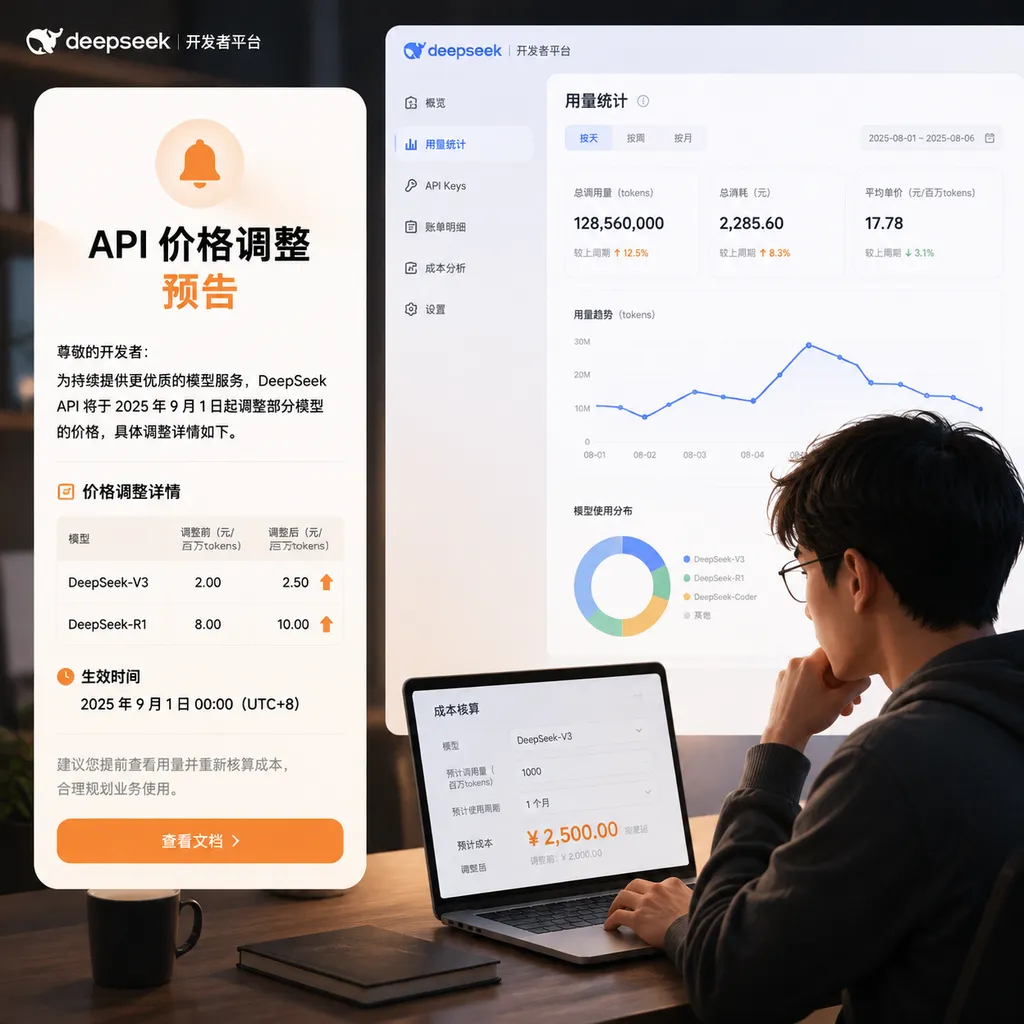
On August 6, DeepSeek issued a pricing adjustment notice to developers: it will soon raise prices across its DeepSeek API services and explicitly warned that the increase is expected to be substantial.
This is not a community rumor, nor is it a vague statement about a particular promotion. However, as of today, DeepSeek has yet to disclose the two most critical pieces of information—how much prices will increase and when the new pricing will take effect.
The company has also not explained how the adjustment will be allocated across the three billing categories of cache-hit input, cache-miss input, and output, nor whether V4 Flash and V4 Pro will be subject to the same percentage increase. At present, developers can confirm only three things:
- The adjustment applies to the overall pricing of DeepSeek API services;
- DeepSeek expects the increase to be substantial and has advised users to plan their usage accordingly;
- Final prices, the effective date, and specific rules will be subject to a subsequent official notice.
This announcement deserves attention, but there is no need to overinterpret it. DeepSeek has not announced corresponding price increases for its website, app, or mini program, nor has it said that existing balances will soon expire. At this stage, API users are the ones directly affected—especially products that have made DeepSeek their default model and whose usage grows linearly with their user base.
More precisely, this is not a price increase that has already taken effect, but a clear warning of higher costs to come.
Current Prices Remain the Only Reliable Baseline
Until the new price list is published, developers can only assess their exposure based on the RMB prices currently displayed by DeepSeek. All rates are per million tokens:
| Model | Input: Cache Hit | Input: Cache Miss | Output |
| --- | ---: | ---: | ---: |
| deepseek-v4-flash | RMB 0.02 | RMB 1 | RMB 2 |
| deepseek-v4-pro | RMB 0.025 | RMB 3 | RMB 6 |
This table can easily create the illusion that DeepSeek is so inexpensive that cost management is almost unnecessary.
The problem is that RMB 0.02 and RMB 0.025 apply to cache-hit input, not all input. In real-world applications, only repeated, reusable prefixes that hit the cache can approach these rates. Documents uploaded on the fly by users, constantly changing agent trajectories, personalized context, and retrieval results that differ with every request generally need to be calculated at cache-miss rates.
Output cannot be ignored either. In applications involving code generation, deep research, long-form writing, and multi-turn reasoning, output tokens often account for most of the bill. If an agent runs for more than a dozen consecutive steps and encounters timeouts, retries, or failed tool calls along the way, actual consumption may be significantly higher than the length of the final answer recorded by the product.
Consider a service that consumes 100 million uncached input tokens and 20 million output tokens per month. At current prices, a rough calculation would be:
V4 Flash: 100 × RMB 1 + 20 × RMB 2 = RMB 140
V4 Pro:   100 × RMB 3 + 20 × RMB 6 = RMB 420

If base prices triple across the board:
V4 Flash: approximately RMB 420
V4 Pro:   approximately RMB 1,260
Taken in isolation, these amounts are still not high. But when usage reaches tens of billions of tokens, or when the product itself generates only thin subscription revenue, the multiplier matters more than the absolute amount. An AI application whose gross-margin model was designed around current pricing may not be able to absorb a threefold, fivefold, or even more complex structural adjustment without difficulty.
The threefold increase used here is only a stress-test scenario, not a prediction of DeepSeek’s official price increase. The company has not provided any specific multiplier.
Peak and Off-Peak Pricing Could Make Bills Harder to Calculate
DeepSeek’s current pricing documentation also states that its API services will adopt a peak and off-peak pricing strategy. The peak periods will be 9:00 a.m. to 12:00 p.m. and 2:00 p.m. to 6:00 p.m. Beijing time each day. Peak-period prices will be twice the standard rates and will apply to all billing categories. The specific rollout arrangements remain subject to an official notice.
If the new base prices are combined with peak and off-peak pricing, developers will need to pay attention not only to how much prices rise, but also to when calls occur.
For example, an AI application serving domestic office use cases will naturally see demand concentrated during morning and afternoon working hours, leaving it with almost no opportunity to benefit from off-peak rates. By contrast, batch summarization, offline evaluations, data cleaning, pre-embedding data processing, and non-real-time agent tasks can be scheduled to run overnight.
Peak and off-peak pricing is not simply a billing mechanism; it effectively transfers the pressure of compute scheduling to customers. It resembles spot instances in cloud computing or time-of-use pricing in electricity markets: workloads that can shift away from peak periods receive lower rates, while latency-sensitive workloads pay for cluster capacity.
This mechanism is reasonable, but it reduces budget predictability. In the past, developers only needed to count tokens. Now they will also need to record the time periods in which those tokens were generated. A FinOps system with only three fields—model name, input volume, and output volume—will quickly become insufficient.
More problematically, it remains unclear whether DeepSeek’s overall price increase will directly change standard rates, whether it will be compounded with the twofold peak-period multiplier, and whether cache-hit discounts will be retained. Any claim that multiplies several unconfirmed figures together and presents the result as definitive is unreliable.
DeepSeek’s Era of Ultra-Low Pricing May Be Coming to an End
Over the past year, DeepSeek repeatedly cut prices, at one point reducing API rates to levels that competitors found difficult to match directly. Low prices helped it rapidly gain adoption in chatbots, coding assistants, knowledge bases, and agent applications. They also encouraged a dangerous habit among many teams: architecture could be optimized later because tokens were cheap enough anyway.
That logic may now need to be reversed.
DeepSeek has already adjusted its pricing strategy several times this year. V4 Pro previously reduced usage costs through a limited-time discount, after which some discounts became long-term pricing. Peak and off-peak billing has also begun appearing in official documentation. The latest notice on August 6 is the first time DeepSeek has simultaneously presented developers with both an across-the-board price increase and an explicit warning that the increase is expected to be substantial.
From a business perspective, this is not surprising. The cost of large-model inference includes more than the rental cost of GPUs or domestically produced accelerators. It also includes cluster redundancy, long-context KV cache, networking, storage, scheduling, failure retries, and idle capacity reserved for peak demand. The longer the model context and the more complex the agent calls, the harder it becomes for a service provider to cover every workload with a single, extremely low price.
The V4 series supports ultra-long context windows and high output limits. These are compelling selling points, but they also place substantial pressure on the service. A user placing a document containing hundreds of thousands of tokens into the context consumes entirely different resources from another user asking short questions. Low pricing can attract traffic and establish mindshare among developers, but it may not be suitable for supporting large-scale production workloads over the long term.
Our assessment is that this price increase looks more like DeepSeek moving from customer-acquisition pricing to commercial pricing, rather than merely responding to a temporary shortage of compute capacity.
But will DeepSeek necessarily lose its competitiveness after raising prices? Not necessarily.
The current baseline is low enough that even after a severalfold increase, DeepSeek could still be less expensive than leading overseas proprietary models for many tasks. What is really being eroded is not its absolute price advantage, but price predictability. Enterprises can accept a high but stable rate, yet may struggle to accept a core supplier repeatedly changing discounts, time-based rates, and base prices over short periods.
Which Products Will Be Most Affected?
The first category is AI tools that do not impose usage limits on users.
If a product charges a fixed monthly fee but allows users to generate unlimited long-form content, process files in batches, or run agents continuously, higher model prices will directly erode gross margins. Abuse that was previously obscured by extremely low token costs will quickly become apparent.
The second category is workflows that depend heavily on V4 Pro’s output quality.
Simple classification, rewriting, and summarization tasks are generally easy to move to Flash or another lower-cost model. However, tasks such as code modification, complex reasoning, and tool planning may be highly sensitive to model behavior. Switching models requires more than changing a name: prompts, structured outputs, tool-call success rates, and retry strategies must all be retested.
The third category is enterprise services whose usage is concentrated during the day.
Customer service, office assistants, sales analytics, and internal knowledge bases have usage peaks that closely overlap with DeepSeek’s proposed peak periods. If higher base prices are compounded by peak-period pricing, these services will find it difficult to fully avoid the additional costs through scheduling.
The fourth category is agent products with poorly managed context.
Many agents resend the complete history to the model at every step and fail to trim tool responses containing tens of kilobytes of data. When model prices are sufficiently low, this is merely inelegant engineering. Once prices rise, it becomes a direct financial problem.
What Developers Should Do Now
The official price list has not yet been released. The most valuable action is not to guess the size of the increase, much less rush to add funds based on rumors, but to accurately quantify your own cost exposure.
1. Export Actual Usage Data for the Past 30 Days
Do not look only at total tokens. At a minimum, break usage down by the following dimensions:
- Model: How much usage came from Flash versus Pro?
- Input: How much was cache-hit versus cache-miss?
- Output: How much came from ordinary responses, long-form content, and reasoning tasks?
- Time: What proportion of calls occurred during peak versus off-peak periods?
- Use case: Which requests directly generated revenue, and which were only background tasks?
- Anomalies: How much was consumed by retries, timeouts, and invalid tool calls?
Without this data, any migration decision will be based only on intuition.
2. Build a Price-Increase Stress-Test Matrix
At a minimum, calculate scenarios involving 1.5-fold, twofold, threefold, and fivefold increases. Also separately test cases in which output prices rise faster than input prices, cache discounts are reduced, and peak-period multipliers are compounded with the new rates.
For subscription products, model costs should also be converted into gross margin per user. An increase of tens of thousands of RMB in the total bill may not sound substantial, but if high-frequency users are already unprofitable, a price increase will rapidly magnify the problem.
3. Make the Model-Calling Layer Truly Switchable
Being switchable does not simply mean putting the model name in an environment variable. Teams need to standardize message formats, tool calling, error handling, streaming output, and usage tracking, while maintaining evaluation sets for different models.
Using an OpenAI-compatible aggregation layer such as OpenAI Hub to access models from multiple providers can reduce the interface-level cost of switching suppliers, but quality regression testing remains essential. API compatibility solves only the method of invocation; it does not guarantee identical prompt handling or tool behavior.
4. Prioritize Context and Output Optimization
The most direct way to reduce costs is usually not to replace the model, but to send fewer unnecessary tokens:
- Keep system prompts fixed to improve cache-hit rates;
- Summarize conversation history in segments instead of appending it indefinitely;
- Limit tool-returned content by retrieving and filtering it before passing it to the model;
- Set appropriate maximum output lengths for different tasks;
- Use Flash for simple tasks and upgrade to Pro only for complex ones;
- Set cost limits for timeouts and retries to prevent infinite loops.
These optimizations should be implemented even if model prices do not increase. A price increase simply makes their benefits appear sooner.
5. Do Not Stockpile Account Balance While the Rules Remain Unclear
It is not yet known when the new prices will take effect or whether existing prepaid balances will lock in the old rates. Most usage-based platforms charge according to the price in effect when the API call is made, not when funds are added to the account. Unless DeepSeek later announces an explicit price-lock policy, prepaying does not mean purchasing tokens in advance.
Teams should instead wait for four pieces of information: the new prices, the effective date, the adjustment percentage for each billing category, and the treatment of existing balances and contracts.
Beyond Price, Consider Stability and Migration Costs
When comparing models, developers often focus only on the price per million tokens. This comparison is becoming increasingly inadequate.
The true cost of API usage also includes latency, failure rates, concurrency limits, retry counts, structured-output success rates, and the average number of tokens required to complete the same task. A model that is 50% cheaper per token but requires frequent retries may not be less expensive overall. A higher-priced model whose tool calls succeed on the first attempt may be better suited to a production environment.
Accordingly, once DeepSeek publishes its new prices, the right way to compare models is not merely to copy their price tables. Instead, test them on real business requests and evaluate:
- Completion rates and human-handoff rates;
- P50 and P95 response latency;
- Total tokens per task rather than tokens per request;
- Rate limiting and error rates during peak periods;
- Stability of structured outputs, function calling, and long-context processing;
- Total cost per successfully completed task.
If DeepSeek retains its advantages across these metrics after the price increase, developers will not immediately migrate simply because the listed prices are higher. Conversely, if higher prices are accompanied by peak-period congestion and instability, the loyalty built through low pricing will quickly erode.
The Next Notice Will Be the Real Decision Point
The significance of the August 6 announcement is that it tells developers their previous cost assumptions will soon become invalid—not that it provides enough information to make an immediate migration decision.
Through its extremely low prices, DeepSeek demonstrated that high-performance model APIs do not inherently need to be expensive. It now faces another, more practical challenge: finding sustainable long-term pricing that balances compute costs, service stability, and developer expectations.
For developers, the safest strategy is to immediately complete a usage audit, stress testing, and a multi-model contingency plan, while postponing any funding or migration decisions based on rumors. Once the official price list is released, they can decide whether to continue using DeepSeek, adjust model routing, or migrate some workloads based on business margins, quality evaluations, and the distribution of usage across peak and off-peak periods.
Prices may rise sharply, but architecture should never depend on a single provider. That may be the most important takeaway from today’s announcement.
References
- DeepSeek Developer Platform Usage and model-pricing pages: August 6 pricing adjustment notice and current billing information. No external link is included due to source-domain restrictions.
- DeepSeek AI on Hugging Face: DeepSeek’s official open-source model page, used to verify the model organization and open-source background. API price increases should still be confirmed through official notices on the developer platform.