Does Whisper Understand Older Adults Better?

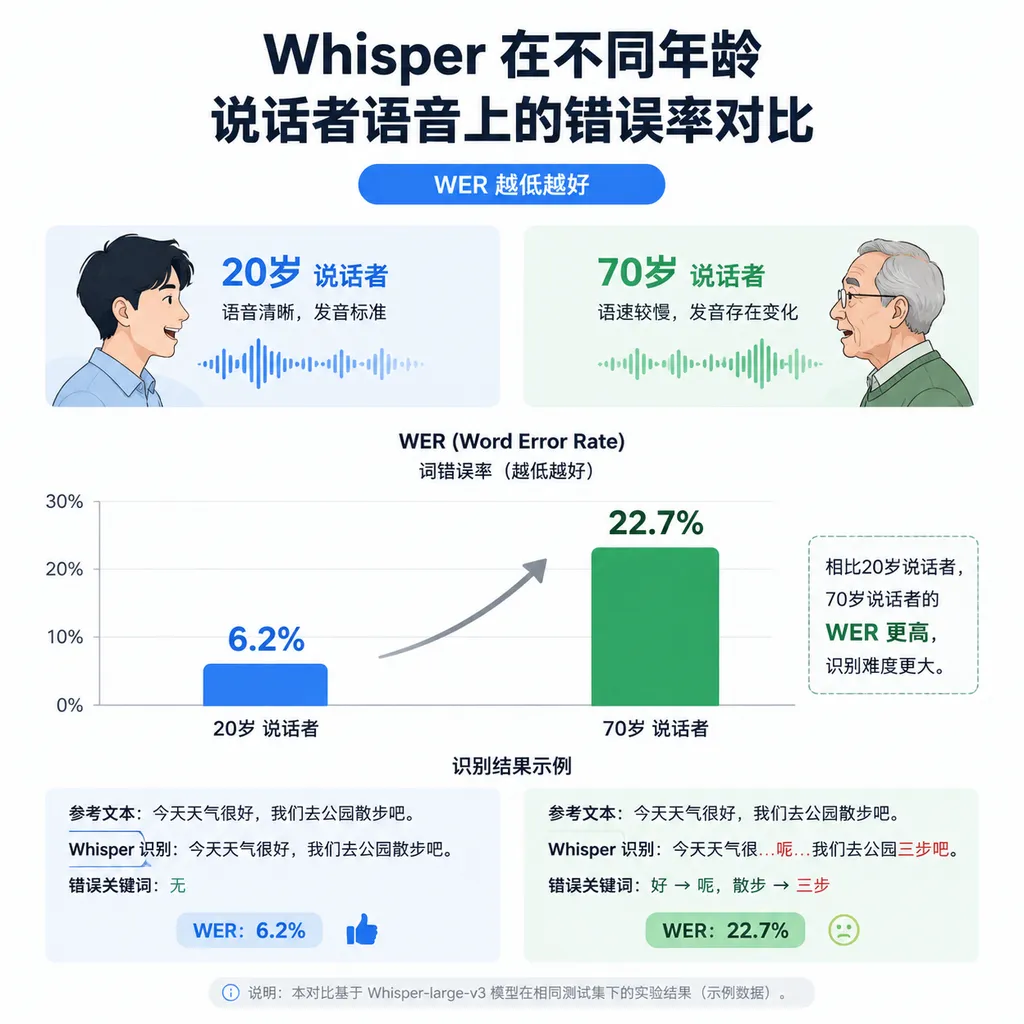
A recent evaluation found that Whisper transcribed speech from people in their 70s more accurately than speech from those in their 20s. The result is counterintuitive, but it more likely reflects differences in speaking rate, expression, and data distribution than an inherent model preference for older voices.
More Accurate for 70-Year-Olds, Harder to Recognize 20-Year-Olds
A recent independent evaluation of age-related bias in Whisper produced a counterintuitive result: in the test data, Whisper transcribed speech from speakers around age 70 more accurately than speech from speakers around age 20.
This runs directly counter to many people’s intuition about automatic speech recognition systems. The usual expectation is that older adults’ voices are more likely to be affected by changes in pitch, reduced breath support, aging of the speech organs, and chronic illness, so ASR (Automatic Speech Recognition) should have a higher error rate for them. In reality, however, it was the younger group that stumbled first.
As of August 7, 2026, this public project is better viewed as an age-sliced evaluation worth replicating than as a definitive conclusion about all younger and older people. It does not prove that Whisper “favors older adults,” much less that older people’s speech is generally easier to recognize than younger people’s. What it actually reveals is that age is not a variable that can explain speech-recognition difficulty on its own. What the model is really dealing with is the entire set of speaking styles, recording conditions, and language habits associated with age.
This is not the release of a new model or new weights, but its practical value to developers may be greater than yet another overall leaderboard. The most dangerous problem in an ASR product is often not inadequate average accuracy, but an average score that conceals persistent errors for a particular class of users.
First, Don’t Misinterpret “Higher Accuracy”
Speech recognition typically uses WER, or word error rate, to measure the quality of English transcription. It consists of three types of errors: substitutions, deletions, and insertions.
- Substitution: Mistaking one word for another;
- Deletion: Omitting a word that appears in the original audio;
- Insertion: Adding a word that does not exist in the original audio.
The calculation can be summarized as:
WER = (Number of substitutions + Number of deletions + Number of insertions) / Number of words in the reference text
Therefore, lower WER is better. For languages such as Chinese that cannot be conveniently tokenized by spaces, CER, or character error rate, is also commonly used. Regardless of the metric, there is no single “Whisper accuracy” independent of a dataset: model size, language, accent, microphone, noise, decoding parameters, and text-normalization methods can all significantly alter the results.
The precise meaning of the project title’s claim that “70-year-olds are transcribed more accurately than 20-year-olds” should be: under the data selection, age grouping, model version, and evaluation process used by this project, the older group achieved a lower transcription error rate. This is an observation, not a law of the model that holds across languages and scenarios.
It is especially important to avoid treating age as a causal explanation. Suppose the 70-year-old group consists of interviews recorded in quiet environments, while much of the 20-year-old group consists of casual conversations recorded spontaneously on phones. What the model is measuring may primarily be signal-to-noise ratio rather than age. If the older group tends to speak in complete sentences and at a slower pace, while the younger group frequently uses abbreviations, reduced pronunciation, and slang, then what is actually being evaluated is a difference in language style.
Younger People’s Speech Is Not Necessarily More “Standard”
Why might 20-year-old speakers be harder to transcribe? Several factors deserve more attention than biological age itself.
1. Faster Speech, With More Reductions and Connected Speech
Younger people’s voices are generally stronger, but that does not mean they are easier for machines to understand. ASR does not receive a measure of “vocal health”; it receives an acoustic signal that must be segmented and mapped to text.
In rapid speech, many phonemes are compressed, merged, or even omitted. Human listeners can fill in the gaps from context; for a model, this is like guessing words from a crumpled spectrogram. Younger people may also be more likely to accelerate suddenly within a sentence, talk over others, or interrupt themselves, making segmentation and timestamp prediction more difficult.
By contrast, some older speakers deliberately control their speaking pace, use more complete syntactic structures, and pause more clearly. Although such speech may have a raspier timbre, its word boundaries can be clearer.
2. More Slang, Abbreviations, and New Entities
Speech recognition is not simply a matter of “hearing sounds and identifying words.” Whisper’s decoder also predicts the most likely text based on context.
Younger speakers use internet slang, brand names, gaming terminology, creator handles, and constantly evolving neologisms more frequently. These expressions may appear less often in the training data and are more easily confused with common words. Even if the model hears a similar sound, its language-model prior may pull it toward a more common—but incorrect—spelling.
If the older group primarily discusses family, work experience, or everyday life, its vocabulary may actually be more stable. This difference will directly affect proper-noun and substitution error rates.
3. Different Recording Devices and Usage Scenarios
Younger users are more accustomed to talking while walking, speaking through headsets, talking inside vehicles, or recording short videos that include music and ambient sound. If older-adult speech data comes from formal interviews, research projects, or organized data-collection efforts, device placement and recording environments may be more consistent.
This creates a classic dataset bias: age is the visible label, but the actual determinants of the result are microphone distance, reverberation, compression codecs, and background noise.
4. Age Labels May Merely Be Proxy Variables
Age often varies together with region, educational background, occupation, accent, and subject matter. A result sliced by age may actually be measuring the distribution of accents; an apparently fair overall WER may simply reflect different biases canceling each other out.
The most important lesson from this evaluation, therefore, is not that “younger people are transcribed less accurately,” but that a demographic label cannot substitute for a comprehensive error analysis.
Why Whisper Might Produce This Result
When OpenAI open-sourced Whisper in 2022, it emphasized large-scale, multilingual, multitask weakly supervised training. The model was trained on approximately 680,000 hours of audio and paired text, around one-third of which was non-English data, while simultaneously learning tasks such as speech transcription, language identification, timestamp prediction, and translation into English.
Its architecture is no mystery: audio is split into segments of approximately 30 seconds, converted into log-Mel spectrograms, and then passed to an encoder-decoder Transformer to generate text. The real competitive advantage comes from the scale and diversity of the training data.
But “diverse” does not mean “strictly balanced across age groups.” Public information about Whisper does not include a sufficiently detailed table of age distributions, and outside researchers have little way to determine the exact proportions of different ages, accents, and recording environments in the training set. Age labels themselves are also generally absent from online audio.
This means the model may have learned certain incidental correlations. For example, older speakers in public online content may appear more frequently in speeches, interviews, audiobooks, or professionally produced programs, while younger speakers may appear more often in multi-person conversations, livestream clips, and noisy videos. Even if the two groups contain similar amounts of audio, the quality of that audio may not be comparable.
Another easily overlooked factor is that Whisper is not merely an acoustic model. Its decoder has powerful text-prediction capabilities. When the audio is unclear, it uses previously generated content to infer what text should come next. This improves fluency, but it may also generate plausible-sounding content that does not exist in the original audio. In scenarios such as medical records, legal evidence, and customer-service commitments, “a coherent sentence” must not be mistaken for “an accurate transcription.”
What This Evaluation Is Still Missing
Looking only at each age group’s average WER is far from sufficient to determine whether Whisper has a consistent age bias. An evaluation suitable for production decisions should disclose at least the following information:
- Model version: Whether it uses tiny, base, small, medium, large, or an optimized derivative implementation;
- Language and accent distribution: Whether each age group comes from the same regions and shares the same native language;
- Sample size and total duration for each group: A small number of long recordings cannot simply be treated as equivalent to a large number of independent speakers;
- Recording conditions: Whether devices, sample rates, signal-to-noise ratios, reverberation, and compression formats are comparable;
- Decoding configuration: Whether the language is fixed and whether beam search, temperature fallback, VAD, and context prompts are used;
- Text-normalization rules: How punctuation, numbers, abbreviations, and capitalization are handled;
- Confidence intervals: Whether the difference between groups exceeds random variation;
- Speaker-level statistics: Whether the results are skewed by a small number of unusually easy or difficult speakers.
The final point is especially important. Speech segments are not independent samples: ten recordings from the same person cannot be treated as ten independent people. A more robust approach is to perform clustered bootstrapping by speaker or calculate average error rates and confidence intervals at the speaker level.
Developers can use the following minimal workflow to examine age-based slices. The code illustrates an evaluation approach and does not correspond to specific commands for running the project repository:
import pandas as pd
from jiwer import wer

# CSV fields: speaker_id, age_group, reference, hypothesis
df = pd.read_csv('transcripts.csv')

def speaker_wer(group):
    return wer(
        group['reference'].tolist(),
        group['hypothesis'].tolist()
    )

by_speaker = (
    df.groupby(['age_group', 'speaker_id'])
      .apply(speaker_wer)
      .rename('wer')
      .reset_index()
)

report = by_speaker.groupby('age_group')['wer'].agg([
    'count', 'mean', 'median', 'std'
])
print(report)
A real evaluation should also retain the three separate categories of insertion, deletion, and substitution errors rather than preserving only a single WER. Two groups may have the same overall score but completely different failure modes: one group may struggle primarily with new entities, while the other may frequently omit negations. The latter clearly poses a greater risk in medical and customer-service scenarios.
For Product Teams, the Conclusion Is Not “Optimize for Younger People”
If a meeting-minutes product sees this result and immediately decides to fine-tune a separate model for younger users, it may be moving too quickly. A more reasonable sequence is to first determine what age is actually serving as a proxy for.
A multidimensional evaluation matrix can be created:
- Age × gender;
- Age × accent;
- Age × speaking rate;
- Age × signal-to-noise ratio;
- Age × recording device;
- Age × content domain;
- Age × single-speaker or multi-speaker conversation.
If the gap disappears after controlling for speaking rate, the main issue is rapid speech. If it disappears after controlling for recording conditions, the priority should be improving microphones, noise suppression, or VAD. If errors are concentrated in slang and new entities, they may be addressed through hotwords, context prompts, domain-specific dictionaries, or post-processing. Only if a stable gap remains after these factors have been ruled out is there sufficient justification for age-targeted data supplementation and fine-tuning.
Product metrics also cannot be limited to average WER. At a minimum, teams should also monitor:
- Error rates for proper nouns and numbers;
- Error rates for critical fields such as negations, dosages, and monetary amounts;
- Hallucination rates on blank audio;
- Miss rates for overlapping multi-speaker speech;
- Worst-percentile performance for each group;
- Human correction time, rather than only character-level differences.
For a captioning product, getting an article wrong has little impact. For a medical dictation system, dropping the word “no” from “no history of allergies” creates a completely different level of risk. Model fairness must ultimately be tied to task-specific loss, rather than remaining confined to demographic tables.
A Valuable Counterintuitive Reminder
This test is compelling because of its counterintuitive headline, but its significance does not lie in ranking the communication abilities of younger and older people.
It shows that fairness in ASR does not always vary in the direction people expect. Disadvantaged groups do not necessarily perform worse on every benchmark, and young users with strong voices are not necessarily easier to recognize. The model processes a mixture of acoustic signals, language habits, and data distributions—not the age printed on an ID card.
From an engineering perspective, this also corrects the tendency to “look only at the overall leaderboard.” Whisper remains an extremely influential open-source baseline for multilingual, noisy, and zero-shot transcription, but a model with robust overall performance can still produce systematic disparities for particular user groups, devices, or modes of expression.
The most prudent conclusion for now is therefore: The 70-year-old group outperforming the 20-year-old group is a signal worth investigating seriously, but it is not yet evidence of a causal relationship with age. The truly professional response is not to share a surprised emoji, but to expand the test to more datasets, languages, and models, while controlling one by one for speaking rate, noise, accent, and the number of speakers.
If the conclusion still holds after replication, it will force the ASR industry to rethink the direction of age-related fairness. If the gap is ultimately shown to result from recording environments or language styles, the evaluation will not have failed—it will at least have revealed how easily existing benchmarks can package complex data biases as a simple demographic conclusion.
References
- Kayvan-Zahiri/asr-age-gap: The public project behind this evaluation of age-related differences in Whisper, reporting the counterintuitive observation that transcription performance was better for speakers around age 70 than for speakers around age 20.