Alibaba Integrates Semantic Understanding into Its Voice Platform
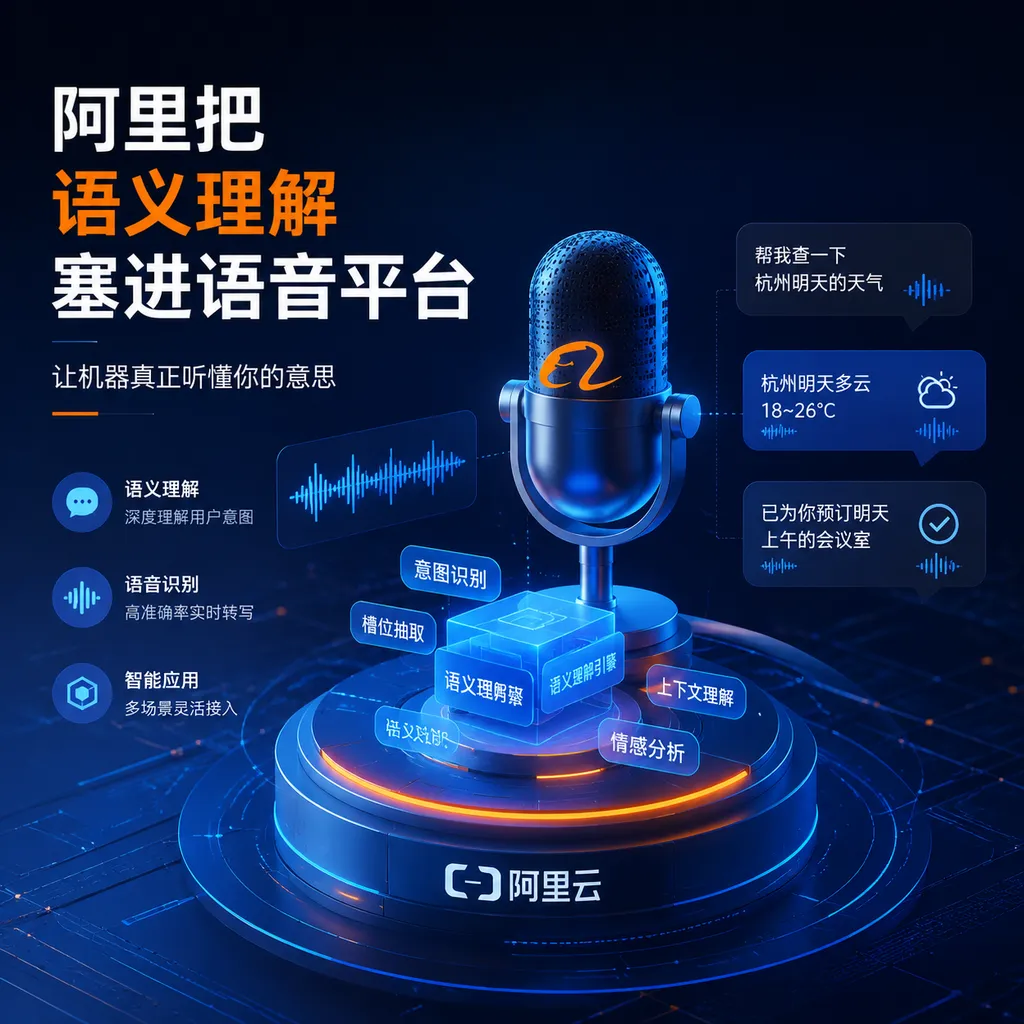
Alibaba launched CosyVoice Studio today, using a semantic model to unify speech transcription, audio creation, and real-time agents. Rather than merely upgrading ASR and TTS, it reimagines the production workflow for voice applications.
Alibaba Brings Semantic Understanding to Its Voice Platform
Alibaba officially launched CosyVoice Studio today (August 7), positioning it as China’s first one-stop AI voice productivity platform.
The focus of this launch is not to build yet another speech-to-text tool, nor simply to wrap CosyVoice in a visual interface. CosyVoice Studio attempts to insert semantic understanding into the middle of the voice pipeline, bringing previously fragmented capabilities—including speech recognition, text organization, content generation, speech synthesis, and real-time conversation—into a single workspace.
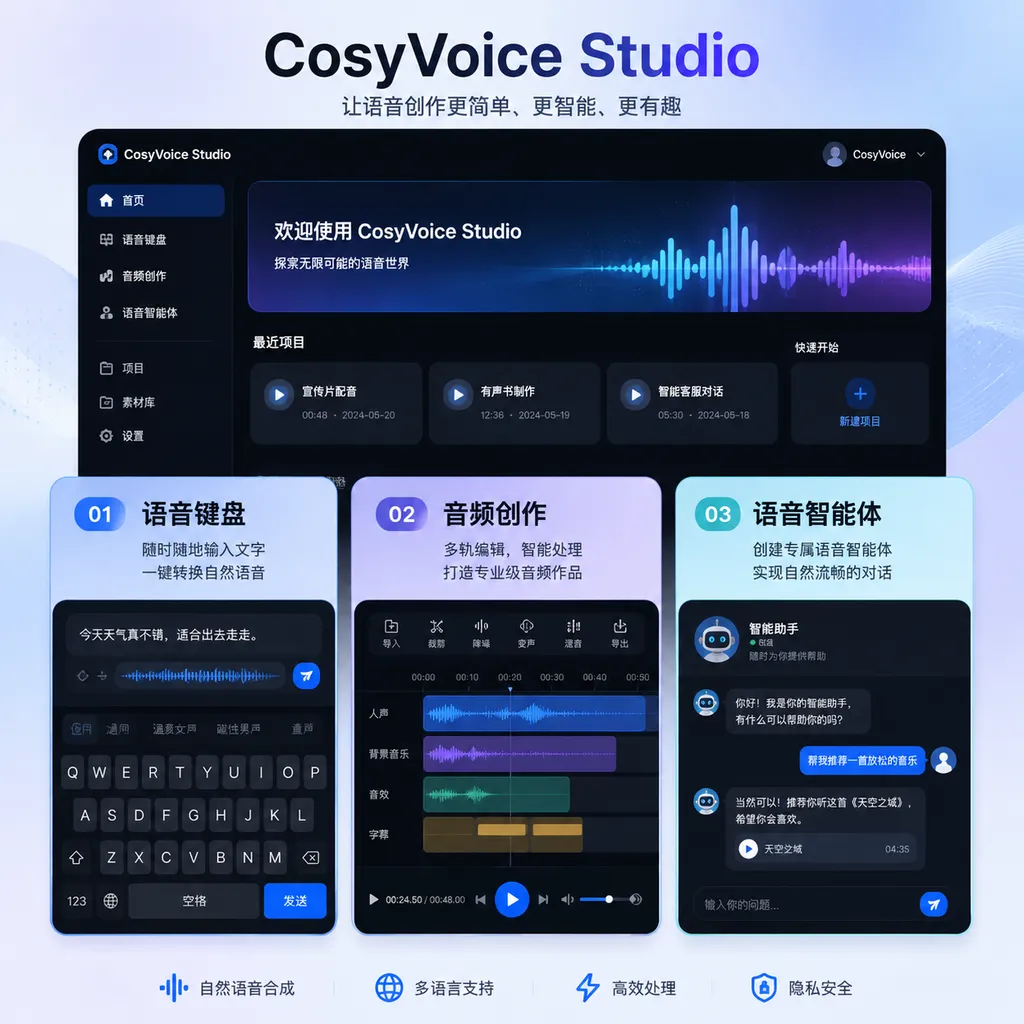
The platform currently focuses on three areas:
- Voice Keyboard: Converts users’ speech into structured text with filler words removed and clearer logic;
- Audio Content Creation: Generates podcasts, audiobooks, and other audio content based on topics or source materials;
- Voice Agents: Enables enterprises and developers to create voice Agents capable of real-time conversation.
Alibaba says the platform is built on its proprietary Qwen-Audio speech model, while the product name retains the CosyVoice brand, which is already familiar to developers. In terms of product form, it is more like an upper-layer suite of Alibaba’s voice model capabilities than a new version of any single TTS model.
The Voice Keyboard Does More Than Turn Speech into Text
Traditional voice input methods have a clearly defined function: audio goes in, text comes out. Their key metrics typically include character error rate, real-time factor, hotword recognition, and dialect coverage.
But real human speech does not resemble a polished article. Users pause, repeat themselves, revise what they say, and frequently use filler words such as “um,” “then,” and “what I mean is.” For example, a product manager might say:
I think, um, on this login page, we could first, uh, put verification-code login up front, and then collapse the password login option.
A traditional ASR system would try to transcribe this sentence as faithfully as possible. CosyVoice Studio’s Voice Keyboard instead attempts to understand what the user actually wants to express and then outputs text like this:
Update the login page interaction: prioritize verification-code login and collapse the password login option by default.
This may look like mere “polishing,” but it represents a change in the objective of voice input. Rather than pursuing word-for-word transcription, the system must perform intent recognition, information deduplication, logical restructuring, and format conversion.
From an engineering pipeline perspective, developers previously had to connect multiple capabilities themselves:
- Use ASR for real-time transcription;
- Segment sentences and restore punctuation in the transcript;
- Call a language model to remove filler words;
- Design prompts for scenarios such as meeting minutes, to-do lists, and emails;
- Validate the output format and handle sensitive information.
CosyVoice Studio aims to productize this pipeline. What it may truly replace is not the input method itself, but a combination of “audio transcription tools plus large-model text organization tools.”
This capability is highly practical for meeting minutes, sales visits, mobile work, and interview organization. On mobile devices in particular, users often do not lack content—they simply do not want to reorganize it all with a keyboard. The value of semantic voice input lies in transforming “messy speech” into “clear writing.”
However, semantic rewriting also introduces a problem rarely encountered by traditional ASR systems: the model may add content the user never said.
Minor rewriting is generally acceptable when drafting emails or recording to-do items. But in scenarios such as medical records, customer service quality assurance, and contract evidence, raw transcripts and semantically organized versions must be stored separately. A reliable enterprise solution should provide the original audio, a verbatim transcript, and an edited version, while marking where the model made changes. Otherwise, the smoother the text becomes, the harder it is to trace back to the source.
From a TTS Tool to an Audio Content Workflow
CosyVoice Studio’s second capability is audio content creation. Users do not need to prepare a voiceover script sentence by sentence. They can start with an idea, a set of materials, or a passage they want to communicate and generate finished audio content such as podcasts or audiobooks.
The difference between this and ordinary text-to-speech is similar to the difference between a “printer” and an “editorial department.”
TTS reads existing text aloud. An audio creation platform must first decide how to present the content—including its structure, roles, tone, pacing, pauses, and emotion—before generating the speech. A two-person podcast also requires consistent character voices, smooth turn-taking, and controlled differentiation between the two voices.
The CosyVoice series already supports multiple voices, languages, dialects, emotional and prosodic control, as well as streaming synthesis. Studio goes one step further by packaging these model parameters into a content production workflow. For content teams that do not want to study phonemes, sample rates, or prompts, this kind of packaging is easier to put into practice than offering a standalone model.
The use cases are also straightforward:
- Enterprises can convert product documentation into training audio;
- Media organizations can quickly produce audio versions of articles;
- Educational institutions can generate course narration in bulk;
- Game studios can create sample character dialogue;
- Global expansion teams can produce multilingual marketing materials;
- Independent creators can generate initial podcast drafts and continue editing them.
However, Alibaba still needs to answer several questions that will determine whether professional users are willing to pay: Can the voices be used commercially? How is authorization obtained for voice cloning? Can character voices remain consistent throughout long-form audio? Can generated content be redone sentence by sentence? Does the platform support subtitles, timelines, and multitrack export?
“Generating an impressive demo” and “reliably producing 100 episodes of a show” are two different things. The truly difficult part of an AI audio product is usually not how impressive the first minute sounds, but whether the sixtieth minute remains stable, editable, and traceable.
Voice Agents Put the Entire Pipeline to the Test
The third capability is real-time voice agents for enterprises. Compared with the Voice Keyboard and content generation, it offers greater commercial potential but also presents more difficult engineering challenges.
A voice Agent capable of making natural-sounding phone calls or handling inquiries must include at least the following components:
- Real-time voice activity detection to determine when the user starts and stops speaking;
- Streaming speech recognition to obtain text before a sentence has been completed;
- A large model that understands intent and decides whether to invoke business tools;
- Streaming speech synthesis that begins playback before the full response has been generated;
- Interruption handling so users can interject while the Agent is speaking;
- Context and state management to prevent critical information such as order numbers and times from being forgotten after multiple conversational turns;
- Risk controls and human handoff mechanisms to prevent the model from improvising on high-risk issues.
The quality of a voice Agent therefore cannot be judged solely by whether its voice sounds human.
If the time to first audio exceeds two or three seconds, even the most natural-sounding voice will make it feel like a sluggish IVR hotline. If the system cannot handle interruptions, the conversation is little more than a text chatbot being read aloud. If the model understands correctly but the tool call fails, it still cannot complete a ticket change, order inquiry, or appointment.
CosyVoice’s existing bidirectional streaming capabilities have practical value here: the upstream language model can generate text while the downstream TTS system synthesizes speech, without waiting for the entire response to be completed. This effectively allows the Agent to think while speaking and is an important way to reduce end-to-end latency.
However, Alibaba’s currently available public information focuses mainly on the product’s positioning and its three core features. Details such as end-to-end latency, concurrency, pricing, supported access channels, private deployment options, and the scope of API availability have yet to be disclosed. For developers, these metrics matter more than demo videos.
Why Alibaba Is Launching Studio Now
Over the past two years, advances in speech models have mainly focused on “sounding more human”: voices have become more natural, emotional expression has grown richer, voice cloning requires shorter samples, and streaming synthesis latency has continued to fall.
But as model capabilities converge, competition is shifting upward toward workflows.
What developers truly need is not a standalone piece of high-quality audio, but a system that connects speech recognition, semantic understanding, content generation, speech synthesis, and business tool invocation. Voice AI companies outside China are also emphasizing “understand the text before speaking,” rather than mechanically mapping text to waveforms.
CosyVoice Studio is moving in the right direction: the next stage of voice products is not a more human-sounding reader, but an interactive interface that understands tasks.
Alibaba’s advantage lies in its relatively complete model stack. Qwen can handle text reasoning and tool invocation, Qwen-Audio can handle speech and audio understanding, CosyVoice can provide high-quality, low-latency speech generation, and Alibaba Cloud can offer enterprise deployment, authentication, monitoring, and concurrency infrastructure. Studio turns these components—which developers previously had to assemble themselves—into a product.
This also explains why the platform covers “listening, speaking, and creating.” A standalone model service can easily become trapped in competition over parameters and pricing, while a one-stop platform can integrate more readily into real enterprise workflows and establish business models based on seats, projects, usage volume, or generated audio duration.
It Is Not China’s First Voice Tool, but Its Product Philosophy Is Different
“China’s first one-stop AI voice productivity platform” is Alibaba’s official positioning for CosyVoice Studio, but this claim should be understood in light of its qualifiers. China already has platforms for speech recognition, voiceovers, voice cloning, digital humans, and intelligent customer service, some of which also offer multiple capabilities.
CosyVoice Studio’s distinction is not that it is the first to offer any particular feature, but that it brings three categories of needs together in a unified workspace:
- For individual users, it is an input tool with a better understanding of semantics;
- For content teams, it is an audio production environment;
- For enterprises and developers, it is a platform for building voice Agents.
This approach spans consumer tools, creator platforms, and enterprise development platforms, giving it broad coverage but also creating a risk that the product becomes cumbersome. Voice Keyboard users value immediate ease of use, content teams need fine-grained editing, and enterprise developers care about APIs, observability, and access controls. The needs of these three groups do not naturally align.
Whether CosyVoice Studio succeeds, therefore, depends not only on its model capabilities, but also on whether Alibaba can provide sufficiently clear entry points and delivery formats for different types of users.
What Developers Should Focus On
For teams preparing to evaluate CosyVoice Studio, five metrics are currently worth watching closely:
- End-to-end latency: Not only TTS time to first audio, but also the total time required for recognition, inference, tool invocation, and playback;
- Semantic fidelity: Whether facts are altered during text organization, and whether the original transcript can be retained alongside a comparison of changes;
- Controllability and editability: Whether voice, emotion, speaking rate, pauses, and roles can be adjusted sentence by sentence;
- System openness: Whether it can connect to enterprise knowledge bases, CRM platforms, ticketing systems, and proprietary large models;
- Compliance mechanisms: Whether it has complete policies for voice-cloning authorization, AI-generated content labeling, content moderation, and data retention.
If these capabilities exist only within Studio’s closed interface, it will be better suited to content creators and business users. Only if Alibaba later provides stable APIs, SDKs, event callbacks, and observability tools will it truly become voice application infrastructure that developers can use.
Verdict: The Direction Matters More Than the “First” Label
The most noteworthy aspect of CosyVoice Studio is not its claim to be “China’s first,” but the fact that Alibaba is beginning to treat semantic understanding as part of voice capability.
Traditional voice systems treated speech as an input and output format: first convert speech into text, then convert text back into speech. Today’s systems must understand why users are speaking, what they want to accomplish, and how they should be answered. The former optimizes recognition accuracy and naturalness; the latter optimizes task completion rates.
This will directly change the criteria by which voice products compete.
In the future, when developers compare different solutions, they will not ask only whose voices sound more human. They will also ask whose Agent responds faster, who handles interruptions better, who can extract structured information from conversational speech, and who can connect reliably to real business systems.
CosyVoice Studio has put the right questions on the table. What remains to be seen is whether Alibaba can turn model demos into a stable, open, and scalable engineering product.
References
- Zhihu: Overview of Major Domestic and International TTS Vendors and the Technical Approaches of CosyVoice and Qwen-TTS—Used to understand the CosyVoice series’ streaming synthesis, dialect, multi-voice, and semantic prosody capabilities, as well as the development direction of competing products in the industry.