openJiuwen Swarm Enters the Bank's Production System
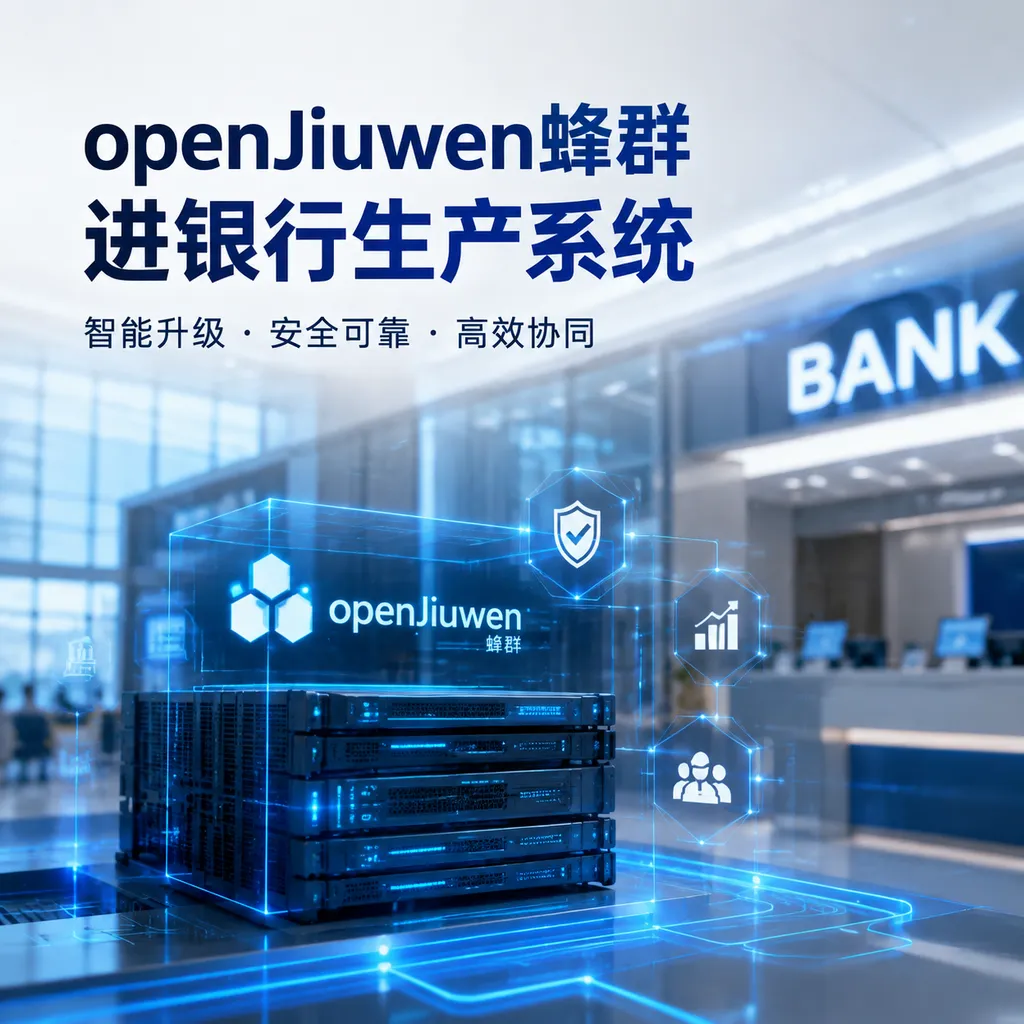
openJiuwen recently released an enterprise-grade distributed swarm architecture and, in collaboration with Postal Savings Bank of China, deployed it in a financial production environment. The focus of competition among multi-agent systems is shifting from “whether they can collaborate” to “whether they can be operated and maintained reliably.”
Multi-Agent Systems Are Finally Doing More Than Holding Meetings in Demos
openJiuwen recently released an enterprise-grade distributed swarm architecture and announced that it has worked with Postal Savings Bank of China to deploy it in a financial production environment. According to the official statement, this is “the industry’s first enterprise-grade distributed swarm architecture.” The “first” claim still needs to be evaluated in light of the deployment scope and acceptance criteria. But the real value of this release is not that yet another team of Agents has been assembled. Rather, multi-Agent systems are beginning to fill in the capabilities most lacking in production environments: distributed execution, deterministic orchestration, failure recovery, human intervention, quota controls, and end-to-end observability.
This is also the practical stage the Agent industry has entered in 2026. Over the past two years, there have been more than enough multi-Agent demos: a Leader breaks down a task, several Agents separately conduct research, analyze, and write, and the Leader then consolidates their output. It works smoothly in a demo, but once deployed in a bank, government or enterprise organization, or large R&D organization, problems quickly emerge—what happens if a task stops halfway through? Should an Agent be retried if it times out? Will a retry cause duplicate execution? How should the system trip a circuit breaker when invocation costs spiral out of control? Who approves intermediate conclusions? Can sensitive data move across nodes?
Not one of these problems can be solved automatically simply by “switching to a smarter model.”
openJiuwen’s answer is to transform swarm intelligence from a conversational pattern running on a single machine into a collaborative system that can be deployed across processes and machines. At the same time, SwarmFlow assigns relatively deterministic execution relationships to the system while leaving the stages that genuinely require understanding and reasoning to Agents.
In one sentence: the model does the thinking; the system keeps it from running wild.
Distributed Does Not Simply Mean Running a Few More Agent Processes
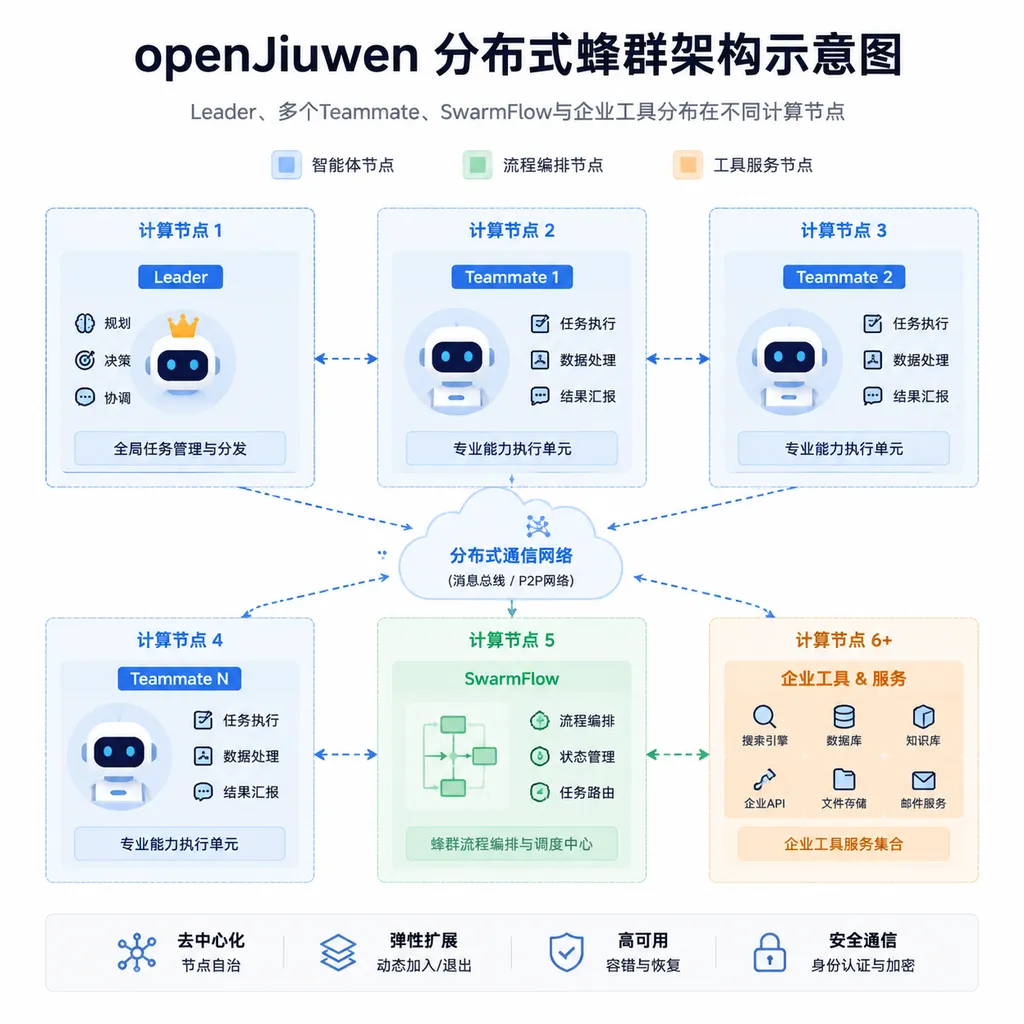
JiuwenSwarm already provided capabilities such as having a Leader decompose tasks, assemble teams, and assign specialized roles to Teammates. The new enterprise-grade distributed architecture goes a step further by allowing Leaders and Teammates to be deployed across processes and machines, shifting from monolithic execution to multi-node collaboration.
Architecturally, this change addresses at least three problems.
First, It Breaks Through the Resource and Failure-Domain Limits of a Single Machine
The bottleneck for multi-Agent systems on a single machine is not limited to the CPU or GPU. Browsers, code sandboxes, document parsers, vector search, and model inference services all compete for memory, connections, and I/O. When more than a dozen Agents simultaneously read long documents, execute tools, or invoke models, cramming every component into a single Python process quickly turns the system into something that “runs, but that no one dares to load-test.”
With cross-machine deployment, different types of Agents can be placed close to the resources they depend on. For example, research Agents can be deployed on nodes with search permissions, coding Agents can run in isolated sandboxes, and risk-control Agents that handle internal data can remain within controlled networks. A failure on one node also does not have to bring down the entire team.
Second, It Makes Independent Scaling of Agent Teams Possible
Enterprise workloads are typically uneven. In financial assessment scenarios, macroeconomic, industry, risk, and investment Agents can start in parallel, while there is only one final aggregation node. A document-processing scenario may involve a large number of parsing tasks but only a small number of approval tasks. A distributed architecture allows popular roles to be scaled independently instead of replicating the entire swarm.
It should be emphasized, however, that openJiuwen’s publicly disclosed capabilities establish a foundation for cross-process and cross-machine collaboration; this does not mean it has automatically solved every elastic-scheduling problem. Node discovery, message-delivery semantics, idempotency, backpressure, tenant isolation, state storage, and failover still determine whether the system can withstand real-world traffic. Developers should not interpret “distributed” as “inherently highly available.”
Third, It Maps Permission Boundaries to Agent Boundaries
In production environments, more capable Agents are not necessarily better; narrower permissions are safer. An Agent responsible for information retrieval should not have permission to transfer funds, and an Agent responsible for generating reports should not be able to publish official conclusions directly. Once roles are separated, each Teammate can be assigned a different data scope, tool allowlist, and set of operational credentials.
This resembles microservice decomposition: service boundaries exist not only for scalability, but also to contain failures and permissions within smaller boxes. As Agent systems truly enter the enterprise, they will ultimately move toward the same engineering discipline.
The following is a conceptual execution relationship, not an actual JiuwenSwarm deployment configuration:
flowchart LR
    U[User or Business System] --> C[Swarm Control Plane]
    C --> L[Leader / Task Planning]
    L --> F[SwarmFlow Orchestration]
    F --> A1[Macroeconomic Analysis Agent]
    F --> A2[Industry Analysis Agent]
    F --> A3[Risk Analysis Agent]
    F --> A4[Investment Analysis Agent]
    A1 --> R[Aggregation and Cross-Validation]
    A2 --> R
    A3 --> R
    A4 --> R
    R --> H[Human Approval Node]
    H --> O[Report or Business Action]
    C --> M[Logs, Traces, Cost, and State Monitoring]
The Core of SwarmFlow: Orchestration Belongs to the System, Intelligence to the Agents
A common approach in multi-Agent systems is to have the Leader simultaneously understand the objective, break down the task, select members, determine the execution order, assess result quality, and handle exceptions. This approach is flexible, but it places too many responsibilities on the Leader. If its reasoning deviates in any single round, the entire downstream collaboration structure may become distorted.
More troublesome still, the same task may follow a different path every time. For creative writing, this randomness is not a problem. For financial reporting, compliance reviews, and R&D delivery, however, it directly undermines reproducibility.
SwarmFlow, as proposed by openJiuwen, attempts to explicitly separate these two categories of capabilities:
- Deterministic collaboration relationships are assigned to the system: who executes first, which nodes run in parallel, who receives the results, when aggregation occurs, whether failures are retried, and where the process waits for human confirmation;
- Non-deterministic cognitive tasks are assigned to Agents: how to understand the materials, how to reason, how to invoke tools, and how to form professional judgments.
This does not turn Agents back into traditional workflows. Instead, it preserves the models’ strongest capability—interpreting ambiguity—within a workflow.
For example, the complete process for “assessing whether a company is worth investing in” is broadly stable: retrieve materials; conduct macroeconomic, industry, operational, and risk analyses; and finally cross-check the findings and generate a report. But every company has a different business, competitive landscape, and set of risks, so the analytical process cannot be encoded as a rigid set of rules.
SwarmFlow fixes the skeleton, not the answer.
| Collaboration Method | Advantages | Main Problems | Best-Suited Tasks | | --- | --- | --- | --- | | Single Agent with tools | Simple, low-cost, centralized context | Long-running tasks can easily lose state; specialized roles become mixed together | Queries, summarization, lightweight automation | | Leader freely dispatching multiple Agents | Flexible and adaptable to open-ended tasks | Unstable paths, difficult to reproduce, and the Leader can easily become a bottleneck | Research, exploration, creative collaboration | | Traditional workflow | Controllable, auditable, and easy to test | Poor adaptability to ambiguous input | Deterministic business processes | | SwarmFlow hybrid model | Stable workflow while retaining intelligence within nodes | Greater system complexity, requiring governance and evaluation | Financial assessment, R&D delivery, complex enterprise processes |
openJiuwen has also introduced automatic routing into Team mode. After a user describes a requirement in natural language, the system determines whether it should be completed by a single Agent, handled through open-ended swarm collaboration, or implemented by generating a fixed SwarmFlow. This design has practical significance because deciding “whether multiple Agents are needed” should not become a configuration burden for end users.
Many tasks can be completed by one Agent. Forcing five Agents to start up will only produce five times the invocation bill and a longer wait. Multi-Agent execution is not a badge of capability; it is an execution strategy with real costs.
The Significance of the Postal Savings Bank Deployment Is Not Simply That “A Bank Is Also Using Agents”
Financial institutions are not short of AI pilot projects. What is genuinely scarce is an Agent system that can enter production while still complying with constraints around permissions, security, audits, continuity, and accountability.
According to the information disclosed in this release, openJiuwen has worked with Postal Savings Bank of China to complete a deployment in a financial production environment. The public materials do not disclose the full business scale, throughput, accuracy, human takeover rate, or cost changes. It would therefore be premature at this stage to interpret the case as evidence that multi-Agent systems have comprehensively replaced financial-analysis workflows.
But it sends at least one clear signal: swarm architectures are beginning to evolve from experimental “role-playing” into execution units governed by enterprise processes.
In a typical financial assessment, multiple specialized Agents can process macroeconomic, industry, risk, investment, and other dimensions in parallel before an aggregation node produces a unified conclusion. Compared with having one large model write everything from beginning to end, this decomposition offers two advantages:
- More focused specialized context. Each Agent loads only the materials, tools, and prompts relevant to its responsibilities, reducing interference among information within long contexts;
- A more auditable process. Enterprises can review which materials each role cited, what intermediate judgments it formed, and at which step the final report changed.
But multiple Agents do not inherently reduce hallucinations. If four Agents cite the same erroneous source, they merely produce a more emphatic false consensus. If the Leader favors the majority view, it may also suppress a minority warning that identifies a critical risk. Production systems therefore need more than Agents “discussing things with one another.” They also require evidence citations, result validation, rule-based safeguards, and human approval.
Especially in financial scenarios, human nodes should not be regarded as a failure of automation. On the contrary, determining which operations must be confirmed by a person and which low-risk steps can pass automatically should be part of the system design from the outset.
Real Production Capability Lies in the Unexciting Details
Compared with earlier multi-Agent frameworks, what deserves greater attention in this openJiuwen release is its engineering capabilities around human-in-the-loop nodes, observability, checkpoint-based resumption, and quota constraints. None of these features is new in isolation, but when combined in a swarm system, they determine whether it can operate reliably over the long term.
Human-Agent Collaboration
When a workflow reaches a high-risk node, the system can wait for human approval, allow modification of intermediate results, or hand subsequent steps over to a person. Humans do not merely stand outside the swarm and inspect logs; they participate in the workflow as stateful actors.
Checkpoint-Based Resumption
A complex assessment may run for tens of minutes or even hours. If the system can only restart from the beginning after the tenth node fails, it not only wastes model calls but may also produce a different set of results upon re-execution. Resuming from checkpoints requires the system to persist task states, intermediate artifacts, and node dependencies, while also handling the side effects caused by duplicate execution.
Observability
Traditional services focus on latency, error rates, and resource utilization. Agent systems must additionally record model versions, prompts, tool calls, input and output summaries, token consumption, node decisions, and human modifications. Otherwise, when an incorrect report is produced, the team can see only that “the final answer is wrong,” without being able to identify which Agent, retrieval operation, or routing decision caused the problem.
Quota and Cost Constraints
The easiest thing to lose control of in a swarm system is not an Agent rebellion—it is the bill. Repeated retries by the Leader, team members continuously questioning one another, and ever-growing long contexts can all cause costs to increase nonlinearly. Quota controls need to be implemented at the task, team, Agent, and tool levels. When a threshold is reached, the system should degrade gracefully, pause, or escalate to a human instead of merely returning an error.
These capabilities indicate that competition in multi-Agent systems is shifting from prompt design to the runtime and control plane. When enterprises select Agent frameworks in the future, their priorities will increasingly resemble those used to select workflow engines and cloud-native platforms: how state is stored, how failures are recovered, how permissions are isolated, how metrics are viewed, and how versions are rolled back.
For Developers, a Swarm Is Not the Default Answer
JiuwenSwarm currently uses Python as its primary development language and provides capabilities including multi-Agent collaboration, distributed Agent Swarm, SwarmFlow, Skill self-evolution, and Skill Hub. Its inference backend is compatible with OpenAI-format APIs and can also connect to local models and various Model-as-a-Service platforms, preventing the collaboration framework from becoming completely tied to a single model provider.
Teams preparing to get started should first ask four questions:
- Does the task genuinely contain parts that can be parallelized or divided by specialization?
- Are the intermediate artifacts worth persisting, reusing, and evaluating independently?
- If an Agent fails, can clear retry, degradation, or takeover strategies be defined?
- Do the additional latency and costs of multiple Agents produce measurable quality improvements?
If most of the answers are no, a single Agent with well-configured tools is usually more suitable. Only when a task requires multiple permission sets, different types of context, parallel processing, or explicit cross-review can the benefits of a swarm architecture potentially outweigh its complexity.
Development teams should not evaluate only the final answer. A more reliable evaluation method is to examine all of the following:
- Task completion rate and end-to-end latency;
- The success rate, number of retries, and token consumption of each node;
- Whether intermediate conclusions are supported by evidence;
- Which Agents and steps account for most human modifications;
- Whether orchestration paths and business outcomes remain stable after changing models;
- Whether the system can recover from node failures, timeouts, or unavailable tools.
This is also the difference between “collaboration engineering” and ordinary Agent development: the optimization target is no longer just the response from a particular model, but the execution trajectory of the entire team.
openJiuwen Has Crossed a Threshold, but It Has Not Reached the Finish Line
This release deserves recognition. Rather than continuing to emphasize “more Agents and livelier discussions,” openJiuwen has chosen to address distributed deployment, deterministic orchestration, human intervention, and operational governance—issues that are harder to showcase but much closer to enterprise procurement criteria. Entering a production environment in collaboration with Postal Savings Bank of China is also more persuasive than simply releasing an open-source demo.
However, “enterprise-grade” is the outcome of continuous validation, not the name of an architecture. The issues more worthy of attention going forward include scheduling efficiency under large-scale workloads, how cross-node state consistency is guaranteed, whether failure recovery can produce duplicate operations, how multi-tenant data is isolated, and whether production cases can provide quantitative metrics. Its ability to expand beyond finance into R&D, healthcare, customer service, and government services will also determine whether this architecture is a general-purpose platform or a highly customized project capability.
In the past, the multi-Agent industry debated whether several Agents could be made to collaborate. It is now beginning to debate whether they can complete work reliably, controllably, and audibly. This is a necessary cooling-off period: a shift away from grand narratives about collective intelligence and back toward state machines, permissions, logs, and costs.
Only after passing through this stage can Agent collaboration truly be considered production-ready.
References
- JiuwenSwarm GitHub Repository: Open-source code, version information, and project documentation for openJiuwen’s multi-Agent collaboration system.
- JiuwenSwarm Chinese README: An introduction to distributed Agent Swarm, SwarmFlow, Skill self-evolution, and inference-backend compatibility.