Kitesurf Puts the Browser in a V8 Isolate

Cloudflare has launched Kitesurf, a lightweight browser for Agents that uses V8 Isolates instead of full Chromium processes, significantly reducing resource consumption. However, compatibility, login-session persistence, and anti-bot capabilities remain shortcomings.
Kitesurf Puts the Browser Inside a V8 Isolate
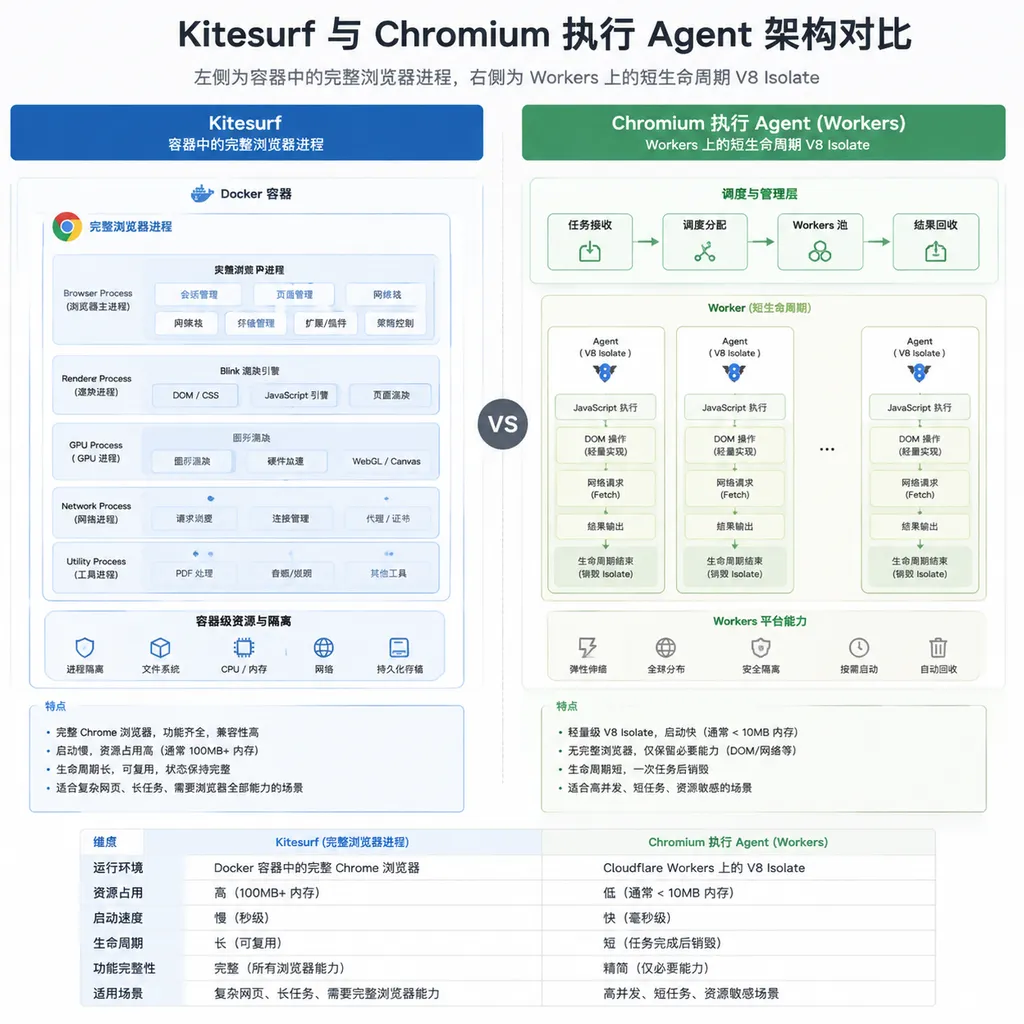
On August 6, Cloudflare released Kitesurf, a headless browser designed for AI agents from the ground up. Instead of assigning each agent a complete Chromium instance, it runs directly inside Cloudflare Workers’ V8 Isolates: an isolated environment is started when a task arrives and released when the task ends, leaving as little browser state behind as possible.
This is not just another automation framework layered on top of Chrome. What Kitesurf really aims to change is the resource and security model for browser-based task execution—turning browser processes that were previously heavyweight, long-lived, and stateful into short-lived execution units more akin to cloud functions.
The figures Cloudflare provides are fairly aggressive: for common agent web tasks, Kitesurf uses 3.1–3.8 times less CPU than Chromium and 4.7–7.0 times less memory. However, it does not win on every metric. Chromium still completes tasks approximately 1.7–1.8 times faster in wall-clock time.
In other words, Kitesurf is not “a faster Chrome,” but rather “a browser that is slightly slower per task, yet cheaper, cleaner, and better suited to running many instances concurrently.”
Why Agents Need a Different Kind of Browser
Today, most web agents still use Chromium under the hood and operate pages through Playwright, Puppeteer, or the Chrome DevTools Protocol (CDP). This combination is mature and highly compatible, and it can handle complex JavaScript, but it also inherits the full weight of a desktop browser.
A complete browser typically includes multiprocess scheduling, GPU and media pipelines, an extension system, window and input systems, a font stack, and numerous capabilities designed around the experience of human users. The parts agents actually use, however, are concentrated elsewhere:
- Sending network requests and handling redirects;
- Executing page JavaScript;
- Building and querying the DOM;
- Clicking buttons and filling out forms;
- Reading text, links, and the accessibility tree;
- Maintaining limited Cookie and session state;
- Passing page structure to the model for further decision-making.
Launching a complete Chromium instance for an agent that only wants to check a flight, organize product prices, or submit an administrative form is a bit like starting a virtual machine with a desktop environment just to run a command-line script. That may be acceptable for a single task, but once the number of tasks rises into the thousands or tens of thousands, memory usage, cold-start time, and isolation costs become significant.
The industry’s common solution has been to put Chromium in containers or lightweight virtual machines and reuse instances through browser pools. This helps spread out startup costs, but introduces another set of problems: How should Cookies, caches, Local Storage, Service Workers, and residual page state be cleaned up? How should an instance be reclaimed after a browser crash? Could a malicious page opened by one task affect subsequent tasks running on the same instance?
Kitesurf’s conclusion is straightforward: instead of continually optimizing how Chromium is hosted, build a new browser for agents that retains only the capabilities they need.
The Core Change: The Browser Becomes a Disposable Execution Unit
Kitesurf’s underlying engine is written in Rust. Public materials refer to the relevant headless engine as obscura. It runs in a form adapted for Workers and V8 Isolates, without relying on a conventional full-browser container.
Its execution flow can be simplified as follows:
Agent / Workflow
        │
        │  CDP, Playwright, or Puppeteer commands
        ▼
Cloudflare Browser Run
        │
        ▼
Short-lived V8 Isolate
        │
        ├─ JavaScript execution
        ├─ DOM and page state
        ├─ Network requests
        └─ Kitesurf browser core
        │
        ▼
Target website
Cloudflare has made it available as a browser backend that existing automation tools can use. Developers already using Puppeteer, Playwright, or CDP do not need to rewrite their entire agent-control logic; they can select the new engine by adding the browser=kitesurf parameter when connecting.
This is important. The hardest part of replacing browser infrastructure is often not the browser itself, but the large amount of accumulated scripts, selectors, retry logic, and observability systems built above it. If Kitesurf required developers to learn a proprietary protocol, it could easily end up as a demo project. CDP compatibility, by contrast, gives it at least a chance to enter existing production pipelines for gradual testing.
However, “CDP-compatible” does not mean “a complete recreation of Chromium.” CDP itself covers a very broad range of functionality. The fact that tools can connect and basic commands can run only means that the interface entry point is similar; it does not mean that all page behaviors, debugging domains, and edge-case features are identical. Developers will still need to conduct regression testing against their actual tasks.
The Security Benefits of V8 Isolates Mainly Come from Shrinking the Blast Radius
Browsing the web is more dangerous for agents than for human users because agents typically possess three things at once: the model’s decision-making capabilities, untrusted content supplied by external websites, and permission to call internal tools or access credentials.
In traditional browser automation, a long-running instance might first log in to an enterprise backend, then visit an external website, and later continue executing another user’s task. If state is not thoroughly cleared, the risks come not only from browser vulnerabilities, but also from Cookie reuse, cache contamination, and data leakage between tenants.
Kitesurf’s short-lived, stateless design improves at least three issues:
- State is less likely to be inherited accidentally between tasks. Starting an independent execution environment for every request makes the security boundary easier to reason about than repeatedly cleaning a browser pool.
- The impact of a single malicious page is more limited. If a page causes a crash, memory expansion, or abnormal behavior, the current Isolate can theoretically simply be discarded.
- Allocating one browser per task becomes affordable. With lower resource consumption, platforms no longer need to force multiple sensitive tasks to share a single long-running instance in order to control costs.
However, V8 Isolates should not be understood as absolute security boundaries. An Isolate is neither a hardware virtual machine nor an independent operating system; it relies on the isolation provided by V8, the Workers runtime, and the Cloudflare platform itself. If a vulnerability appears in the underlying engine, JavaScript runtime, or host interfaces, an escape path may still exist.
More importantly, Kitesurf does not solve the most difficult semantic attacks in agent security. A web page can embed prompts in its body text, hidden elements, or tool return values, inducing an agent to leak data, change its task objective, or call high-privilege tools. Browser isolation protects the execution environment; it does not help the model decide whether “this sentence on the page is trustworthy.”
Therefore, a production-ready agent browsing architecture still needs to add the following beyond Kitesurf:
- Task-specific credentials that are short-lived and issued on demand;
- Network egress allowlists and domain policies;
- Tiered tool permissions, with secondary confirmation required for sensitive operations;
- Policy gateways for actions such as uploads, transfers, and sending emails;
- Clear data boundaries between browsing content and system instructions;
- Comprehensive auditing of page access, tool calls, and credential usage.
What Kitesurf reduces is the attack surface and residual state at the browser layer. It does not give agents a shield that makes them “impossible to deceive.”
It Wins on Resource Efficiency, but Not on Latency
In Cloudflare’s published benchmarks, Kitesurf uses approximately one-third as much CPU as Chromium, while its memory usage can fall to as little as one-seventh of Chromium’s. This is highly attractive for large-scale agent platforms.
If a task must wait for several rounds of model reasoning, the browser is often idle for a significant portion of the time. In such cases, reducing persistent memory usage and per-session costs may be more valuable than shaving a few hundred milliseconds off page processing. High-concurrency scenarios such as customer-service verification, price monitoring, information gathering, and batch form processing are particularly well suited to this trade-off.
However, Chromium still has an approximately 1.7–1.8× advantage in wall-clock completion time. This suggests that Kitesurf is currently more of a throughput- and cost-oriented engine than a latency-oriented one. For interactive agents that require immediate feedback, or for tasks involving websites with large amounts of complex scripting, Chromium may still be the safer choice.
It is also important to note that these figures come from Cloudflare’s own tests. The task set, page complexity, caching strategy, and statistical methodology can all affect the results. Before third-party benchmarks become available, directly converting “seven times less memory” into “seven times lower costs” would be imprecise. The browser is only one part of an agent’s total cost; model inference, network transfer, retries, and observability also consume budget.
Its Current Limitations Mean It Cannot Replace Chromium Yet
Kitesurf is currently in a free Beta phase, with fairly clear capability boundaries: it does not support video or WebGL, cannot handle bot challenges based on TLS fingerprints, and is not suitable for sessions that require authentication state to be stored for long periods.
These limitations are not marginal.
First, many websites’ automation defenses do more than inspect DOM behavior. They combine TLS fingerprints, network characteristics, JavaScript APIs, fonts, graphics-rendering results, and interaction timing. Kitesurf is not Chromium, and its distinctive fingerprint may actually make it easier to identify. It is suitable for websites that permit automation, provide explicit authorization, or are controlled by the enterprise itself; it should not be understood as a new “anti-bot bypass tool.”
Second, the lack of persistent authentication affects operations involving enterprise backends, social platforms, and complex SaaS applications. Statelessness is beneficial for security, but real workflows often require login continuity across multiple steps. Platforms will eventually need to design controlled mechanisms for Cookies, tokens, or session snapshots—and those mechanisms will reintroduce the risks of state management.
In addition, the lack of video and WebGL means Kitesurf is temporarily unsuitable for visual content moderation, 3D pages, online design tools, cloud gaming, and applications that depend on graphics pipelines. For these tasks, a complete Chromium is not historical baggage but a necessary capability.
Therefore, a more realistic deployment model is not to remove Chromium immediately, but to create browser tiers:
- Use Kitesurf first for static content retrieval, lightweight JavaScript, search, and form tasks;
- Fall back to Chromium for complex logins, media, graphics, and high-compatibility tasks;
- Keep upper-layer agent workflows unchanged through a unified CDP interface;
- Select the engine dynamically according to failure types, website characteristics, and security levels.
This is similar to hot-and-cold tiering in database systems: the goal is not to make the lightweight engine handle everything, but to stop defaulting every task to the heaviest and most expensive configuration.
What Really Matters Is That Browsers Are Starting to Be Rebuilt for Machine Users
Over the past two years, agent infrastructure has primarily competed on model orchestration, tool calls, memory, and sandboxes, while browsers have often been treated as off-the-shelf components to plug in directly. Kitesurf raises a more fundamental question: if web users increasingly include large numbers of software agents, does the browser still need to retain the complete form originally designed for the human desktop?
Cloudflare’s advantage is not merely that it has written a smaller browser. It has the Workers runtime, a global network, edge-computing scheduling, and a browser-hosting entry point, allowing it to turn Kitesurf directly into an on-demand infrastructure capability. Judged solely by browser compatibility, it will have difficulty challenging Chromium in the short term. But if the metrics change to how many isolated sessions can run per dollar and whether state can be completely reclaimed when a task ends, Kitesurf enters a space where Chromium is not particularly strong.
Our assessment is that Kitesurf is not yet a replacement for Chromium, but it may represent a meaningful fork in agent-browser architecture. Its greatest value lies not in the CPU or memory figures themselves, but in demonstrating that a browser can be created and destroyed like a function, rather than remaining forever as a collection of heavyweight, long-running operating-system processes.
The next stage will hinge on three questions: How far can CDP compatibility be extended? Will success rates on real-world websites approach those of Chromium? Can Cloudflare find a controllable compromise between persistent login and stateless isolation? If all three conditions are met, the practice of launching “one Chrome instance per task” by default on agent platforms may indeed begin to look outdated.
References
- Reddit: Discussion of Kitesurf and V8 Isolates in the Rust community: Includes developer discussions of the Rust browser engine, the possibility of open-sourcing it, compatibility, and browser diversity. The performance figures and product limitations in the article come from Cloudflare’s official materials published on August 6, 2026.