AI Teachers Also Need to Learn to Talk Less
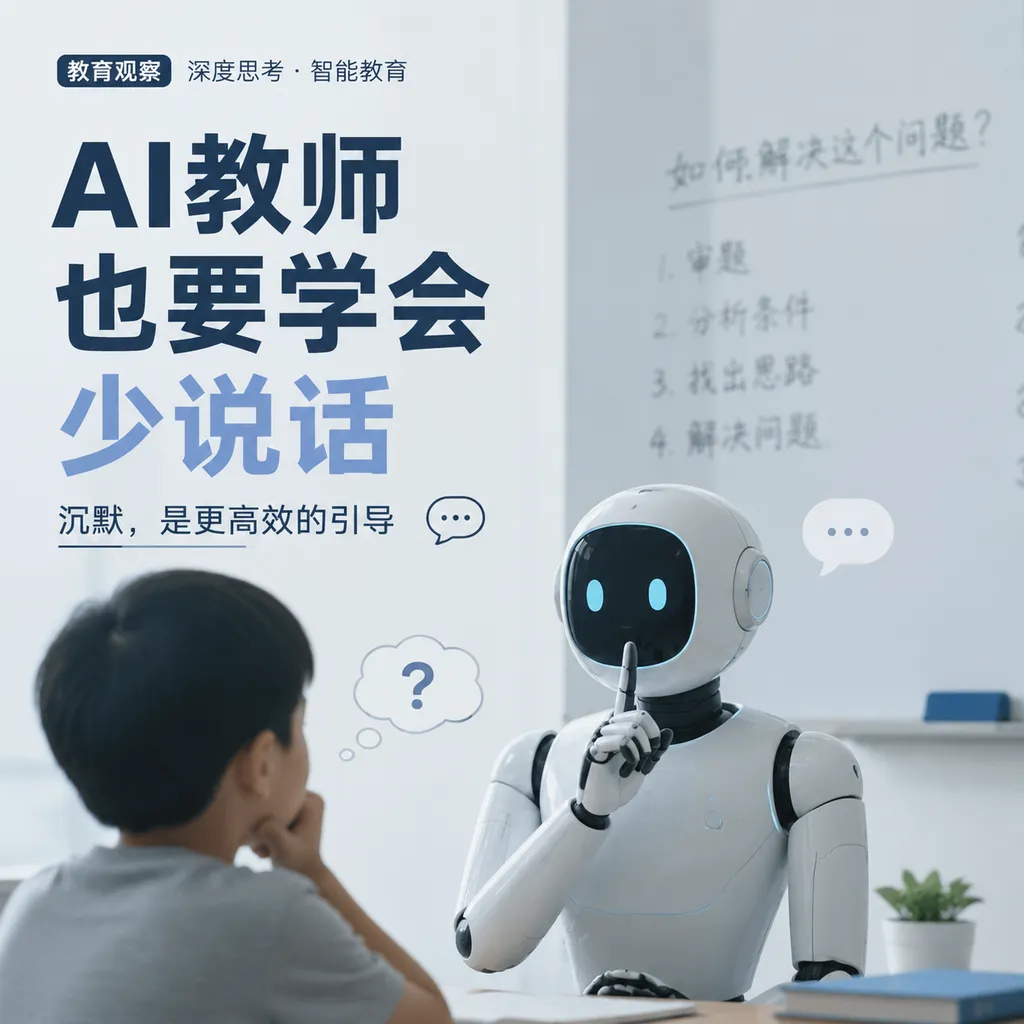
The Allen Institute for AI has released TutorMoments, a benchmark for evaluating when AI tutors should prompt learners and when they should hold back during instructional conversations. It places the teaching judgment beyond simply “knowing how to answer” at the center of model evaluation.
AI Teachers Also Need to Learn to Talk Less
August 7, 2026, Seattle— The next challenge for AI teachers is not whether they can explain an answer, but whether they know when they should not.
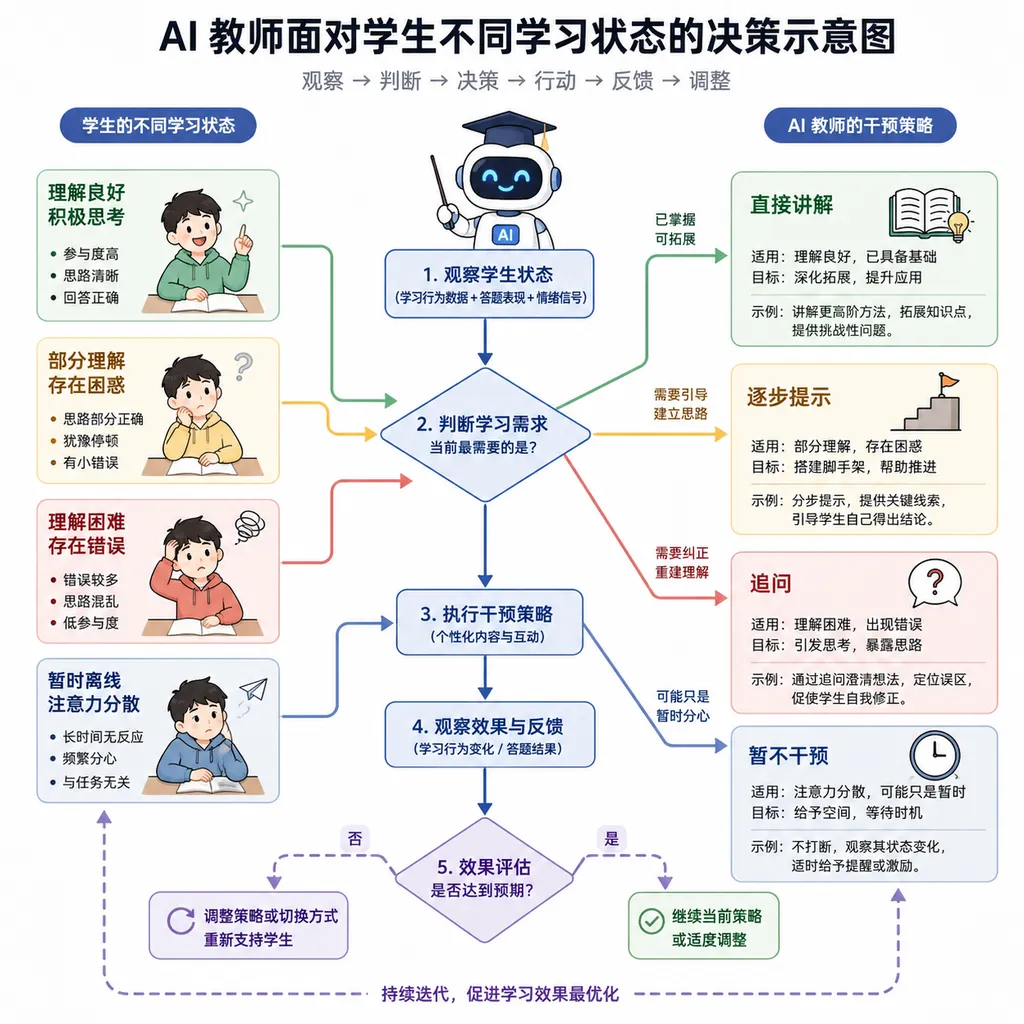
The Allen Institute for AI (AI2) recently introduced TutorMoments, a benchmark designed specifically to evaluate an AI tutor’s ability to judge the right moment to teach. It focuses on a question that looks simple but is extremely difficult in practice: when a student gets stuck, makes a mistake, or gives an incomplete answer, should the model explain directly, offer a small hint, ask about the student’s thinking, or temporarily hold back and let the student continue thinking?
The value of this effort lies in the fact that it does not continue to reduce AI teachers’ abilities to “how many questions they answer correctly.” In real teaching, getting the answer right is only the minimum requirement. A model that reveals the solution too early may help a student get the problem right on the spot without actually learning how to solve it; a model that always responds with “What do you think?” may turn guidance into a perfunctory gesture.
TutorMoments aims to measure precisely this narrow but decisive middle ground in teaching quality.
The Core Ability of an AI Tutor Is Not to “Say More,” but to “Say Just Enough”
Over the past few years, evaluations of large educational models have largely followed the approach used for general-purpose models: measuring math-problem accuracy, knowledge question-answering scores, whether explanations are complete, or having teachers and students subjectively rate responses. These metrics are certainly important, but they struggle to answer the most critical question in a teaching setting: Did the model provide help too early, or too late?
Take a programming problem as an example. A student writes a solution that runs but has very high time complexity. At this point, AI has several options:
- Directly provide a more efficient algorithm and complete code;
- Point out the performance bottleneck without offering a solution;
- Ask about the input size, prompting the student to recognize the complexity issue independently;
- First affirm the current solution, then ask the student to compare different approaches;
- If the student is still working through the problem independently, avoid interrupting for the time being.
From the perspective of “solving the problem immediately,” the first option is the most effective. From the perspective of learning outcomes, it may be precisely the worst. The student takes a shorter detour, but also loses an opportunity to develop a concept.
TutorMoments starts from the premise that this kind of teaching decision should be transformed from an implicit requirement into an explicit evaluation target. The model must not only determine whether “the student is right or wrong,” but also assess “what learning state the student is currently in,” “what level of intervention is most appropriate next,” and “whether this intervention will complete thinking that the student should have carried out independently.”
This differs from the logic of traditional chatbots. Ordinary assistants seek to reduce the cost of task completion for users; AI teachers must balance reducing frustration with preserving cognitive challenge. The former wants the model to produce a result as quickly as possible; the latter sometimes requires the model to deliberately leave space.
What Does TutorMoments Evaluate?
According to AI2’s introduction to the project, TutorMoments extracts key points in teaching conversations as “moments” in which the model must make a pedagogical judgment. These moments typically occur when a student makes a mistake, expresses uncertainty, asks for help, presents partially correct reasoning, or is already close to the correct answer.
At these points, the evaluation does not look only at whether the model’s generated text is fluent. It also focuses on several dimensions.
1. Does It Recognize the Student’s Current State?
When a student says, “I can’t do this anymore,” it may mean that they have no idea how to proceed, or it may simply mean that they want confirmation. Likewise, a student’s incorrect answer does not necessarily indicate a lack of relevant knowledge: the error may result from a calculation mistake, conceptual confusion, or merely incomplete expression.
If the model treats every mistake as a signal to “start over from the beginning,” the teaching process will quickly deteriorate into answer delivery. A better tutor should make a further assessment: What has the student already mastered? Where exactly did the error occur? Is the student still capable of correcting it independently?
2. Is the Level of Help Appropriate?
Teaching prompts usually differ in intensity: from open-ended questions, to pointing out a direction, to narrowing the scope of the problem, and finally to providing steps or an answer. If the model jumps to the highest level of assistance every time, the short-term experience may be excellent, but students will gradually become dependent on it.
The opposite extreme—excessive restraint—is also a problem. For a student who has tried repeatedly and is clearly stuck in a loop, simply saying “Think about it some more” does not constitute effective teaching. TutorMoments is not concerned with whether “fewer hints are always better,” but with whether the hints match the student’s needs.
3. Does It Preserve the Student’s Agency?
The fact that AI generates an elegant derivation does not mean that the student has learned. The model needs to avoid rewriting an entire line of reasoning on the student’s behalf, especially when the student is already close to the correct answer.
For example, a student may have found the key auxiliary line in a geometry proof but failed to organize the explanation clearly. In this situation, the most valuable response may be to ask the student to explain why the auxiliary line is effective, rather than directly outputting a standard proof. The model’s goal should be to help the student complete the reasoning, not to showcase its own reasoning ability.
4. Does It Know When to Stop?
This is one of the most easily overlooked aspects of an AI tutor. Models are often trained to be “as helpful as possible,” so they continue adding explanations, examples, and summaries at the end of an answer. But in a teaching context, an overly long response may obscure the small, specific problem the student actually needs to solve.
A mature teaching model needs to possess the ability to “close”: provide enough guidance for the next step, then hand the turn back to the student. It should not turn every exchange into a miniature textbook.
This Is Not Simply an Upgrade to Traditional Answer Accuracy
The importance of TutorMoments also lies in the way it changes the unit of evaluation for AI teachers.
Traditional model evaluations mostly use the “question–answer” as their unit. Given a problem, the model produces a result, and the evaluation system determines whether that result is correct. This setup is suitable for measuring knowledge and reasoning ability, but not interactive teaching, because teaching quality often depends on the relationship between several consecutive turns.
The same sentence may represent entirely different behaviors in different contexts.
“Try checking the second step again.”
If the student has just made their first attempt, this may be an effective low-intensity hint. If the student has already checked it three times, however, the same sentence may simply be a way of delaying. The model must make its judgment based on the conversation history, the student’s performance, and the task objective, rather than generate a response based only on the current sentence.
This means that evaluating AI tutors is closer to a “strategic decision-making” problem: the model must choose an action among helping, waiting, asking follow-up questions, and correcting errors, and then implement that action through language. Language quality is only the surface; the intervention strategy behind it is the core.
From an engineering perspective, this will also bring changes to system design. Developers cannot simply connect a general-purpose large model to a knowledge base and add a system prompt saying, “You are a patient teacher.” A genuinely useful product needs, at a minimum, to record the student’s attempt history, error types, number of hints given, and stage of the task, and to have the model reassess the student’s state at every turn.
Implications for Model Training: Rewarding Restraint Is Harder Than It Seems
Large models are naturally inclined to answer. Training data and user feedback typically reward responses that are complete, rapid, and seemingly helpful; by contrast, “not explaining yet,” “asking only one question,” or “letting the student try again” may appear, on the surface, to be inadequate service.
This creates a typical conflict:
- User-experience metrics favor faster and more complete answers;
- Learning-outcome metrics sometimes favor slower and less complete answers;
- Preference optimization makes it easier for models to learn to “say more” than to learn when to stop.
If training relies solely on human preference annotations, annotators may also favor content-rich, clearly explained answers while underestimating the damage they can cause to learner autonomy. Therefore, the significance of benchmarks like TutorMoments is not limited to ranking models; they may also encourage a shift in training objectives from “answer quality” to “teaching-behavior quality.”
Future tutor training may need to introduce more granular reward signals: Did the student complete the task independently in the next turn? Did their dependence on similar hints decrease? Were they able to explain their own mistake? Did the model intervene unnecessarily? These metrics are closer to educational outcomes than a simple thumbs-up/thumbs-down rating, but they are also significantly more expensive to collect.
For Product Managers, the Hardest Part Is Defining “Effective Help”
Educational products often face a real-world contradiction: parents and students want AI to solve problems immediately, while schools and teachers care more about whether abilities are genuinely developed. A product that directly provides answers is often more likely to earn short-term satisfaction; a product that insists on step-by-step guidance may instead initially be considered “not smart enough” or “not easy enough to use.”
TutorMoments reminds product teams that “the user types less, thinks less, and finishes faster” should not be directly equated with an improved learning experience.
A more reasonable product design should allow users to choose a help mode, such as:
- Practice mode: Do not provide complete answers by default; offer tiered hints only;
- Q&A mode: Allow the model to explain concepts directly, but require the student to restate or apply them;
- Review mode: Instead of reteaching all the material, identify the step where the error occurred;
- Exam simulation mode: Limit the model’s intervention and provide only minimal hints after the student actively requests help.
For developers, the important thing is not simply adding a “prompt switch,” but turning intervention strategy into an observable and debuggable product capability. For example, the system could record why the model chose to provide a hint rather than answer directly, measure how different hint levels affect subsequent independent completion rates, and allow teachers to adjust the rules.
Of course, the model’s “reasoning process” should not be mistaken for a completely reliable explanation. The system can record structured decision labels, such as student_confused, partial_progress, and hint_level_2, for evaluation and auditing purposes; however, it should not treat a post hoc explanation generated by the model as a genuine, verifiable internal causal process.
Competitors and Existing AI Education Products Are Missing More Than Just a Chat Window
Many AI learning products today already offer photo-based problem solving, automatic grading, concept explanations, and personalized recommendations. But most of these functions revolve around “content delivery”: what the model knows, what it can generate, and whether it can cover more courses.
TutorMoments shifts attention toward “interaction control.” This is a more difficult path because it requires the system to understand the student, not merely the problem.
Compared with ordinary general-purpose models, a specialized AI tutor does not necessarily need to be stronger in every knowledge domain, but it must be better at three things:
- Recognizing uncertainty: Knowing whether a student genuinely does not understand or is simply testing the answer;
- Controlling intervention granularity: Breaking assistance down into levels that can be escalated gradually;
- Tracking learning outcomes: Focusing on whether the student learns in the next step, rather than whether they are satisfied in the current turn.
This also means that model size alone cannot solve the problem. Larger models are generally better at explaining, but not necessarily better at exercising restraint. A model with stronger reasoning ability may even be more likely to complete tasks for students because it can see through the solution too easily. In educational settings, the upper limit of capability and teaching strategy are two different curves.
A Necessary Caveat: Benchmarks Cannot Replace the Real Classroom
The direction taken by TutorMoments deserves recognition, but it should not be treated as the final report card for AI teachers.
First, determining the “correct intervention” in a benchmark depends on educational theory, expert annotation, or behavioral outcomes. Judgments about the right timing for hints may vary across age groups, subjects, and cultural contexts. Silence during a mathematical proof may not be appropriate for language learning; with younger students, moderate encouragement may be more important than preserving cognitive difficulty.
Second, students are not static labels. A student who chooses to look directly at an answer today may have mastered the foundational concepts and simply be in a hurry; it may also be the result of long-term dependence on AI. Without sufficient long-term interaction history, it is difficult for a model to make stable judgments.
Third, learning outcomes have a time lag. The fact that a student does not answer correctly immediately in a given conversation does not mean that the tutor performed poorly; some effective teaching deliberately preserves short-term frustration. Conversely, the fact that a student answers correctly on the spot does not mean that they have developed transferable ability.
Therefore, TutorMoments is better understood as an important testing dashboard than as a certification that can solve educational problems once and for all. It can help researchers identify whether models are biased toward “over-helping” or “under-helping,” and help developers compare different prompting strategies. But real-world deployment still requires classroom observation, teacher feedback, and long-term learning data.
The Dividing Line for AI Teachers May Be Whether They Can Resist the Urge to Answer
After generative AI entered education, its most readily demonstrated strengths were its expressive abilities: explaining quickly, covering a broad range of material, and rewriting complex content at different levels of difficulty. But as models become increasingly articulate, the educational question is turning into one of when not to speak.
By bringing this question to the forefront, TutorMoments signals a shift in AI education from “automated question answering” to “intelligent teaching.” It reminds the industry that an AI tutor is not simply a teacher’s lecture notes moved into a chat window, nor an always-online answer search box. It needs to make judgments amid students’ mistakes, hesitation, and pauses—and recognize that at some moments, the best help may be nothing more than a question, a clue, or even a few seconds of waiting.
For model developers, this means that the next stage of competition will not take place solely around parameter size, context length, and knowledge coverage. For education products, the real moat will not be limited to question banks and interfaces either; it will be the ability to turn “how much help to provide” into a measurable, explainable, and iterative system capability.
At least from this perspective, AI teachers should not aspire to become the most talkative person in the classroom. They should instead become the one who knows when to hand the microphone back to the student.
Sources
- TutorMoments: Do AI tutors know when to help and when to hold back?: AI2’s introduction to the TutorMoments project and its evaluation objectives; the primary source for this article’s discussion of the benchmark’s positioning and core questions.
- Assessment Toolkit Teacher Guide: Reference examples concerning AI applications in formative assessment, reflection, self-assessment, role-playing, and other educational contexts.
- The Reconfiguration and Challenges of the Teacher’s Role in the Age of Generative AI: A discussion of generative AI’s impact on teachers’ roles, critical thinking, and data protection.
- What Should Change Is How Teachers Teach; Restricting Students’ Use of AI Is Futile (II): A discussion of teachers’ shift from knowledge transmitters to learning guides, and of the relationship between AI use and instructional objectives.