Suno Watermarks AI Music

Suno will add imperceptible audio watermarks and fingerprinting to AI-generated music while tightening download restrictions. This could improve provenance tracking, but it will not resolve disputes over training copyrights and streaming revenue sharing.
Suno Begins Adding Provenance Markers to AI-Generated Music
Suno is adding hidden audio watermarks and fingerprinting technology to AI-generated music on its platform. It also plans to revise its download policies to limit the bulk redistribution of generated content to streaming platforms such as Spotify and Apple Music.
The update was disclosed on August 7. According to Suno’s current description, a song may still be identified as “generated by Suno” even after it leaves the platform and is uploaded to another service. However, the company has not announced a specific launch date, clarified who will have access to its detection tools, or disclosed how reliably the watermark can be detected after transcoding, editing, or remixing.
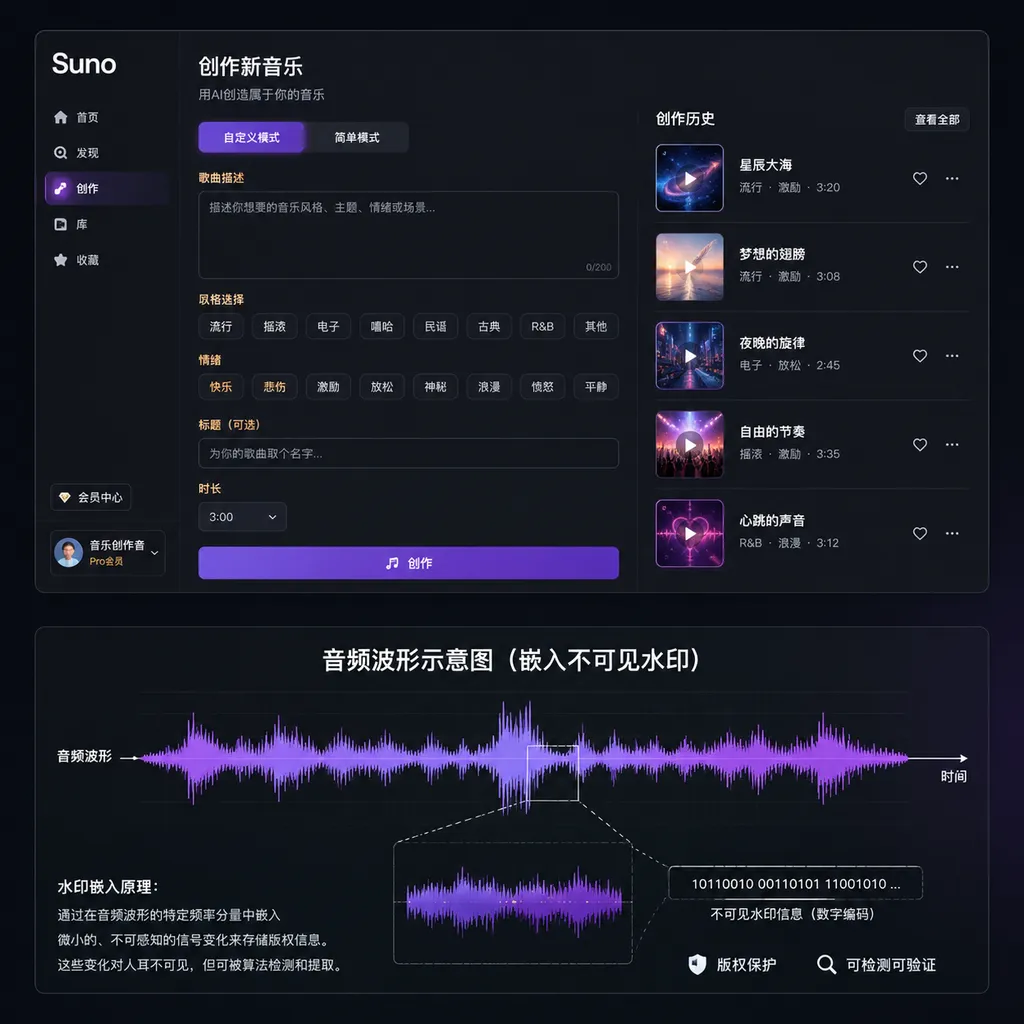
Watermarking and fingerprinting are not new concepts. They have long been used in record distribution, copyright monitoring, and short-form video content identification. What is truly noteworthy is that a leading AI music generation platform has begun proactively embedding information about “where a work came from” into the audio itself, rather than relying solely on file tags or users to disclose it voluntarily.
This is a lesson Suno needed to learn—but it has not learned it particularly early.
Hidden Watermarks and Audio Fingerprints Are Not the Same Thing
Many reports discuss watermarks and fingerprints together, making it easy to assume that they are simply two names for the same thing. In reality, they address different problems and may complement each other within a system.
Invisible Audio Watermarks: Embedding a Marker in the Sound
Audio watermarking generally involves embedding a machine-detectable signal into audio during generation or export. The signal must not noticeably affect the listening experience, yet it must remain readable by a corresponding detector.
It can be understood as a subtle pattern embedded in the fibers of a sheet of paper, rather than an “AI-generated” label appended to a filename. The latter is metadata, which may disappear if the tag is changed or the file is re-exported. The former becomes part of the audio signal itself and must withstand common processing operations without noticeably degrading the music.
A usable audio watermark must, at a minimum, contend with the following:
- Lossy compression formats such as MP3 and AAC;
- Loudness normalization and re-encoding by streaming platforms;
- Pitch shifting, speed changes, and resampling;
- Excerpting, splicing, and looping;
- The addition of ambient noise, equalization, or reverb;
- Playback through speakers followed by re-recording with a microphone.
The stronger the watermark, the harder it is to destroy—but the more likely it is to affect sound quality. The weaker the watermark, the more natural the audio sounds—but it may become undetectable after several rounds of transcoding. The issue Suno must address is not the binary question of whether a watermark exists, but how to balance perceptual quality, robustness, and false-positive rates.
Acoustic Fingerprints: Creating a Content Summary for the Entire Song
Audio fingerprinting is closer to Shazam-style identification. The system extracts a summary from features such as the frequency spectrum, rhythm, and energy peaks, then compares it with known works in a database.
Fingerprinting generally does not require modifying the original audio. As long as Suno creates and registers fingerprints for generated songs in a matching system, the platform may still recognize them even if an uploader changes the filenames or removes the metadata. Mature fingerprinting systems can also produce similarity scores for content that excerpts a chorus, changes the bitrate, or has been lightly remixed.
When the two technologies are combined, the basic logic is as follows:
- The watermark proves that the audio contains a marker indicating a particular type of generative origin;
- The fingerprint identifies which work in Suno’s database it matches;
- Downstream platforms use this information to decide whether to label, downrank, block, suspend revenue sharing for, or manually review the content.
This is far more reliable than simply adding a line reading AI-generated to the file’s metadata, but it is still not an unconditional “digital ID.” Extensive editing, re-performance, partial recreation, or adversarial processing can all reduce detection effectiveness.
Download Restrictions Target Content Farms, Not Ordinary Creators
Suno also plans to introduce new download restrictions intended to reduce the repeated uploading of AI-generated songs to major streaming platforms. So far, the company has not disclosed whether the restrictions will be triggered by account tier, download volume, a specific time window, or anomalous behavior.
If the policy merely limits the number of downloads per session, its effectiveness may be fairly limited. Those engaged in bulk distribution can use multiple accounts, automated browsers, or audio loopback recording, or even build entire pipelines around generation and uploading. Download quotas are more like one layer of a risk-control system than a complete solution.
Even so, they can still have a practical effect.
Once generative music drives content production costs extremely low, abusers can continuously generate thousands of songs, swap out the cover art and titles, and distribute them across streaming platforms in hopes of capturing recommendations and long-tail plays. Revenue from each individual work may be low, but at sufficient scale, these operations can still siphon money from royalty pools. For platforms, this resembles the content farms of the search-engine era: an individual piece of content may not be illegal, but massive volume, low costs, and automated distribution can pollute the entire ecosystem.
Record giants such as Sony Music, Universal Music Group, and Warner Music Group are pushing for stricter industry rules in hopes of keeping mass-produced AI “junk songs” off global music charts. The labels’ position is not difficult to understand. Music charts, recommendation systems, and royalty distribution models were originally designed around human creation and limited supply. When suddenly confronted with an almost unlimited supply of machine-generated content, the old rules can easily break down.
By tightening downloads, Suno is effectively adding friction at the point of generation. It cannot prevent all redistribution, but it can raise the cost of arbitrage at scale. It can also signal to record labels and streaming platforms that Suno does not intend to remain merely a model provider while leaving everyone else to deal with all post-distribution problems.
This Update Is Useful, but “Traceable” Does Not Mean “Licensed”
A watermark can help answer whether a piece of audio may have been generated by Suno, but it cannot answer two other, more sensitive questions: what the model was trained on, and whether the output infringes the rights to a specific work.
This is the part of the update most likely to cause confusion.
Provenance markers are a content-tracing mechanism. Copyright licensing, by contrast, involves training-data permissions, similarity to existing works, the degree of copying, lyric rights, recording rights, and performers’ rights. Even if a song carries a clear Suno watermark, that does not mean it has automatically been licensed for commercial distribution. Conversely, the absence of a detectable watermark does not prove that a song was created by a human or that it is non-infringing.
Suno is currently facing legal pressure from the music industry. Its platform has previously imposed restrictions on prompts—for example, discouraging users from directly specifying living artists or copyrighted works—and uses third-party technology to screen audio and lyrics. Adding watermarks and fingerprints extends its governance from “before and during generation” to “after generation.”
This is a necessary infrastructure upgrade, but it is not a button that settles copyright disputes.
Detection Interfaces and Enforcement Rules Will Ultimately Determine Effectiveness
From a developer’s perspective, the watermarking algorithm itself completes only half the job. The other half is determining who can run detections, how results are returned, and who handles false positives.
At a minimum, Suno still needs to clarify the following:
- Whether watermarks will cover all content generated by both free and paid accounts;
- Whether fingerprints will be retroactively created for previously generated songs;
- Whether detection capabilities will be offered only to partner platforms or opened to the public;
- Whether it will provide a bulk-detection API or a trusted verification tool;
- How much recall will decline after transcoding, speed changes, and editing;
- How it will distinguish fully generated works, partially generated works, and works produced only with AI assistance;
- Whether there will be mechanisms for appeals, reviews, and corrections following false positives;
- What information the fingerprint database will retain, and whether it will involve user privacy or unpublished works.
Particular caution is needed regarding simplistic “detect and immediately remove” rules. Acoustic fingerprinting generally returns a similarity score, not a definitive conclusion in the legal sense. Music also involves complex issues such as sampling, cover versions, public-domain material, and similar arrangements. If streaming platforms automatically equate a machine-generated match with a violation, independent musicians may become collateral damage.
A more prudent enforcement approach would be tiered: content with a high-confidence, complete match and evidence of bulk uploading could be blocked automatically; works with partial matches or complex provenance could be sent for manual review; and works identified only as generated content could receive a label rather than automatically lose eligibility for distribution and monetization.
This also means Suno should publish at least a minimum level of technical evaluation, including precision, recall, and false-acceptance rates under different types of audio processing. Without such metrics, “we have added watermarks” sounds more like a compliance statement than a verifiable governance capability.
AI Music Is Shifting From a Generation Race to Distribution Governance
Over the past two years, AI music products competed over who could generate complete songs faster, whose vocals sounded more natural, and who could understand prompts better. By 2026, competition has entered its next stage: generation capabilities are gradually becoming commoditized, while provenance tracking, copyright controls, and downstream distribution are beginning to determine whether a product can remain in the game.
For developers and creators who use Suno normally to produce demos, advertising music, or prototype music for games, invisible watermarks may not have any noticeable impact. As long as the watermark does not degrade audio quality, a provenance marker may instead provide an audit trail in copyright disputes. The businesses that will be most affected are gray-market operations built around bulk generation, marker removal, and cross-platform distribution.
However, Suno cannot make watermarking a black box that benefits external platforms while remaining opaque to creators. At a minimum, paying users should know whether their works contain markers, whether commercial licensing is affected, which distribution channels the platform can track through fingerprints, and how related records will be handled after an account is deleted.
From an industry perspective, Suno is moving in the right direction. Generative music cannot maintain order indefinitely by relying on “users to disclose it themselves,” and file metadata cannot even survive a single round of re-encoding. Embedding provenance information in the signal and cross-checking it against a fingerprint database is a more robust solution than simply applying a label.
But this addresses only the problem of “identifying AI content,” not “resolving AI copyright.” The former is an engineering problem; the latter remains a matter of licensing, revenue allocation, and legal boundaries. Suno has now added an engineering-level hidden marker. Next, it must answer a harder question: once a song is identified as coming from Suno, what exactly should everyone involved do with it?
References
- ITHome: Suno to Add Hidden Watermarks to AI-Generated Music to Prevent Abuse—Reports on Suno’s plans to introduce hidden audio watermarks, fingerprinting, and download restrictions, and describes the industry pressure the company faces.
- Reddit Discussion on Suno Watermarks and Acoustic Fingerprints—An unofficial user discussion of potential watermarks, audio processing, and third-party fingerprinting systems. The claims made there cannot substitute for formal technical documentation from Suno.