Databricks Cuts AI Coding Costs by 70%

Databricks revealed that it reduced AI coding expenses by approximately 70% through model tiering, usage governance, and usage data analysis. This indicates that enterprise AI is shifting from “making as many calls as possible” to fine-grained management based on task, quality, and budget.
Databricks Cut AI Coding Costs by 70%, Bringing Enterprise AI into the Era of Fine-Grained Governance
Databricks recently disclosed an internal practice: by analyzing calls to AI coding tools, tiering models, and implementing cost governance, the company reduced related spending by approximately 70%.
That figure is noteworthy, but the change behind it is even more significant: enterprise use of AI coding tools is no longer simply about equipping employees with a Copilot, purchasing a batch of seats, and waiting for productivity gains to appear naturally. As coding agents begin to autonomously read code, modify code, run tests, and repeatedly fix issues, AI coding bills are shifting from a fixed software subscription fee to a cloud computing expense that fluctuates with task complexity and agent behavior.
The Databricks case shows that the core of AI coding cost optimization is not simply to “use models less,” but to evaluate every call in the context of the specific task: Does this request really require the most powerful model? Is the context too long? Is the agent retrying ineffectively? Is the benefit of a code change worth the tokens it consumes?
In other words, large-scale AI usage is shifting from “token maxxing” to “value maxing.”
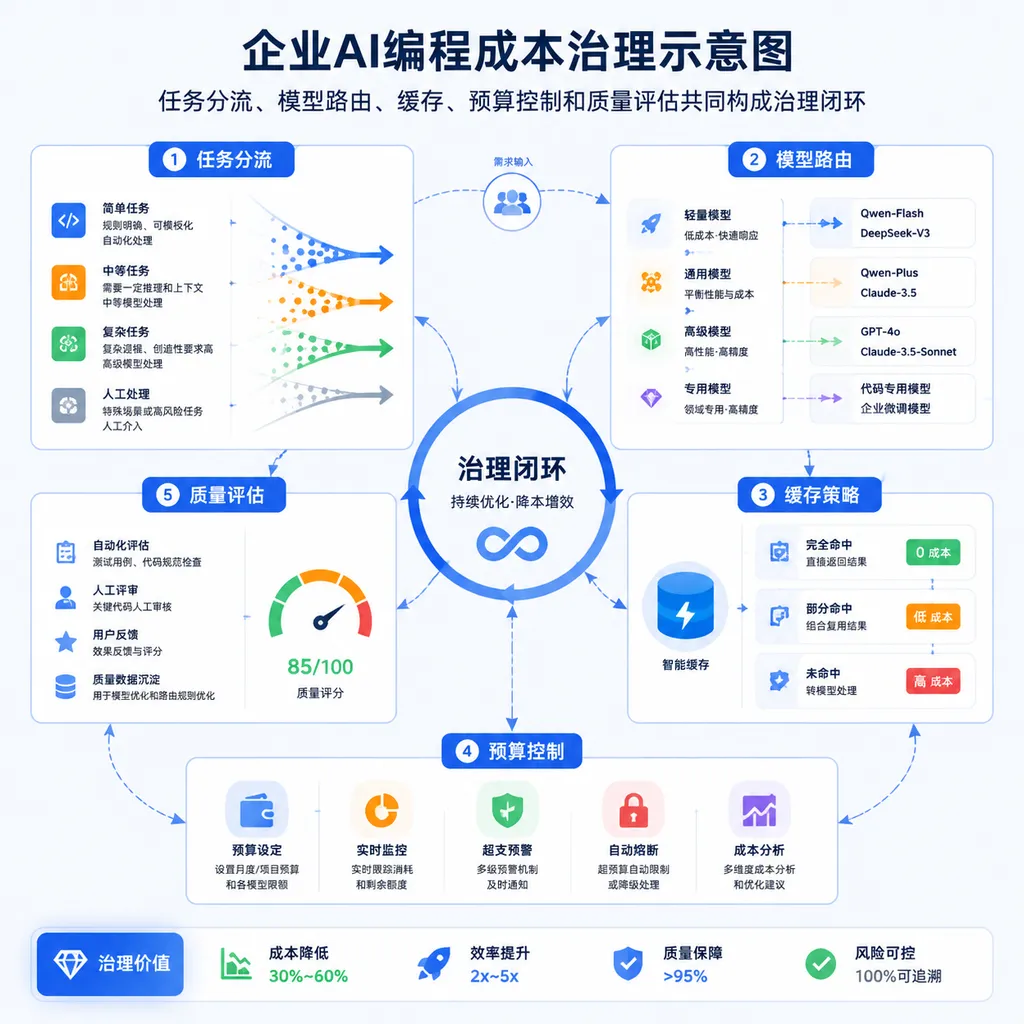
A 70% Cost Reduction Does Not Mean Model Prices Fell by 70%
First, it is important to clarify that the 70% mentioned by Databricks does not represent a uniform price reduction by model providers, nor is it a discount that every enterprise can directly replicate. It is closer to an internal operational result: after the scale of AI coding workflows expanded, Databricks reexamined the calling pipeline, identified a large number of unnecessary, low-value requests or requests that could be handled by cheaper models, and implemented governance across the entire system.
This is different from simply comparing model API prices.
The actual AI coding costs borne by enterprises generally include at least the following components:
- Model inference costs: Input tokens, output tokens, long contexts, and advanced reasoning modes all affect the bill.
- Agent loop costs: A coding agent may call a model a dozen or even dozens of times for a single task, with each call potentially including the full repository context, tool results, and message history.
- Development environment costs: Code search, vector indexing, sandbox execution, test environments, and log storage also incur computing costs.
- Failed retry costs: When a model fails to understand a task correctly, tests fail, or tool calls encounter errors, the system often retries automatically.
- Management and auditing costs: Enterprises also need to record who called which model, what code was processed, how much was spent, and whether any security boundaries were crossed.
Therefore, even if model prices remain unchanged, the final bill can still fall significantly by reducing irrelevant context, lowering the number of retries, and routing simple tasks to lighter-weight models.
This is the practical value of the Databricks case: it turns AI coding costs from a procurement issue into an engineering issue.
First Tactic: Do Not Use the Most Powerful Model for Every Coding Task
When many teams deploy AI coding tools, their default logic is “the more capable the model, the better.” After a developer submits a request, the system sends it directly to the most capable and expensive model, which may also have higher latency.
During early experimentation, this approach can quickly demonstrate results. But once usage reaches scale, it almost inevitably creates waste.
Coding tasks have clear tiers of complexity:
- Completing a simple getter, type definition, or test assertion;
- Modifying a function based on explicit requirements;
- Tracing call chains across multiple modules;
- Designing a database migration plan;
- Refactoring a large codebase;
- Analyzing a production incident and proposing a fix.
These tasks place different demands on model capabilities. Simple completion and formatting do not require the most powerful reasoning model, while complex refactoring may require a longer context, stronger tool-use capabilities, and more stable multi-turn reasoning.
A more reasonable architecture is to establish a model-routing layer:
| Task type | Default strategy | Cost-control focus | | --- | --- | --- | | Code completion, comments, simple tests | Lightweight model | Low latency, short outputs | | Single-file modifications, routine bug fixes | Mid-range model | Control context length | | Cross-module refactoring, complex debugging | High-capability model | Limit retries and maximum turns | | Security reviews, critical production changes | High-capability model + human approval | Prioritize quality and retain audit records |
Routing does not necessarily need to rely entirely on the model’s own judgment. It can also incorporate IDE operations, repository size, file count, task labels, and historical success rates.
A truly effective routing system cannot look only at whether a model’s response “seems good.” It must also consider whether the code passes tests on the first attempt, whether manual modifications are required, how long the task took to complete, and what the final cost was. Otherwise, an enterprise may simply be hiding expensive calls inside a more complex system.
Second Tactic: Treat Context as a Resource That Must Be Managed Carefully
One of the most underestimated components of AI coding costs is context.
What a developer sees may be a simple request: “Help me fix the authentication bug in this API.” But behind the scenes, the agent may simultaneously read project documentation, dependency manifests, multiple source files, commit history, test logs, compiler errors, and tool-call results. If all of this is reinserted into the model at every conversational turn, input tokens can quickly balloon.
This kind of waste is not always immediately visible. The model may still produce correct outputs, and developers may still feel a productivity boost. But once usage expands from dozens of engineers to thousands of employees, costs can accumulate rapidly in proportion to the number of calls and the length of the context.
Context governance typically involves several approaches:
- Retrieve on demand instead of injecting the entire repository: First locate relevant files and symbols, then gradually expand the context.
- Compress historical information: Summarize resolved conversations, tool outputs, and test logs to avoid repeatedly transmitting the original text.
- Control tool outputs: By default, return only error excerpts and key stack traces rather than complete terminal output.
- Reuse stable prefixes: Keep system prompts, repository rules, and fixed project documentation structurally consistent where possible to enable caching.
- Set context limits: A longer context is not always better. Beyond a certain point, model attention and task success rates may not continue to improve.
In coding-agent scenarios, the most expensive activity is often not “answering a question,” but repeatedly carrying the same code and tool results into the next turn. Good context governance can generally reduce costs and latency simultaneously, while also lowering the probability that the model will be distracted by irrelevant information.
Third Tactic: Use Success Rates to Constrain Retries Instead of Continuing Indefinitely
Another cost black hole for coding agents is automated looping.
A typical process looks like this: the agent modifies the code, runs tests, reads the failure information, modifies the code again, and reruns the tests. As long as the tests do not pass, the system continues calling the model. For simple tasks, this mechanism is convenient; for complex tasks, it can become a token-consuming machine with no brakes.
Retries are particularly prone to getting out of control in the following situations:
- The test failure is unrelated to the current code;
- The tool returns an exception message the model cannot understand;
- The agent repeatedly modifies the same code without changing its troubleshooting approach;
- The tests themselves are unstable, causing the agent to misjudge the situation;
- The task description is unclear, causing the model to continuously optimize toward the wrong objective.
Therefore, enterprises need to set explicit stopping conditions for agents instead of merely setting a very large maximum number of turns. Relevant signals may include:
- No additional tests pass after two consecutive rounds of modifications;
- The same file is repeatedly rewritten while the error type remains unchanged;
- The tokens, time, or cost for a single task exceed a threshold;
- The agent cannot confirm whether the current modification meets the user’s objective;
- The test environment returns the same system-level error.
Once these conditions are met, the system should switch to human confirmation, move to a more capable model, or require the developer to provide additional task information. Asking an agent to “keep trying” may be appealing in a demo, but it can be extremely expensive on a production bill.
Databricks’ Experience: Cost Governance Must Be Embedded in the Development Workflow
When Databricks disclosed its AI spending control tools in June this year, it mentioned that some customers had unexpectedly generated AI bills in the tens of millions of dollars in a single month. This phenomenon is not difficult to understand: enterprises were accustomed to relatively stable SaaS seat fees, but the usage of AI agents depends on employee count, task complexity, degree of automation, and model behavior. As a result, the bill looks more like a constantly changing cloud-resource bill.
Traditional FinOps tools typically issue alerts only after expenses have been incurred. By then, the overspending may have already happened, leaving administrators with little to do beyond assigning responsibility and restricting the budget for the next cycle.
AI scenarios require earlier controls:
- Estimate the tokens and costs a task may consume before making the call;
- Allocate budgets based on teams, projects, environments, and task types;
- Lower the model tier or limit agent turns as a threshold is approached;
- Intercept anomalous calls in real time;
- Analyze costs together with task outcomes, code quality, and development time.
This means cost control cannot exist only in financial reports maintained by the finance team, nor can it be left solely to platform administrators. It should appear in the IDE, agent orchestrator, model gateway, and CI/CD pipeline.
For example, an enterprise-oriented model gateway should record at least:
- The caller, team, project, and environment;
- The model used and the reason for routing;
- Input, output, and cached tokens;
- The number of tool calls and agent loop iterations;
- Whether the task passed tests;
- Whether human intervention was required;
- The cost of each task and the cost per unit of output.
Only then can teams answer a genuinely useful question: not “How much did we spend this month?” but “For every dollar spent, how much manual time did we save, and how much tested code did we deliver?”
The Other Side of a 70% Cost Reduction: Do Not Mistake Cheap for Efficient
Of course, cost reduction alone does not equal success.
If an enterprise switches every task to a low-cost model or forcibly truncates context to reduce token usage, the short-term bill may decline, but the long-term result could be more manual rework, more production defects, and longer delivery cycles. The cost of code generation cannot be measured solely by API fees; subsequent maintenance costs must also be considered.
A relatively sound evaluation framework is to break AI coding efficiency into four dimensions:
- Cost per task: The average amount spent to complete one effective code change.
- First-pass success rate: The proportion of outputs that pass tests, code review, and type checking on the first attempt.
- Human intervention rate: The proportion of tasks that ultimately require developers to redesign or substantially modify the output.
- Delivery cycle: The actual time from task creation to merge and release.
Suppose a lightweight model costs only one-tenth as much to call as a powerful model but doubles the amount of manual rework required. It may not actually be cheaper. Conversely, a more expensive model may have a lower total cost if it can significantly reduce debugging and review work.
Databricks’ 70% figure should be understood as “the savings potential created by system governance,” rather than as a new industry benchmark. Codebases, model prices, task structures, and security requirements vary widely among enterprises, so the figure cannot be applied directly.
What Development Teams Can Do Now
For teams already using AI coding tools at scale, the most valuable first step is not to purchase another new model, but to establish both a call-cost ledger and a quality ledger.
They can begin with the following steps:
1. Measure First, Then Optimize
Break down call volume by team, project, model, and task type, and identify the 10% of workflows that cost the most. Do not immediately impose global rate limits, as this can easily harm critical tasks.
2. Set Task-Level Budgets
Compared with setting only a total monthly budget, task-level budgets are better suited to agent systems. A routine bug fix and a large-scale refactoring task should not share the same call limit.
3. Establish Model Tiers
Set default models for common tasks, and upgrade to more capable models only when failures occur, complexity increases, or high-risk code is involved.
4. Record “Why It Is Expensive”
Cost monitoring should show more than the number of calls. It should distinguish between long contexts, long outputs, repeated retries, tool loops, and cache hit rates. A bill without cause categories can generally be used only for post hoc complaints.
5. Incorporate Quality Metrics into Routing
Model routing should not make decisions based solely on price. At a minimum, teams should also monitor test pass rates, the amount of manual modification, latency, and security review results.
6. Put Brakes on Agents
Set time, token, cost, and turn limits for individual tasks, and design a human-handoff mechanism for consecutive failures. One of the most important capabilities of an automated system is knowing when to stop.
The Next Stage of AI Coding Is Not “Everyone Uses the Most Powerful Model”
Over the past two years, the narrative around AI coding competition has focused primarily on model capabilities: who can read longer contexts, who can complete more complex coding tasks, and who can allow agents to run autonomously for longer periods.
But after entering the second half of 2026, the problems enterprises face have changed. Model capabilities remain important, but “whether usage can be kept under control” is becoming an equally important infrastructure capability.
This will drive the rapid development of model gateways, agent orchestration, evaluation systems, and AI FinOps tools. Enterprises will need more than a model selector; they will need an operating system capable of automatically determining the model, context, tools, and budget based on the value of each task.
Model providers may want enterprises to make as many calls as possible to more powerful models, while platform providers must help customers keep usage within an explainable and predictable range. The conflict between the two will become increasingly apparent: for model providers, token growth means revenue; for enterprises, uncontrolled tokens mean risk.
Databricks’ approach is highly representative. It is not content to be merely a data platform or model-call gateway; it is attempting to become the control layer for enterprise AI workloads—knowing where the data is, how models are called, what agents have done, and whether each call was worthwhile.
For developers, the conclusion is also direct: AI coding is no longer merely a question of “which model to choose,” but a complete systems-engineering problem. Truly mature teams will not strive to give every request the maximum model capability. Instead, they will aim to complete tasks at the lowest possible cost while maintaining acceptable quality.
This is the key lesson behind Databricks’ ability to reduce AI coding spending by approximately 70%: future competition will not be just about model capabilities, but also about call efficiency, task orchestration, and value measurement.
Sources
- Databricks official blog: “Databricks drove down AI coding spend 70%”: Describes how Databricks reduced AI coding spending through internal engineering practices and summarizes cost-governance methods for scaled usage. The original was published on the official Databricks website; as required for this article, no link was included because the domain is not on the specified whitelist.
- Axios: “Exclusive: Databricks rolls out AI spend controls”: Reports on Databricks’ launch of AI spending control tools, as well as cases of enterprise AI agents causing bills to spiral out of control. The original was published by Axios; as required for this article, no link was included because the domain is not on the specified whitelist.
- Public information from the Databricks CEO regarding DBRX training costs: Used to supplement the explanation that the costs of model training, inference, and enterprise AI workloads are shifting from one-time budgeting concerns to ongoing governance challenges. The original source is not on the specified link whitelist for this article, so no link was included.
This article represents development insights and industry observations. The 70% cost-reduction figure disclosed by Databricks reflects its own practices and should not be treated directly as a replicable benchmark for all enterprises.