The U.S. Department of Energy Bets on Open-Source Scientific Models
The U.S. Department of Energy recently launched the Genesis Open Model Initiative, seeking to bring federal scientific data, supercomputing, and AI models into a unified open collaboration framework serving high-barrier research in energy, materials, biology, nuclear science, and other fields. Its value lies not in creating yet another chatbot model, but in competing for the foundational infrastructure gateway to scientific AI.
U.S. Department of Energy Bets on Open Models for Science
The U.S. Department of Energy recently launched the Genesis Open Models Initiative, aimed at advancing open collaboration on scientific computing and basic research. This marks an important step in the “Genesis Mission” moving from a national-level strategic deployment toward the implementation of models and tools.
The core of this initiative is not to release yet another general-purpose large model for public chat. Instead, it seeks to build an entirely new open model ecosystem around scientific research: models must be able to understand research data, connect to high-performance computing environments, call simulators and experimental facilities, and be audited, modified, and reproduced by research institutions.
In other words, the Department of Energy is not trying to solve the problem of whether “AI can write an experimental report.” It wants AI to enter the main workflow of scientific discovery: from reading decades of accumulated experimental data, to proposing research hypotheses and designing simulation plans, to scheduling experiments, analyzing results, and passing validated conclusions on to the next round of research.
From “Using Models” to “Building a Scientific Model Foundation”
Over the past two years, discussions about AI for Science have focused largely on several high-profile projects: protein structure prediction, materials property prediction, climate simulation, drug screening, and the use of large language models to help researchers search and summarize academic papers. These applications have already demonstrated that models can save substantial time in scientific workflows, but they have also exposed a problem: general-purpose models are not naturally suited to scientific computing.
General-purpose large models are good at processing natural language and code, but scientific research often requires much stricter constraints. A model must not merely “sound plausible”; it must also satisfy unit consistency, physical laws, boundary conditions, and numerical stability. Generating a seemingly reasonable piece of Python code is not difficult. The hard part is whether that code can run reliably on a supercomputer, and whether the simulation results can be cross-validated against real-world experiments.
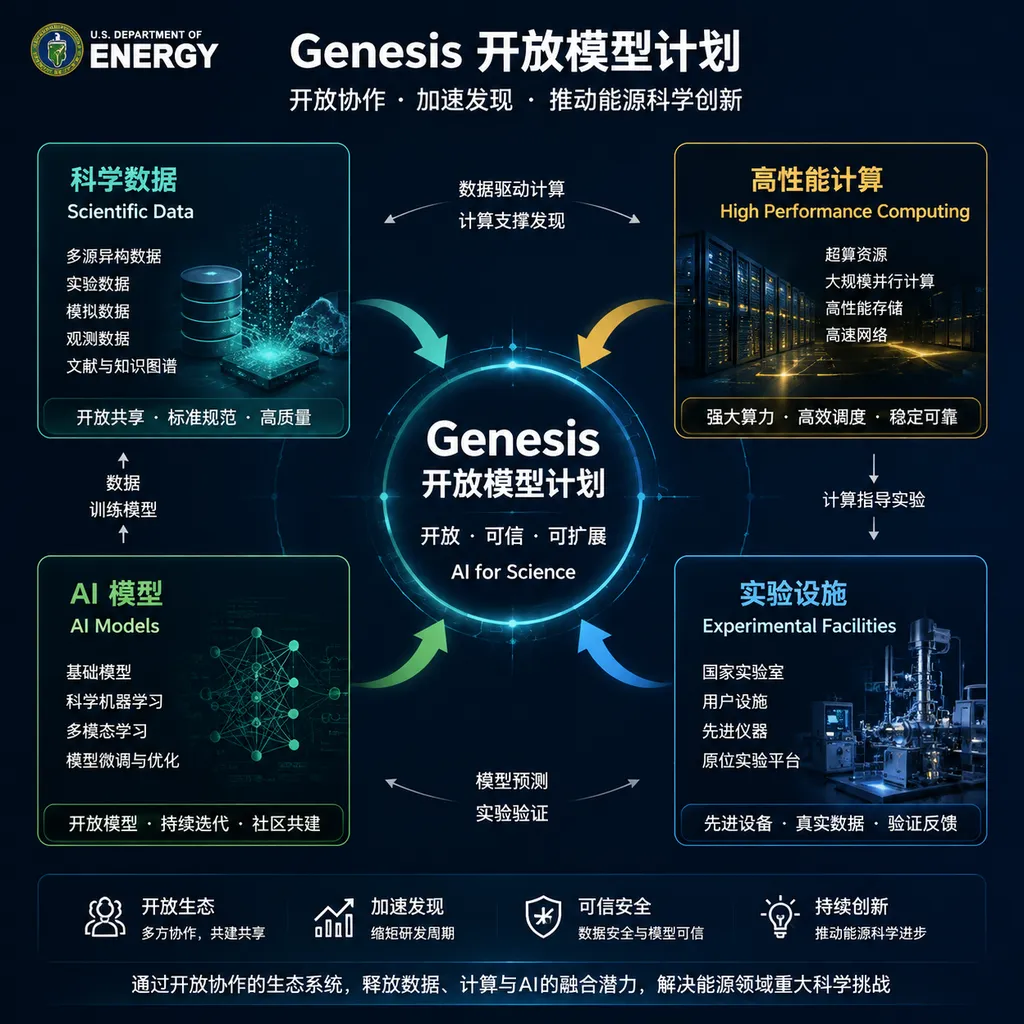
The direction of the Genesis Open Models Initiative is precisely to bind model capabilities to scientific research infrastructure. Its potential objectives include at least the following layers:
- Scientific data layer: Leverage materials, energy, nuclear science, climate, and biomedical data accumulated over many years by the Department of Energy and the national laboratories;
- Model layer: Develop scientific models capable of processing papers, tables, experimental records, code, three-dimensional structures, and simulation results;
- Computing layer: Enable models to call high-performance computing clusters, scientific simulation software, and specialized accelerators;
- Tool layer: Connect retrieval, code execution, numerical simulation, experimental control, and result evaluation into reproducible workflows;
- Collaboration layer: Enable national laboratories, universities, companies, and independent researchers to jointly test, improve, and reuse models.
If these components can truly be connected, a scientific model will no longer be merely a “research Q&A chatbot.” It will look more like a research assistant capable of calling laboratory tools. Its output should not stop at textual answers, but should also include executable code, simulation configurations, experimental parameters, data-processing procedures, and a traceable chain of evidence.
The Genesis Mission Is Already More Than a Policy Slogan
Behind the Genesis Open Models initiative is the U.S. government’s expanding Genesis Mission. According to recently released information, the U.S. government plans to integrate more than $5 billion in research funding and resources while advancing national science and technology challenges in areas including energy, life sciences, advanced materials, manufacturing, and spaceflight.
Previously, the Department of Energy announced an initial round of research funding totaling approximately $293 million, covering more than 20 national science and technology challenge areas. By late July, more than 15 federal agencies had joined the Genesis Mission. The Department of Energy, the National Science Foundation, NASA, the National Institutes of Health, and other institutions have all been incorporated into the collaborative framework.
This means the Genesis Mission is neither a standalone model procurement budget nor an AI project confined to the Department of Energy. It is attempting to bring together several categories of resources that were previously scattered across the government’s research system:
- Federal research funding: Define challenges around national missions rather than relying entirely on decentralized academic grant applications;
- The national laboratory system: The 17 national laboratories under the Department of Energy possess major facilities, supercomputers, and long-term research data;
- High-performance computing resources: Give frontier models access to real scientific computing environments rather than limiting them to text inference on cloud GPUs;
- Large-scale experimental facilities: Including light sources, neutron sources, fusion facilities, particle accelerators, and automated experimental platforms;
- Industry model capabilities: Bring in model companies, chipmakers, and software service providers to supplement the engineering capabilities of government research institutions.
This organizational approach differs substantially from that of ordinary large-model startups. Startups typically revolve around one model, one product, and one commercial loop, whereas the Genesis Mission is more like an effort to build a national scientific research operating system: the model is only one component, while data, computing power, experimental facilities, and researchers are the other parts of the complete system.
Why “Open Models” Are Especially Important for Scientific Research
The need for openness is stronger in scientific research than in enterprise knowledge bases or consumer chat products.
First is reproducibility. If researchers can access model outputs only through a closed API, it is difficult to determine exactly which version, system prompt, tools, and data the model used. For papers, patents, and major engineering projects, this lack of reproducibility directly undermines the credibility of the conclusions.
Second is domain adaptation. Different laboratories vary widely in their data formats, simulators, and research processes. A unified closed-source model can provide general capabilities, but it is difficult to tailor it to the specific requirements of nuclear materials, fusion, climate, or biological experiments. Open models allow research teams to fine-tune, distill, or restructure them locally so that they can adapt to specific equipment and datasets.
Third is security auditing. Errors in scientific AI may be far more serious than simply getting a question wrong. If a model incorrectly modifies experimental parameters, misinterprets radiation data, or provides unverified operational advice in the biological sciences, the consequences could involve equipment safety, experimental safety, or even national security. Open weights, training-data documentation, evaluation sets, and tool-calling logs can provide a stronger foundation for assessing model risks.
However, one important question remains: “Open Models” does not necessarily mean fully open source.
As of now, the specific model architectures, weights, training data, licenses, release schedules, and limits on commercial use under the Genesis Open Models initiative still need to be confirmed by subsequent Department of Energy announcements. The degree of openness will determine whether the initiative ultimately becomes an open collaborative infrastructure or merely a government-led model distribution program.
If only the inference interface is open, researchers will still be dealing with a black box. If the weights are open but the training data are not, reproducibility will remain limited. Only when the models, data specifications, evaluation standards, and toolchain are all open will the initiative more closely resemble a genuine scientific model ecosystem.
Its Competition with Ordinary Large Models Is Not About Chat Performance
The Genesis initiative is unlikely to directly challenge products such as GPT, Claude, or Gemini in general-purpose chat, office writing, or consumer applications. Nor should scientific models be evaluated simply by applying the knowledge-question-answering and coding scores used on public leaderboards.
More important metrics may include:
- Whether the model can reduce prediction errors on real scientific data;
- Whether it can propose new hypotheses that are subsequently validated through experiments;
- Whether it can reduce the time and computing power required for simulations;
- Whether it can transfer effectively between different laboratories;
- Whether it can reliably call existing scientific software and instruments;
- Whether it can provide complete, traceable, and reproducible experimental procedures;
- Whether it can maintain permission isolation and human approval in high-risk research scenarios.
For example, in materials research, a scientific model that can connect candidate-material screening, quantum chemistry calculations, and structural stability analysis all the way through to experimental-plan generation and automated validation would be far more valuable than one that merely produces a more fluent materials review. In fusion, nuclear energy, and climate simulation, compressing a single expensive computation into a few minutes may be far more meaningful than improving a few percentage points on a general-purpose benchmark.
This is what makes the Genesis initiative worth watching: it shifts AI evaluation away from “How human-like are the model’s answers?” and back toward “Can it complete a verifiable scientific task?”
The Real Challenge Lies in Data and Workflows, Not Parameter Count
Scientific AI may appear to require larger models, but a greater number of parameters cannot automatically solve the problems of scientific research.
Scientific data are highly heterogeneous. Papers are text, experimental records may be semi-structured tables, instrument outputs are often high-dimensional time-series data, and simulation results may be stored as grids, particles, or three-dimensional structures. Units, naming conventions, error ranges, and data-quality standards also vary across fields. Simply combining all of these data for training can easily produce a model that “knows many terms but understands nothing about experimental conditions.”
Data are also scarce and sensitive. High-value experimental data often require years of accumulation. Some datasets involve defense, nuclear safety, critical infrastructure, or personal health information and cannot simply be made public like internet text. Open collaboration must simultaneously address data classification, access control, de-identification, model leakage, and export controls.
Third is the cost of validation. General-purpose models can be rapidly iterated through human preferences and automated evaluations, but scientific models often require weeks, months, or even longer to complete a single experimental validation. Whether a new material structure proposed by a model can be synthesized, whether it is stable, and whether its performance meets requirements cannot be “graded” by a language model itself.
Therefore, the success or failure of Genesis will not depend solely on whether it trains a model with tens or hundreds of billions—or even trillions—of parameters. More important will be whether it can establish a scientific evaluation and human–machine collaboration mechanism: models expand the search space; scientists define the problems, set constraints, and review the evidence; and experimental facilities validate the results.
What It Means for Developers
For developers, the Genesis Open Models Initiative is significant in three main ways.
First, scientific models may evolve from “research projects” into foundational software components. Future research development may not involve training a model from scratch. Instead, developers may build domain-specific agents on top of open models and connect them to retrieval systems, simulators, code execution environments, and experimental control interfaces.
Second, tool calling and data standards will become competitive focal points alongside model interfaces. A truly usable scientific agent needs to handle unit conversion, version management, computational task scheduling, experimental permissions, and result archiving. A chat window alone cannot meet these requirements.
Third, open models will accelerate secondary development for scientific AI, but they will not eliminate infrastructure barriers. Research institutions will still need high-performance computing resources, data engineering teams, domain experts, and security auditing capabilities. For individual developers, more realistic entry points may include building scientific data-processing tools, evaluation sets, simulator connectors, and reproducible workflows rather than directly training a general-purpose scientific foundation model.
When selecting models, developers also do not need to bind every task to a single provider. General-purpose models are suitable for natural-language interaction and code generation, specialized scientific models are better suited to domain-specific prediction and simulation, and traditional numerical methods remain the baseline for result verification. Through model aggregation services compatible with the OpenAI format, teams can quickly switch among models such as GPT, Claude, Gemini, and DeepSeek during the prototyping stage, then integrate scientific or local models into the same application architecture to reduce vendor lock-in. However, when sensitive research data are involved, whether the data will leave the country or region, whether the model is permitted to train on them, and how logs are stored must be assessed before considering invocation costs.
Assessment: This Is a Competition to Build Scientific AI Infrastructure
The most noteworthy aspect of the Genesis Open Models initiative is not that “the U.S. Department of Energy is also going to build large models.” It is that the U.S. government has begun treating models, computing power, scientific data, and national laboratories as a single system to be built.
This approach has clear advantages. The government can provide long-term research data, major experimental facilities, and stable funding that are difficult for any single company to obtain. It can also organize dispersed universities, laboratories, and companies around national missions. If the openness mechanism is designed thoroughly enough, external researchers will gain access to real scientific problems, real computing resources, and real-world validation scenarios—something more valuable than simply releasing model weights.
It also faces three categories of risk: first, data sharing and permission coordination among government agencies may slow implementation; second, security and export controls may narrow the scope of openness; and third, there remains a hard barrier of experimental validation between model outputs and scientific conclusions that are publishable and ready for engineering deployment.
Therefore, Genesis will not replace scientists in the short term, nor will the words “open models” automatically produce major breakthroughs. But it may change the coordinates of the next phase of AI competition: the competition will no longer be only about who has the strongest general-purpose model, but also about who can embed models into real-world scientific production systems.
As of August 8, 2026, the Genesis Open Models Initiative remains in its launch phase, with its rules still being gradually clarified. The three specific developments most worth watching next are not promotional slogans, but whether the first models will genuinely release their weights, whether scientific data and evaluation standards will be reusable, and whether external developers will be able to access computing resources and experimental workflows without relying on special connections.
If these three conditions are fulfilled, Genesis may evolve from a government AI initiative into genuinely reusable open infrastructure for scientific computing.