Fable 5 No Longer Stops Every Creature on Sight

Anthropic has updated Claude Fable 5’s biosecurity classifier, reducing the number of times biological questions trigger a downgrade by approximately 85%. The user experience has improved significantly, but this figure does not mean that the false-positive rate has fallen by 85%, nor have restrictions on professional research been lifted.
Fable 5 No Longer Blocks Everything Biological
Yesterday (August 7), Anthropic updated the biosafety safeguards for Claude Fable 5. The most immediate change is that when users ask biology-related questions, the system now triggers model downgrades about 85% less often. Everyday health consultations, biology education, and routine life-science analysis are now less likely to be mistakenly flagged by the safety classifier.
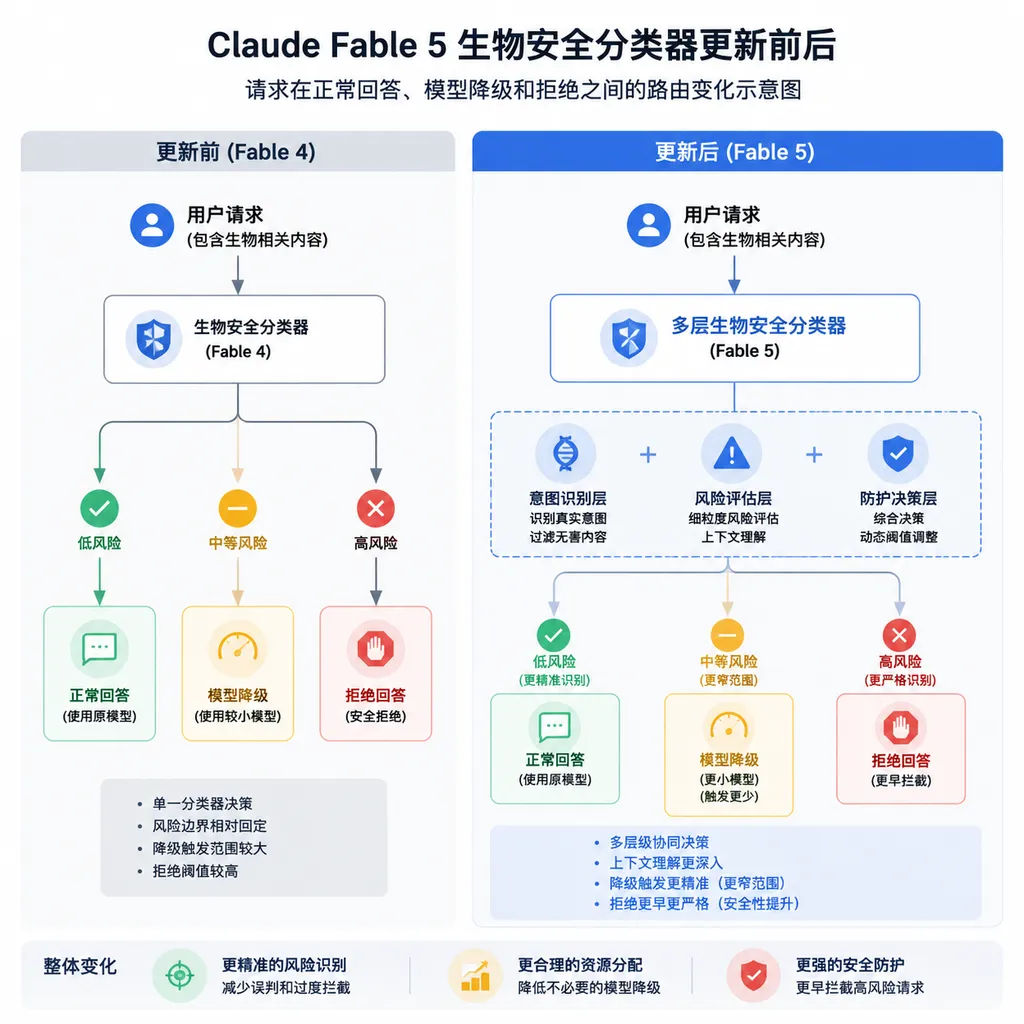
This is not a model-weight upgrade, nor does it give Fable 5 any new biological knowledge. What Anthropic changed is the safety classification and routing system in front of the model. Previously, if the system detected even a hint of high-risk biology, it might hand the request off to a less capable model. Now, it is beginning to distinguish more carefully between ordinary questions and requests that could potentially be used for biological weapons, toxicological attacks, or other high-risk activities.
For developers, this update may not be as eye-catching as a new model release, but it could be more useful than a modest benchmark increase. The most troublesome aspect of safety systems is often not an explicit refusal, but that the service still returns a result while the underlying capabilities have quietly changed.
What Exactly Was Reduced by 85%?
Anthropic’s key metric is that downgrades in biology-related Q&A have decreased by approximately 85%.
A technical distinction is necessary here. This does not necessarily mean that the classifier’s overall “false-positive rate fell by 85%,” much less that Fable 5 has relaxed 85% of its safety restrictions. The public information describes the change in the number of downgrades observed on the user side, not a comprehensive classifier evaluation report containing precision, recall, false-positive rates, and false-negative rates.
A typical safety-routing system generally involves three layers of assessment:
- Input classification: Determine whether a request concerns ordinary biological knowledge, assistance with professional experiments, or something with clear dual-use potential.
- Risk assessment: Consider the question’s specificity, actionability, user intent, and context to determine whether the model’s response would significantly lower the barrier to dangerous activities.
- Execution policy: Allow Fable 5 to answer normally, restrict the level of detail, switch to a restricted model, or refuse outright.
The previous problem was that Anthropic used relatively conservative classification thresholds to launch the more capable Fable 5 safely. Any request involving experimental methods, molecular mechanisms, virology, toxicology, or similar features could trigger a fallback. Safety was maintained, but the classifier behaved like an overly sensitive airport security officer: genuinely dangerous items were stopped, but an ordinary metal water bottle in a bag would also be inspected repeatedly.
This update primarily addresses that excessive defensiveness. Anthropic says the new mechanism can distinguish harmless questions from high-risk ones more accurately, allowing Fable 5 to handle a broader range of biology-related tasks.
A more appropriate way to describe the 85% figure, therefore, is: Within Anthropic’s test distribution, the frequency with which biology-related queries were routed to a downgraded path by the safety system fell by approximately 85%.
Anthropic has not yet disclosed enough detailed data to determine whether recall for genuinely high-risk requests remained unchanged, whether the classifier introduced new false negatives, or how the test set covered multi-turn conversations and indirect phrasing. For a model company that emphasizes safety, this degree of confidentiality is understandable. From an evaluation standpoint, however, the 85% figure alone is not enough to prove that the entire system was optimized without trade-offs.
What Users Will Notice Most Is That “The Same Claude” Is Finally More Consistent
A model downgrade is not an error in the traditional sense.
If an API returns a 500 error, developers will quickly notice the problem. But when a request is routed to a less capable or more restricted model, the endpoint may still return a 200 response, while the model name and product interface may not provide any sufficiently prominent warning. What actually changes is the quality of the answer: reasoning becomes shallower, long-context utilization declines, format compliance deteriorates, or the model suddenly begins avoiding questions it could previously answer normally.
This kind of hidden downgrade can create several problems:
- The same prompt produces results of noticeably different quality at different times;
- Biology education and health-information applications encounter frequent, unnecessary refusals;
- Structured-output reliability declines, disrupting downstream parsing or workflows;
- Developers mistakenly assume that temperature, context length, or prompt design is the problem;
- Automated evaluation results show long-tail fluctuations that are difficult to trace back to the underlying routing system.
Consider a simple example. Asking a model to explain the role of a particular protein in a cellular signaling pathway is fundamentally a routine educational question. Asking about a drug target described in a published paper may likewise be nothing more than literature review. Yet these requests contain technical terms such as proteins, molecules, receptors, and inhibitors, sharing substantial vocabulary with genuinely risky tasks.
If a classifier relies primarily on keywords and coarse-grained topic detection, it can easily “panic at the sight of biology.” A more mature solution must determine whether the request is actionable, whether it seeks critical experimental parameters, and whether the answer would materially improve the user’s ability to carry out high-risk activities.
The value of this Fable 5 update lies in reducing that kind of blunt, topic-level blocking. It does not remove the guardrails; it attempts to move them from the middle of the entire road to the branches that are actually dangerous.
Professional Biological Research Is Still Not an Open Zone
Anthropic also emphasized that Fable 5 will continue to restrict requests related to professional biological research and drug development. Tasks involving dual-use virology, toxicology, molecular design, and similar fields may still trigger model fallback, restricted answers, or refusals.
This suggests that Anthropic’s current boundary is roughly as follows:
Tasks More Likely to Be Handled Normally
- Explanations of basic biological concepts;
- Health education for students and general users;
- Summarization, translation, and information organization based on public materials;
- Assistance with reading papers that does not provide dangerous operational details;
- Routine terminology explanations, knowledge Q&A, and content creation.
Tasks That May Still Be Restricted
- Operational guidance that could directly improve the feasibility of high-risk experiments;
- Virology and toxicology requests with clear dual-use potential;
- Molecular-design tasks aimed at enhancing dangerous capabilities;
- Biological-weapons research and related requests to evade detection;
- Professional drug-development workflows that require the model to make core decisions.
The difficult part is not deciding whether “biological weapons are good or bad,” but identifying the gray area between legitimate research and dangerous use. Virology, toxicology, and molecular design are all important components of lawful scientific research. The same knowledge may be used to develop vaccines and drugs, or it may be misused. Looking only at the name of the discipline is insufficient, while relying solely on the user’s stated purpose is also unreliable.
Anthropic said it would narrow the capability gap in professional research scenarios through trusted-access pathways. The implication is clear: Claude for the general public will not receive unconditional access to full biological-research capabilities. Users who pass identity, institutional, use-case, or compliance reviews may eventually receive higher levels of access under stricter auditing.
This may be the long-term model for frontier AI in high-risk fields—not a simple choice between “available” and “unavailable,” but tiered access based on user identity, task risk, and auditing conditions.
Why This Update Matters More Than Ordinary Refusal Optimization
Over the past two years, model vendors have primarily focused their safety-experience improvements on reducing formulaic “I’m sorry, but I can’t help with that” refusals. Fable 5 faced a more complicated problem: rather than simply refusing, it used dynamic routing to send high-risk questions down a separate, capability-restricted processing path.
This approach is highly attractive to vendors.
On the one hand, powerful models may have greater ability to integrate high-risk knowledge and support execution, making prompt-based constraints alone unreliable. On the other hand, reducing the model’s overall capabilities would force ordinary users to bear a performance penalty because of a very small number of dangerous requests. An independent classifier combined with model routing is effectively an adjustable safety gate installed in front of the powerful model.
However, it also introduces three engineering problems.
First, the classifier itself becomes a new quality bottleneck. No matter how capable the main model is, users cannot access it if the entry point makes the wrong decision.
Second, routing undermines predictability. Developers call the same product, but the actual capability level they receive may vary with semantics and context.
Third, the classifier and the main model may become misaligned in capability. The main model may be able to understand that a particular question is entirely harmless, but a less capable upstream classifier may misjudge it before the request ever reaches the main model.
By reducing biology-related downgrades by 85%, Anthropic is at least acknowledging that Fable 5’s initial safety boundaries were too conservative and had clearly affected normal use. The rapid correction is a positive sign and shows that safety policies are not permanently fixed at launch, but can be continually calibrated using real-world traffic and red-team testing.
However, the next development worth watching is not whether Anthropic announces an even larger reduction, but whether it can provide developers with more transparent signals—for example, clearly indicating whether a request has been downgraded, what category of safety policy was applied, and whether structured output and tool use still carry the same guarantees.
Developers Do Not Need to Change Their APIs for Now, but They Should Rerun Evaluations
This update occurred at the server-side safety-classification and routing layer. Based on the information currently available, developers do not need to migrate endpoints, and there are no new parameters for manually disabling the biosafety classifier.
However, teams that rely on Claude to process life-science content should rerun their own evaluation sets, with particular attention to the following metrics:
- The rate of complete answers to ordinary biology questions;
- The frequency of refusals, evasions, and suspected downgrades;
- Compliance rates for structured outputs such as JSON;
- Information retention in summaries of long papers;
- Whether safety policies change abruptly after multiple conversational turns;
- Whether requests in Chinese, English, and mixed languages perform consistently;
- Whether requests near high-risk boundaries remain consistently restricted.
Do not test only with a few dozen clean educational questions. Inputs in real products often contain excerpts from papers, experimental terminology, quoted material, and multi-turn context, all of which can affect classification results.
Applications that access Claude through OpenAI-compatible aggregation interfaces such as OpenAI Hub also do not need to change their calling method because of this update; the change still comes from Anthropic’s servers. However, aggregated access cannot eliminate the upstream model’s own safety routing. Applications must still implement refusal detection, result validation, and fallback-model strategies.
One bad practice should be avoided in particular: automatically forwarding the original request to another, less restricted model whenever Claude refuses. For ordinary false positives, this may appear to improve the success rate. For genuinely dangerous requests, however, it can render the upstream safety mechanism meaningless. A more reasonable fallback strategy should be based on task category, rather than deciding solely on whether the model returned an answer.
Anthropic Has Found a Better Balance, but the Problem Is Far From Solved
From a product-experience perspective, this update deserves credit. When Fable 5 launched, Anthropic used an overly broad blocking range for biology questions to control the risks of frontier capabilities. Now, rather than simply removing restrictions, the company has narrowed the zone of collateral blocking, allowing more ordinary health, educational, and knowledge tasks to remain on the more capable model.
That is more useful than adding a few disclaimers, and more substantive than having the model refuse in a more tactful tone.
But 85% is an easy figure to misinterpret. It describes a reduction in downgrade events; it does not automatically prove that the classifier’s false-positive rate fell by the same amount, nor does it prove that safety recall suffered no loss. If Anthropic wants developers to truly trust this routing mechanism, it will need to gradually disclose more detailed evaluation methods, including at least the scope of ordinary-task coverage, the risk-testing framework, and the specific effects of model downgrades on output capabilities.
For now, the conclusion is: Claude Fable 5’s biosafety guardrails have finally taken a step away from one-size-fits-all blocking and toward more granular routing. Ordinary users will encounter fewer inexplicable capability reductions, while restrictions on professional researchers remain.
For developers, this is a server-side update that requires no code changes but does justify rerunning benchmark tests. Genuine product improvement is not only about making models more capable; it is also about ensuring that users can actually access those capabilities when they should.
References
- ITHome: Anthropic Optimizes Claude Fable 5’s Biosafety Mechanism, Reducing False Blocks by 85%—Reports on Anthropic’s safety-classifier adjustments, the change in downgrade frequency, and restrictions on professional biological research.