Microsoft’s image generation model surges to second place

Microsoft Releases MAI-Image-2.6, Reaching an Arena Elo Score of 1,336 and Surging from Tenth to Second Place. What Truly Matters Is Not the Ranking, but That Its Text Rendering and Commercial Visual Capabilities Are Approaching Production-Ready Quality.
Microsoft’s Image Generation Model Surges to Second Place
Microsoft released its next-generation, self-developed text-to-image model, MAI-Image-2.6, on August 10 local time. This is a substantial upgrade: the model scored 1,336 points on the Arena text-to-image leaderboard, ranking second behind only OpenAI’s GPT Image 2 (Medium).
Compared with MAI-Image-2.5, version 2.6 improved its overall Elo score by 79 points, jumping directly from tenth to second place. The most significant improvement came in an area where previous generative models were most prone to failure: text within images. Its text-rendering score increased by 91 points, also rising to second place.
Judging solely by the rankings, this may look like another Microsoft model update optimized for the leaderboard. But a closer look at the individual categories shows that MAI-Image-2.6’s progress is not limited to a single visual style. Its scores rose simultaneously in categories such as 3D, product visuals, art, portraits, and anime, indicating that Microsoft is pushing MAI-Image beyond a model that can merely “generate beautiful images” and toward a visual foundation model that can enter commercial creative workflows.
From Tenth to Second: What Does a 79-Point Gain Mean?
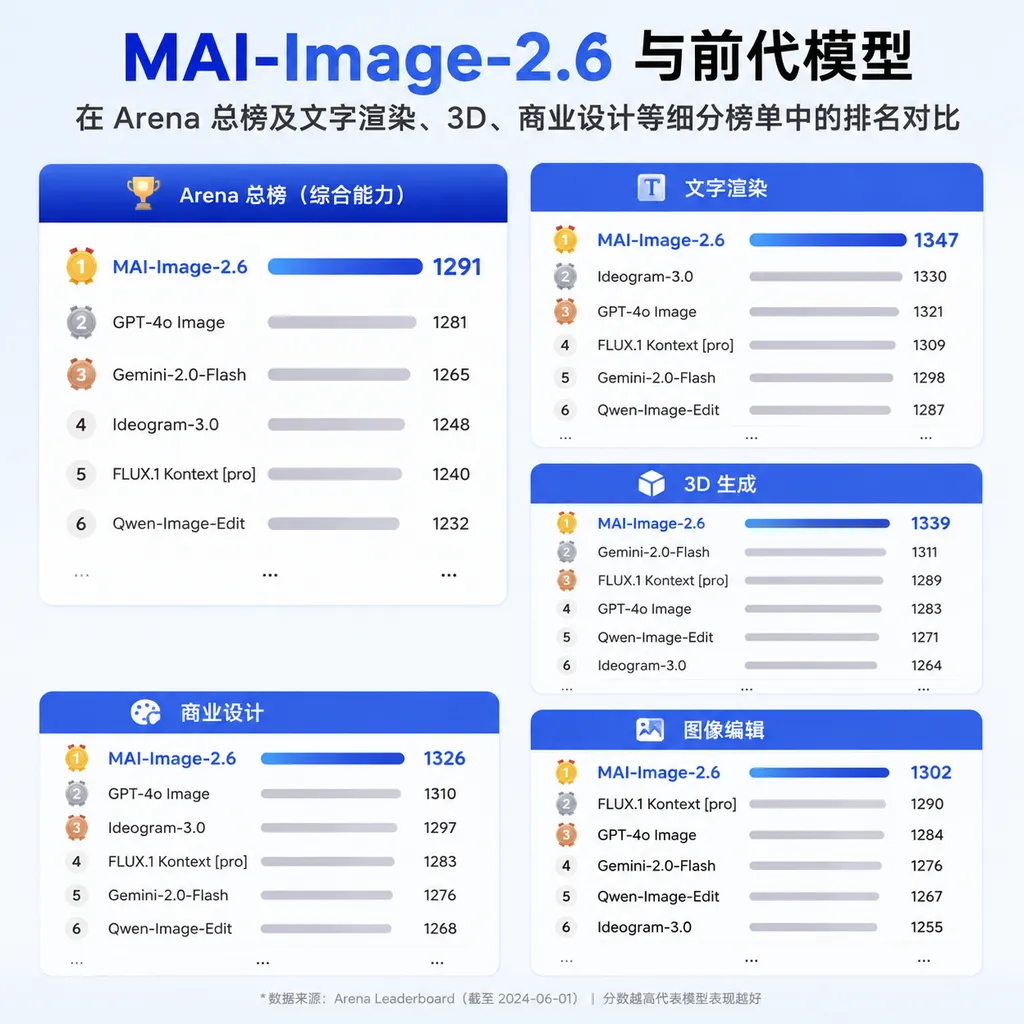
MAI-Image-2.6 has an Elo score of 1,336 on Arena’s text-to-image leaderboard. Compared with version 2.5, the changes can be summarized as follows:
| Category | MAI-Image-2.5 | MAI-Image-2.6 | Change | | --- | ---: | ---: | ---: | | Overall text-to-image ranking | 10th | 2nd | Up 8 places | | Overall Elo | Approx. 1,257 | 1,336 | Up 79 points | | 3D imaging and modeling | 6th | 1st | Up 5 places | | Cartoons, anime, and fantasy | 8th | 2nd | Up 6 places | | Product, branding, and commercial design | 7th | 2nd | Up 5 places | | Text rendering | 8th | 2nd | Up 6 places, with a 91-point Elo increase | | Art category | 4th | 2nd | Up 2 places |
It is important to note that Arena’s Elo score is not an accuracy metric, nor can it simply be interpreted as “quality improved by 79%.” It is based on users’ pairwise preference votes between anonymous model outputs and is closer to measuring “which image most people choose more often.” It can reflect visual appeal, prompt adherence, and overall polish, but it cannot independently prove that the model has improved to the same extent in spelling accuracy, identity preservation, generation speed, or enterprise compliance.
In addition, Arena rankings change continuously as participating models, voting samples, and leaderboard slices are updated. MAI-Image-2.5 entered the top three when it was released, while its predecessor is ranked tenth in the comparison published this time. These results are not necessarily contradictory and are more likely the dynamic outcome of leaderboard updates. Therefore, second place carries significant weight, but it is not a permanent position.
Even so, climbing from tenth to second while improving across multiple category leaderboards is still more persuasive than leading on a single benchmark. At least in current human-preference evaluations, Microsoft has surpassed relevant models from companies such as Meta, Google, and xAI, putting it in a position to compete directly with OpenAI.
Text Is Finally More Than Just “Letter-Like Texture”
The most important upgrade this time is text rendering.
Early image generation models handled text very differently from genuine typesetting engines. Rather than first understanding a sentence and then calling a font system to place the characters, they often generated text as a visual texture within the image. As a result, something might look like a title from a distance, but zooming in would reveal missing or incorrect characters, merged glyphs, or English letters rendered as nonexistent symbols.
This has little impact on ordinary landscape images, but it directly blocks commercial applications. Posters, packaging boxes, beverage-bottle labels, primary e-commerce images, film and television concept posters, and social media ads almost all require text. If even one character in a product name is wrong, the entire image becomes undeliverable.
MAI-Image-2.6’s text-rendering Elo increased by 91 points over its predecessor, moving from eighth to second place. This means users in blind tests showed a significant preference for the images with text that it generated. Combined with Microsoft’s positioning of the model, the new version primarily improves the following areas:
- More accurately mapping copy from prompts to specified regions of an image;
- Maintaining clearer character structures in titles, labels, and packaging surfaces;
- Balancing font size, visual hierarchy, whitespace, and overall layout when handling text;
- Reducing cases where the text is correct but its placement, perspective, or material appearance is inconsistent;
- Preserving more complete visual quality in commercial photography and brand imagery.
This is more difficult than simply making text “readable.” For example, suppose a model is prompted to generate a coffee bag on a wooden table, with the product name on the front and a small roasting description on the side. The model must not only spell the words correctly, but also make the text follow the bag’s perspective and folds while avoiding duplicating the product name in the background. If any aspect of the text, material, spatial relationships, or composition falls apart, the result remains a demo image rather than a design asset.
The value of MAI-Image-2.6 lies precisely in narrowing the gap between an “AI first draft” and “material that can continue to be edited.” It is unlikely to completely replace professional typesetting in Illustrator, Photoshop, or Figma for now, but it could reduce the number of times designers need to reroll generations, repaint local areas, and manually correct text.
First Place in 3D May Have Greater Commercial Value Than Second Overall
MAI-Image-2.6 rose from sixth to first place in the 3D imaging and modeling category, another change that can easily be overshadowed by its overall ranking.
Here, “3D” does not mean that the model can directly output editable three-dimensional assets with topology, materials, and rigs. Instead, it primarily means that the two-dimensional images it generates exhibit a credible sense of three-dimensional structure, including object proportions, spatial relationships, lighting, shadows, perspective, and material rendering. For developers and enterprises, these capabilities are suitable for:
- E-commerce product concepts and virtual displays;
- Scene previsualization for games, animation, film, and television projects;
- Early-stage visual exploration for home furnishings and industrial design;
- Key product visuals in advertising proposals;
- Prototyping promotional materials before physical product photography is complete.
The challenge with product visuals is often not whether the image is “beautiful enough,” but whether its structure is internally consistent. A cup handle cannot inexplicably connect to the background, the three visible faces of a box must follow the same perspective, and metal and frosted plastic should respond differently to the same light source. Microsoft’s first-place ranking in the 3D category suggests that this round of training may have strengthened not only stylistic aesthetics but also the model’s representation of spatial and object relationships.
However, Arena’s results still cannot answer several key questions relevant to production environments: When generating ten images in succession, can the product’s shape remain consistent? Does the logo drift when the viewing angle changes? Will multi-turn editing alter a person’s identity? Can complex Chinese text achieve stability comparable to English? These questions will require further testing with fixed prompts and batch samples once the model is officially available.
Multi-Reference Image Fusion Is Not Aimed at “One-Sentence Image Generation”
In addition to generating images from text, MAI-Image-2.6 supports multi-reference image fusion. Put simply, users can ask the model to simultaneously reference different information from multiple images, such as:
- Preserving the person’s identity from the first image;
- Using the clothing from the second image;
- Adopting the interior space from the third image;
- Reusing the brand colors and photographic style from the fourth image.
A single reference image is more like “modify this based on the image,” while multiple references are closer to breaking different assets down into conditions and having the model recombine them. The challenge is that the model cannot simply create a mechanical collage, nor can it carry over irrelevant elements from the different images. It must understand exactly which part of which image the user is referencing.
Microsoft describes this capability as richer semantic understanding—in other words, establishing more accurate correspondences between concepts in the prompt and regions of the image. For developers, this directly affects whether a workflow is controllable. A truly useful visual model should not require users to redescribe every detail each time. Instead, it should allow them to provide brand assets, character references, product photos, and composition sketches, then clearly specify the intended purpose of each.
This also marks the dividing line between MAI-Image-2.6 and ordinary consumer-grade “rerolling tools”: the latter aim to produce a single stunning image, while the former must reliably complete tasks under clearly defined constraints.
Microsoft’s Iteration Speed Is Already More Noteworthy Than the Leaderboard Itself
Microsoft’s first self-developed text-to-image model, MAI-Image-1, was released in October 2025 and entered Arena’s top ten upon debut. In March 2026, MAI-Image-2 rose to third place. It was followed by version 2.5 and then 2.6, released on August 10.
In less than a year from the first generation to version 2.6, Microsoft has completed multiple major and intermediate version iterations. In particular, the interval between versions 2.5 and 2.6 was very short, yet the update produced a 79-point gain in overall Elo. Compared with the traditional cadence of “holding a launch event every six months,” this looks more like continuous deployment for an internet product: model training, preference data, and product feedback form a rapid closed loop, and even a minor version number may represent a significant leap in capability.
This has two implications for the competitive landscape.
First, Microsoft is reducing its strategic dependence on external image models. As a platform company with Copilot, Bing, PowerPoint, Designer, Windows, and Foundry, Microsoft already has numerous entry points for image generation. Once its first-party model reaches a leading level, the company can simultaneously control the model, inference costs, product form, and enterprise distribution, rather than merely serving as a channel for models from other labs.
Second, Microsoft does not need to win only on the overall leaderboard. A more practical strategy is to optimize the model for the areas its own products need most, such as presentation illustrations, advertising assets, product visuals, brand posters, and controllable editing. MAI-Image-2.6’s rankings in commercial design, text, and 3D correspond precisely to these high-frequency use cases.
Developers Are Still Missing Three Key Pieces of Information
As of August 11, users can already try MAI-Image-2.6 directly in Arena. Microsoft plans to deploy the model to MAI Playground this week, followed by a gradual rollout to Microsoft Foundry and other products.
This means it is currently closer to a public evaluation and product preview than an API that is fully ready for production deployment. Microsoft has not yet fully disclosed several details that matter most to developers:
- API pricing and billing model: Whether pricing will be per image, by resolution, or based on inference resources;
- Latency and throughput: How long high-quality mode will take and whether Flash or Efficient versions will be offered;
- Specific API capabilities: The maximum number of reference images, supported resolutions, output formats, and the design of seed and editing parameters;
- Chinese text performance: Arena’s overall score cannot replace dedicated testing of Simplified Chinese, Traditional Chinese, and mixed Chinese-English layouts;
- Content safety and commercial-use terms: How brand elements, personal likenesses, copyrighted material, and enterprise data will be handled;
- Version stability: Whether results from the same prompt will drift unpredictably after model upgrades.
Therefore, it is not yet appropriate to write integration code based on interface details that have not been announced, nor should developers assume that the model ID and parameter names in Foundry will be identical to those of existing versions. It would be more prudent for developers to evaluate integration costs after the official API goes live. If the model later becomes available through major aggregation platforms, standardizing it to an OpenAI-compatible format would also reduce the engineering cost of multi-model A/B testing and fallbacks.
Verdict: It Is Becoming Useful, but Designers Are Not About to Lose Their Jobs
MAI-Image-2.6 is a significant update for Microsoft in the field of image generation. Its second-place overall ranking demonstrates that its overall visual quality has entered the top tier, while the 91-point increase in text rendering points to clearer production value. For posters, packaging, product images, and brand assets in particular, whether text appears correctly is far more important than adding a little more cinematic flair.
But second place on Arena does not mean second place in production readiness. Human-preference leaderboards are more likely to reward images that look good at first glance, while enterprise workflows demand consistency, reproducibility, local editing, access controls, low latency, and manageable costs. Microsoft has demonstrated the first half of that equation; the second half still depends on the Foundry API, pricing, and real-world stress testing.
A more accurate conclusion is: MAI-Image-2.6 is no longer merely a backup image generation model within Microsoft’s ecosystem, but a candidate worthy of comparative testing against leading models such as GPT Image 2. If it can maintain its current leaderboard performance in Chinese typesetting, multi-turn editing, and batch consistency, Microsoft will have secured more than second place on Arena—it will have gained an entry point into enterprise creative workflows.
References
- IT Home: Microsoft Releases MAI-Image-2.6, Surging to Second Place on Arena’s Text-to-Image Model Leaderboard — Includes the model’s release date, Arena Elo score, category rankings, core capabilities, and rollout plans.