GPT-5.6-Cyber Is Here, but It Vets the Client First

OpenAI has split Daybreak into two tiers, Blue and Red, and introduced GPT-5.6-Cyber in the Red tier. It is not a new API intended for all developers, but a controlled service that exchanges identity verification, task scoping, and auditing mechanisms for stronger cybersecurity capabilities.
OpenAI Adds an “Access Gate” for Cybersecurity Models
At local time on August 10, OpenAI expanded its cybersecurity defense service Daybreak, splitting its access framework into Blue and Red tiers, while also launching a new model specifically for advanced security testing and vulnerability research: GPT-5.6-Cyber.
This model will not be made directly available to all developers like ordinary GPT models. At this stage, GPT-5.6-Cyber is available only to vetted Red customers. Initial partners reportedly include companies such as Accenture, IBM, CrowdStrike, and Cloudflare.
What is truly worth noting is not that OpenAI has released another model with a Cyber suffix, but that it is changing how high-risk models are delivered: instead of relying solely on uniform model refusals, it dynamically enables different capabilities based on customer identity, authorization scope, operating environment, and auditing capacity.
If an ordinary API is like getting a membership card to enter a gym, Daybreak Red is more like entering a biological laboratory: the institution’s qualifications, experimental subjects, scope of operations, and process records all have to be clarified in advance. The model is more capable and subject to fewer restrictions, but the chain of responsibility is also longer.
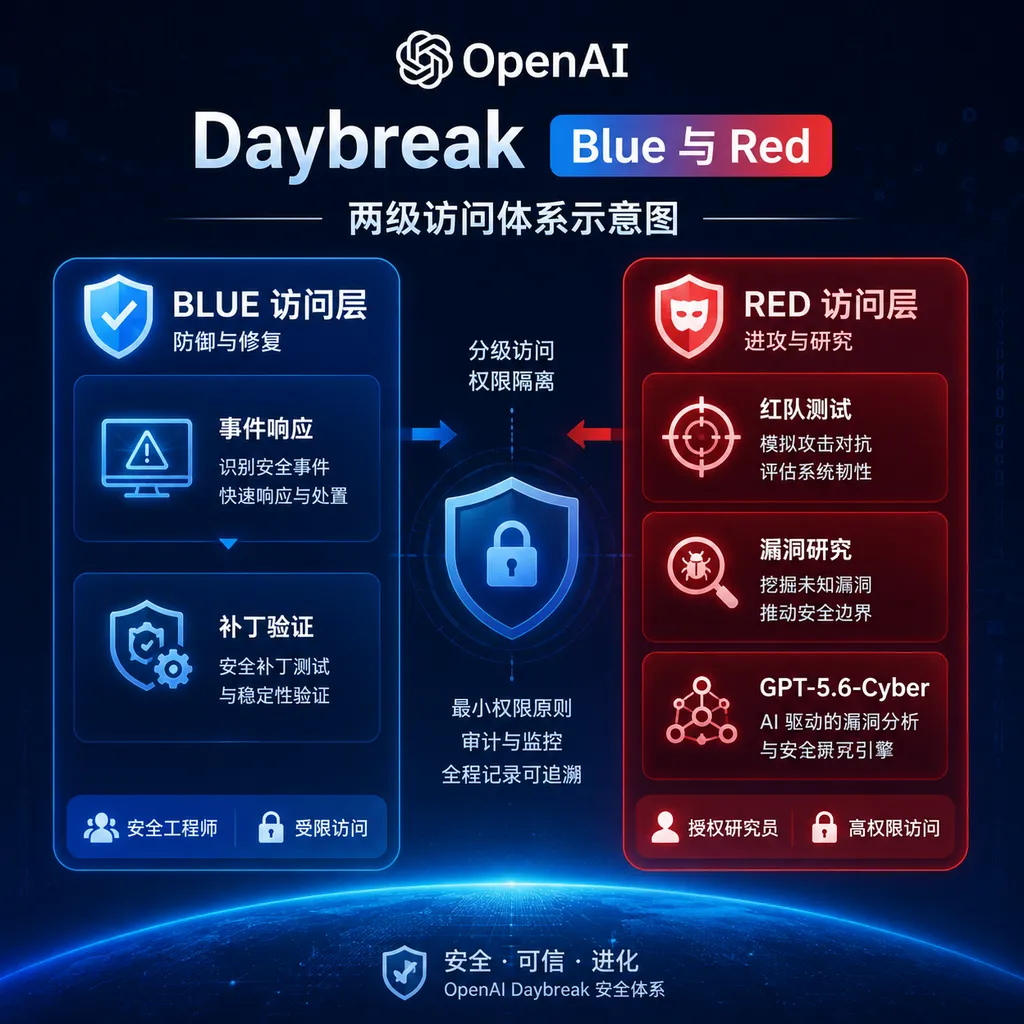
Blue and Red Are More Than Just “Basic” and “Premium”
Judging by the product names, Blue and Red can easily be interpreted as the high and low tiers of a traditional SaaS subscription. But the key difference between them is not price or usage quotas; it is how far the model is permitted to advance a security task.
Blue: Automating Routine Work for Defense Teams First
OpenAI defines Blue as the recommended starting point for most defense personnel. It covers tasks including:
- Security incident response and preliminary investigation;
- Malware analysis;
- Vulnerability discovery, classification, and prioritization;
- Secure code review;
- Detection-rule and remediation-recommendation generation;
- Patch validation and dependency risk analysis.
Although these tasks also involve knowledge of attacks, their primary goals are to understand problems, shorten response times, and complete remediation. For example, the model can read a large code repository and use call relationships to determine whether an input-validation flaw can actually be triggered by external requests. It can also verify in an isolated environment whether a patch has blocked the original attack path.
For enterprise security teams, these capabilities are more useful than “finding another 10,000 suspected vulnerabilities.” The biggest problem with traditional scanners is usually not that they find too little, but that they produce too many results: security teams are overwhelmed by large numbers of duplicate, irreproducible, or context-poor alerts, while genuinely dangerous issues may fail to rise to the top.
Daybreak’s approach is to move the model from being an “alert generator” toward becoming a “remediation workflow agent.” Finding a problem is only the starting point. The subsequent steps include reproduction, severity assessment, patch generation, regression testing, disclosure coordination, and review by code maintainers. The risk is not truly reduced until the patch has entered production.
Red: Bringing the Model Closer to a Real Attack Chain
Red is intended for authorized red teams, security vendors, vulnerability researchers, and penetration-testing teams. It offers a broader scope of access, including:
- Authorized red-team exercises;
- Penetration testing and attack-path validation;
- Vulnerability exploitability research;
- High-risk validation in controlled environments;
- Execution of multi-stage cybersecurity tasks.
This is also the tier where GPT-5.6-Cyber is available.
The boundary between the two tiers can be illustrated by the difference between “understanding a lock” and “actually trying to open it.” Blue can analyze the lock’s structure, identify weak points, and check whether a fix is reliable. Red may go further by generating and executing validation steps to confirm whether an attacker could follow that path to achieve code execution or privilege escalation.
The latter clearly has value for real-world defense, but attackers need these capabilities as well. OpenAI has therefore chosen not to make them broadly available. Instead, it places the model within a trusted-access framework and seeks to reduce misuse through customer verification, task-scope restrictions, logging, and account-level controls.
Where GPT-5.6-Cyber Is Strong
According to information disclosed by OpenAI, GPT-5.6-Cyber is built on GPT-5.6 Sol and has been enhanced for certain specialized cybersecurity tasks. Its focus is not on answering more security-related questions, but on executing longer and more complex task chains that require continuous state maintenance.
The truly difficult part of an autonomous cybersecurity agent is often not writing a particular command, but continuously completing dozens of interdependent steps:
- Identify assets and service boundaries;
- Analyze code, configurations, and the runtime environment;
- Propose multiple vulnerability hypotheses;
- Validate them one by one in an isolated environment;
- Adjust its strategy based on failed results;
- Combine multiple low-risk issues into an attack path;
- Generate reproducible reports and remediation recommendations;
- Verify whether a patch has introduced new regressions.
This is entirely different from an ordinary conversational model generating a block of text in a single response. It is closer to a junior security researcher capable of continuously operating tools, reading feedback, and revising plans.
One long-chain simulation result released by OpenAI showed that GPT-5.6 Sol completed the 32-step “The Last Ones” task in 7 out of 10 attempts, while GPT-5.5 completed it only 2 times. Although this result concerns GPT-5.6 Sol, it explains why GPT-5.6-Cyber was built on Sol: cybersecurity tasks increasingly depend on long-term planning, tool use, and failure recovery, rather than simply recalling knowledge.
In controlled evaluations such as ExploitGym, GPT-5.6-Cyber reportedly outperformed GPT-5.6 Sol and the previous-generation GPT-5.5-Cyber. The evaluation focuses on whether a model can turn a known vulnerability into a functioning validation procedure and achieve code execution in a sandbox. In other words, it tests not whether the model can memorize vulnerability identifiers, but whether it can actually “run” the vulnerability.
However, a specialized model does not win on every metric. In vulnerability discovery and report-writing evaluations, GPT-5.6-Cyber improved over GPT-5.5-Cyber but still scored below the general-purpose GPT-5.6 Sol. One explanation provided by OpenAI is that Cyber model reports are shorter and more focused on execution results, putting them at a disadvantage on some scoring criteria that depend on complete narratives.
This illustrates the real trade-off of vertical models: they may not be better at writing reports, but they may be better at completing high-risk validation tasks. For security teams, these two capabilities usually need to be combined rather than simply replacing a general-purpose model with Cyber.
The Real New Product Is “Capability Tiering”
In the past, OpenAI primarily relied on prompt classifiers, content policies, and model refusals to restrict requests related to cyberattacks. This uniform boundary has created a long-standing contradiction: the stricter it is, the harder it becomes for legitimate defenders to work; the looser it is, the easier it becomes for anonymous attackers to obtain assistance.
For example, the following two types of requests may appear very similar on the surface when both involve analyzing a remote code execution vulnerability:
- An enterprise security team verifying whether a patch works in its own test environment;
- An attacker attempting to compromise an unauthorized production server on the internet.
It is difficult for a model to reliably distinguish between the two based solely on the prompt. Daybreak’s solution is not to continue guessing user intent, but to move the assessment up to the organizational and workflow levels: Who is making the call? Who owns the target assets? Has the task been authorized? Which tools can the model access? Are the execution results recorded?
This represents a shift from “content review” to “identity and context review.”
For developers, high-risk AI APIs may eventually adopt a permission model resembling cloud-platform IAM. A key will no longer inherently possess all the capabilities of a given model; instead, it will also be constrained by organizational identity, projects, target assets, tool permissions, and calling policies. A typical call chain might look like this:
Organization authentication
  -> Project and personnel authorization
  -> Declaration of test targets and time windows
  -> Restriction of network, repository, and tool scope
  -> Model execution
  -> Full logging and anomaly detection
  -> Human approval for high-risk actions
  -> Result archiving and responsibility tracking
This design is more reasonable than simple keyword blocking, but it is also more costly. It requires model providers to do more than offer inference services; they must also take on responsibilities similar to those of a secure cloud platform, including customer vetting, permission governance, and auditing.
Why Release It Now?
The timing of OpenAI’s expansion of Daybreak is not surprising. Over the past year, security researchers have repeatedly observed AI agents being used for automated reconnaissance, bulk creation of fake identities, and the generation of social-engineering content. They have even been used in attempts to attack developer platforms and internet services.
The core risk is not that models have suddenly acquired some form of attack knowledge unknown to humans, but that they are beginning to possess three conditions that were previously difficult to obtain simultaneously:
- Scale: One operator can run a large number of agents in parallel;
- Persistence: Agents can repeatedly attempt a task without becoming fatigued;
- Tool access: Models can call browsers, terminals, code executors, and network-scanning tools.
Even if the success rate of an individual attack is not high, large-scale trial and error can still pose a real threat as long as the marginal cost is low enough. This is why the security industry is shifting from asking “Can AI write phishing emails?” to asking “Can AI independently complete an attack chain?”
Competitive pressure is also a factor. Anthropic previously released Mythos, a model aimed at cybersecurity. By upgrading Daybreak at this point, OpenAI is both responding to the automation of attacks and competing for enterprise security budgets. Security risks do need to be addressed, but they are also being packaged by model companies as a new high-value product line—these two facts are not mutually exclusive.
OpenAI’s advantage is that its models, Codex-style development tools, and enterprise channels can be integrated into the same workflow. Its weakness is that many of its evaluations remain closed; outsiders still find it difficult to independently assess GPT-5.6-Cyber’s false-positive rate, stability, and privilege-escalation risks in real-world complex networks. Particularly while a complete system card and more evaluation details have not yet been fully disclosed, “leading on internal benchmarks” cannot be directly equated with “being capable of replacing a professional red team.”
Can Developers Call It Directly?
The short answer is: Most people cannot.
GPT-5.6-Cyber is not a conventional model that anyone can freely call after registering an account and adding funds. Red access requires an organization to pass a review and accept stricter scope definitions, logging, and account controls. Even after access is granted, the model is more likely to be placed within designated workflows and controlled environments rather than used as an unrestricted chat interface.
Therefore, developers should not currently assume that gpt-5.6-cyber is a publicly available standard model ID in production code, nor should they make it a default dependency. For teams that have obtained authorization from the upstream provider and whose aggregation platform has completed model mapping, the calling method is expected to remain compatible with the OpenAI SDK.
The following code only demonstrates the interface format, and the task is limited to analyzing sanitized internal scan results. The actual model name, permissions, and Base URL should be determined by the console:
import os
from openai import OpenAI

client = OpenAI(
    api_key=os.environ["OPENAI_API_KEY"],
    base_url=os.environ["OPENAI_BASE_URL"]
)

response = client.responses.create(
    model="gpt-5.6-cyber",  # Available only if the account is authorized and the platform has completed the mapping
    input=[
        {
            "role": "system",
            "content": (
                "You are an internal enterprise defense analysis assistant. Analyze only authorized assets. "
                "Do not generate exploitation or persistence steps targeting external systems."
            )
        },
        {
            "role": "user",
            "content": (
                "The following is a sanitized internal SAST result. Determine whether the vulnerability is reachable, "
                "provide a risk priority, remediation recommendations, and a patch-validation checklist.\n\n"
                "<sanitized_findings>...</sanitized_findings>"
            )
        }
    ]
)

print(response.output_text)
OpenAI Hub is compatible with the OpenAI format, making it suitable for switching between different models under the same SDK. However, GPT-5.6-Cyber is a restricted model. Whether it can be connected still depends on OpenAI’s Red qualification review and upstream authorization; an aggregation API cannot be treated as a channel for bypassing access controls.
For teams that cannot yet obtain Red access, a more practical approach is to first use general-purpose models to improve low-risk workflows: code review, vulnerability triage, patch explanation, test-case generation, and security knowledge-base retrieval. These steps typically consume a large amount of security engineers’ time and do not require directly connecting the model to the production network.
GPT-5.6-Cyber Is Useful, but Do Not Treat It as an Automated Hacker
The scenarios most likely to generate value for GPT-5.6-Cyber first are not “one-click penetration tests,” but increasing the validation throughput of professional teams.
For example, a security vendor may receive thousands of vulnerability leads every day. The model can first attempt to reproduce them in a sandbox, filter out issues that cannot be triggered, and then hand samples with genuine attack paths to researchers. Large software companies can also have the model automatically run targeted tests after a patch is submitted, avoiding situations where a fix merely blocks the surface symptoms.
However, it will not eliminate security teams; instead, it will raise the governance requirements for those teams. Once a model can execute tools, organizations must address issues including credential isolation, network egress, data leakage, prompt injection, log retention, and manual termination. Connecting GPT-5.6-Cyber to an enterprise environment is itself a new supply-chain and permission risk.
More importantly, cybersecurity outcomes are highly context-dependent. The same piece of code may pose entirely different risks when placed in an internal service versus a public-facing entry point. The fact that a vulnerability can be reproduced in a test environment does not mean that automated exploit validation should continue in production. Humans need to decide which actions are worth executing and when to stop.
This release can therefore be viewed as a clear industry signal: frontier models have moved beyond the stage of merely “explaining security issues” and are beginning to approach the stage of “continuously executing security tasks.” OpenAI’s use of the two-tier Daybreak Blue and Red framework to accommodate this shift is directionally correct and more responsible than simply releasing a powerful model without restrictions.
But its success will ultimately depend not on how many benchmarks the model can run, but on three more basic questions: Can it reduce false positives? Can it drive patches to actual deployment? And can responsibility be assigned when privilege escalation or operational errors occur?
GPT-5.6-Cyber is a capability upgrade, but Daybreak’s tiered access system is the more important product change. The former determines how deeply the model can act; the latter determines whether those capabilities can enter real enterprise environments without first creating an even larger security problem.
Sources
- ITHome: OpenAI Expands Cybersecurity Defense Service Daybreak and Launches GPT-5.6-Cyber — Introduces the Daybreak Blue and Red tiered access system, the positioning of the new model, and the scope of its initial trusted customers.