Claude’s text comes with an invisible watermark.

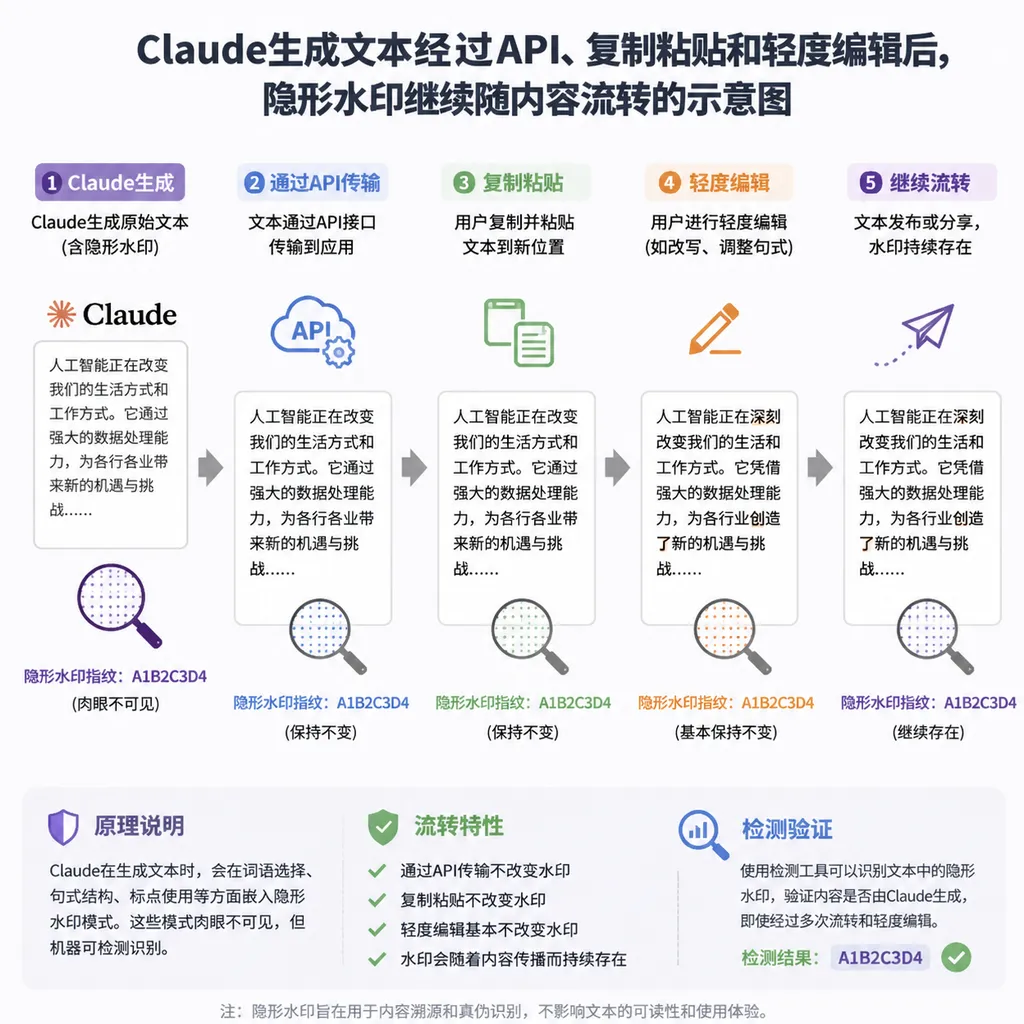
Anthropic has begun embedding machine-detectable invisible watermarks in text generated by the new version of Claude, which may persist even after copy-pasting and minor edits. This can raise the cost of passing off AI-generated content as original, but it is far from a definitive detection tool.
Anthropic Has Given Every Piece of Text Generated by Claude an “Invisible ID”
Anthropic announced on August 10, local time, that text generated by new Claude models will include a machine-detectable invisible watermark. According to its disclosed rollout plan, new Claude models released on or after August 2, 2026, will support this marking capability from the day they launch, while older models are also being gradually adapted.
This is not a logo in the bottom-right corner of a webpage, nor is it ordinary metadata attached to a file. The watermark is embedded directly into the text generated by the model without affecting readability or meaning. The marker may remain even after users copy the content into emails, documents, forums, or code repositories; minor deletions or edits may not necessarily remove it.
More importantly for developers, Anthropic has not limited the feature to the Claude website or the European Union. Based on the information currently available, the watermark applies globally to supported Claude-generated content, including output obtained by calling the model through APIs and cloud service providers. In other words, when an enterprise receives a piece of text from the Claude API and forwards it to downstream systems, the watermark may theoretically be passed along with it.
This update is clearly intended to address the transparency requirements of the EU AI Act, but Anthropic has chosen to roll it out globally. Regulation may take effect in Europe, while the resulting product behavior spreads worldwide. This may become a common way for major model vendors to handle compliance features: rather than maintaining two sets of inference policies, they can simply make the version that meets the stricter requirements the default.
The Watermark Is Not Hidden “Between the Letters,” but More Likely in Generation Probabilities
Anthropic has not yet fully disclosed its watermarking algorithm or detection thresholds, so it would be premature to claim exactly which tokens it modifies. Based on existing approaches to text watermarking, however, it is probably more sophisticated than inserting zero-width characters, special spaces, or invisible Unicode symbols.
Such character-level markers are fragile: copying the text into a plain-text editor, running a formatting cleanup, or even forwarding it through certain messaging apps could strip them out entirely. Since Anthropic emphasizes that the watermark is embedded by the model during generation and may persist after copying, pasting, and partial editing, a more reasonable interpretation is that it leverages the language model’s probability distribution.
Every time a model generates a token, it must choose from a set of candidates. A watermarking system can apply a slight preference to certain candidate tokens without noticeably degrading text quality. In any individual sentence, the words appear entirely normal. Once the text is long enough, however, a statistical pattern gradually emerges. The detector is not checking for “a mysterious character”; it is checking whether the token choices throughout the text conform significantly to a predefined pattern.
You can think of it as flipping a coin. Under normal circumstances, heads and tails each appear roughly half the time. With special controls applied, nothing looks unusual in any single toss. But after hundreds of consecutive tosses, if heads consistently appears more often, there is reason to suspect that the coin has been tampered with.
This method has three direct consequences:
- Copying and pasting generally will not immediately destroy the watermark. The text itself remains unchanged, so the statistical characteristics corresponding to the token sequence remain as well.
- Minor edits may not be enough to remove it. Changing a few words only weakens part of the signal and may not return the entire passage to a normal distribution.
- Short text is harder to assess. A single headline or a reply only a few words long usually does not provide enough samples for stable detection results.
However, until Anthropic publishes more complete technical documentation, the above should be treated only as a technical explanation of how text watermarking may work, not as a substitute for an official implementation description. Chinese tokenization, multilingual text, code blocks, tables, and structured JSON in particular may use different marking strengths or detection methods.
API Output Is Covered Too, So Developers Need to Focus on the Data Pipeline
For developers integrating Claude, this update is unlikely to change the request and response structure of OpenAI-compatible APIs. The watermark is not an additional watermark: true field; it is already incorporated into the generated output itself. Existing clients generally do not need code changes to “preserve the watermark.”
When calling Claude through platforms such as OpenAI Hub that support the OpenAI format, requests will still look similar to the following. The actual model name should be based on the platform’s current model list:
curl https://<YOUR_API_BASE>/v1/chat/completions \
  -H "Authorization: Bearer $OPENAI_API_KEY" \
  -H "Content-Type: application/json" \
  -d '{
    "model": "<SUPPORTED_CLAUDE_MODEL_ID>",
    "messages": [
      {
        "role": "user",
        "content": "Explain hybrid search in vector databases in three paragraphs."
      }
    ],
    "temperature": 0.7
  }'
If an intermediary simply forwards the text returned by Claude without modification, the watermark should not theoretically disappear merely because the API gateway has changed. However, the situation is different if the business pipeline performs secondary generation, translation, summarization, template-based rewriting, or multi-model composition.
For example, a content production system might follow this workflow:
- Claude generates an initial draft;
- A rules engine removes redundant paragraphs;
- Another model rewrites the tone;
- A translation model produces an English version;
- A human editor adds interview material;
- A CMS recombines the headline, introduction, and body text.
By the final step, traces of the Claude watermark may still remain, or it may no longer be reliably detectable. The issue is not whether Claude was involved in producing the content, but how extensively the original token distribution has been altered.
Enterprises therefore cannot treat watermarks as a substitute for data lineage systems. Teams that genuinely need to audit the generation process should still retain the model name, version, request time, prompt summary, response hash, human editing history, and content publication records. Watermarks are useful as external clues; logs are the internal evidence.
Useful for Schools and Publishers, but Not Grounds for an Immediate “Conviction”
Claude watermarks are most likely to be adopted by schools, publishers, content platforms, and recruiting teams. In the past, these institutions mainly relied on so-called AI detectors: they would submit an article and receive a “probability that it was generated by AI.” Such detectors are essentially guessing based on writing style. They can misclassify polished human writing as AI-generated and may also fail to detect model output that has undergone basic editing.
A watermark proactively embedded by the model provider is, in principle, more reliable than having a third party infer the source from writing style. At the very least, the detector is no longer asking only, “Does this passage sound as though it was written by AI?” Instead, it is searching for a statistical signal intentionally left behind during generation.
This is particularly important for the publishing industry. Several recent controversies involving books have already shown that suspecting an author of using AI based solely on writing style can quickly escalate into copyright, representation, and reputational risks. The novel Call Me, I’ll Hide the Body previously attracted bids from 14 publishers, but questions about AI use later led the author’s agency to withdraw representation; author Jerry Falade denied using AI. Hachette also withdrew Shy Girl after it was alleged to contain AI-generated content, while author Mia Ballard said the content came from a freelance editor who had not clearly informed her.
A watermark can provide investigators with an additional technical clue, but it cannot automatically determine responsibility.
The reason is simple: detecting a Claude watermark does not mean that the entire work was ghostwritten by Claude, much less that the person who submitted it acted deceptively. An author may have used Claude only to proofread grammar or translate a quotation, or an editor may have added model-generated content without the author’s knowledge. Any of these actions could introduce a watermark into the final text.
Conversely, failing to detect a watermark does not prove that an article was written entirely by a human. Extensive rewriting, cross-language translation, mixing with other content, or having another model rephrase the text could all disrupt the original statistical characteristics. Outputs from older models, models from other vendors, and systems without watermarking enabled would likewise not be covered by Claude’s detection tools.
A more prudent approach would therefore be to:
- Treat detection results as the starting point of an investigation, not a final verdict;
- Also review version histories, drafts, cited sources, and editing records;
- Clearly distinguish among “AI-assisted,” “partially generated,” and “entirely ghostwritten” content;
- Provide those being assessed with channels for explanation and review;
- Avoid directly accusing someone of academic misconduct or copyright fraud based on a percentage presented without context.
If schools integrate watermark detection into automated disciplinary systems, or publishers treat a single positive result as grounds for terminating a contract, a technology originally intended to improve transparency could instead create new false accusations.
The Biggest Question Is Not Whether It Can Be Bypassed, but Who Can Detect It
Anthropic says it plans to make watermark detection tools available to third parties in the future. This step is more consequential than embedding the watermark itself.
If Anthropic alone controls the detector, publishers, schools, and platforms will have to upload the text they want checked. This immediately raises privacy and trade-secret concerns: is it appropriate to send unpublished manuscripts, student papers, internal corporate documents, or legal materials to a model vendor? How long will detection requests and results be retained? Can the detector be deployed privately? Can third parties audit its false-positive rate?
If the detection tool is made broadly available, another problem emerges: attackers could repeatedly modify text and run it through the detector until the result changes from positive to negative. This would effectively give evaders a real-time tuning instrument. Striking a balance between open verification and resistance to adversarial attacks is an unavoidable challenge for every watermarking system.
A more practical approach may be tiered access: ordinary users receive a limited number of online checks, schools and publishers gain access to authenticated APIs for batch queries, and regulators or research teams receive offline tools and more detailed confidence data. All these arrangements, however, will depend on how Anthropic designs its access controls, pricing, and privacy policies.
Another easily overlooked issue is that if watermarks from different model vendors are incompatible, content platforms will ultimately have to integrate detectors for Claude, Gemini, GPT, and many other models simultaneously. Each will have its own thresholds, versions, and interfaces, creating substantial management overhead. What the industry truly needs is not a dozen proprietary “counterfeit detectors,” but interoperable, auditable standards.
Anthropic Is Not the First, but the Scope of This Rollout Deserves More Attention
Google DeepMind was already using SynthID in 2024 for text and video generated by Gemini, having previously provided watermarking for AI-generated images as well. Anthropic is not the first major AI lab to implement text watermarking.
Claude’s update is nevertheless important—not because the technical concept is new, but because of its scope. It is not limited to consumer products; it extends to API and cloud-service calls and is being deployed globally. Claude is already widely used in writing tools, coding assistants, enterprise knowledge bases, and automated agents, which means the watermark will enter more content through real-world production pipelines.
For ordinary users, it will be almost invisible. For developers and content organizations, it may gradually become a new piece of infrastructure.
Our assessment is that Claude’s invisible watermark is useful, but for now it is more like a smoke detector than forensic-grade DNA testing. It can raise the cost of copying AI-generated text wholesale at scale and provide publishers and educational institutions with a more reliable signal than stylistic guesswork. However, it will still weaken when content is translated, rewritten, processed by multiple models, or combined with human writing, and it cannot independently answer who used AI, when they used it, or how.
What is truly worth watching is not whether “Claude watermark removal tutorials” will quickly appear online—they almost certainly will—but whether Anthropic can provide transparent information on false-positive rates, cross-language performance, minimum detectable length, version compatibility, and appeal mechanisms.
The value of a watermark ultimately depends not on how invisible it is, but on whether its detection results can be interpreted responsibly.
References
- ITHome: Anthropic to Add Invisible Watermarks to Claude-Generated Text—An overview of the coverage of Claude’s new text watermark, its ability to survive copying and pasting, its limitations, and the background of the EU AI Act.