
Google releases Gemini 3.1 Flash TTS: control AI speech style with tags
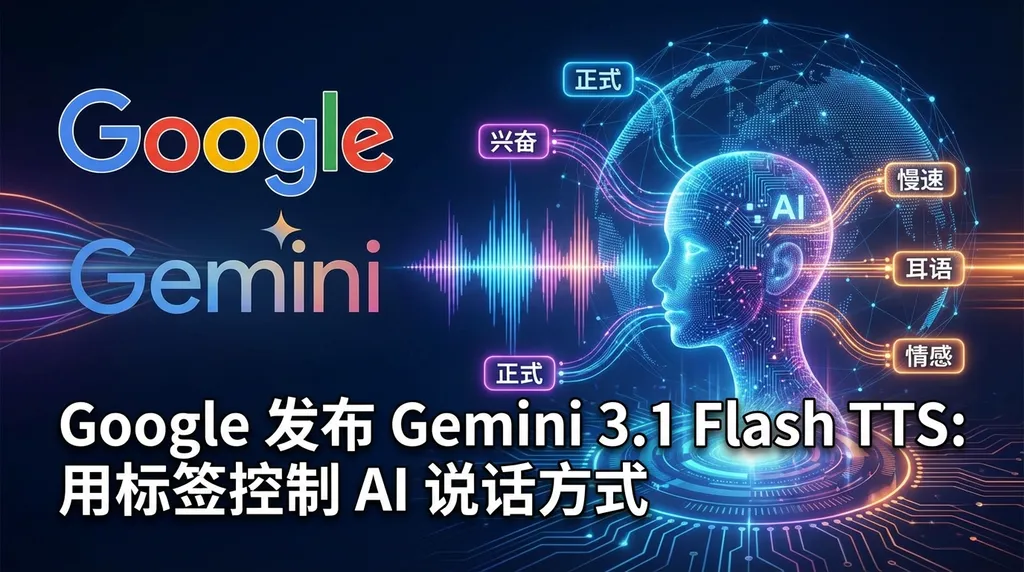
Google launches the Gemini 3.1 Flash TTS speech generation model, enabling precise control over speech rate, pitch, and emotion through fine-grained audio labeling, complementing the previously released Flash Live real-time dialogue model.
Google Releases Gemini 3.1 Flash TTS: Control AI Speaking Style with Tags
Today (April 15, 2026), Google announced Gemini 3.1 Flash TTS, a model specifically designed for speech generation. The biggest difference between this and other TTS models on the market is that it introduces a granular audio tags system, allowing developers to precisely control how generated speech is expressed—not just choosing a voice, but specifying speed, pitch, emotional intensity, and even pauses.
The timing of this release is noteworthy. A month ago (March 26), Google launched Gemini 3.1 Flash Live, a real-time voice conversation model focusing on low latency and native audio processing. Now Flash TTS completes the lineup, clearly distinguishing the two models: Live is for real-time interaction, while TTS is for voice generation requiring precision. One “understands and responds quickly to you,” while the other “reads text the way you specify.”
Audio Tag System: Making Speech Generation Programmable
The core of Gemini 3.1 Flash TTS is its tag system. Traditional TTS models typically provide preset voice styles such as “professional,” “friendly,” or “serious.” Flash TTS, however, treats voice generation like API parameter control.
Specifically, you can use tags to adjust:
- Speaking rate – not just fast or slow, but controlling rhythm at the sentence level
- Pitch – manipulate rises and falls in intonation to express questions, emphasis, or emotions
- Emotion intensity – smoothly tune from neutral statements to passionate expressions
- Pauses – insert stops at specific points to control breathing and phrasing
- Emphasis – mark words or phrases to highlight
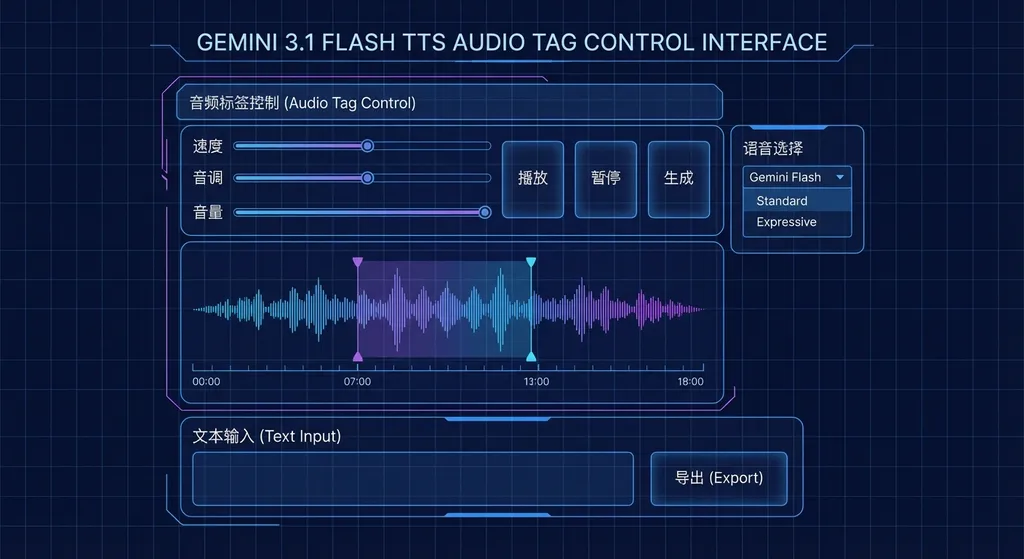
Where’s the practical value of this system? Here are some examples:
Audiobooks and podcasts: Adjust tone according to emotional content—steady pace for narration, faster speech and more pitch variation for dialogue, lower pitch and slower speed for suspense. These details used to require human voice actors or tedious parameter tuning; now they can be marked directly in the text.
Customer service and voice assistants: Different situations require different speaking styles—use a calm tone for handling complaints, a faster and more upbeat one for promotions, or slower speech with pauses for complex explanations. Previously you needed multiple models or voices; now one model can do it all.
Educational content: When explaining math problems, add emphasis and pauses at key steps; when reading texts aloud, adjust tone according to punctuation and context. Compared to traditional TTS’s robotic uniform pacing, this improves learning experience significantly.
Technical Implementation: How Tags Affect Generation
Google hasn’t disclosed Flash TTS’s full architecture, but insights from Flash Live and related design suggest some possibilities.
Flash Live uses a “native audio processing” architecture—audio goes in, audio comes out, with no intermediate text conversion. Flash TTS likely reverses that pathway: text plus tags in, audio waveform out.
Traditional TTS workflows go: text → phoneme sequence → prosody prediction → acoustic features → audio waveform. Each step is a separate model, so tag information can get lost along the way. If Flash TTS is truly end-to-end, tags remain influential throughout the generation process.
The advantage: more precise control. The drawback: harder training. You need large datasets with high-quality tag annotations. Google has the advantage here—YouTube’s abundance of captioned videos and huge amounts of Google Assistant and Search voice data provide rich training sources.
Relationship with Flash Live: Complementary, Not Replacement
You might wonder: since Flash Live already generates speech in real time, why make a separate TTS model?
It’s all about use cases. Flash Live emphasizes speed and naturalness, with latency below 300 ms, full-duplex conversations, and interruptions support. However, because its generation is real-time streaming, it can’t precisely control every nuance—just like in real conversation, you adjust general style but can’t plan each word’s pitch ahead.
Flash TTS, by contrast, is meticulous. It doesn’t need instant response, can spend time producing high-quality audio, and supports detailed tag control. Ideal for content creation, where you have full scripts and know the desired effect.
The technical comparison illustrates the distinction:
| Feature | Flash Live | Flash TTS | |----------|-------------|-----------| | Latency | <300 ms | Not disclosed (non-real-time) | | Input | Audio + Text + Image + Video | Text + Tags | | Output | Audio + Text (streaming) | Audio (complete) | | Context window | 128K tokens | Not disclosed | | Control granularity | Overall style | Fine-grained tags | | Typical scenarios | Real-time dialogue, customer service | Content creation, dubbing |
Strategically, Google is covering the two major directions in voice AI—real-time interaction and content generation. OpenAI’s Realtime API and TTS API follow a similar model, but Google places both under the Gemini 3.1 Flash brand, emphasizing a shared technology stack with different variants.
Industry Comparison: Controllability as the New Battleground
Competition in voice generation has shifted. In 2023–2024 it was all about “realism”—companies like ElevenLabs, Play.ht, and Resemble AI chased human-like sound quality. Since 2025, focus has moved to “control precision.”
OpenAI’s TTS API offers six voices and speed adjustment but lacks fine-grained control. ElevenLabs adds “stability” and “similarity boost” parameters, but those are global settings, not sentence-level.
Amazon Polly provides SSML (Speech Synthesis Markup Language) for tag-based control, similar in approach to Flash TTS. But Polly’s older architecture limits accuracy and naturalness.
Flash TTS’s advantage is native tag integration—end-to-end modeling where control parameters are core, not bolted on later. This means tags co-optimize with audio generation, potentially yielding better results.
Another model to watch: xAI’s Grok TTS. According to March’s announcements, it also supports emotion and style control, though details remain unclear. Given xAI’s multimodal investments, they likely pursue end-to-end design too.
API Integration: How to Use Flash TTS
Google hasn’t released Flash TTS API docs yet, but likely it will follow Flash Live’s method. Flash Live is accessed via Gemini Live API in Google AI Studio, so Flash TTS may come through the same channel.
If the API resembles OpenAI’s TTS structure, the call might look like this:
import openai

# Call Gemini 3.1 Flash TTS via OpenAI Hub
client = openai.OpenAI(
    api_key="your-openai-hub-key",
    base_url="https://api.openai-hub.net/v1"
)

response = client.audio.speech.create(
    model="gemini-3.1-flash-tts",
    voice="nova",
    input="Welcome to Gemini Flash TTS. <rate speed='slow'>This sentence will be spoken slowly.</rate><pitch level='high'>This one will have a higher pitch.</pitch>",
    response_format="mp3"
)

response.stream_to_file("output.mp3")
The tag syntax might follow SSML standards or use Google’s own design. Crucially, it should support nesting and combinations, e.g., simultaneously adjusting rate and pitch:
<speak>
  This sentence uses normal speed.
  <prosody rate="slow" pitch="+2st">
    This one is slower and two semitones higher.
  </prosody>
  <emphasis level="strong">This sentence needs emphasis.</emphasis>
  <break time="500ms"/>
  Continue after a half-second pause.
</speak>
Once Google officially releases the API, it will likely be callable via OpenAI Hub’s compatible interface.
Practical Challenges
While tag control sounds appealing, real-world usage presents challenges.
Learning cost of tag design – To get the most from Flash TTS, you need to understand tag effects and when to use certain parameters. It’s more like audio editing than voice selection—non-audio-savvy developers may need time to master it.
Ideally, Google will offer preset templates like “news broadcast,” “storytelling,” or “customer dialogue,” so developers can start from examples and fine-tune afterward.
Tag conflicts and priority – When multiple tags overlap, which takes precedence? For instance, a parent tag sets slow speed, but an inner one is fast—how is that resolved? Clear documentation and rules will be crucial.
Generation stability – End-to-end models can be sensitive: small input changes causing big output differences. Poor tag settings might produce unnatural pauses, abrupt pitch shifts, or inconsistent emotion. Extensive testing and tuning will be needed.
Cost and latency – Precision often means higher compute costs. Flash TTS’s pricing isn’t known yet, but OpenAI TTS offers HD quality at $15 per 1M characters, producing one minute of audio in 5–10 s. With more complex tag processing, Flash TTS may be pricier and slower.
What This Release Shows
Flash TTS highlights several ongoing trends:
Voice AI is shifting from “usable” to “refined.” Early TTS solved “can it sound natural?”—now the focus is “can it be precisely controlled?” Analogous to image generation: early Stable Diffusion could just create pictures; now we have tools like ControlNet, LoRA, and inpainting for precision.
End-to-end architecture is becoming mainstream. Flash Live and Flash TTS both emphasize direct audio handling, skipping text intermediates. Traditional pipeline setups (ASR + LLM + TTS) have latency and information-loss issues. Future models will increasingly unify steps into a single system.
Multimodal specialization. Gemini 3.1 Flash now has three variants: standard (text + image + video), Live (real-time speech dialogue), and TTS (controllable speech generation). This shows that even one base model benefits from scenario-specific optimization—general and specialized models will coexist.
Google’s comprehensive move into voice AI. From Flash Live to Flash TTS to Gemini Live production releases, Google is pushing aggressively into voice AI. It directly competes with OpenAI’s Realtime API, xAI’s Grok TTS, and NVIDIA’s Nemotron VoiceChat. Voice AI capability is becoming a core requirement for large-model platforms, not an optional feature.
For developers, Flash TTS opens a new option: if your application demands fine-grained speech control rather than simple text reading, this model is worth exploring. But effective use requires time spent understanding the tag system, testing parameters, and adjusting per use case.
Once Google provides official API and pricing, its market competitiveness will become clearer. For now, one thing is certain—the voice-generation field has gained another strong contender, and one with a distinctive edge.
References
This article primarily references Google DeepMind’s official blog and related technical documentation from overseas sources; no domestic mirror links are currently available. Technical details and data come from Google’s official materials and publicly available industry information.


