Gemini 3.7 Flash Appears in the SDK
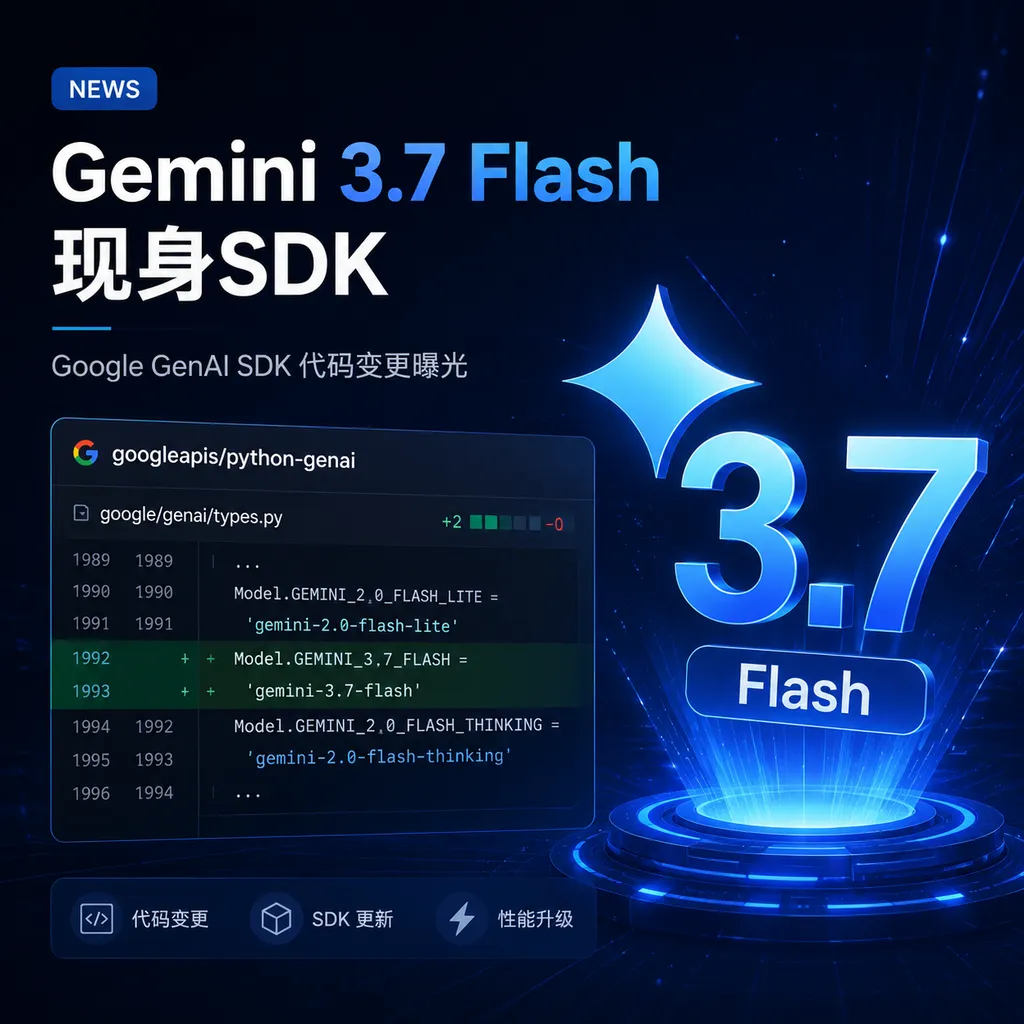
Just 21 days after the release of Gemini 3.6 Flash, the 3.7 Flash model name briefly appeared in the Google Python GenAI SDK’s public synchronization workflow. This looks more like a premature exposure of release preparations, but several hurdles remain before it becomes officially available.
Gemini 3.7 Flash Appears in SDK, Suggesting Google May Be Accelerating Its Release Schedule
Google’s next low-latency model may arrive sooner than expected.
On August 10, tech outlet TestingCatalog discovered that Google insiders had attempted to add a model named gemini-3.7-flash to the Python GenAI SDK and synchronize the change to the public GitHub repository via Copybara. The change was ultimately rejected and closed because of a model naming issue, but this yet-to-be-released model name has already left a trace in the public development workflow.
As of today, August 11, Google’s official Gemini API model catalog and changelog still primarily feature Gemini 3.6 Flash, released on July 21. Gemini 3.7 Flash has not been announced, nor has Google disclosed its pricing, context window, rate limits, regional availability, or official launch date.
In other words: Gemini 3.7 Flash very likely exists, but a single code synchronization record should not be equated with a product release.
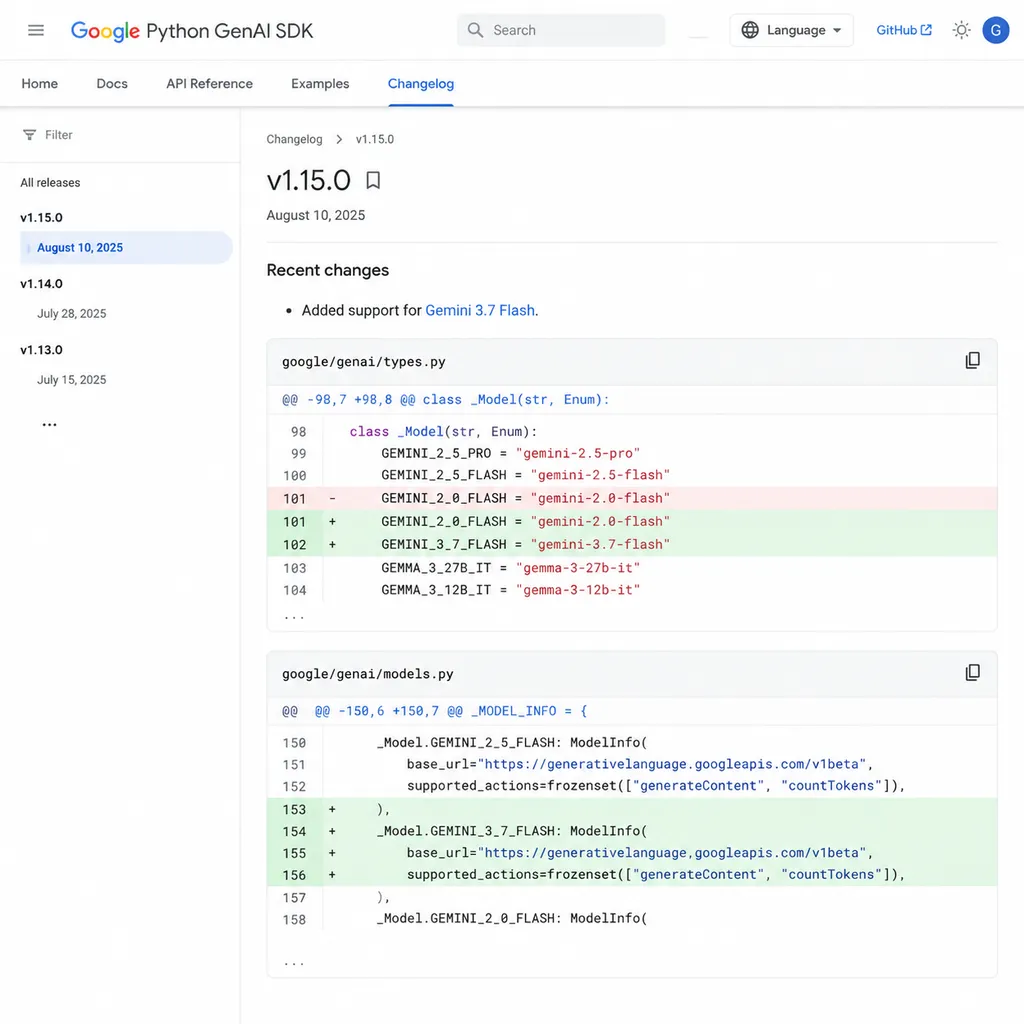
Why a Failed Sync Is Worth Watching
The key to this discovery is not merely the string gemini-3.7-flash, but where and how it appeared.
Google uses Copybara to synchronize code between internal codebases and public repositories. It can transform and sanitize changes from internal development branches before submitting them to GitHub, reducing the cost of manually maintaining two separate codebases. For large technology companies, tools like this effectively serve as a conveyor belt between internal R&D systems and the open-source world.
As a result, a model name entering the Copybara synchronization process generally means that it has reached at least some stage of development or integration, rather than being a placeholder casually guessed by someone online. Possible stages include:
- The SDK team adding the model identifier in advance;
- Documentation or sample code being prepared for release;
- Automated tests beginning to validate model routing;
- An internal preview being prepared for selected projects;
- The official name not yet being finalized, causing the public sync to be blocked.
However, the limits of this evidence are also clear. The change was rejected and closed, meaning it never became a functional part of the public SDK. The reported “naming error” could indicate a typo, an incorrect version number, or a noncompliant registration format—but it could also mean that the final product will not use this name at all.
Developers should not hard-code gemini-3.7-flash into production systems based on this information. If calls fail today, that does not necessarily mean the account lacks permission. Likewise, if an endpoint happens to accept the string in the future, that does not mean the model comes with any stability guarantees.
Many models have appeared in SDK enums, static web assets, cloud console configurations, or client-side code before their official launches. These traces can show that a vendor is “working on something,” but they cannot accurately answer “when will it be released?” A model may still be renamed, delayed, or even absorbed into another product line at the final stage.
3.6 Flash Was Released Just 21 Days Ago—An Unusually Fast Pace
Gemini 3.6 Flash was released on July 21, only 21 days before this discovery. Given the Flash series’ historically rapid iteration cycle of roughly two months, the appearance of 3.7 this early is unusual.
There are two possible explanations.
The first is routine advance preparation. SDK, documentation, billing, and cloud routing work cannot wait until model training is fully complete. Google may simply be preparing clients and infrastructure to recognize the new model, while the actual release remains scheduled for the next cycle.
The second possibility is more noteworthy: Google may be shortening the upgrade cycle for the Flash product line.
Flash is not a flagship model designed primarily to showcase top benchmark scores. It is intended for high-concurrency, low-cost, and low-latency workloads. Customer-service classification, search summarization, code completion, structured extraction, agent tool calls, and batch processing of videos or documents all place greater emphasis on cost per million tokens, time to first token, and throughput than on gaining a few extra points on the most difficult reasoning benchmarks.
This is also where competition among proprietary models has recently been most intense. In production systems, developers generally do not pursue the “smartest” model at any cost. Instead, they look for the cheapest, fastest, and most stable model that clears their quality threshold. Flagship models determine brand visibility; products like Flash determine API usage volume.
If 3.7 Flash launches soon, it would suggest that Google may not intend for 3.6 to remain in place for a full conventional iteration cycle. Instead, it may be pursuing more frequent minor releases to continuously refine capabilities. The version change from 3.6 to 3.7 also looks more like a moderate update than a complete overhaul of the architecture and product positioning.
What Really Matters Is Not the Version Number, but These Four Metrics
There is currently no official technical report, so any specific parameters would be speculative. Rather than predicting how many points 3.7 Flash might gain on a particular benchmark, it is more useful to examine whether it addresses several core production issues facing the Flash series.
1. More Reliable Tool Calling
Many agent failures today do not occur because the model is completely incapable of reasoning. Instead, they result from missing parameters, malformed JSON, incorrect tool selection, or lost state across multiple turns.
For a system executing tens of thousands of tasks per minute, improving the function-calling success rate from 96% to 98% may deliver more value than gaining five points on an academic benchmark. Failed requests require retries, and retries increase latency, token consumption, and pressure on downstream services.
Google’s latest GenAI SDK has brought automatic function calling, code execution, and search grounding into a more unified interface design. For 3.7 Flash to become meaningfully competitive, it should further improve consistency in multi-tool orchestration rather than merely make ordinary question answering more fluent.
2. Balancing Reasoning Capability and Latency
The Flash series faces a long-standing tension: users want it to be as fast as a lightweight model while performing like a flagship model on complex tasks.
The most practical solution is not to use lengthy reasoning chains by default, but to let the model dynamically allocate compute according to task difficulty. Simple classification tasks should return immediately, while code debugging and multi-constraint planning can receive a larger reasoning budget. This prevents every request from paying the latency cost required by a small number of difficult cases.
If 3.7 Flash introduces more granular reasoning controls, developers should focus on two questions: whether output quality remains stable when the reasoning budget is reduced or disabled, and whether tail latency remains acceptable when reasoning is enabled.
3. Unit Cost of Multimodal Inputs
Gemini’s differentiating advantages have always included long context and native multimodality, but supporting images, audio, and video does not necessarily mean that the model is suitable for processing them at scale.
What enterprises truly care about is how much it costs to process an hour of video, whether long-document caches can be reused, whether batch processing receives discounts, and whether the same task triggers rate limits under peak concurrency. If 3.7 Flash merely raises multimodal limits, its impact will be limited. If it also reduces the effective token cost of vision, audio, and video, it could change application architectures.
4. Predictability of Structured Outputs
For consumer-facing chat products, occasionally phrasing an answer differently is usually not a major issue. For backend services that write to databases or trigger workflows, a change in fields can cause an incident.
When a new model is released, teams often switch traffic after testing only a handful of prompts, only to run into problems involving enum values, null fields, or extremely long inputs. Whether 3.7 Flash can follow schemas more strictly—and whether it maintains behavioral compatibility after an upgrade—should be a key part of the evaluation.
Developers Should Not Rush Ahead—They Should Improve Their Switching Mechanisms
Because Google has not officially released 3.7 Flash, there are currently no reliable API parameters to validate, and it would be inappropriate to provide invocation examples. A more practical form of preparation is to decouple model versions from application code.
The following is a conceptual deployment configuration. It does not represent official Google fields or confirm that the model name is available:
model_routing:
  primary: gemini-3.6-flash
  candidate: null
  fallback: stable-model
  allow_unannounced_models: false

rollout:
  shadow_traffic_percent: 0
  canary_traffic_percent: 0
  rollback_on_error_rate_increase: true
Once 3.7 Flash officially appears in the model catalog, it should first be introduced as a candidate model through shadow traffic rather than immediately replacing the primary production model. A cautious process should include at least the following:
- Establish a baseline with a pinned version. Do not rely solely on aliases that may change automatically; retain reproducible test results from the previous version.
- Replay real requests. Public benchmarks cannot cover internal enterprise terminology, tool parameters, or messy data.
- Track quality and cost separately. Changes in average output length can produce different bills even when two models have the same listed price.
- Monitor P95 and P99 latency. Average response times can easily conceal tail-latency problems during peak periods.
- Prepare automatic rollback. This is especially important when structured-output failure rates, content-safety block rates, or tool-calling error rates become abnormal.
- Check quotas and regions. A model release does not mean that it is simultaneously available to every project, region, and account tier.
Teams that manage models from multiple vendors through an OpenAI-compatible layer or an aggregation platform such as OpenAI Hub should likewise wait until the model officially enters the available-model list before switching. Aggregation interfaces can reduce SDK migration costs, but they cannot replace model-level regression testing. Changing a model name is easy; output behavior does not automatically become compatible as a result.
3.7 Flash May Launch Early, but That Does Not Mean “Tomorrow”
Based on the available information, Gemini 3.7 Flash is likely in an early preparation or internal testing stage. The appearance of the model name in the Python GenAI SDK synchronization pipeline is more credible than a mere social-media rumor. However, the change was not merged, and the official model catalog, API changelog, and product announcements have not been updated accordingly. The evidence is therefore insufficient to confirm a release date.
Our assessment is that this leak looks more like an early glimpse of the release pipeline than an official launch that was later withdrawn.
If Google follows its previous cadence of roughly two months, 3.7 Flash could still enter preview or general availability in the coming weeks. If competitive pressure prompts Google to shorten the cycle, an earlier release is also possible. However, until pricing, context limits, tool capabilities, and service levels are clearly defined, an “early launch” has little practical significance for production developers.
There are three signals truly worth watching: 3.7 appearing in the official model catalog, the Gemini API changelog providing an availability date, and Vertex AI or Google AI Studio beginning to return the model for real projects. At least one of these must occur before the model moves from a code trace to a testable stage.
For now, developers can prepare evaluation datasets and staged-rollout mechanisms, but there is no need to modify code around a model ID that is not yet active. Flash’s value has never depended on how quickly its name changes. What matters is whether it can reliably take over tasks that previously had to be assigned to flagship models, at a lower cost.
References
- ITHome: Traces of Google’s Gemini 3.7 Flash AI Model Surface Less Than a Month After the Release of 3.6 Flash—Summarizes the appearance of the model name in the public synchronization workflow for Google’s Python GenAI SDK, the closure of the change, and the fact that the model has not yet been officially released.