Claude Pushes the Riemann Lower Bound to 67.2%

Anthropic says an unreleased research version of Claude has raised the lower bound on the proportion of zeros of the Riemann zeta function that lie on the critical line from 41.6% to 67.2%. It does not prove the Riemann hypothesis, but it may set a new record in an area of analytic number theory that has seen little progress for decades.
Claude Didn’t Solve the Riemann Hypothesis, but It Pushed the Boundary Forward Significantly
Anthropic announced today (August 11) that an unreleased research version of Claude has made progress on a problem related to the Riemann hypothesis: it raised the lower bound on the proportion of nontrivial zeros of the Riemann zeta function that lie on the critical line from approximately 41.6% to 67.2%.
First, let’s clarify the point most likely to be misunderstood: Claude did not prove the Riemann hypothesis, nor did it claim the $1 million prize.
The Riemann hypothesis requires proving that all nontrivial zeros lie on the critical line with real part 1/2, meaning the target must be 100%. Claude’s result is closer to saying that even if we cannot yet prove this for “all” of them, we can now prove that at least 67.2% lie on the line.
Using simplified notation, if N(T) is the total number of nontrivial zeros up to height T, and N₀(T) is the number of those zeros lying on the critical line, the new result claims to advance the provable asymptotic lower bound to:
lim inf  N₀(T) / N(T)  ≥  0.672
          T → ∞
This is not a “hit rate” obtained by computationally scanning a finite number of zeros, but an analytic lower bound that applies in the infinite limit. The significance of the two is entirely different: the former can be achieved through brute-force computation, while the latter requires a mathematical argument that holds in general.
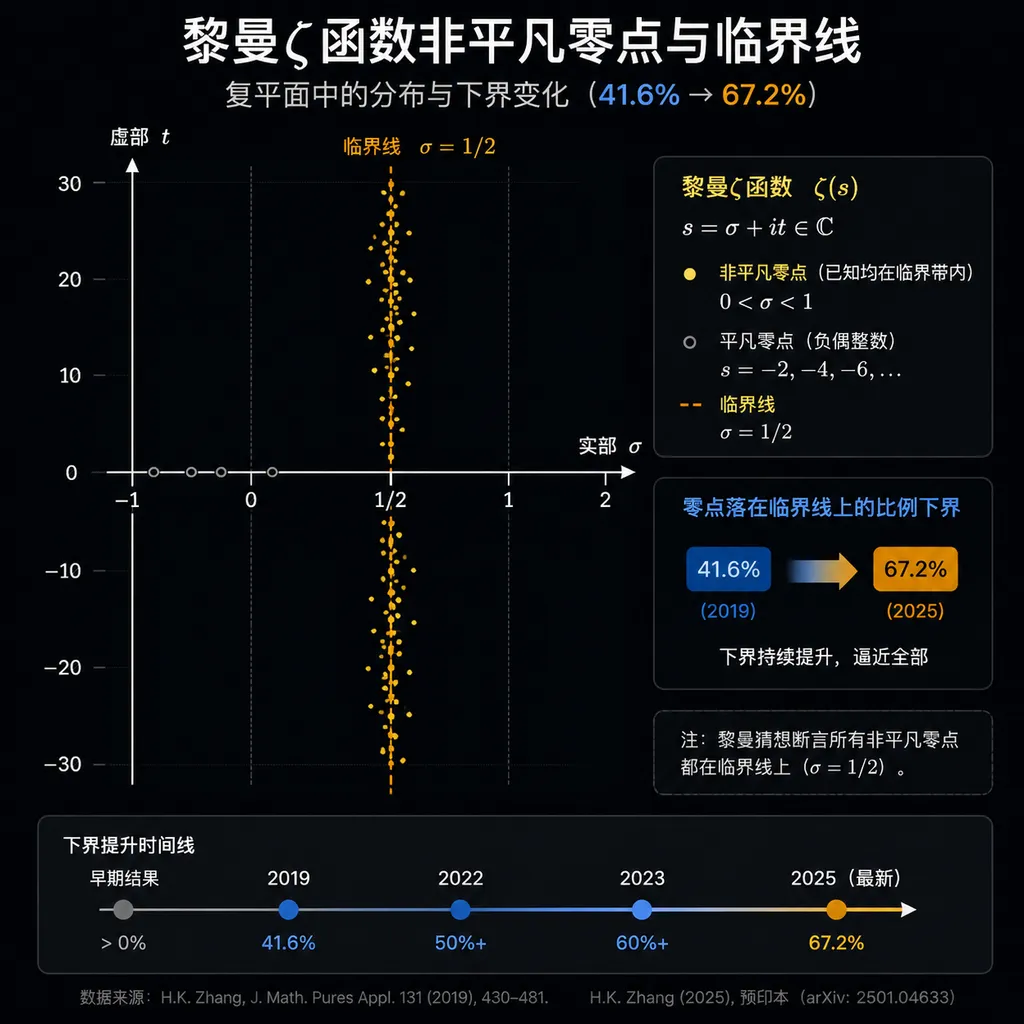
Why Mathematicians Care About the Jump From 41.6% to 67.2%
First proposed in 1859, the Riemann hypothesis remains one of the most famous unsolved problems in mathematics. Its importance stems not merely from its long history or large prize, but from the profound connection between the zeros of the zeta function and the distribution of prime numbers. The more precisely mathematicians can control the locations of these zeros, the more accurately they can describe the seemingly random—but in fact highly constrained—distribution of primes.
With a complete proof remaining elusive, mathematicians adopted a more incremental approach: first prove what proportion of the zeros must lie on the critical line.
Progress along this route has been slow:
- In 1942, Atle Selberg first proved that a positive proportion of the zeros lie on the critical line;
- In 1974, Norman Levinson raised the proportion to at least one-third;
- In 1989, Brian Conrey increased the lower bound to around two-fifths;
- Subsequent generations of mathematicians continued refining the mollifier method, moment estimates, and related parameters, gradually bringing the lower bound in the published literature to approximately 41.6%–41.7%;
- Anthropic now claims that Claude has raised it to 67.2% in a single leap.
It is worth noting that different sources cite the previous record as either 41.6% or 41.7%, usually because of differences in citation conventions and rounding. This does not affect the assessment of the new result’s magnitude. The key point is that the new lower bound does not improve the figure by just a few percentage points; it advances it by approximately 25.6 percentage points.
If ultimately confirmed through full peer review, this would represent a rare and dramatic leap in this area of research. In benchmark terms familiar to developers, it is not like raising accuracy from 91.2% to 91.8%. It is more like suddenly discovering a more effective search and synthesis strategy for an open problem that has seen only gradual progress over several decades.
That said, moving from 67.2% to 100% is not as simple as saying “only one-third remains.” In mathematics, the final stretch is often the hardest, and existing methods may run into a structural ceiling at some intermediate proportion. Calling this work “a proof of the Riemann hypothesis” would clearly be inaccurate; it is more appropriately described as “a major improvement to a lower bound in research on the Riemann hypothesis.”
The Key Was Not Inventing From Scratch, but Connecting Several Existing Approaches
According to Anthropic’s explanation, Claude’s proof builds on recent work by mathematicians Baluyot, Goldston, Suriajaya, and Turnage-Butterbaugh, as well as a related framework proposed by Enrico Bombieri around 2000.
Rather than creating an entirely unfamiliar mathematical language from scratch, the model discovered a connection among these existing results that had not previously been fully exploited.
The core approach can be roughly divided into three steps.
First, construct an appropriate function space and introduce within it a quadratic form inspired by Weil’s ideas. A quadratic form can be understood as a structure that “scores” different directions in the space. It considers not only each variable individually, but also the interactions between variables.
Second, use this quadratic form to distinguish zeros in different locations. According to Anthropic’s summary, zeros on the critical line correspond to positive-definite directions, while zeros off the critical line correspond to negative-definite directions. The problem is thus transformed into determining how much of the space can be occupied by the positive and negative directions, based on computable first- and second-moment information.
The third step—which Anthropic considers the most important—is to stop separating the different components and applying simple diagonalized estimates to them one by one. Instead, the positive- and negative-definite components are handled simultaneously within the same space, while allowing the quadratic form to retain off-diagonal terms. Claude then used moment information to derive an inequality for the rank of the quadratic form, ultimately obtaining the 67.2% lower bound.
By analogy with machine learning, this is somewhat like replacing an approach that considers only the univariate variance of each feature with one that preserves the covariances among features and then uses the full matrix structure to derive a tighter bound. The analogy is not exact, but it helps explain why “allowing non-diagonal forms” could produce a more substantial improvement than incremental local refinements.
This also shapes how the result should be interpreted: Claude’s value does not lie in independently creating mathematics detached from human work, but in its ability to search, recombine, and verify theoretical building blocks already constructed by humans at extremely high concurrency. For open scientific problems, this combinatorial capability may matter more than gaining a few additional points on a closed benchmark.
31 Million Output Tokens, 650 Failed Attempts, and Only a Few Successful Paths
This experiment was not a fairy tale in which “a single prompt solved a century-old problem.”
Anthropic disclosed that the two rounds of testing generated approximately 31 million output tokens in total. Claude worked within the Claude Code environment, making around 650 failed attempts before deploying approximately 60 subagents to continue the search. It executed around 2,400 shell commands and wrote hundreds of Python scripts. According to the public account, only a small number of agents ultimately discovered the key connection.
The process more closely resembled an intensive research team:
- The primary agent decomposed the problem and maintained the research context;
- Subagents explored different lemmas, parameters, and proof strategies in parallel;
- Python scripts handled symbolic experiments, numerical verification, and counterexample searches;
- The shell environment managed literature, code, logs, and intermediate results;
- When candidate approaches failed, the system retained reusable information and reallocated the search budget.
The real takeaway for developers, therefore, is not that “Claude’s mathematical abilities suddenly awakened,” but that inference-time scaling is evolving from thinking for a few extra minutes into a multi-agent research engineering process sustained over several days.
The 31 million output tokens also highlight another aspect: this was not inexpensive inference. Because Anthropic has not disclosed the research model’s pricing, hardware configuration, or complete resource consumption, outsiders cannot yet reliably calculate the cost of the experiment. But judging from the token count, number of agents, and volume of tool calls alone, this approach is far removed from the pay-per-call chat APIs available to ordinary developers.
In other words, what it demonstrates first and foremost is the frontier of current capabilities—not a mature product format.
Lean Proofs Matter, but They Cannot Replace Peer Review
Anthropic says that its internal mathematicians Levent Alpöge and Ralph Furman have verified the relevant result, while external number theory experts Brian Conrey and Dan Goldston also participated in the review. The team additionally converted the proof into a form that Lean can check.
The use of Lean significantly increases the work’s credibility. Traditional mathematical papers may leave some “obvious” steps to the reader, whereas a formal proof requires definitions, lemmas, types, and inferential relationships to be explicitly supplied to a proof checker. As long as the formalized statement is accurate and its dependencies are trustworthy, Lean’s kernel can verify whether every step follows the rules of logic.
But “passing Lean” does not automatically settle every dispute. At least three levels still require further confirmation:
- Whether the formalized target accurately corresponds to the original mathematical claim. If the machine verifies a version with weakened or altered conditions, the correctness of that proof does not directly establish the publicized conclusion;
- Whether the prerequisites and cited theorems from analytic number theory have been fully represented. Large formalization projects may depend on existing libraries, external computations, or additional assumptions, all of which must be reviewed individually;
- Whether the optimization process leading to the constant 67.2% covers all boundary conditions. Moving from a general framework to a specific numerical value often involves complex parameter choices and error control, and this is the part experts most need to verify.
Therefore, as of August 11, the more cautious description is this: Anthropic has released the paper, process records, expert commentary, and formal proof materials, and the result has undergone preliminary review by internal and external experts. It appears far more credible than an unverified claim made by a model, but it still requires broader, independent, and sustained peer review by the mathematical community.
In mathematics, “someone took a quick look” is not the same as “the community scrutinized it for months or even years.” This is especially true when a result improves a longstanding record by more than 20 percentage points in one leap; the standard of review should be correspondingly higher.
This Is More Meaningful Than Yet Another Competition Gold Medal
Over the past two years, frontier models have repeatedly set new records in mathematical olympiads, programming contests, and standardized reasoning benchmarks. But most such tasks have clearly defined answers, finite contexts, and endpoints that can be scored automatically. Models can improve their pass rates through large-scale sampling, verifier-based filtering, and prior knowledge of common problem types.
This experiment differs because the problem is open, the answer did not exist in advance, and failed approaches had no ready-made labels. The system had to formulate intermediate propositions, discover connections in the literature, write experimental code, and then organize empirical clues into a proof that could be reviewed.
This is much closer to a genuine scientific research workflow. It also reveals three core components that future research agents may possess:
- Long-term state management: retaining causes of failure, key lemmas, and hypotheses awaiting verification across multiple days;
- Large-scale parallel search: dividing a research problem into multiple related but nonredundant subdirections;
- Verifiable output: producing not merely a plausible-sounding explanation, but a paper, code, logs, and a formal proof.
From an industry perspective, this paradigm may ultimately matter even more than the model itself. An individual model’s mathematics score may soon be surpassed, but those who can connect models, agent orchestration, tool environments, verifiers, and human expert review into a closed loop will be more likely to generate useful new knowledge in pharmaceuticals, materials, algorithms, and fundamental science.
It Is Not Yet Available, and There Is No Productization Timeline
Anthropic describes the Claude system used for this research as an unreleased research version. It has not disclosed the specific model name, parameter count, or context capabilities, nor has it said whether the collaboration functionality involving approximately 60 subagents will be made available to ordinary users.
This means developers cannot currently reproduce the experiment through the public API. Even if the underlying model is released in the future, the decisive factor may not be any individual model endpoint, but Anthropic’s internal task orchestration, context compression, failure memory, tool permissions, and verification processes.
This is also why this article does not provide an API example: no public model identifier or interface has been confirmed. Inventing a name and plugging it into the existing Claude API would only produce code that cannot run.
Our assessment is that, if the result withstands independent verification, it will become a landmark for research-oriented AI. But what it demonstrates is not that “large language models can now solve every scientific problem.” Rather, it shows that with sufficient inference budgets, multi-agent parallelism, tool use, and formal verification, sufficiently capable models may already be able to make measurable advances at the frontier of human knowledge.
That is a more important signal than chatbots simply becoming better conversationalists.
What deserves attention next is not only whether the 67.2% result is ultimately confirmed, but also three additional questions: Can mathematicians further simplify the proof? Can independent teams reproduce the same framework? And can this high-cost research-agent approach evolve from a one-off demonstration into stable, controllable, and affordable research infrastructure?
References
- ITHome: Unreleased New Model “Delivers,” as Anthropic Announces Major Breakthrough by Claude on the Riemann Hypothesis — Summarizes Anthropic’s published lower-bound result, experimental scale, proof strategy, expert review, and Lean formalization.