SenseTime 6.8 Lightweight Agent Goes Live

SenseNova 6.8 Flash Lite Preview is available for testing today, shifting the focus from single-turn Q&A to tasks involving hundreds of steps, autonomous error correction, and multi-agent collaboration. However, until pricing, benchmarks, and production stability are disclosed, its “delegated intelligence” still needs to be validated in real-world testing.
SenseTime Pushes Lightweight Models Toward “Autonomous Delivery”
On August 11, SenseTime officially launched the multimodal agent model SenseNova 6.8 Flash Lite Preview and made it available through the SenseNova Token Plan. Its positioning is clear: rather than focusing primarily on carrying on extended conversations with users, it aims to accept a goal, autonomously plan the steps, invoke tools, coordinate multiple sub-agents, and ultimately deliver a usable result.
SenseTime calls this direction Delegated Intelligence. Put simply, earlier AI systems were more like interns who needed constant direction, requiring users to break a task down into a dozen or more prompts. Delegated Intelligence, by contrast, aims to function like a project lead: the user provides only the goal, constraints, and acceptance criteria, while the system handles the remaining research, analysis, production, verification, and retries after failures.
The version launched this time is a preview. SenseTime says the production version of SenseNova 6.8 Flash Lite, along with the higher-performance SenseNova 6.8 Flash, will be released soon. The company has not yet disclosed the full model specifications, context length, API pricing, or standardized benchmark results. At this stage, then, the more important question is not its benchmark scores, but whether it can reduce the cost and failure rate of long-horizon agents.
The Focus of This Upgrade Is Completing Tasks End to End
The capabilities of SenseNova 6.8 Flash Lite Preview can be summarized in three keywords: long-horizon stability, multi-agent collaboration, and native multimodality. None of these is new on its own. The challenge is making all three work within the same task trajectory without falling apart over several hours of execution.
1. Hundreds of Execution Steps Mean More Than Simply Packing More Text Into the Context Window
SenseTime says the new model can maintain goals, constraints, and key facts throughout tasks spanning hundreds of steps, multiple phases, and several hours, while autonomously rolling back and replanning when a step fails.
This is harder than merely “supporting long context.” Long context addresses whether a model can see earlier information; a long-horizon agent must be able to keep doing the right thing. Even if an agent remembers the entire conversation history, it may misunderstand the objective at step 80, invoke the same tool again at step 150, or allow a single webpage loading failure to derail the rest of its plan.
Truly stable long-horizon execution requires at least four layers of capability:
- Breaking down ambiguous goals into verifiable stage-level tasks;
- Maintaining structured state during execution rather than relying solely on conversation history;
- Checking whether the result of each tool call meets expectations;
- Identifying the faulty node when a failure occurs and rolling back only the necessary steps instead of starting over.
The number of steps itself is therefore not the most important metric. Developers should instead ask: If the same task is run ten times, what is the success rate? How many additional tokens and tool calls are used on average after a failure? Can task state be persisted? Can a human approve, modify, or take over the task midway through execution? These metrics determine whether it is a production tool or merely an impressive demo.
2. A Primary Agent Dynamically Coordinates More Than a Dozen Specialized Agents
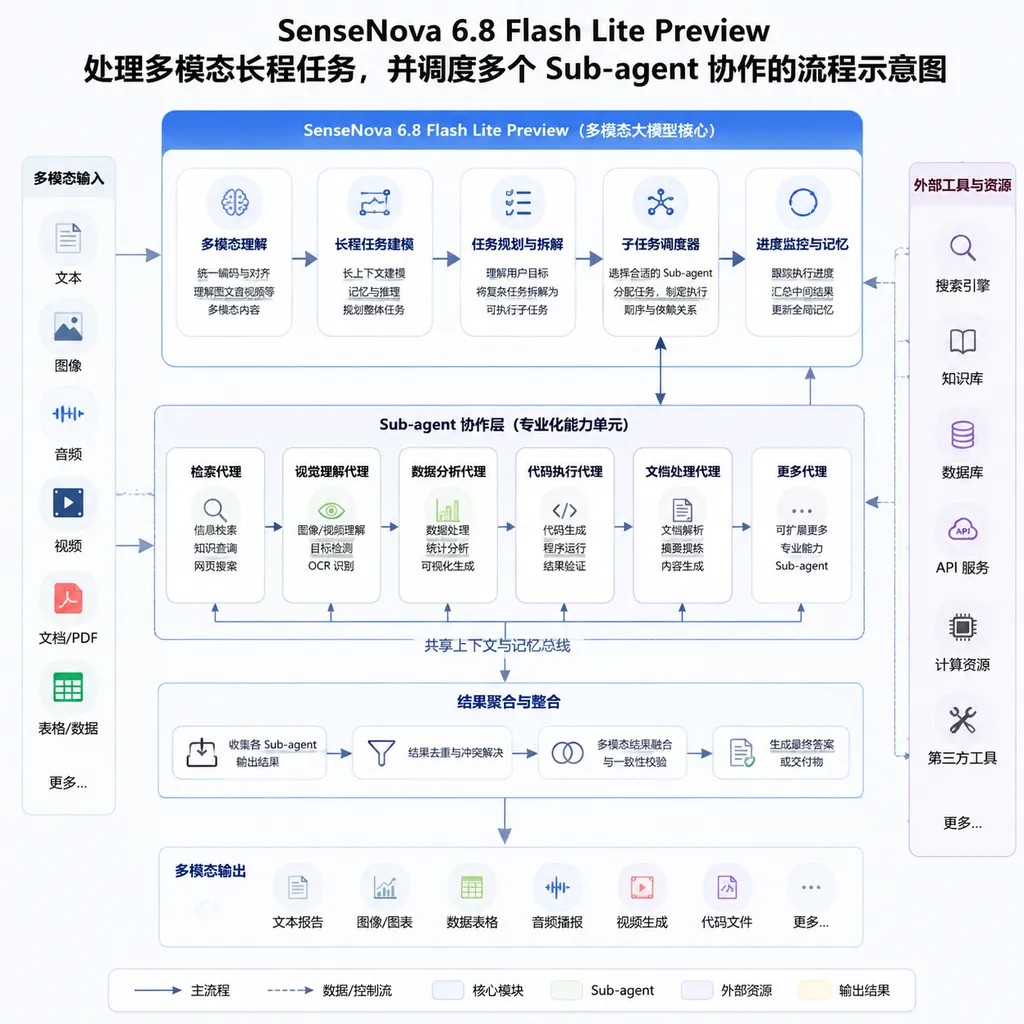
SenseNova 6.8 Flash Lite Preview allows a primary agent to dynamically organize more than a dozen sub-agents that can perform information retrieval, data analysis, mathematical calculations, visual understanding, and fact-checking in parallel.
The value of multi-agent systems does not lie in stitching together a dozen chat windows, but in task isolation and parallelism. When producing an industry analysis report, for example, one agent could clean a local CSV file, another could retrieve public information, a third could read charts from financial reports, and a fourth could verify citations and figures, with the primary agent merging their conclusions at the end. When done well, this can reduce a workflow that would take tens of minutes sequentially to several branches running in parallel. When done poorly, multiple agents may duplicate searches, produce conflicting views, and drive token consumption out of control.
A reasonable coordination process would look roughly like this:
Receive objective
  → Break it down into stages and acceptance criteria
  → Determine which tasks can run in parallel
  → Select specialized agents and tools for each subtask
  → Aggregate intermediate results and cross-check them
  → Conduct additional research or rerun tasks when conflicts are found
  → Generate the final file
  → Verify it against the acceptance criteria and deliver it
The key here is not the number of agents, but whether the coordinator knows when it should not launch another agent. This is particularly important for a lightweight model: inexpensive individual calls do not necessarily remain inexpensive after more than a dozen branches repeatedly retry their work. If Flash Lite can coordinate tasks reliably with relatively low inference overhead, its practical value may exceed that of gaining a few extra points on general-purpose benchmarks.
3. Multiple Modalities Enter the Same Task Trajectory
The new model can process text, images, charts, documents, videos, and application interfaces within a single task, then use that information for planning, reasoning, tool invocation, and result verification.
This is not the same as the traditional “upload an image and describe its contents” workflow. In an office task, for example, an agent might first read a local spreadsheet and identify anomalies in a dataset; then open a webpage to investigate the cause and extract information from online charts; next, run a Python script to perform calculations; and finally, generate an HTML presentation containing animations and interactive charts. The model must not only understand different media, but also recognize the causal relationships among them throughout the task.
Typical deliverables demonstrated by SenseTime include dynamic PowerPoint presentations: the model handles content writing, chart creation, and layout design, while native HTML enables dynamic presentation features. It can also understand webpages, application interfaces, and local files; operate browsers and applications; and write and automatically execute scripts.
This is also the aspect of SenseNova 6.8 Flash Lite Preview most worth watching. Static PowerPoint generation is already quite common, but a complete office workflow requires starting from real data, performing analysis, research, and verification, and ultimately generating an editable, presentation-ready file.
“Native Capabilities” Do Not Mean Calling Only One Model API
Developers should avoid a common misconception: the end-to-end results shown in official demos usually cannot be reproduced with a single direct request to the model API.
According to SenseTime’s previously published documentation for SenseNova 6.7 Flash-Lite, a complete office workflow requires the model, an agent runtime, and skills to work together. The company previously recommended OpenClaw or hermes-agent, combined with SenseNova-Skills. The model handles understanding, planning, and decision-making; the runtime maintains task state and the invocation loop; and skills encapsulate specific capabilities such as browser operation, file processing, data analysis, and content generation.
With version 6.8, this layered architecture remains essential to understanding the product:
- The model layer determines planning quality, multimodal understanding, and error-correction capabilities;
- The runtime layer handles iterative execution, concurrent coordination, timeouts, and state recovery;
- The skills layer determines which files and applications the agent can actually operate;
- The permissions layer controls which actions can be executed automatically and which require human approval;
- The observability layer records call chains, costs, errors, and the sources of final results.
If an enterprise merely replaces the underlying model without implementing task-state management, tool permissions, and observability, execution across hundreds of steps will instead amplify risk. Every additional step an agent takes creates another opportunity to call the wrong tool, read the wrong file, or write incorrect data.
Lightweight Models for Agents Are a More Practical Path
SenseTime’s emphasis on “Flash Lite” is not simply about producing a scaled-down version. Agent tasks call models repeatedly: once to plan, once to execute, and once to check, with additional retries when problems occur. Even if per-turn inference costs differ by only a few times, that gap quickly becomes a substantial difference in the final bill when multiplied across hundreds of steps.
Lightweight models are therefore particularly well suited to three roles:
- High-frequency, low-risk tool selection and parameter generation;
- Subtask execution within multi-agent systems;
- Formatting and basic verification after a primary model completes the critical reasoning.
Compared with using the most powerful model for every stage, this approach is closer to real-world engineering requirements. Computer-use, deep-research, and coding agents developed by OpenAI, Anthropic, Google, and others all face the same problem: the capability ceiling is determined by powerful models, but whether a product can scale often depends on latency, per-task cost, and the success rate of long execution chains.
SenseNova 6.8 Flash Lite Preview has an opportunity to differentiate itself in Chinese-language documents, complex spreadsheets, local office files, and web interfaces. SenseTime has accumulated extensive expertise in computer vision. If that expertise can be reliably translated into UI understanding and document-handling capabilities, the model could stand out more clearly in China’s office automation market than it would by pursuing general conversational capabilities alone.
However, it is still too early to conclude from official descriptions alone that it has taken the lead. SenseTime has not published standardized comparisons with peer models on BrowserGym, OSWorld, GAIA, or long-horizon agent tasks, nor has it disclosed end-to-end task success rates, average execution times, or total token consumption. The preview should reasonably be viewed as a technical validation rather than a direct replacement for production systems.
When Testing, Developers Should Look Beyond Whether the Demo Works
Teams preparing to evaluate SenseNova 6.8 Flash Lite Preview should build test sets based on real business tasks rather than simply reproducing official examples. At a minimum, they should record the following data:
- End-to-end success rates for the initial run and repeated runs;
- Average number of steps, model calls, and tool calls;
- Tokens, time, and total cost per task;
- Recovery capabilities after webpage changes, missing files, or tool timeouts;
- How conflicts between sub-agents are handled;
- Whether final conclusions can be traced back to source files or supporting evidence on webpages;
- Whether the system supports pausing, human approval, and resuming from checkpoints;
- Whether browser, file-system, and script-execution permissions can be controlled at a granular level.
Security boundaries are equally essential. An agent capable of operating browsers, applications, and local files effectively receives digital permissions comparable to those of a junior employee. A development environment can allow broader experimentation, but production environments should use sandboxes, directory allowlists, domain allowlists, confirmation for sensitive operations, and complete audit logs. Sending emails, uploading files, modifying databases, and executing shell commands are particularly unsuitable for full automation without an approval mechanism.
Assessment: The Direction Is Right, but Stability Is the Real Test
SenseNova 6.8 Flash Lite Preview reflects a clear shift: lightweight models are no longer limited to summarization, classification, and simple question answering, but are beginning to participate in planning, collaboration, and delivery. Model competition is consequently shifting from “who can provide smarter answers” to “who can complete tasks at an acceptable cost.”
SenseTime’s decision to begin with dynamic PowerPoint presentations, data analysis, web operations, and local file processing is a pragmatic one. These tasks have clear inputs, tools, and deliverables, making it easier to establish acceptance criteria than for completely open-ended general-purpose agents. They are also closer to scenarios for which enterprises are willing to pay.
But “Delegated Intelligence” is a major promise. There is still a substantial gap between executing hundreds of consecutive steps in a demo and reliably processing thousands of tasks every day—a gap involving error recovery, permission controls, cost governance, and system observability. SenseNova 6.8 Flash Lite Preview currently demonstrates that SenseTime is working to solve these problems, but not that they have been solved completely.
For developers, the preview is worth testing, particularly for teams whose work involves a high proportion of Chinese-language documents, spreadsheets, webpages, and office automation. For production deployment, however, it would be prudent to wait until pricing, API specifications, benchmark data, and stability information for the production release are made public. Teams using multi-model architectures can also begin by managing different models through a unified interface. OpenAI Hub provides aggregated access compatible with the OpenAI API format, making it easier to switch between and compare models such as GPT, Claude, Gemini, and DeepSeek under the same business logic. The specific availability of SenseNova 6.8, however, should be verified against the platform’s actual model catalog.
SenseNova 6.8 Flash Lite Preview is now available through the SenseNova Token Plan, and related project materials have also been released. The production version of Flash Lite and the higher-performance Flash version will arrive soon. At that point, pricing, latency, and long-running task success rates will determine whether this attempt at “Delegated Intelligence” represents a genuine product capability or merely another compelling concept.
References
- ITHome: SenseTime Launches SenseNova 6.8 Flash Lite Preview — Introduces the model’s release date, three core capabilities, application scenarios, and plans for subsequent versions.
- GitHub: OpenSenseNova / SenseNova6.8 — Project materials and future usage documentation for SenseNova 6.8.
- GitHub: SenseNova 6.7 Chinese Documentation — Explains how the model, agent runtime, and skills work together to form a complete office workflow.