NVIDIA to Build Trillion-Parameter Nemotron 4
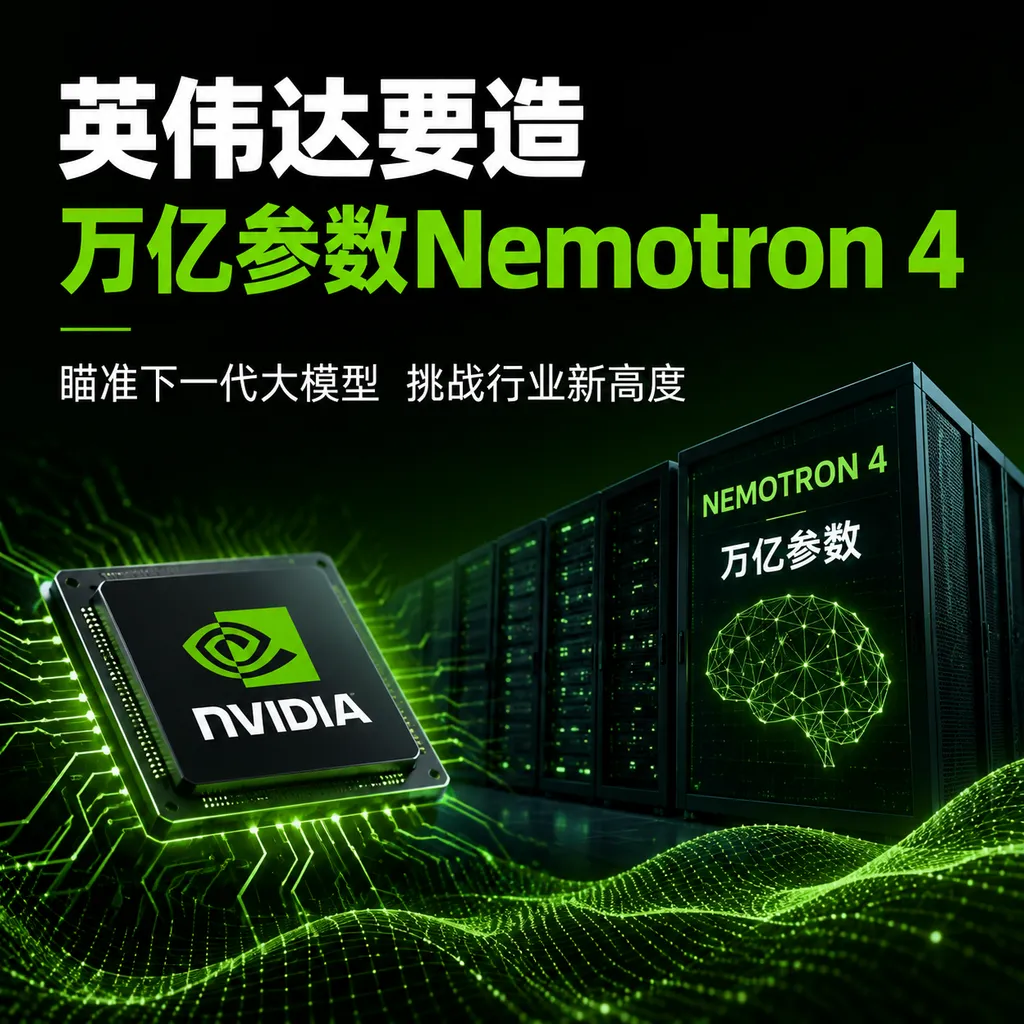
NVIDIA is reportedly developing Nemotron 4 with at least one trillion parameters, with completion possible as early as late autumn 2026. It is both a new card in the open-source model race and a move by NVIDIA to expand demand for its GPUs and software stack.
NVIDIA is moving Nemotron from a model product suite designed to serve its own GPU ecosystem into the main arena of frontier open models.
According to an evening report on August 11, The Information, citing multiple project participants, said NVIDIA is developing the next-generation Nemotron 4 model family. Its largest version is expected to have at least 1 trillion parameters, with the goal of competing head-on with the world’s most advanced open models. Final training has not yet been completed, and no release date has been set. The earliest timeframe cited by insiders is late fall 2026.
This news first needs to be taken with a grain of salt: NVIDIA has not yet officially released Nemotron 4, nor has it disclosed its architecture, number of active parameters, training data, license, or benchmarks. The “trillion-parameter” figure comes from project participants rather than an official technical report. It is therefore more like an early glimpse of a roadmap than a new model that is already available to download and deploy.
Even so, the roadmap deserves attention. NVIDIA clearly no longer intends to remain merely an “arms dealer” selling GPUs to model companies. It is pushing the boundaries of competition upward into models, inference frameworks, agent runtimes, and enterprise delivery.
One Trillion Parameters Is Huge, but “Bigger” Does Not Necessarily Mean Better
The most eye-catching number associated with Nemotron 4 is at least 1 trillion parameters. If the report is accurate, its total parameter count will be nearly double that of the current Nemotron 3 Ultra: NVIDIA released Nemotron 3 Ultra this June as a 550-billion-parameter mixture-of-experts model for software development, scientific research, and long-horizon enterprise agents.
For developers, however, looking only at the total parameter count is no longer particularly meaningful.
If Nemotron 4 continues along the MoE (mixture-of-experts) path of Nemotron 3, the 1 trillion figure will likely refer to “how many parameters exist in the model’s entire repository,” rather than how many parameters are used to generate each token. MoE operates more like a consulting firm with thousands of specialists: the company has a very large workforce, but only a small number of teams are assigned to each project. Inference cost is determined primarily by the number of parameters activated per pass, expert-routing efficiency, memory usage, and communication overhead.
Take Nemotron 3 Super as an example. The model has approximately 120 billion total parameters, but activates only around 12 billion parameters per token. Nemotron 3 Ultra’s total parameter count reaches 550 billion, but that does not mean inference costs are equivalent to those of a 550-billion-parameter dense model. If Nemotron 4 adopts a similar design, it could expand its knowledge capacity while keeping active computation within a relatively deployable range.
Conversely, if NVIDIA merely increases the total parameter count to 1 trillion without also addressing uneven expert loads, inter-GPU communication, long-context stability, and inference throughput, the number will be more useful as marketing material than anything else.
What is really worth waiting for is the following information:
- Ratio of total to active parameters: Determines the real computational efficiency of the MoE architecture;
- Model architecture: Whether it will continue using a hybrid design combining Mamba, Transformer, and MoE;
- Training and inference precision: Whether low-precision formats will be further optimized around Blackwell and subsequent GPUs;
- Context window: Whether it can continue Nemotron 3’s million-token trajectory;
- Training-token count and data composition: A model of this scale must be supported by sufficient data, or it risks being undertrained;
- Real-world throughput: Tokens per second in single- and multi-GPU deployments are more informative than the total parameter count;
- Scope of the license: Open weights, open code, and true open source are not the same thing.
The last point is especially important. Current reports generally describe Nemotron 4 as an “open-source model,” but until its license is published, it would be more accurate to say that NVIDIA plans to release a frontier open model. Downloadable model weights do not necessarily mean that the training data, complete training code, commercial use, and distribution of derivative models will all be unrestricted.
From Nemotron 3 to 4, NVIDIA Is Beginning to Pursue Frontier Capabilities
Nemotron 3’s positioning is quite clear: rather than simply pursuing rankings on chatbot leaderboards, it is optimized for enterprise agents.
Nemotron 3 Super, launched this year, has approximately 120 billion total parameters, around 12 billion active parameters, and a 1-million-token context window. It focuses on solving two common problems in multi-agent systems.
The first is “context explosion.” After an agent calls search tools, code executors, databases, and other agents, it continuously feeds tool results and historical traces back into the context. In complex workflows, token consumption may be several or even more than ten times that of ordinary conversations. The longer the context, the greater the memory pressure, time-to-first-token latency, and inference cost. Agents are also more likely to forget their original goals after dozens of operations.
The second is the “reasoning tax.” If an agent invokes an expensive frontier closed-source model for every minor decision, the system will often lose control of costs and latency before it runs into capability limitations. What enterprises actually need is usually a tiered combination of models: large models handle difficult problems, while faster models take care of classification, retrieval, routing, and routine tool calls.
The hybrid Mamba-Transformer MoE architecture used by the Nemotron 3 family was designed around precisely these problems. Mamba excels at processing long sequences at relatively low cost, Transformer attention layers handle information that requires precise lookbacks and complex associations, and MoE controls computation by activating experts on demand. Combining the three is not about architectural novelty; it is about enabling models in long-context agentic systems to simultaneously “remember more, retrieve accurately, and run efficiently.”
If Nemotron 4 scales this foundation to 1 trillion parameters, its goal will probably not be to create a chatbot that is simply better at casual conversation. Instead, it will likely aim to bring demanding agentic tasks—such as coding, tool use, planning, scientific research, and cybersecurity—closer to the capabilities of frontier closed-source models.
NVIDIA’s recent product moves reinforce this assessment. In addition to reports about Nemotron 4’s development, the company has expanded its Nemotron 3.5 Lightning product line for specific tasks such as code review, tool use, security-alert monitoring, and billing-related Q&A. It has also launched the open-source model-routing library NeMo Switchyard, which assigns requests to the most suitable model based on task characteristics.
This means NVIDIA is no longer selling just a model, but a “fleet of models”: large models handle complex reasoning, small and midsize models take care of high-frequency tasks, and a router decides which vehicle should be dispatched for each request. For enterprise applications, this is often more practical than obsessively pursuing a single model that can do everything.
Open Models Are the Means; GPU Demand Completes the Business Loop
NVIDIA’s active investment in open models may look like it is giving models away to developers, but the business logic is not complicated: models can be open, but demand for compute will not disappear.
Even if a trillion-parameter MoE model activates only some of its parameters at a time, storing and loading the full weights, handling inter-GPU communication, and serving the model will still require large-scale GPU clusters. Enterprises that continue pretraining, apply reinforcement learning, or perform domain-specific fine-tuning based on Nemotron will consume even more compute.
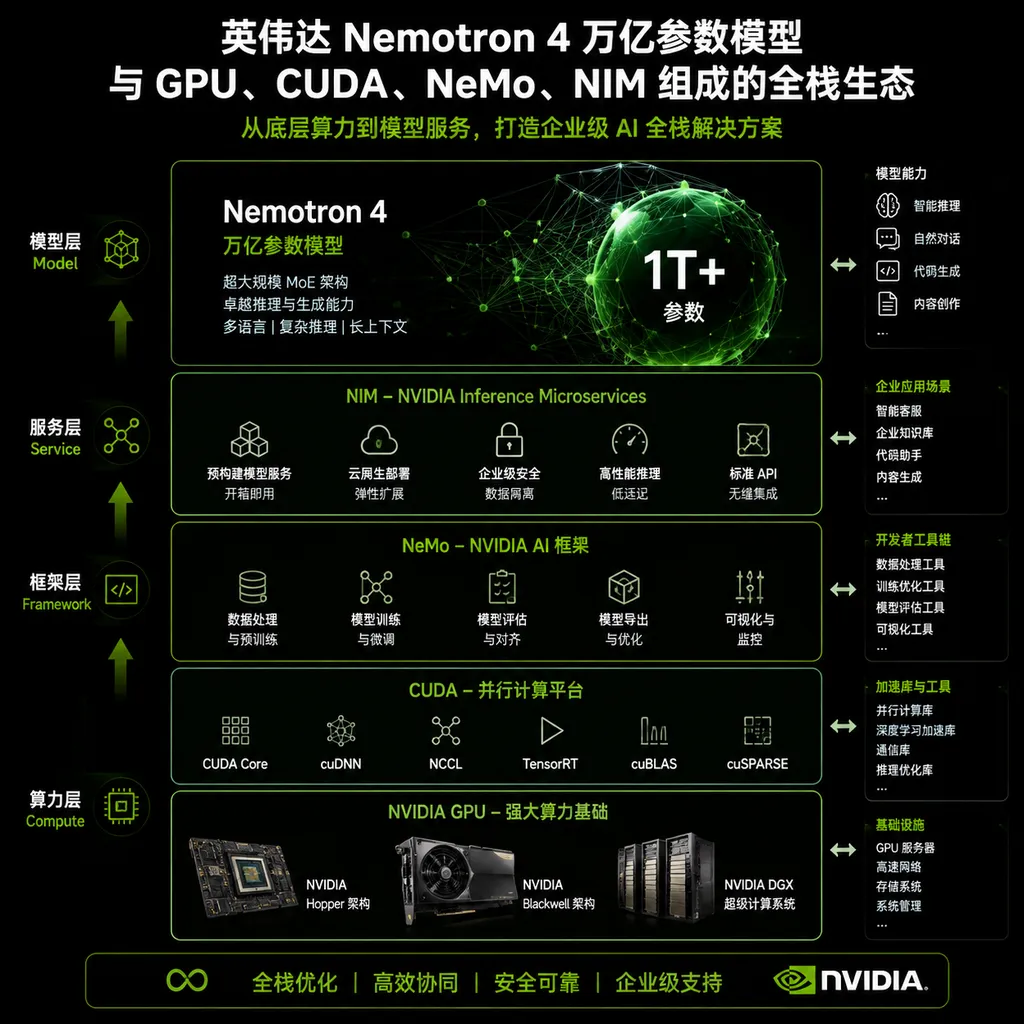
More importantly, Nemotron is not a standalone product. It is integrated with NVIDIA’s existing technology stack:
- At the bottom are GPUs such as Blackwell and NVLink interconnects;
- The middle layer includes CUDA, TensorRT, NeMo, and low-precision compute formats;
- The model layer consists of Nemotron and its accompanying datasets and reinforcement-learning environments;
- The delivery layer includes NIM microservices and enterprise agent tools.
Developers can, of course, deploy the open weights themselves, but the easiest path with the best performance will usually lead back to NVIDIA-optimized software and hardware. In other words, opening Nemotron does not weaken NVIDIA’s moat—it expands the area that moat covers.
This is also the fundamental difference between NVIDIA and pure-play model startups. Model companies need to recoup training costs through APIs or subscriptions, whereas NVIDIA can use models to generate demand for its hardware and platforms. Even if the model weights are free, NVIDIA can still profit elsewhere as long as they encourage more enterprises to purchase GPUs, use NIM, or deploy NeMo.
From this perspective, Nemotron 4 extends NVIDIA’s “CUDA model” into the model layer: first get developers to use it, then allow tools, workflows, and infrastructure to grow around it.
Chinese Open Models Are Forcing U.S. Vendors to Reconsider the Open Path
The report notes that one reason behind NVIDIA’s investment in Nemotron is that Chinese models are steadily approaching the capabilities of leading U.S. closed-source systems at lower training and inference costs.
Over the past two years, Meta has ceased to be the sole focus of competition among open models. Chinese models such as DeepSeek, Qwen, and GLM have continuously improved their reasoning, coding, and agentic capabilities, rapidly entering developer workflows through open weights, low API prices, and support for local deployment. For enterprises, once the capability gap narrows enough to be bridged through engineering, cost, controllability, and data boundaries become more important procurement considerations.
NVIDIA faces pressure on two fronts.
On the one hand, if the most popular open models primarily come from Chinese teams, U.S. enterprises and the government may worry that critical AI capabilities are becoming concentrated in overseas ecosystems. NVIDIA has previously joined Microsoft and other companies in supporting open-weight models, partly to prevent the United States from falling behind in open-model innovation.
On the other hand, no matter which model ultimately wins, NVIDIA wants it to run primarily on its GPUs. By developing Nemotron itself, NVIDIA can provide a reference implementation deeply optimized for its own hardware while also establishing de facto standards for model training, low-precision inference, and agent deployment.
Nemotron 4 is therefore not challenging just one particular model. It faces an already crowded open ecosystem: some models excel at reasoning, some at coding, some offer low deployment costs, and others have vast Chinese-language and enterprise user bases. NVIDIA’s strengths lie in compute, engineering, and enterprise channels. Its weaknesses include its model brand, mindshare among developers, and whether it can consistently deliver genuinely leading capabilities.
Parameter counts can be scaled with clusters; community standing cannot.
Cybersecurity Will Be Both a Highlight and a Center of Controversy
NVIDIA has explicitly identified security-alert monitoring, vulnerability analysis, and autonomous security orchestration as important use cases for Nemotron. This year, the company also formed an alliance with multiple enterprises to jointly develop and share AI safety and cybersecurity tools.
Open models have a dual-use nature in cybersecurity. Defenders can deploy models on internal networks to continuously analyze logs, inspect configurations, and identify vulnerabilities without sending sensitive data to external APIs. Researchers can also fine-tune models for specific domains, enabling them to understand particular codebases and infrastructure.
However, the same customizability can also be used for automated scanning, phishing-content generation, or attack-chain orchestration. Closed-source models generally add content moderation, account-level risk controls, and rate limits at the API layer. Once open-weight models are deployed independently, it becomes difficult to retain the same level of centralized control.
This does not mean open models are inherently more dangerous. Actual risk is determined by capability level, tool permissions, the operating environment, and the operator’s intent. However, if Nemotron 4 achieves tool-use and planning capabilities comparable to frontier closed-source models while allowing local deployment, it will inevitably make the governance challenges surrounding open models more acute.
Whether NVIDIA also releases safety classifiers, permission-isolation mechanisms, agent audit logs, and red-team evaluations will be just as important as the model’s benchmark scores. For enterprises, the ability to call tools is only the first step. Being able to demonstrate which tools the model called, when it called them, and why is the threshold for entering production.
Developers Do Not Need to Wait for the Model, but They Can Watch Seven Signals
Nemotron 4 has not yet been scheduled for release, and final training is still incomplete, so it is too early to discuss deployment. Development teams do not need to pause their current model-selection efforts because of rumors about a trillion-parameter model, but they can monitor the following signals:
- Whether NVIDIA releases multiple variants, such as base, instruction-tuned, and reasoning versions;
- Whether the weights can be downloaded directly from platforms such as Hugging Face;
- Whether commercial use, fine-tuning, and distillation are permitted;
- Whether the number of active parameters and memory requirements at different precision levels are disclosed;
- Whether mainstream inference frameworks such as vLLM and SGLang are supported, rather than only NIM;
- Whether the million-token context can maintain accuracy in real-world retrieval and coding tasks;
- Whether official benchmarks can be reproduced by third parties, especially for tool use, long-horizon tasks, and performance per unit of cost.
Deployment compatibility is especially important. If Nemotron 4 can demonstrate its advantages only on NVIDIA’s latest clusters, with specific precision formats and the company’s official serving stack, it will still be a valuable enterprise model—but the freedom to choose hardware that comes with being “open” will be relatively limited.
Conversely, if NVIDIA not only releases the weights but also opens its training methods, data recipes, and reinforcement-learning environments, as it did with Nemotron 3, Nemotron 4’s value to the community will extend beyond simply providing another model to call. It would offer an engineering blueprint for training trillion-parameter MoE models and long-horizon agents.
The Real Contest Is Not About One Trillion Parameters, but Who Can Actually Run the Model
The significance of Nemotron 4 does not lie in NVIDIA finally joining the “trillion-parameter club.” Parameter count has long ceased to be a reliable shortcut for judging model quality. What developers ultimately care about is whether the model can complete the same code-repair, deep-research, or security-analysis task with fewer GPUs, lower latency, and a higher success rate.
NVIDIA’s chances of success also depend on more than model capabilities. It has GPUs, interconnects, compilers, inference engines, and enterprise customers, allowing it to integrate models directly into a mature computing platform. This kind of vertical integration is something most open-model teams do not possess.
But Nemotron 4 still needs to answer the most fundamental question: Is it truly an open model with frontier-level competitiveness, or merely a massive reference implementation showcasing the throughput of NVIDIA hardware?
The answer will have to wait until at least late fall 2026, if not later. What is already clear is that NVIDIA is no longer content merely to provide compute for the model wars. It is preparing to define how the next generation of open models should be trained, how they should perform inference, and which infrastructure they should run on.
References
- ITHome: NVIDIA Reportedly Developing Trillion-Parameter Open-Source AI Model Nemotron 4 — Summarizes Nemotron 4’s development status, parameter scale, potential release date, and NVIDIA’s open-model strategy.
- ITHome: NVIDIA Releases 550-Billion-Parameter Nemotron 3 Ultra — Introduces the previous-generation Ultra model’s parameter scale, agentic positioning, inference efficiency, and release channels.