Ant Bets on Haptics, Giving Robots an Interactive Brain
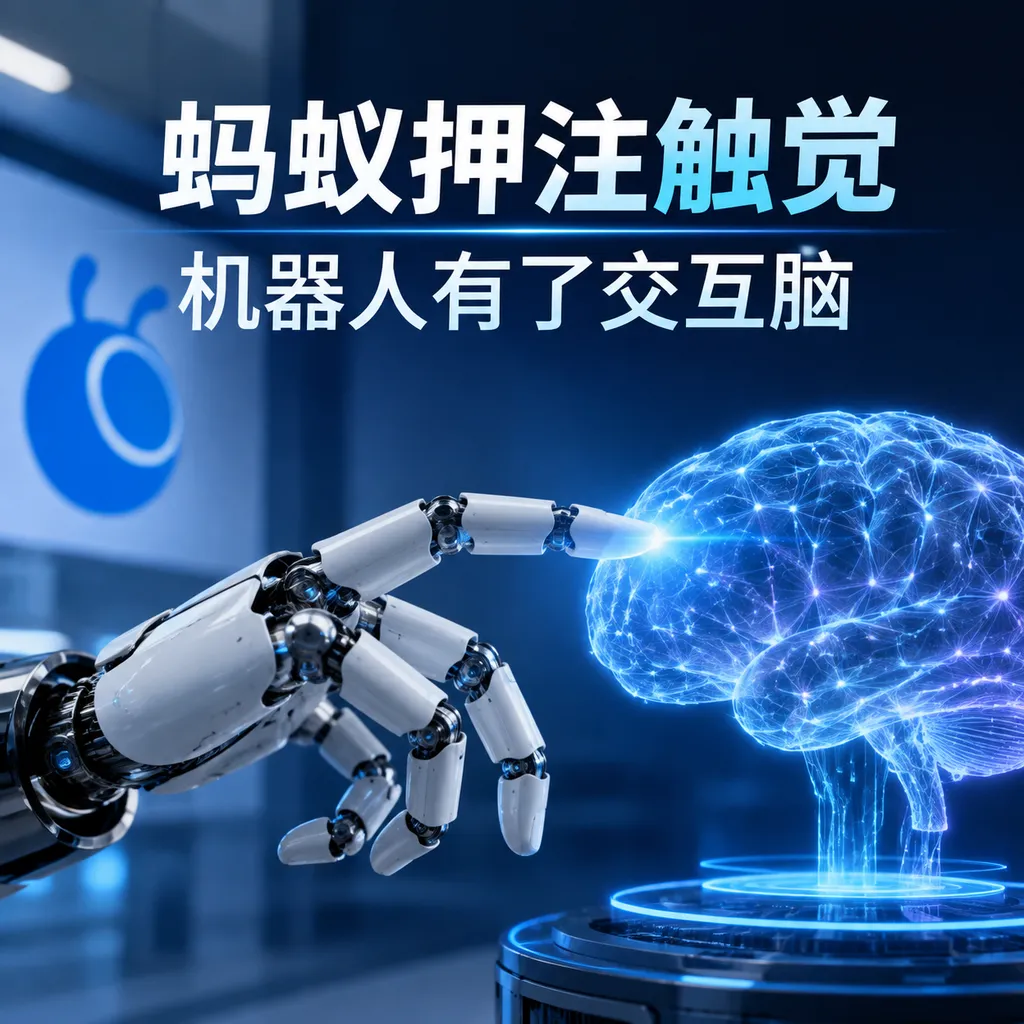
Ant Group leads a multi-hundred-million-yuan funding round for Daimon Robotics, which simultaneously unveiled its tactile-anchored world model, Daimon-TWM. Competition in robotics is shifting from visual understanding to whether robots can maintain a stable grasp, correct errors, and predict the consequences of their actions after making contact.
Ant Bets on Touch, Giving Robots an Interactive Brain
On August 11, Ant Group made a strategic investment worth hundreds of millions of yuan in the “fingertips” of robots. The recipient was tactile intelligence company Daimon Robotics, which simultaneously unveiled the Daimon-TWM (Tactile-grounded World Model), calling it the world’s first “physical interaction brain” for dexterous robotic manipulation.
What truly deserves attention is not that robots have gained yet another type of sensor, but that the focus of competition in embodied intelligence is shifting. Until now, the industry has largely focused on whether robots can “understand what they see.” The next challenge is whether, after making contact with an object, they can determine whether they have a secure grip, whether the object is slipping, whether the applied force might crush it, and what consequences the next action will produce.
What Ant is investing in is not a more human-like hand, but a model and data system intended to control robotic hands. According to information disclosed by Daimon, the funding will be used to iterate its tactile foundation model, scale up hardware production, and deploy physical intelligence in real-world scenarios.
The conclusion up front: Touch will very likely become a foundational modality for embodied intelligence, but whether Daimon-TWM has already bridged the gap between laboratory demonstrations and large-scale deployment cannot yet be determined from a single broken-glass demo.
Seeing a Cup Does Not Mean a Robot Can Pick It Up
Most mainstream robot models currently follow the VLA, or Vision-Language-Action, approach. Cameras observe the environment, language models understand the task, and action models then convert the objective into a robotic-arm trajectory.
This approach is well suited to questions such as “Where is the cup?” and “Which one should be picked up first?” But it is not inherently good at handling changes that occur at the moment of contact.
For example, when a robot picks up a paper cup, vision can tell it the cup’s location, shape, and approximate pose, but it struggles to answer these questions accurately:
- Have the gripper fingers actually made contact with the cup wall?
- Is the cup rising steadily, or is it slowly slipping from the fingertips?
- Will the current gripping force crush the empty paper cup?
- Does the cup contain water or screws, and has its center of gravity shifted?
- Are gloves, grease, reflections, or occlusion distorting visual perception?
Humans do not perform these actions using vision alone either. Once the fingers touch an object, the skin provides feedback on pressure, shear force, slippage, and texture changes at frequencies far higher than those used for visual planning. The brain can take its time deciding where to place the cup, but the fingers must increase force immediately when the cup begins to slip.
What robots have lacked is precisely this closed loop from “fingertip nerves” to “motor reflexes.”
Daimon-TWM Aims to Do More Than Tactile Recognition
Tactile sensing is not a new technology. Industrial grippers have long used force-torque sensors, while research institutions have developed numerous visual-tactile sensors and electronic skins. Traditional systems, however, often treat touch as a threshold switch: release when pressure exceeds a certain value, or increase gripping force when slippage is detected.
What makes Daimon-TWM different is its attempt to incorporate touch into a world model.
A world model can be understood as a physical simulator inside the robot’s brain. Rather than merely recognizing the current state, it must also predict, “If I do this, what will happen next?” Language models predict the next token; physical world models may predict the next visual frame, the next sequence of tactile changes, an object’s pose, and the outcome of a robot action.
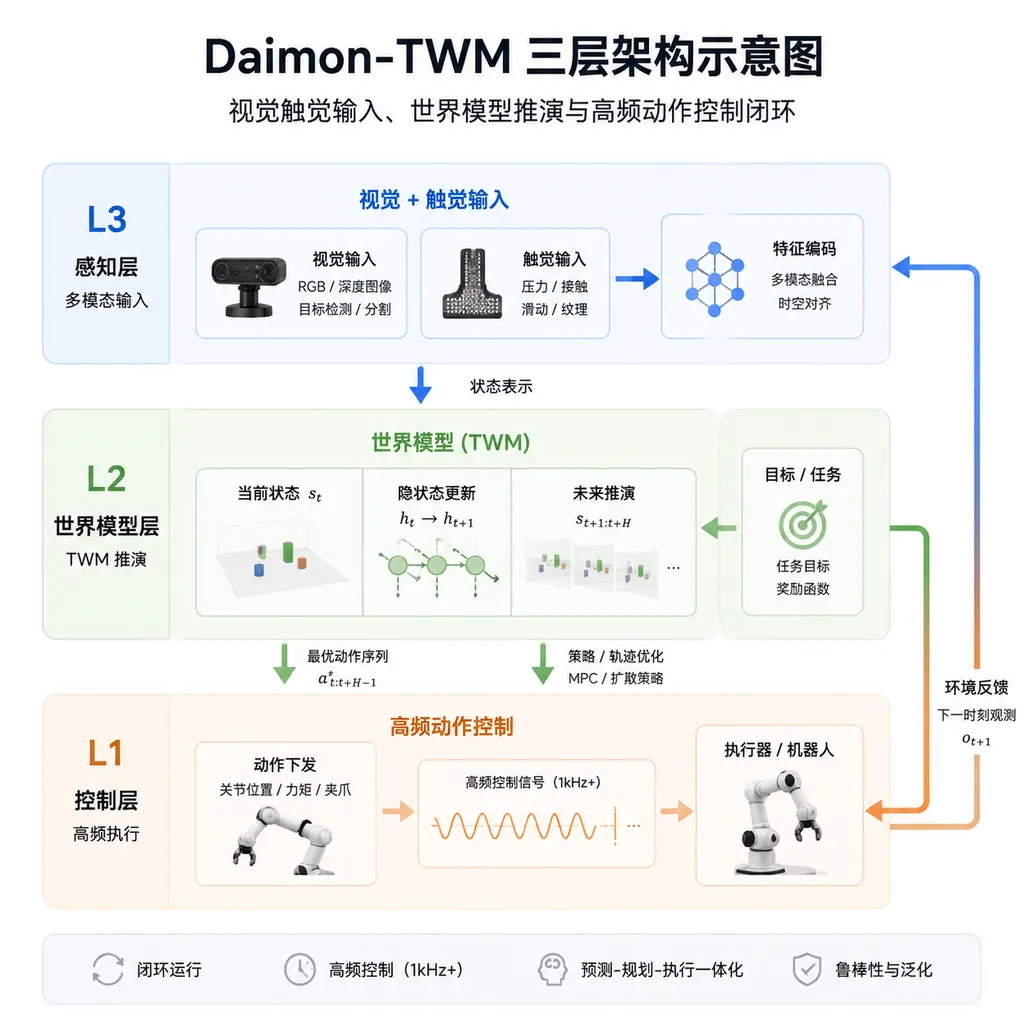
According to information published by Daimon, Daimon-TWM uses native tactile information throughout understanding, reasoning, prediction, and verification, rather than simply appending a sequence of pressure readings to visual features. Its three-layer collaborative architecture can be summarized across three timescales:
- Physical cognition layer: Fuses vision, touch, and the robot’s proprioceptive state to determine object properties, contact relationships, and force conditions;
- Simulation and planning layer: Predicts the potential outcomes of different grasping angles, force levels, and motion trajectories;
- Fast control layer: Uses high-frequency tactile feedback to correct actions immediately when slippage, collisions, or abnormal forces occur.
This mechanism resembles “slow thinking in the brain, fast reflexes in the spinal cord.” The upper layer can devote more computing resources to planning how to pick up a piece of glass, while the lower layer cannot wait several seconds for the large model to reason again. It must quickly reduce force or alter the trajectory as soon as contact occurs.
Recent research on tactile robotics has repeatedly highlighted one issue: Touch is not low-resolution vision, nor is it well suited to being crudely inserted into the input sequence of an existing VLA model. Vision excels at long-range observation and has a relatively low sampling frequency. Touch emerges only after contact, but requires higher frequencies and lower latency. If the fusion method is poorly designed, the additional modality may not improve performance and could instead interfere with existing visual capabilities.
An independent, high-frequency tactile pathway is therefore becoming a more sensible architectural choice. Daimon has taken this idea one step further: instead of using touch only for post hoc correction, it also seeks to predict future physical consequences from historical contact data, transforming touch from a “feedback signal” into a “basis for simulation.”
Cleaning Up Broken Glass Is a Deliberately Chosen Challenge
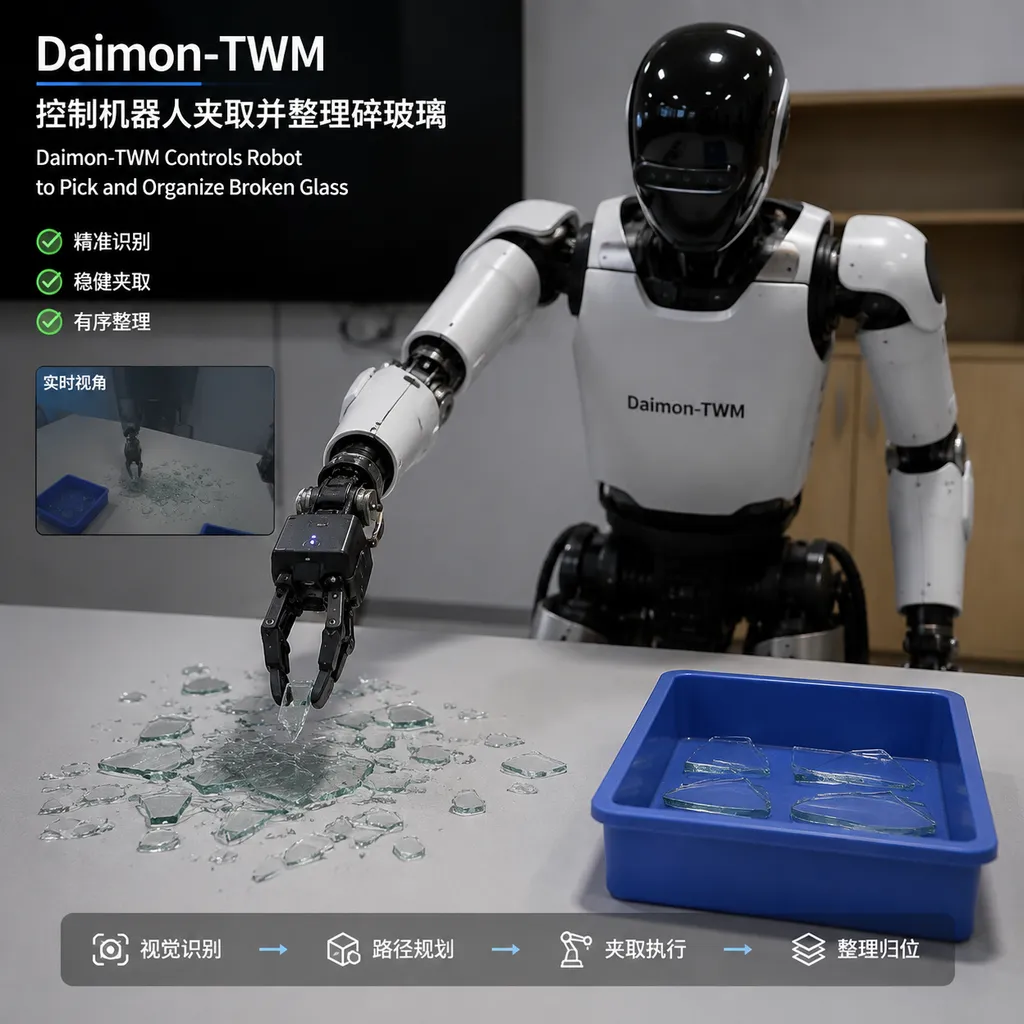
Daimon’s representative demonstration involves having a robot autonomously clean up broken glass from a tabletop.
This scenario is not friendly to vision-only approaches. Transparent glass creates reflections and refraction, while irregular edges are difficult to segment reliably. When a fragment lies against a tablecloth, a camera cannot accurately determine whether the two are stuck together. Grip too lightly and the fragment may slip; grip too tightly and it may break again.
In the demonstration, Daimon-TWM first uses contact to confirm whether a fragment has been securely grasped, then simulates the consequences of different grasp angles, lifting directions, and placement methods. When the model determines that lifting straight up might pull up the tablecloth, it first adjusts the glass fragment’s pose, then continuously modifies gripping force and motion trajectory based on real-time tactile feedback, ultimately placing the fragment in a tabletop trash bin.
The value of this demo is that it does not show standardized assembly-line grasping. Instead, it presents a task with incomplete visual information, high contact risk, and a need for continuous correction. It is precisely in such scenarios that the benefits of touch are most apparent.
However, demo performance cannot be equated directly with general-purpose capability. Developers and robot manufacturers should be asking:
- How many independent trials were used to calculate the success rate?
- Were the glass shapes, tablecloth materials, and lighting conditions outside the training distribution?
- After replacing the gripper, robotic arm, or tactile sensor, how much data is required for readaptation?
- What is the end-to-end latency from tactile sampling to action correction?
- Will sensor wear, contamination, and thermal drift degrade model performance?
- How large is the improvement over baselines such as vision-only VLA and vision-plus-force-torque control?
These data have not yet been disclosed in sufficient detail. Daimon claims that the model was built on the world’s largest all-modal physical-world dataset containing tactile data and that it exhibits continued scaling trends. However, the dataset size, task distribution, training compute, and standardized benchmark results still need to be made public.
The Real Moat May Be Access to Data, Not the Model’s Name
In the field of language models, the internet provides an almost ready-made training corpus. Robots are not so fortunate. High-quality physical interaction data must be collected by having real hardware repeatedly make contact, grasp, slip, and fail. The cost of collecting such data is far higher than that of images and text.
Tactile data are particularly troublesome because sensors from different manufacturers vary in form factor, resolution, material, and sampling frequency. Two hardware systems may produce entirely different signals when performing the same action, such as “grasping a sponge.” To transfer across scenarios and robotic embodiments, a model cannot merely memorize changes in pixels from a specific sensor. It must abstract the physical relationships underlying pressure, deformation, friction, and slippage.
Daimon’s chosen path is to first develop tactile sensors and data-collection interfaces, and then train a tactile-grounded world model. This sequence makes more commercial sense than simply releasing an algorithm: whoever can place sensors in more robotic fingertips will have more opportunities to continuously acquire real-world interaction data. That data can then improve the model, which in turn drives the hardware into more scenarios.
This is a classic hardware-data-model flywheel, and it also explains why Ant is willing to place this bet.
Over the past two years, vast amounts of capital have poured into humanoid robot platforms. The market now contains numerous structurally similar bipedal platforms and multi-fingered dexterous hands. But adding more joints does not mean manipulation capabilities improve in step. A hand with more than 20 degrees of freedom is still merely an expensive mechanical structure if it cannot tell whether an object is slipping.
As the robot-platform supply chain matures, value will naturally migrate toward sensors, data, and control models. Vision cameras have already become highly commoditized, while touch still lacks standardized hardware, data formats, and foundation models. Once a de facto standard emerges in this area, its commercial position may resemble that of camera modules plus perception chips in the robotics era, rather than that of a replaceable software plug-in.
Touch Is Useful, but It Will Not Replace Vision-Based VLA
It would also be a mistake to interpret this release as “touch overthrowing vision.”
Touch can perceive only local areas that have already been contacted. Robots still need vision to locate targets, understand scenes, and plan long-distance movements. They also need language and commonsense reasoning to understand tasks such as “Put the medicine bottle in the drawer to the elderly person’s right.”
A more realistic technical combination would be:
- Vision handles global localization, object recognition, and spatial planning;
- Language models handle task decomposition and semantic reasoning;
- World models predict the physical consequences of actions;
- Touch handles contact-state estimation and high-frequency closed-loop control;
- Proprioceptive state and torque signals constrain safety boundaries.
In other words, VLA will not disappear. It will evolve from “outputting actions after looking at an image” into a control system with feedback across multiple timescales. The significance of Daimon-TWM lies in elevating touch—long treated as an auxiliary signal—to a central position in the model architecture.
Three Hurdles Remain Between Model Release and Commercial Deployment
The first hurdle is hardware reliability. Tactile sensors are installed in the parts of a robot most vulnerable to collisions, wear, and contamination. Sensitivity in a laboratory does not guarantee long-term stability in warehouses, kitchens, or factories. Models can be updated online, but fingertip materials must withstand grease, dust, sharp objects, and hundreds of thousands of contacts.
The second hurdle is cross-embodiment generalization. If the world model can serve only Daimon’s own sensors and specific robotic arms, its market potential will be constrained. It can become genuine infrastructure only if a unified representation allows it to adapt to different dexterous hands, grippers, and mobile robots.
The third hurdle is the cost-benefit ratio. Automotive assembly, precision manufacturing, and hazardous-material handling may be willing to pay a premium for higher success rates, but ordinary warehouse picking may not require an expensive tactile system. Daimon must identify scenarios where vision-only systems clearly fail and labor costs are sufficiently high, rather than indiscriminately adding hardware to every robot.
Medical care, flexible manufacturing, household services, fragile-goods sorting, and cable assembly may be among the first areas where this technology delivers value. These tasks share several characteristics: objects are soft, transparent, fragile, or easily deformed; visual information is insufficient; and the cost of failure is high.
This Is Not Another “Foundation Model API” You Can Call Directly
Developers should note the difference between Daimon-TWM and cloud-based models such as GPT and Claude. It is not a general-purpose API that accepts text and returns an action sequence, nor can it easily operate independently of a robot platform, tactile sensors, and a real-time control system.
Models of this kind ultimately require comprehensive systems engineering, including sensor calibration, time synchronization, action-space mapping, edge inference, control frequency, and safety redundancy. Even if the model itself is capable of simulation, cloud-network latency cannot be allowed into a millisecond-scale control loop.
The key metric for Daimon-TWM going forward is therefore not parameter count, but deployment efficiency: whether it can run reliably on edge-computing devices, adapt quickly to different hardware, and learn new tasks using less real-world interaction data.
Embodied Intelligence Is Beginning to Learn How to “Touch the World”
Over the past year, the industry has tended to demonstrate progress through larger VLA models, more robot videos, and more sophisticated dexterous hands. But the real world is not a video dataset that needs only to be watched. Objects have weight, friction, softness, and fragility, while actions can have irreversible consequences.
Ant’s lead investment in Daimon shows that capital is moving beyond the crowded robot-platform sector toward tactile sensing, closed data loops, and physical world models. This direction may be less visually striking than videos of humanoid robots walking, but it is closer to the core question of whether robots can actually perform useful work.
Daimon-TWM’s most important contribution at present is that it proposes a clear path: incorporate touch into understanding, simulation, and verification, then close the action loop through high-frequency control. Whether the title of “the world’s first physical interaction brain” holds up will depend on public benchmarks, cross-embodiment testing, and real customer deployments.
Robots are becoming increasingly capable of seeing and speaking. The next source of differentiation will not be giving them a few more joints, but enabling them—at the moment they touch the world—to truly know what they have touched.
References and Further Reading
- GitHub: Search for open-source tactile robotics projects—A resource for exploring open-source implementations of visual-tactile sensing, slip detection, robotic grasping, and tactile control.
- Hugging Face: Search for tactile robotics models—A resource for tracking public progress in tactile representations, multimodal robot models, and related model weights.